
Updated June 2026 · Reviewed by Billy Forte
No. A Florida CDL driver usually cannot use traffic school election to dismiss a traffic ticket, and a CDL holder cannot use the Florida BDI election under Florida Statute 318.14 to avoid points for a violation in a commercial motor vehicle. Under federal FMCSA rules, states cannot mask a commercial driver’s conviction, and in Florida the normal ticket election through the Clerk of Court is limited by rule, deadline, and driver status. A driver may still be ordered by a court to take a course, and some non-commercial citations in a personal vehicle can be treated differently, but the election must be made within 30 days and the usual BDI limits include a 12-month frequency limit and a 8-election lifetime limit.
Key Facts {#key-facts}
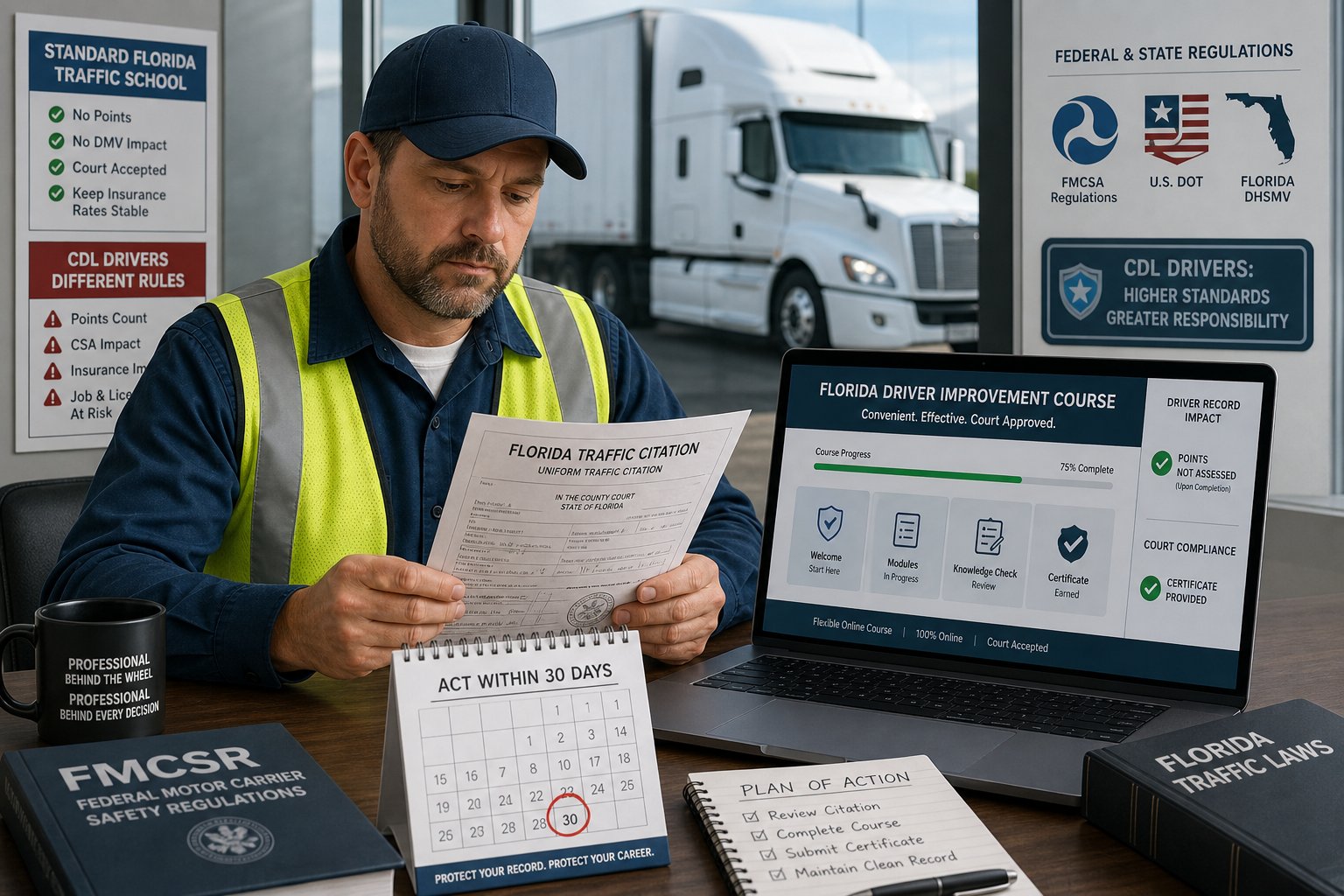
- Main rule: CDL holders generally cannot elect traffic school for violations committed in a commercial vehicle
- Federal standards: CDL violations are governed by federal regulations (FMCSA) that override state traffic school options
- Personal vehicle: Different rules may apply for violations in a non-commercial vehicle — confirm with the clerk
- No masking: Federal law prohibits masking CDL violations; traffic school adjudication withheld does not apply
- What to do: Contact the Clerk of Court and consider consulting a CDL attorney
- BDI may still be ordered: A court can order BDI as part of a ruling even if election is not available
What Florida CDL Traffic School Means For Commercial Drivers
Florida CDL traffic school is usually not a special CDL-only class. In most cases, it means a Florida-approved driver course that may come up after a ticket, a court order, or a license issue.
For many drivers, the common course is Basic Driver Improvement (BDI). In Florida, BDI, traffic school, and a defensive driving course often mean the same 4-hour course approved by the Florida Department of Highway Safety and Motor Vehicles. You can review approved provider information through FLHSMV.
But CDL holders are different. A regular Florida driver may be able to make a ticket election under Florida Statute 318.14 through the Clerk of Court. That process usually lets the driver pay the ticket fine, pay an election fee, take BDI within the deadline, and receive adjudication withheld instead of points.
That general election process does not usually apply to CDL drivers for commercial vehicle violations. The main reason is federal law. Under FMCSA rules, states may not mask a conviction for a CDL holder in a way that hides it from the driver record.
So if you drive for work, the key question is not just, “Can I take traffic school?” The real question is, what vehicle were you driving, what citation did you get, and did the court order a course? Those facts can change the answer.
And that is why many CDL holders should talk to a traffic attorney before paying any moving violation. Paying first can act like a plea in many cases, and that can limit your options later.
Who Must Take A Course And When It May Be Court-Ordered
A Florida CDL holder may have to take a driver course if a court orders it, even when a normal election is not allowed. That is different from choosing traffic school on your own.
For a standard Florida ticket election, the process usually works like this:
- You contact the Clerk of Court
- You make the election within 30 days
- You pay the fine and an election fee
- You complete the required course by the court deadline
For non-CDL drivers, that can lead to adjudication withheld. But for CDL holders, the big issue is whether the violation happened in a commercial vehicle.
If the ticket was issued while driving a commercial motor vehicle, a CDL holder generally cannot use BDI election to keep points off the record. Federal anti-masking rules are the main reason.
If the ticket happened in a personal vehicle, the answer can be less clear. Some counties and courts may handle eligibility based on the statute, the citation type, and the driver’s record. That is why you should check with the local Florida Clerk of Court system and get legal advice before you respond.
A court-ordered course may also come up after:
- A moving violation hearing
- A plea or reduced charge
- A suspension-related matter
- A judge’s case-specific order
Court-ordered school may not count against the normal 8-election lifetime limit or 12-month frequency limit tied to a voluntary election. Still, the rule can depend on the county, the court, the judge, and the facts of your case.
If your citation has a required court date, do not miss it. Follow the notice and confirm the next step with the court.
Florida Driver Courses That Commonly Apply Alongside CDL Requirements
Florida CDL holders are usually sent to regular Florida driver improvement courses, not a special CDL traffic school program. The right course depends on why the course is needed.
Common Florida course types include:
- BDI: 4-hour Basic Driver Improvement
- IDI: 8-hour Intermediate Driver Improvement
- ADI: 12-hour Advanced Driver Improvement
- TLSAE: Traffic Law and Substance Abuse Education for first-time licensing in some cases
A provider like Driving Logic or MyDrivingLogic.com can be useful when you already know the exact course you need and want a flexible online option. The key is making sure the course is state-approved and matches the court or license requirement.
For CDL holders, the course itself is only part of the issue. The harder question is often whether taking the course changes the citation result at all. In many CDL cases, especially in a commercial vehicle, it does not work like a normal election.
That is why you should match the course to the order, not just to the ticket. If the judge ordered an 8-hour class, a 4-hour BDI course will not fix the problem.
Below are the course types that most often come up.
Basic Driver Improvement And Court-Ordered Traffic School
BDI is the Florida 4-hour traffic school course most people mean when they say traffic school. It is also often called a defensive driving course.
This course usually covers:
- Florida traffic laws
- Safe driving habits
- DUI risks
- Driving in bad weather
- Crash prevention basics
For many non-CDL drivers, BDI can be elected under Florida Statute 318.14 after an eligible moving violation. The driver must usually act within 30 days, pay the fine, pay the election fee, and finish the course on time.
For CDL holders, that normal election path is usually not available for a violation in a commercial vehicle. That is the point many drivers miss. The issue is not whether BDI exists. It does. The issue is whether a CDL holder may use it to avoid points through the election process.
A court can still order BDI in some cases. If that happens, follow the exact order. Check whether the court wants the certificate filed by you, the school, or both. Also confirm the due date with the Clerk of Court.
If you already know you need the 4-hour course, you can review the online Florida BDI option from Driving Logic.
Advanced Driver Improvement, Three Crashes, And Wireless Device Violations
ADI is a longer Florida course, usually 12 hours, and it often appears in more serious cases. It can be required after a suspension, a revocation, or a court order.
For example, a driver may need ADI to help restore driving privileges after a license problem. In some cases, courts also order a longer class instead of the basic 4-hour course.
You may also hear about IDI, which is often an 8-hour course. Some courts use it for case-specific orders. So the exact course length matters.
The outline topic also mentions three crashes and wireless device violations. Here, caution matters. The provided source set does not clearly confirm a Florida rule that ties CDL traffic school to those exact facts in a broad way. Because of that, the safest statement is simple: those issues may affect a case, but the required course depends on the citation, court order, and driver history.
For CDL holders, the same warning still applies. A course requirement is not the same as a ticket election. If you hold a CDL, do not assume that taking a class will make the citation disappear from your record.
Check the citation, check the court paper, and if needed, ask a lawyer before you respond.
How Online Completion, Certificates, And County Court Processing Work In Florida
Most Florida driver courses can be completed online, but the court process does not end when you finish the last screen. You still need to make sure the right office gets proof on time.
A Florida-approved online school lets you work from a phone, tablet, or computer. That helps busy drivers who cannot sit in a classroom. Many schools, including MyDrivingLogic.com, offer flexible access and quick certificate processing.
Still, the steps after completion matter just as much as the course:
- Confirm you took the correct course length
- Save your completion record
- Check whether the provider sends the certificate electronically
- Confirm whether the county court or Clerk of Court needs anything else
- Watch every deadline in your ticket or court order
Some counties accept direct reporting from the school. Others still expect the driver to verify filing. The rule can differ by county and case type.
If you made a normal election, timing matters a lot. The election usually must be made within 30 days of the citation. You also usually pay the fine and an election fee, often around $16 to $20, though the exact amount can vary. And remember: this process usually results in adjudication withheld, not a dismissal.
For official state information, use FLHSMV, your local Clerk of Court, and the text of Florida Statute 318.14.
How To Choose A State-Approved Online Course That Fits A Busy Schedule
Pick a Florida-approved course that matches your exact court or license need. Speed matters, but the right course matters more.
Start with four checks:
- Is the school approved by FLHSMV?
- Is the course the correct length: 4, 8, or 12 hours?
- Will the course meet your court or clerk requirement?
- Can you log in on your own schedule?
That last point matters for working drivers. If you drive long routes or odd shifts, you need a course that saves progress and works on any device.
For many drivers, Driving Logic is a practical choice because it focuses on short, state-approved online courses with flexible access and fast certificate handling. But even then, you should still make sure the course fits your exact order or citation status.
If you hold a CDL, be extra careful with any site that suggests traffic school will erase a commercial ticket. Florida CDL traffic school does not usually work that way through election for commercial vehicle violations. A provider can offer the course. It cannot change FMCSA masking rules or local court limits.
If you need a Florida BDI course and your case allows it, you can review your options at Driving Logic. Then confirm acceptance with the court before you enroll.
How County Rules Can Vary
Florida traffic school election rules follow state law under Florida Statute 318.14, but how elections are processed, what fees apply, and what deadlines the clerk sets can vary by county. Before you act, confirm the specific process with the Clerk of Court in the county listed on your citation.
FAQ
Can CDL holders elect traffic school in Florida?
CDL holders generally cannot use the standard Florida traffic school election under Florida Statute 318.14 for violations committed while operating a commercial vehicle. Federal regulations prohibit masking CDL convictions, which means adjudication withheld does not apply to commercial vehicle violations.
Why does traffic school not apply to CDL violations?
Federal Motor Carrier Safety Administration (FMCSA) regulations require that CDL violations appear on the driver’s record and cannot be masked through state traffic school programs. Florida cannot grant adjudication withheld for CDL commercial vehicle violations in a way that removes the conviction from the commercial driver record.
What if I got a ticket in my personal vehicle while holding a CDL?
Rules for personal vehicle violations for CDL holders vary and depend on the specific violation, court, and circumstances. Contact the Clerk of Court in the county where the ticket was issued. In some cases, personal vehicle violations may be handled differently from commercial vehicle violations.
Can a court order me to complete BDI even if I cannot elect traffic school?
Yes. A court can order completion of the Florida BDI course as part of its ruling regardless of whether the standard election process is available. A court-ordered BDI completion is different from a voluntary election.
What should a CDL holder do when they receive a traffic ticket?
Contact the Clerk of Court to understand what options are available for your specific citation and CDL status. Given the complexity of CDL regulations, consulting a CDL attorney is often advisable before making any decisions.
Conclusion
CDL holders generally cannot use Florida’s standard traffic school election for commercial vehicle violations due to federal masking prohibitions. If you hold a CDL and have received a citation, contact the Clerk of Court and consider consulting a CDL attorney before the response deadline.
Related Articles
- How to Elect Traffic School in Florida: The Complete Election Guide
- What Florida Traffic Violations Qualify for Traffic School Election?
- Florida Traffic School Election Deadline: 30 Days to Act
- How Many Times Can You Use Traffic School in Florida? The 8-Election Lifetime and 12-Month Rule
Sources
- Florida Statute 318.14 — Noncriminal Traffic Infractions
- Florida Statute 318.14 — Noncriminal Traffic Infractions
- FLHSMV — Basic Driver Improvement Course Providers
- FLHSMV — Driver Improvement Schools
- Florida Clerks of Court
Billy Forte is the owner of Driving Logic, a state-approved driver improvement course provider serving Florida and other U.S. states. Driving Logic offers FLHSMV-approved online BDI courses for drivers handling traffic tickets, court orders, and state requirements.
This article is general information, not legal advice. Eligibility, deadlines, court acceptance, and filing steps depend on the citation type, county, court, judge, and the facts of your case. Use official Florida court and state sources for current requirements, and consult a qualified Florida attorney for legal guidance specific to your situation.