
Updated June 2026 · Reviewed by Billy Forte
You should dispute an Indiana BMV driving record error by checking the record details and contacting the BMV or court tied to the entry. This article is for Indiana drivers who need a clear answer before choosing a course, responding to a notice, or checking their record. You will learn what the rule means, how the Driver Safety Program fits in, and what to check before your next step.
This article covers Indiana requirements only.
Key Facts
- Indiana record: Your Indiana BMV record controls your point and license status.
- DSP credit: A BMV-approved DSP may provide a 4-point credit when eligible.
- No erasure: DSP does not erase tickets, convictions, or violations.
- Deadlines: Court and BMV notices control required deadlines.
- Verify first: Check official records before relying on assumptions.
What An Indiana Driving Record Dispute Usually Involves
If you need the approved online option, review the indiana driving record dispute before your deadline.
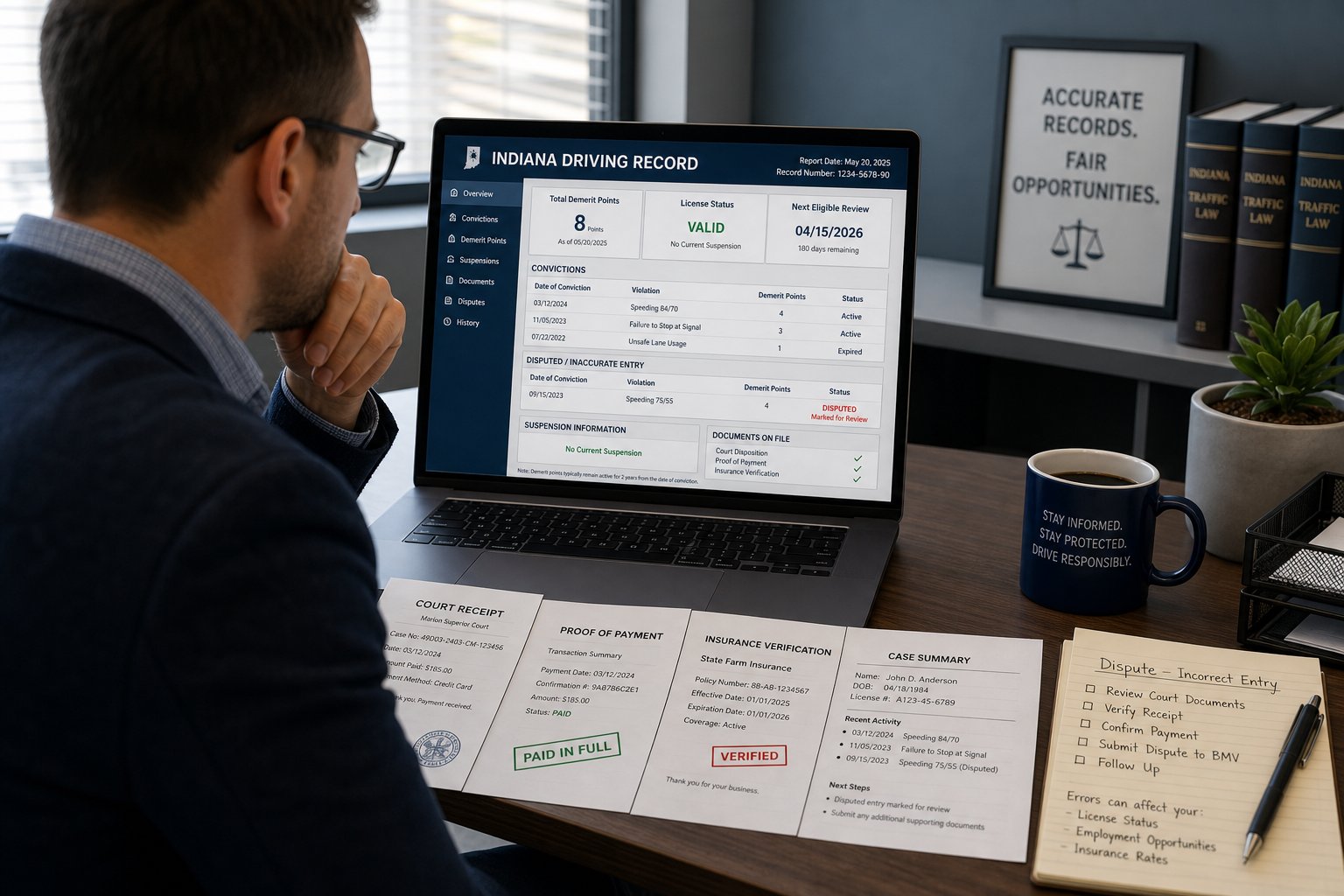
An Indiana driving record dispute usually starts with one simple step: checking what the state says is on your record. Your Indiana driving record can show traffic convictions, suspensions, insurance-related entries, and your current point total. If any of that is wrong, the mistake can affect your license, your job, and what you pay for insurance.
In Indiana, many disputes come down to one of these problems:
- A ticket or conviction that is not yours
- A wrong conviction date
- Demerit points added in error
- A paid ticket still showing as unpaid
- A dismissal, deferral, or correction that never reached the Indiana BMV
- A suspension entry based on missing or wrong court data
The usual path is to compare your BMV record with your own papers. That may include court receipts, case summaries, proof of payment, insurance documents, or an order that changed the case result. If the BMV entry itself is wrong, you may ask for a review. If the court record is wrong, you often need the court to fix the source first.
This matters because Indiana uses points and record status to decide risk. A bad entry can push you closer to a license suspension or create problems in a background check. And if your record is near the 20-point threshold, even one wrong item can have real effects.
Common BMV Errors And License Issues That Can Be Challenged
Some Indiana BMV errors are small on paper but serious in real life. A single wrong line on your driving record can raise your point total, trigger notices, or cause trouble with employers that check motor vehicle records.
Common record issues you may be able to challenge include:
- Incorrect traffic convictions
- Duplicate entries for the same case
- A wrong offense level or code
- A wrong conviction date
- Points that should not be there
- Points that should no longer count because they are too old
- A suspension based on clerical error
- Insurance filings listed wrong or not updated
Indiana demerit points generally count for two years from the conviction date, so the date matters a lot. If the BMV shows the wrong date, your points may stay active longer than they should. That can affect a warning letter, a required hearing, or a suspension review.
Another issue involves court outcomes that did not get reflected properly. For example, if a case was dismissed, deferred, or changed by later court action, your BMV record should match the final court result. If it does not, you may need records from the court clerk to prove the mismatch.
When you spot an Indiana BMV driving record error, do not assume it will fix itself. Check the exact entry, confirm the case number, and save copies of every document tied to that line item.
How To Review Your Indiana Driving Record For Mistakes
The best way to review your record is to get your official Indiana driver record directly from the Indiana Bureau of Motor Vehicles. Do not rely on memory alone. Small details like dates, court names, and offense codes matter.
As you review the record, compare each entry to your own documents:
- Ticket or citation copies
- Court receipts
- Payment confirmations
- Case docket entries
- Orders of dismissal or deferral
- Proof of insurance
- Any suspension or reinstatement notices
Look closely at four things. First, make sure the violation is yours. Second, check the conviction date. Third, review the points tied to the entry. Fourth, confirm the final case result matches what the court ordered.
It also helps to know what Indiana points can do. If your record shows enough active points, the BMV may require action through its safety process. In some cases, a driver may take a BMV-approved Driver Safety Program (DSP). Indiana’s official DSP is a 4-hour course, and it can earn a 4-point credit. That credit reduces your point total, but it does not erase the conviction or remove the violation from your record.
If your record looks wrong, mark each questionable entry and match it with proof before you contact the BMV or court.
Your Options To Dispute An Error With The Indiana BMV
If your record has a mistake, your options depend on where the mistake started. If the Indiana BMV entered bad data or failed to update a record, you may ask the BMV to review and correct it. If the problem came from the court file, you often must go back to that court first.
A common option is a Material Error Review Request. That is used when the BMV record has a factual error, such as the wrong date, wrong points, or the wrong entry. You should include clear copies of anything that proves the mistake, like court orders, payment proof, or insurance records.
If the entry is based on a traffic case, the court may be the real source of the problem. In that situation, the BMV may not change the record until the court updates its own file. You may need the clerk or judge to correct the case record, depending on the facts.
Use official sources as you prepare. The Indiana BMV has record and hearing information on its website, and Indiana law and rules may apply through the Indiana Code and the Indiana Administrative Code. Requirements can depend on the Indiana BMV notice, court order, ticket, driver record, license status, court, judge, and case facts.
When A Hearing, Review Request, Or Appeal May Apply
A review request fits cases where the BMV record is factually wrong. A hearing may apply when you are challenging a BMV action, such as a suspension. An appeal may apply if there is a final agency or court decision and the law allows further review.
If your case involves a notice of suspension or another final action, read it closely. It may list deadlines, hearing rights, or what records you must provide. Missing a deadline can make a bad record harder to fix, so keep copies and respond on time.
What To Expect If Your Case Involves A Suspension Or Final Order
If your dispute involves a license suspension or final BMV order, expect a more formal process. You may need to send records, attend a hearing, or respond within a set time. The exact path depends on the type of suspension and the reason it was entered.
Some cases involve point-based action. Others involve insurance issues, court reporting, or failure-to-act entries. When the record is wrong, the goal is usually to show that the BMV action rests on bad or outdated information.
Possible results can include:
- Correction of the driving record
- Removal of a wrong suspension entry
- A lower point total
- A shorter suspension period if the record is updated
- No change if the evidence does not support the request
Bring documents that connect directly to the disputed item. That may be a court order, clerk letter, proof of payment, or insurance filing. Keep your explanation simple and tied to dates and record lines.
If the BMV requires a program because of your point status, pay attention to the notice. Indiana may require a Driver Safety Program in some situations. The DSP is a BMV-approved 4-hour course, and completion can earn a 4-point credit. That can help reduce the point total, but again, it does not remove the underlying conviction.
If you need a flexible online option, Driving Logic’s Indiana Driver Safety Program is built for busy drivers who need to complete a required course on their own schedule.
How Traffic School, Ticket Defenses, Or Court Action May Help
A dispute is not always just about fixing a clerical error. Sometimes the real issue is the ticket or court result behind the entry. In that case, traffic school, a ticket defense, or court action may help limit the damage or correct the record source.
If you have not resolved the ticket yet, contesting it in court may prevent a conviction and points if the result goes your way. In other cases, a deferral program may keep the violation off your record if you meet the terms. If a case was dismissed or deferred and the BMV record still shows a conviction, use the court paperwork to ask for a correction.
Traffic school can also matter after a conviction. In Indiana, the official course is the Driver Safety Program (DSP). It is a 4-hour BMV-approved course. When allowed, the DSP gives a 4-point credit once every three years. It reduces your point total, which may help if you are trying to stay below a suspension level, but it does not erase the ticket.
That is why it helps to think in layers:
- Dispute the record if the BMV entry is wrong
- Fix the court record if the case result is wrong
- Use the DSP if you need a 4-point credit or must meet a BMV or court requirement
If your notice or court order allows an online course, you can take the Indiana Driver Safety Program at Driving Logic on your phone, tablet, or computer.
FAQ
Can the Indiana DSP help with points?
Yes, an approved Indiana Driver Safety Program may provide a 4-point credit when you qualify. It does not erase the conviction or violation.
Does the DSP remove a ticket from my record?
No. The DSP does not remove a ticket, conviction, or violation from your Indiana driving record.
Where should I check my Indiana points?
Use your Indiana BMV driving record to check your current point status, conviction dates, and license status.
What if I have a court order or BMV notice?
Follow the exact deadline and instructions in the court order or BMV notice. Do not rely only on general article guidance.
Conclusion
How to Dispute an Error on Your Indiana BMV Driving Record is easier to manage when you check your Indiana BMV record, understand what the points mean, and know what the Driver Safety Program can and cannot do. The Indiana DSP may provide a 4-point credit when eligible, but it does not erase a ticket, conviction, or violation. Before you act, compare your record, BMV notice, or court papers with official instructions.
Take the Indiana Driver Safety Program course online when you are ready to begin.
Related Articles
- Indiana BMV Points System Explained
- Indiana Driver Safety Program and Points: What It Can and Cannot Do
- Indiana DSP 4-Point Credit: How It Works
- How Long Do Points Stay on Your Indiana Driving Record?
Sources
- Indiana BMV — Citation Points and Driver Safety Program
- Indiana BMV — Driver Record Points
- Indiana BMV — Driver Records
- Indiana Code and Administrative Rules
Billy Forte is the owner of Driving Logic, a state-approved driver improvement course provider serving Indiana and other U.S. states. Driving Logic offers online driver safety and driver improvement courses for drivers handling BMV notices, court orders, and state requirements.
This article is general information, not legal advice. Indiana BMV rules, court orders, deadlines, provider reporting, insurance decisions, and case facts can differ. Use official Indiana BMV and court sources for current requirements, and consult a qualified Indiana attorney for legal guidance specific to your situation.