
Updated June 2026 · Reviewed by Billy Forte
An Indiana speeding ticket can add points based on how far over the speed limit the conviction is recorded. This article is for Indiana drivers who need a clear answer before choosing a course, responding to a notice, or checking their record. You will learn what the rule means, how the Driver Safety Program fits in, and what to check before your next step.
This article covers Indiana requirements only.
Key Facts
- Speed matters: Indiana speeding points depend on the speed range of the conviction.
- Conviction date: Points generally count from the conviction date.
- DSP credit: A DSP may provide a 4-point credit when eligible.
- No erasure: DSP does not erase the speeding conviction.
- Deadline control: Court and BMV instructions control next steps.
How Indiana’s Driver’s License Point System Works
If you need the approved online option, review the how many points is a speeding ticket in indiana before your deadline.
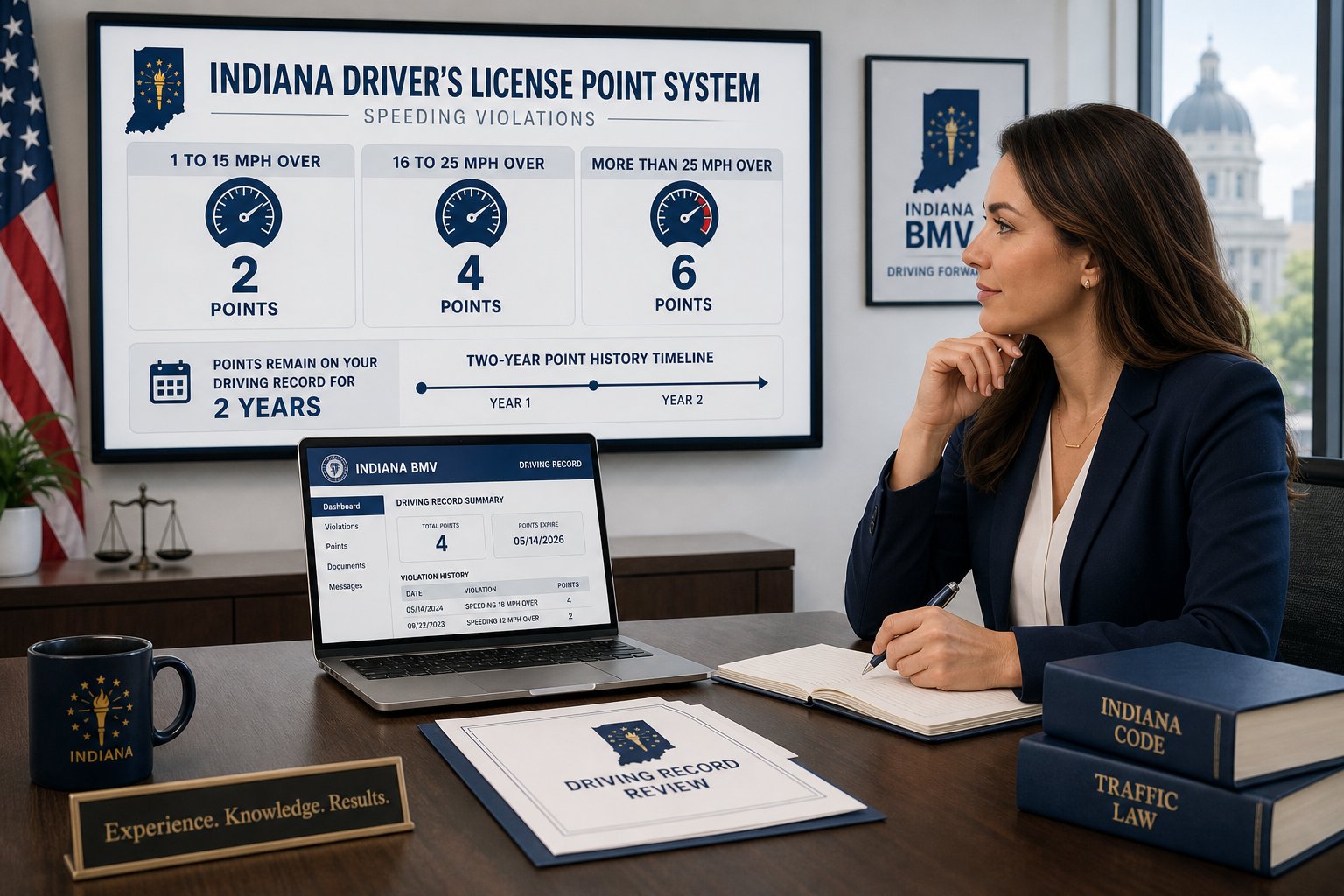
Indiana uses a demerit point system through the Indiana Bureau of Motor Vehicles to track moving violations. Each traffic conviction carries a set point value. The more serious the violation, the more points the Indiana BMV adds to your driving record.
For speeding, the key issue is not just whether you were cited. It is how fast over the limit the ticket says you were driving. That speed tier controls the point value the BMV will assess after a conviction.
Here is the basic rule:
- 1 to 15 mph over: 2 points
- 16 to 25 mph over: 4 points
- More than 25 mph over: 6 points
In Indiana, these points stay active for 2 years from the conviction date. That matters because your point total can trigger BMV action if it gets too high in a 24-month period. The conviction itself may remain on your record longer, which can matter for employers, insurers, and court review.
Indiana’s point schedule and suspension rules are set out by the state. You can review the official point system through the Indiana Administrative Code and BMV materials, including the Indiana BMV driver safety information and the Indiana Administrative Code point schedule.
A small but important detail: a ticket does not become BMV points just because an officer writes it. In most cases, points are assessed after a conviction or other reportable court outcome. So if you are deciding what to do with a citation, timing and case outcome both matter.
How Many Points A Speeding Ticket Adds In Indiana
The short answer to how many points is a speeding ticket in Indiana is 2, 4, or 6 points, depending on your speed.
Indiana speeding ticket points by speed tier
If you were cited for speeding in Indiana, the normal point ranges are:
- 1 to 15 mph over the speed limit: 2 demerit points
- 16 to 25 mph over the speed limit: 4 demerit points
- More than 25 mph over the speed limit: 6 demerit points
This is the clearest way to estimate your likely Indiana speeding ticket points. Check the citation and compare the listed speed with the posted limit.
For example:
- Driving 72 in a 60 usually means 2 points
- Driving 81 in a 60 usually means 4 points
- Driving 88 in a 60 usually means 6 points
When the speed is more than 25 mph over the limit, the case can draw more attention. In some facts, that conduct may also be charged or reviewed as reckless driving, which can carry different consequences. That does not happen in every case, but it is one reason high-speed tickets deserve close review.
Official state materials support these point values. You can review Indiana law and agency sources through the Indiana Code website and the Indiana BMV.
If you do not know what point tier applies, look at the exact alleged speed, the posted limit, and whether the ticket lists any added charge besides basic speeding.
What Happens If You Get Too Many Points
Too many points can lead to warnings, a hearing, and a license suspension. In Indiana, the BMV looks closely at your total points within a 24-month period.
The general thresholds are:
- 14 to 18 points: the BMV may send a warning notice
- 20 or more points: the BMV can require an administrative hearing
- After that hearing, your license may be suspended for 1 to 12 months, depending on the total points and record
This is why a speeding ticket can matter even when the point value seems low. A 2-point ticket may not look serious by itself. But if you already have other moving violations on your record, even a small new ticket can push your point total closer to the 20-point threshold.
Here is a simple example. If you already have 16 active points and you are convicted of speeding 16 to 25 mph over, the extra 4 points can bring you to 20 points. That can trigger the next level of BMV action.
You should not ignore any Indiana BMV notice, court order, citation, deadline, or required court date. Requirements can depend on the notice you received, your driver record, your license status, the court involved, the judge, and the specific facts of your case.
For official rules, see the Indiana BMV and applicable provisions in the Indiana Administrative Code.
How A Speeding Ticket Can Affect Fines, Insurance, And Your Record
A speeding ticket can cost more than the fine. It can affect your court costs, your insurance price, and your driving record for years.
First, if you are convicted, you usually must pay a fine and court costs. The exact amount is not the same in every county or court, so you should check the ticket, court notice, or local court information rather than guess.
Second, a conviction adds demerit points to your Indiana record based on the speed tier. Those points stay active for 2 years from the conviction date. That active point period is what the BMV uses when it reviews suspension risk.
Third, the conviction itself can stay on your record longer than the active points. State materials indicate that a conviction may remain visible for up to 10 years on the record. Insurance companies often review moving violations when they set rates, so a speeding conviction may raise premiums even after the 2-year point window ends.
The effect is often bigger if:
- You already have other moving violations
- The speed was far over the limit
- The case involved an accident
- Your insurer reviews records often
So the real cost is not just what you pay to the court. It can also include higher insurance and added risk to your license if your record is already crowded. Before you respond to the ticket, review your Indiana BMV driving record and the exact charge listed on the citation.
Should You Pay The Ticket Or Fight It
Paying a speeding ticket is usually the same as accepting guilt for that violation. Once that happens, the court reports the outcome, and the Indiana BMV can assess the related demerit points.
That means paying may be simple, but it can also lock in:
- The speeding conviction
- The related 2, 4, or 6 points
- The fine and court costs
- Possible insurance impact
In some cases, it makes sense to review whether you should contest the ticket instead. Fighting a ticket does not guarantee dismissal or a lower charge. But depending on the court, your record, and the case facts, you may have options such as a reduction, a deferral, or another result that changes the point outcome.
This decision often matters most when:
- You already have several active points
- The ticket alleges 16+ mph over the limit
- The speed was more than 25 mph over
- You drive for work
- You received a court order or mandatory appearance notice
If your case has higher stakes, it may be smart to speak with a traffic attorney before you pay. You can also ask the court what options are available in that county. Just make sure you still follow all deadlines and appearance requirements listed on the ticket or court notice.
Can Traffic School Or A Driver Safety Program Help Reduce The Impact
Yes, a BMV-approved Driver Safety Program (DSP) can help in some cases. In Indiana, completing the official DSP can give you a 4-point credit on the Indiana Official Driver Record.
That credit matters because it can offset active points on your record. But there is a limit that many drivers miss: the DSP does not remove the ticket, does not erase the conviction, and does not delete the underlying violation. It only gives a 4-point credit if you qualify.
Indiana’s official DSP is a 4-hour course. State rules also limit how often you can get the credit. In general, a driver may receive the 4-point credit once every 3 years.
The DSP may come up in a few ways:
- You choose to take it voluntarily, if eligible
- The Indiana BMV requires it based on your record
- A court order requires it in your case
If the BMV or court requires the program, complete it exactly as ordered. Your duties can depend on the BMV notice, court order, citation, license status, and case facts.
If you want a flexible online option, Driving Logic offers the Indiana Driver Safety Program online through MyDrivingLogic.com. Check the course details first to make sure the program matches your notice or court requirement.
What To Do After Getting A Speeding Ticket In Indiana
Start with the facts on the ticket. The best first step is to check how far over the limit the officer says you were driving, because that usually tells you whether the case means 2, 4, or 6 points.
Then work through a short checklist:
- Read the ticket and all notices closely
- Check whether a court appearance is required
- Look up your Indiana BMV driving record
- Add up your current active points
- Decide whether paying the ticket could put you near the 20-point threshold
- Ask the court or a lawyer about possible options if the stakes are high
- Review whether you qualify for a Driver Safety Program
This process matters because the right next step depends on several things. It can depend on your BMV notice, a court order, the exact citation, your current record, your license status, the court, the judge, and the case facts.
If you need to complete the official course, you can take the Indiana Driver Safety Program online with Driving Logic at MyDrivingLogic.com. Make sure the course fits your requirement before you enroll.
For official information, verify details with the Indiana BMV, the Indiana Code website, and the applicable Indiana Administrative Code.
This article is for general information only and is not legal advice.
FAQ
Can the Indiana DSP help with points?
Yes, an approved Indiana Driver Safety Program may provide a 4-point credit when you qualify. It does not erase the conviction or violation.
Does the DSP remove a ticket from my record?
No. The DSP does not remove a ticket, conviction, or violation from your Indiana driving record.
Where should I check my Indiana points?
Use your Indiana BMV driving record to check your current point status, conviction dates, and license status.
What if I have a court order or BMV notice?
Follow the exact deadline and instructions in the court order or BMV notice. Do not rely only on general article guidance.
Conclusion
How Many Points Is a Speeding Ticket in Indiana? is easier to manage when you check your Indiana BMV record, understand what the points mean, and know what the Driver Safety Program can and cannot do. The Indiana DSP may provide a 4-point credit when eligible, but it does not erase a ticket, conviction, or violation. Before you act, compare your record, BMV notice, or court papers with official instructions.
Take the Indiana Driver Safety Program course online when you are ready to begin.
Related Articles
- Indiana BMV Points System Explained
- Indiana Driver Safety Program and Points: What It Can and Cannot Do
- Indiana DSP 4-Point Credit: How It Works
- How Long Do Points Stay on Your Indiana Driving Record?
Sources
- Indiana BMV — Citation Points and Driver Safety Program
- Indiana BMV — Driver Record Points
- Indiana BMV — Driver Records
- Indiana Code and Administrative Rules
Billy Forte is the owner of Driving Logic, a state-approved driver improvement course provider serving Indiana and other U.S. states. Driving Logic offers online driver safety and driver improvement courses for drivers handling BMV notices, court orders, and state requirements.
This article is general information, not legal advice. Indiana BMV rules, court orders, deadlines, provider reporting, insurance decisions, and case facts can differ. Use official Indiana BMV and court sources for current requirements, and consult a qualified Indiana attorney for legal guidance specific to your situation.