
Updated June 2026 · Reviewed by Billy Forte
The Indiana BMV demerit points chart shows how many points common traffic convictions can add to your driver record. This article is for Indiana drivers who need a clear answer before choosing a course, responding to a notice, or checking their record. You will learn what the rule means, how the Driver Safety Program fits in, and what to check before your next step.
This article covers Indiana requirements only.
Key Facts
- Point values: Different violations carry different Indiana BMV point values.
- Speeding: Speeding points can increase as the speed over the limit rises.
- Record timing: Points are tied to convictions on your driving record.
- DSP credit: An approved DSP may provide a 4-point credit.
- Check official sources: Use Indiana BMV materials for current point information.
How The Indiana Driver’s License Point System Works
If you need the approved online option, review the indiana bmv points chart before your deadline.
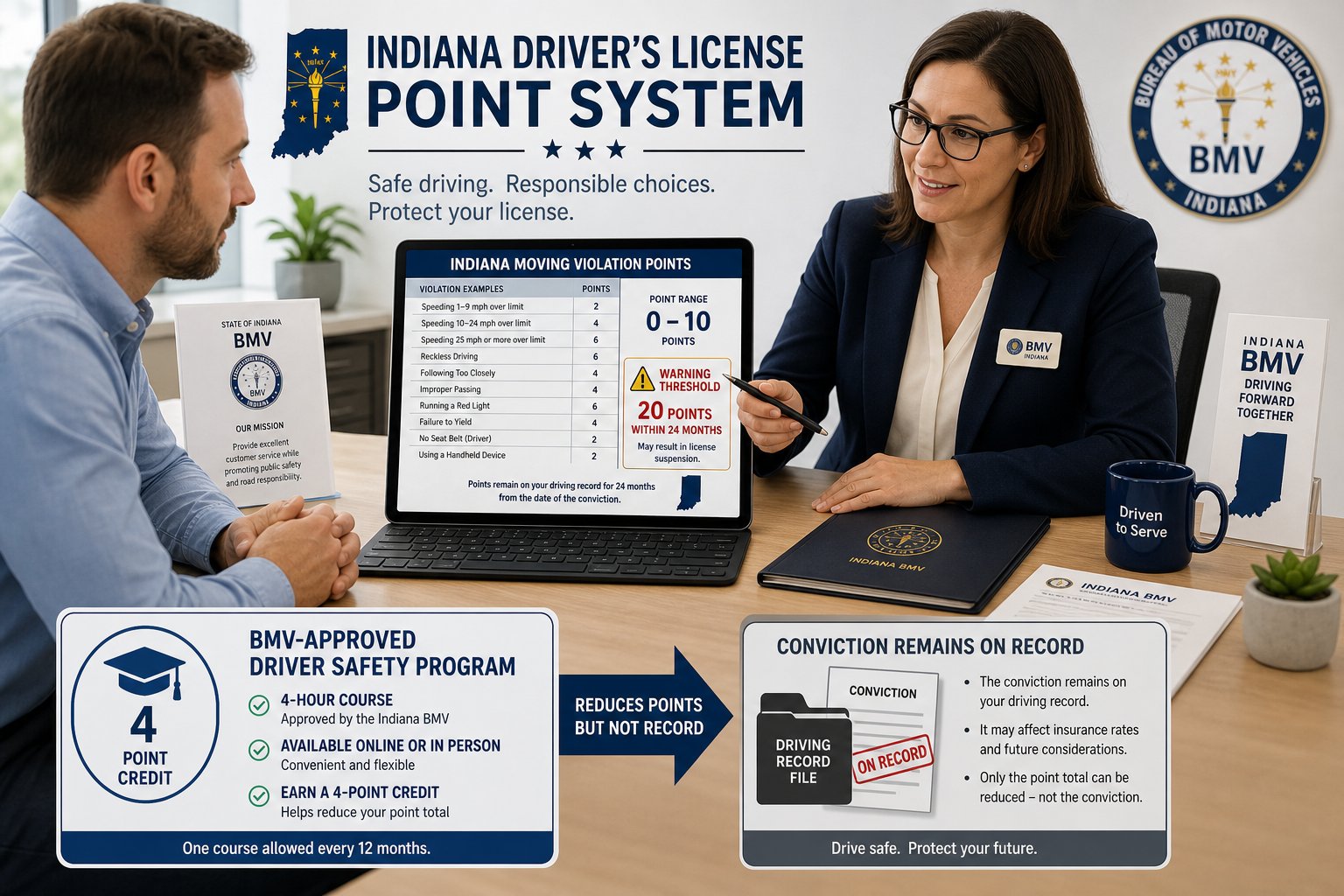
Indiana uses a driver record point system to track moving violations. Each traffic offense has a point value set by the state, and the more serious the violation, the more points the Indiana Bureau of Motor Vehicles assigns.
The key fact is simple: points are tied to convictions. A ticket by itself does not automatically add points. The Indiana BMV generally adds points after a court reports a conviction or another reportable outcome to the agency.
Most common moving violations fall within a 0 to 10 point range under the Indiana system. Lower-level offenses, like mild speeding, often add fewer points. More serious conduct, like certain reckless driving or OWI-related offenses, adds much more.
Points matter because your point total can trigger BMV action. If your active points get high enough within about 24 months, the BMV may send a warning, place you on probation, require action, or suspend your license. In practice, drivers often start seeing point-related trouble near the 20-point threshold.
The state also gives drivers one main way to reduce active points: the Driver Safety Program, often called the DSP. Indiana’s official course is a BMV-approved, 4-hour Driver Safety Program, and when you complete an eligible course, you can receive a 4-point credit. That credit reduces your point total, but it does not remove the conviction from your driving record.
Requirements can depend on several things, including your BMV notice, court order, ticket or citation, driver record, license status, the court, the judge, and the facts of your case. That is why two drivers with similar tickets may not get the exact same result.
You can review the state’s rules through the Indiana BMV and the Indiana Administrative Code.
Indiana BMV Points Chart For Common Traffic Violations
If you are looking for an Indiana BMV points chart, the fastest answer is that common violations usually add 2, 4, 6, 8, or 10 points. The exact point value depends on the offense listed by the BMV and state rules.
Common 2-point violations
These are lower-point offenses, but they still count against your record:
- Speeding 1 to 15 mph over the limit: 2 points
- Failure to signal: often treated as a 2-point moving violation in common BMV tables
- Improper equipment: often listed at 2 points when reportable under the BMV schedule
Common 4-point violations
These are more serious and add up quickly:
- Speeding 16 to 25 mph over the limit: 4 points
- Illegal U-turn: 4 points in common BMV point schedules
- Unsafe lane movement: 4 points
- Texting while driving: often treated as a 4-point offense when reported as a moving violation
- Disregarding a stop sign or yield sign: 4 points
Common 6-point violations
These can push your point total up fast:
- Speeding more than 25 mph over the limit: 6 points
- Basic reckless driving: commonly 6 points
- Failure to yield to an emergency vehicle: 6 points
Common 8-point violations
These are major violations under the Indiana demerit points chart:
- Driving while suspended: 8 points
- Passing a stopped school bus: 8 points
- Aggressive driving: often 8 points in BMV tables
Common 10-point violations
These are among the highest point values:
- Reckless driving causing bodily injury: 10 points
- OWI-related offenses: often 10 points, depending on the offense and reportable record entry
Point schedules come from state sources, including the Indiana Administrative Code and Indiana BMV materials. For statutory offense details, you can also review the Indiana Code.
When Points Lead To Penalties, Probation, Or Suspension
In Indiana, a high point total can lead to warnings, probation, hearings, and license suspension. The BMV uses your active points to decide when action is needed.
A common benchmark is the 20-point threshold. When your active total reaches that level, the Indiana BMV may suspend your license. Based on BMV point suspension scales commonly cited in Indiana materials, the suspension period often grows as points increase.
Typical examples include:
- 20 points: 1-month suspension
- 22 points: 2-month suspension
- Higher totals can keep rising in steps
- 42 or more points: up to 12 months
That does not mean every driver with a given total has the exact same path. Your case may depend on the BMV notice you receive, any court order, your recent violations, and your overall license status. Some drivers are also placed on probation or asked to complete a safety program instead of, or before, another action.
The timing matters too. Indiana generally looks at active points within about a 2-year period. So a cluster of tickets close together can create more risk than many drivers expect.
Here is a simple example. If you get convicted of speeding 16 to 25 mph over twice, that is 8 points total. Add driving while suspended for 8 more, and you are at 16 points. One more 4-point violation can bring you to 20 points, where suspension risk becomes very real.
If you get a BMV notice, read it right away and follow all deadlines and appearance rules. Use the details in the notice to confirm what the BMV requires next.
How Long Points Stay On Your Indiana Driving Record
In Indiana, demerit points stay active for 2 years from the conviction date. That 2-year window is what matters most for point totals, probation issues, and suspension risk.
This is where many drivers get confused. The points and the conviction are not the same thing. The points usually stop counting as active after 2 years, but the underlying conviction can stay on your driving record much longer.
In many cases, the conviction may remain visible for up to 10 years on your record. That longer record can matter for insurance reviews, employment checks, and commercial driving issues. So even after the active points expire, the violation itself may still show up.
The 4-point credit from a BMV-approved Driver Safety Program also works within this system. It reduces your active point total, but it does not delete the conviction and does not erase the violation entry. That is an important difference.
For example:
- A 6-point speeding conviction stays active for 2 years
- If you earn a 4-point credit, your active total may be reduced
- But the conviction can still remain on the record for years after that
Indiana record rules can also affect repeat-offense review and license actions. Because of that, you should keep copies of court papers, BMV notices, and completion records for any approved course you take.
You can verify current record details through the Indiana BMV or your account at myBMV.
How To Check Your Indiana BMV Points And License Status
You can check your Indiana BMV points and license status online. The main tool is your account at myBMV.com, where Indiana drivers can view driver record information.
A common first step is the free Viewable Driver Record. That record can help you see whether points are active and whether the BMV has posted recent convictions. If you need a formal copy, Indiana also offers an official certified driver record for a fee, often about $4, and there is also a mail request option using State Form 53789.
When you review your record, look for these items:
- Current point total
- Recent convictions and offense dates
- License status
- Suspension or probation entries
- Any notices that may require action
It is smart to compare your record with your ticket, court paperwork, and any BMV letter. Small details matter. A conviction date can affect when points expire, and a notice can explain whether a course, hearing, or reinstatement step applies.
If your notice or court paperwork refers to a safety course, make sure it is the BMV-approved Driver Safety Program, not just any traffic class. Indiana’s official DSP is a 4-hour course.
For direct access, use the Indiana BMV online services page and the main Indiana BMV website. Check your record before a deadline if you have an open ticket or BMV notice.
How To Reduce Points And Whether You Should Fight Or Pay A Ticket
The main way to reduce active Indiana points is the BMV-approved Driver Safety Program. When eligible, completing the 4-hour DSP gives you a 4-point credit on your driving record.
That credit helps, but the limits matter:
- It reduces your point total
- It does not remove the conviction
- It does not erase the violation from the record
- It is generally available once every 3 years
Some counties may also offer deferral or diversion programs. If you qualify and complete all terms, those programs can sometimes lead to no conviction and no points. But local rules vary, and requirements can depend on the court, judge, citation, and facts of the case.
Whether you should fight or pay a ticket depends on the stakes. If the ticket carries 6, 8, or 10 points, or if you already have points on your record, paying can be costly because a conviction may push you closer to suspension. In those cases, some drivers choose to speak with a lawyer or contest the charge. If the issue is minor and your record is otherwise clean, the choice may look different.
If you need a BMV-approved course, Driving Logic offers the Indiana Driver Safety Program online through MyDrivingLogic.com. The course is built for busy drivers who want flexible access on any device and fast completion when they need to meet a BMV or court requirement.
FAQ
Can the Indiana DSP help with points?
Yes, an approved Indiana Driver Safety Program may provide a 4-point credit when you qualify. It does not erase the conviction or violation.
Does the DSP remove a ticket from my record?
No. The DSP does not remove a ticket, conviction, or violation from your Indiana driving record.
Where should I check my Indiana points?
Use your Indiana BMV driving record to check your current point status, conviction dates, and license status.
What if I have a court order or BMV notice?
Follow the exact deadline and instructions in the court order or BMV notice. Do not rely only on general article guidance.
Conclusion
Indiana BMV Demerit Points Chart: How Many Points for Each Violation is easier to manage when you check your Indiana BMV record, understand what the points mean, and know what the Driver Safety Program can and cannot do. The Indiana DSP may provide a 4-point credit when eligible, but it does not erase a ticket, conviction, or violation. Before you act, compare your record, BMV notice, or court papers with official instructions.
Take the Indiana Driver Safety Program course online when you are ready to begin.
Related Articles
- Indiana BMV Points System Explained
- Indiana Driver Safety Program and Points: What It Can and Cannot Do
- Indiana DSP 4-Point Credit: How It Works
- How Long Do Points Stay on Your Indiana Driving Record?
Sources
- Indiana BMV — Citation Points and Driver Safety Program
- Indiana BMV — Driver Record Points
- Indiana BMV — Driver Records
- Indiana Code and Administrative Rules
Billy Forte is the owner of Driving Logic, a state-approved driver improvement course provider serving Indiana and other U.S. states. Driving Logic offers online driver safety and driver improvement courses for drivers handling BMV notices, court orders, and state requirements.
This article is general information, not legal advice. Indiana BMV rules, court orders, deadlines, provider reporting, insurance decisions, and case facts can differ. Use official Indiana BMV and court sources for current requirements, and consult a qualified Indiana attorney for legal guidance specific to your situation.