
Updated June 2026 · Reviewed by Billy Forte
Your Indiana driving record shows license status, convictions, points, suspensions, and other BMV actions tied to your license. This article is for Indiana drivers who need a clear answer before choosing a course, responding to a notice, or checking their record. You will learn what the rule means, how the Driver Safety Program fits in, and what to check before your next step.
This article covers Indiana requirements only.
Key Facts
- Indiana record: Your Indiana BMV record controls your point and license status.
- DSP credit: A BMV-approved DSP may provide a 4-point credit when eligible.
- No erasure: DSP does not erase tickets, convictions, or violations.
- Deadlines: Court and BMV notices control required deadlines.
- Verify first: Check official records before relying on assumptions.
What An Indiana Driving Record Is And Why It Matters
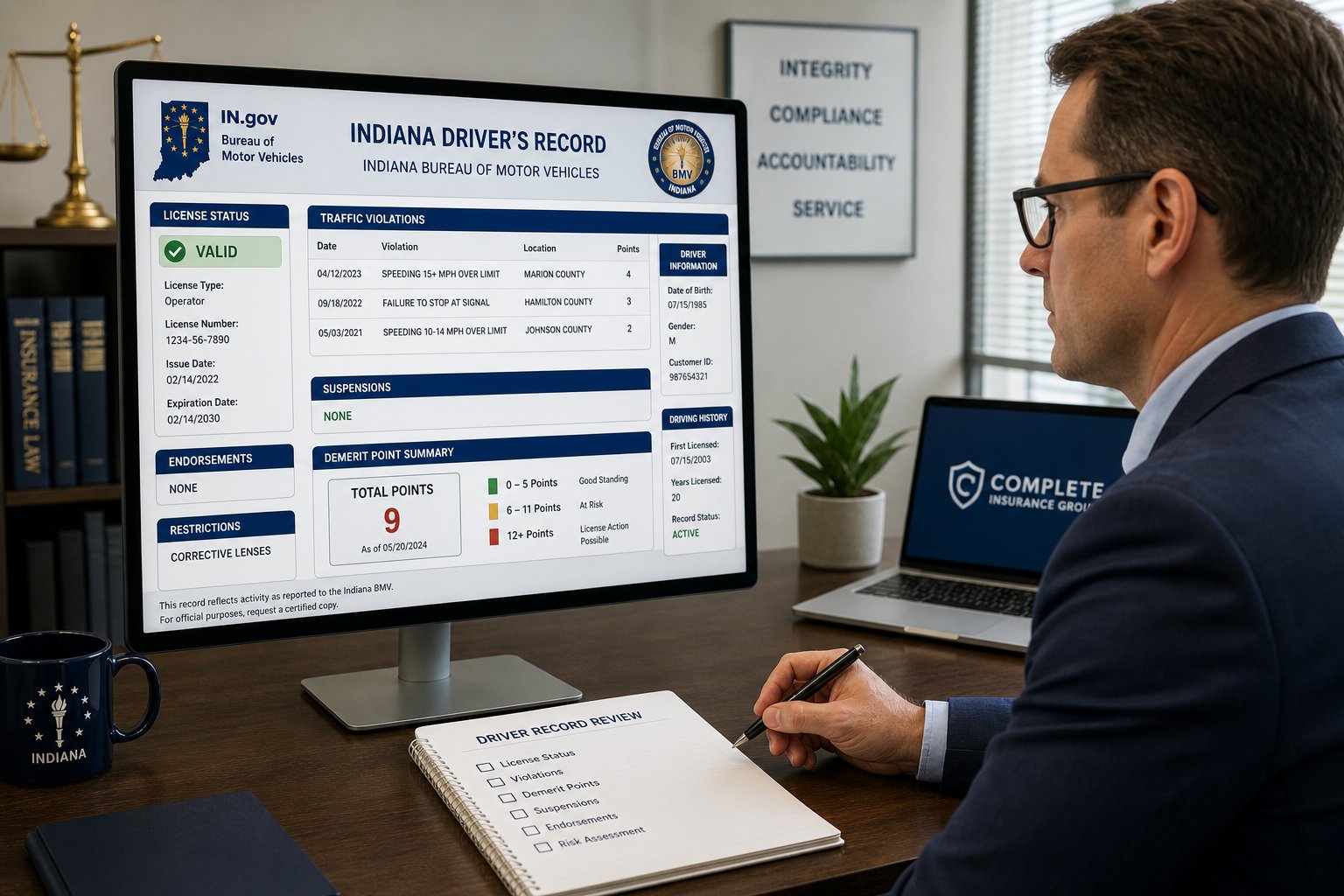
Your Indiana driving record is the Indiana Bureau of Motor Vehicles record of your driving history. It shows what the state has on file about your license and your driving privileges.
That matters because other people use it. The Indiana BMV, courts, employers, and insurance companies may review your record when they make decisions about your license, work, or rates.
A record can show:
- License status, such as valid or suspended
- Traffic convictions and violation entries
- Demerit points tied to offenses
- Suspensions and related dates
- Endorsements and driving privileges
- In some cases, fees due tied to a suspension event
Indiana uses a point system. If your point total gets high enough, the BMV can act against your license. Indiana guidance commonly refers to a 20-point threshold as a key level for suspension review, depending on the facts on your record.
Your record also matters if you were told to complete a class. Indiana’s official course is the BMV-approved Driver Safety Program (DSP). It is a 4-hour course. If you complete it when allowed, the record may show a 4-point credit. That credit lowers your point total, but it does not remove the conviction or the violation itself.
The rules that apply to you can depend on the Indiana BMV notice, court order, ticket, driver record, license status, court, judge, and case facts. So your record is not just a summary. It is often the main document used to decide what happens next.
How To Get Your Indiana Driving Record Online Or Through The BMV
You can get your Indiana BMV driving record in three main ways: online, by mail, or in person. For most people, online is the fastest.
Online through myBMV
Go to the Indiana BMV myBMV portal. After you log in or create an account, you may see options such as:
- Viewable Driver Record
- Official Driver Record
The viewable version is for your own use. The official version is the certified record that many courts, employers, and insurers want.
By mail
If you need a certified record by mail, use State Form 53789, the request form for certified records. Complete the form and mail it with the required payment to the BMV records address listed on the form or records page.
You can find current forms and records details on the Indiana BMV website.
In person at a BMV branch
You may also request help at an Indiana BMV branch. Branch staff can explain what record options are available and what ID or payment may be needed.
Personal vs. certified record
This distinction matters:
- Personal or viewable record: good for checking your own status
- Certified or official record: often needed for court, work, or formal proof
If an employer, court, or agency asks for an official copy, do not assume a screen view is enough. Check the request closely and order the correct version.
What Information Appears On An Indiana Driving Record
An Indiana driving record usually shows the parts of your history that affect your legal right to drive. It is not just a ticket list.
Most records include:
- Your license status
- Traffic convictions and related dates
- Demerit points for listed offenses
- Current and past suspensions
- Endorsements or restrictions
- Fees due connected to some suspension actions
If you are checking for a problem, start with your current status. A line that shows valid, suspended, or another status tells you the most important fact first.
Then look at the violation entries. These often include the offense date and the points tied to that offense. Indiana point values come from state rules, including the Indiana Administrative Code point schedule.
Your record may also show Driver Safety Program completion. If the DSP was accepted, the entry may reflect the 4-point credit. That credit reduces your point total. It does not erase the underlying ticket, conviction, or violation.
If you need the legal basis for records and access, see Indiana law and records rules through the Indiana General Assembly and BMV records pages. Those sources help when you need to match a record entry to a court order, notice, or suspension event.
How To Check Points, Suspensions, And Driving Privileges
The quickest way to understand your record is to look for three things first: point total, suspension entries, and current driving status. Those tell you whether you may have a problem that needs quick action.
For points, review each violation line. Indiana assigns demerit points by offense. The points stay active for 24 months from the offense date under BMV guidance. That means the offense date matters more than the date you pull the record.
For suspensions, the record may show whether a suspension is active or not active. Indiana BMV record guidance may use markers or symbols to show different suspension states. You may also see:
- Effective date
- Expiration date
- Mail date
- Fees due
Read those dates carefully. A suspension can appear on the record as history even after it is no longer active.
For driving privileges, check whether your status is valid and whether any restriction, hold, or suspension affects your right to drive. If something on the record does not match what the court told you, compare the record to the BMV notice and court papers.
Do not ignore a BMV notice, court order, citation, deadline, or required court appearance. If your record shows a suspension or high point total, review the official notice and act based on the instructions in that notice.
How To Correct Errors On Your Indiana Driving Record
If your record is wrong, you can ask the Indiana BMV to review it. You should do that as soon as you spot the error.
Common problems include:
- A ticket that was dismissed but still appears wrong
- A suspension that should have ended
- A payment or compliance item not credited
- Wrong dates or wrong court results
Indiana provides records review and public records access tools through the BMV. Start with the BMV records or contact pages, including the BMV process used for material error review or records correction. The main starting point is the Indiana BMV records page.
When you ask for a correction, include proof. Good examples are:
- Court orders
- Dismissal records
- Payment receipts
- Compliance notices
- Other official documents tied to your case
Be clear and specific. Point to the exact line that looks wrong. Include dates, case numbers, and copies of supporting papers if the BMV asks for them.
If the issue involves a court result, you may also need to confirm that the court sent the update to the BMV. That can matter when your record is based on a court report. Keep copies of everything you send.
How Long Violations Stay On Your Record And How Points Affect You
In Indiana, demerit points remain for 24 months from the offense date. That is the main rule most drivers need to know.
But the full record can last longer than the points. A violation, suspension, or other event may still appear as part of your driving history after the active point period ends. So do not assume an old item will vanish just because the points aged out.
Points can affect you in several ways:
- They can raise concern for the Indiana BMV
- They can matter to insurance companies
- They can matter to employers who review driving history
- They can contribute to license suspension risk
Indiana also allows a 4-point credit in some situations through the BMV-approved Driver Safety Program. The DSP is a 4-hour course. If you are eligible and complete it, the credit can reduce your point total. It does not remove the conviction, the ticket, or the listed violation from your record.
Eligibility and acceptance can depend on the BMV notice, court order, citation, your record, license status, the court, the judge, and the facts of your case. That is why it is smart to read every notice closely before you enroll or submit anything.
For the current point system and related rules, use the Indiana BMV point system page and the Indiana Administrative Code.
When You May Need Your Record For Court, Work, Or Traffic School
You may need your record any time someone asks for proof of your driving status or history. In Indiana, the most common reasons are court, work, and traffic school.
Court
A court may ask for your official record in a traffic case or a driving privilege matter. The record can help show your status, prior entries, suspensions, or compliance steps.
Work
Employers often want a certified Official Driver Record if the job involves driving. That is common for delivery, fleet, sales, and transport roles. A simple personal copy may not meet the request.
Traffic school or Driver Safety Program
If you were ordered or allowed to take a course, your record helps confirm what is on file. In Indiana, the official course is the Driver Safety Program (DSP), a 4-hour BMV-approved course.
If you need a flexible online option, you can review the Indiana course options at indiana driving record. Check your BMV notice, court papers, and case details first so you choose the right course and submit it the right way.
A record can also help before you apply for work, respond to a court issue, or verify whether a suspension has cleared. When someone asks for proof, confirm whether they want a personal copy or a certified one.
This article also relates to searches for free driving record indiana, but the safe answer depends on the Indiana BMV record, conviction date, and any court or BMV notice.
FAQ
Can the Indiana DSP help with points?
Yes, an approved Indiana Driver Safety Program may provide a 4-point credit when you qualify. It does not erase the conviction or violation.
Does the DSP remove a ticket from my record?
No. The DSP does not remove a ticket, conviction, or violation from your Indiana driving record.
Where should I check my Indiana points?
Use your Indiana BMV driving record to check your current point status, conviction dates, and license status.
What if I have a court order or BMV notice?
Follow the exact deadline and instructions in the court order or BMV notice. Do not rely only on general article guidance.
Conclusion
Your Indiana Driving Record: How to Get It and What It Shows is easier to manage when you check your Indiana BMV record, understand what the points mean, and know what the Driver Safety Program can and cannot do. The Indiana DSP may provide a 4-point credit when eligible, but it does not erase a ticket, conviction, or violation. Before you act, compare your record, BMV notice, or court papers with official instructions.
Take the Indiana Driver Safety Program course online when you are ready to begin.
Related Articles
- Indiana BMV Points System Explained
- Indiana Driver Safety Program and Points: What It Can and Cannot Do
- Indiana DSP 4-Point Credit: How It Works
- How Long Do Points Stay on Your Indiana Driving Record?
Sources
- Indiana BMV — Citation Points and Driver Safety Program
- Indiana BMV — Driver Record Points
- Indiana BMV — Driver Records
- Indiana Code and Administrative Rules
Billy Forte is the owner of Driving Logic, a state-approved driver improvement course provider serving Indiana and other U.S. states. Driving Logic offers online driver safety and driver improvement courses for drivers handling BMV notices, court orders, and state requirements.
This article is general information, not legal advice. Indiana BMV rules, court orders, deadlines, provider reporting, insurance decisions, and case facts can differ. Use official Indiana BMV and court sources for current requirements, and consult a qualified Indiana attorney for legal guidance specific to your situation.