
Updated June 2026 · Reviewed by Billy Forte
Indiana license suspension for points can happen when active demerit points reach the BMV suspension range. This article is for Indiana drivers who need a clear answer before choosing a course, responding to a notice, or checking their record. You will learn what the rule means, how the Driver Safety Program fits in, and what to check before your next step.
This article covers Indiana requirements only.
Key Facts
- Suspension risk: High active point totals can lead to license suspension.
- Notices matter: Read any BMV notice or court order closely.
- DSP role: A DSP credit may help reduce active point totals.
- No guarantee: DSP does not guarantee reinstatement or dismissal.
- Record check: Confirm your status with the BMV.
What An Indiana License Suspension Means And How It Differs From Revocation
If you need the approved online option, review the indiana license suspension before your deadline.
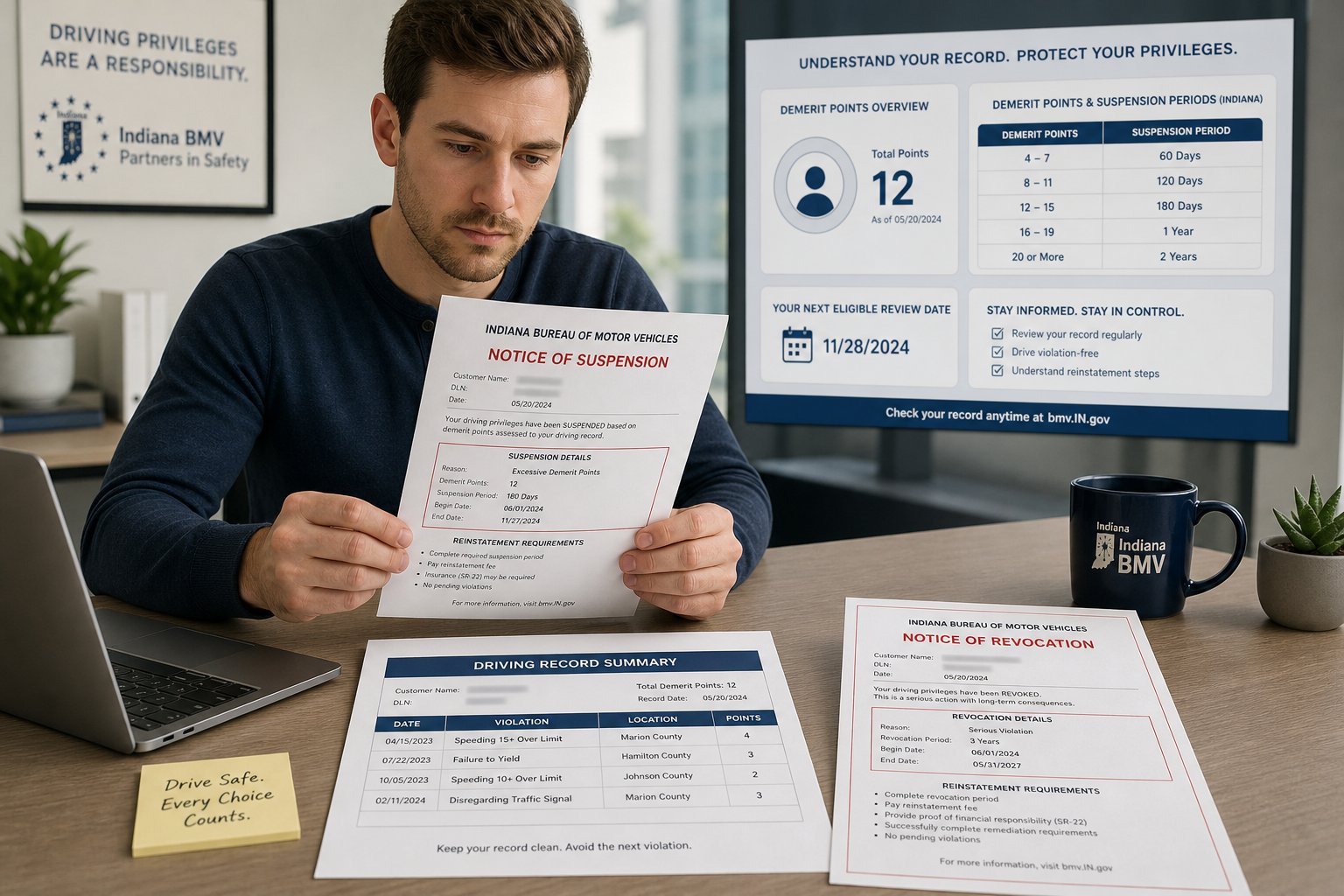
An Indiana license suspension is a temporary loss of your driving privileges. You cannot legally drive until the suspension ends and you complete any required steps. A revocation is more serious. It ends your license, and you may need to apply again as a new driver after the revocation period.
That difference matters. With a suspension, the Indiana Bureau of Motor Vehicles may restore your privileges after you wait out the suspension, pay fees, file insurance forms if required, and complete any court or BMV conditions. With a revocation, you often face a longer process and stricter rules.
For point-based cases, the issue is usually a suspension, not a revocation. Indiana tracks traffic violations on your driving record using demerit points. If your point total reaches the BMV threshold in a 24-month period, the BMV can suspend your license.
Here is the key point schedule readers usually want to know:
- 20 to 24 points in 24 months: 1 month suspension
- 25 to 29 points: 2 months
- 30 to 34 points: 4 months
- 35 to 39 points: 6 months
- 40 to 41 points: 8 months
- 42 or more points: 12 months
Indiana may also treat drivers under 21 differently in some situations, so your notice and record matter. If the BMV suspends you, read the notice closely. It should state the reason, the start date, and what must happen before reinstatement.
If you have a point-based indiana license suspended points problem, do not assume you can keep driving until you sort it out. Once the suspension is active, driving can create a new legal problem.
The Most Common Reasons Your Indiana License Can Be Suspended
Too many demerit points are one common reason, but they are not the only one. Indiana can suspend a license for both driving and non-driving issues.
Common reasons include:
- Too many demerit points on your driving record
- OWI or refusing a chemical test
- No insurance or failure to provide proof of insurance
- Failure to appear in court
- Failure to pay a ticket, fine, or judgment
- Habitual traffic violator status
- Serious offenses like reckless driving or leaving the scene
- Failure to complete a court-ordered program
For this topic, the point system is the focus. Indiana assigns points to moving violations. If enough convictions stack up within 24 months, the BMV can move from warning signs to suspension. And the problem can grow fast if you keep getting tickets before older points age out.
The BMV notice process is important here. If your point total reaches a suspension level, the Indiana BMV generally sends a notice to the address it has on file. That is one reason your address must stay current with the BMV. Missing the letter does not make the suspension disappear.
In some cases, there may be an administrative hearing process tied to the suspension notice or the issue involved. The notice should explain if a hearing is available, how to request it, and any deadline. Follow the notice exactly. Requirements can depend on the BMV notice, court order, ticket, driver record, license status, court, judge, and the facts of your case.
How To Check Your Indiana Suspension Status And Find Out What You Owe
The fastest way to check your status is through the Indiana BMV. Your Official Driver Record is the main document to review because it can show active suspensions, eligibility dates, insurance filing needs, and fee information.
You can start with the Indiana BMV tools and records pages, including myBMV and the BMV driver record information. Your record may include codes that show whether you need SR-22 or another insurance filing, and whether reinstatement fees are due.
When you review your record, look for these items:
- The reason for each suspension
- The start date and end date
- Whether the suspension is from the BMV, a court, or both
- Any listed reinstatement fees
- Any required proof of insurance
- Any missing step, such as a class or court compliance
If your issue is too many points, confirm your current point total and check the timing of the violations. Indiana uses a 24-month lookback for the point suspension thresholds discussed above.
You should also compare your BMV record to any court papers you have. A court may order conditions that the BMV will not clear until the court updates the case. If something looks wrong, contact the BMV or the court listed on the record. Do not ignore a deadline or required appearance.
The Steps To Reinstate Your Indiana Driver’s License
To reinstate your Indiana license, you must complete every condition tied to the suspension. The exact steps depend on the reason for the suspension, but the basic path is usually the same.
Start with the clear sequence:
- Wait out the suspension period, if one applies.
- Read the BMV notice and any court order.
- Finish every required action.
- Submit any insurance filing the BMV requires.
- Pay reinstatement fees.
- Confirm your license status before driving again.
If your suspension came from too many demerit points, the waiting period is based on your point level. A person at the 20-point threshold may face one month. A person at 42 or more points may face 12 months. After that, the BMV may still require more before restoration.
One key tool is the Indiana BMV-approved Driver Safety Program (DSP). This is the official 4-hour course. If you take it voluntarily and qualify, you can earn a 4-point credit on your driving record. That credit can help you stay below the suspension threshold, but it does not erase the ticket, the conviction, or the violation itself.
If you need an approved Indiana online course, Driving Logic’s Indiana Driver Safety Program is built for busy drivers who want flexible scheduling on almost any device.
Requirements That May Apply Before Reinstatement
Before the BMV restores your license, you may need more than time and money. Some cases require extra compliance steps.
These may include:
- A Driver Safety Program
- Proof of insurance such as SR-22 or SR-50
- A court-ordered class
- A court appearance or proof that fines were paid
- Vision, written, or driving tests if the BMV lists them
- Other case-specific conditions
The right answer is always the one in your own notice and record. Indiana rules also appear in sources like the Indiana Administrative Code and the Indiana General Assembly code site.
What To Know About Reinstatement Fees, SR-22, And Court-Ordered Courses
You usually cannot get your license back until all required fees are paid. The Indiana BMV may assess reinstatement fees and insurance-related fees based on the suspension type. Your driver record or BMV notice should show what is due.
Do not guess at the amount. Use the BMV record and payment channels listed by the state. If a court controls part of the hold, paying only the BMV may not be enough.
SR-22 is another common issue. SR-22 is not insurance by itself. It is a filing from your insurer that proves you carry the required coverage. Indiana often requires it after high-risk cases, such as certain OWI-related matters or other serious violations. If the BMV requires SR-22, the filing usually must come directly from the insurance company.
Court-ordered courses also matter. If a court or the BMV requires a course, your suspension can continue if you do not complete it. For point control, the official Indiana option is the BMV-approved Driver Safety Program, which is a 4-hour course. It may provide a 4-point credit, which can help lower your point total and reduce the risk of crossing the 20-point threshold.
But keep one detail straight: the 4-point credit lowers the total used for points. It does not remove the conviction from your record. That distinction matters when you review your driving history or deal with future violations.
When You May Need Legal Help Or A Specialized Driving Course
Some Indiana suspensions are simple. Others are not. If your case involves OWI, refusal of a chemical test, habitual traffic violator status, a long suspension, or both court and BMV issues, legal help may be useful.
A lawyer may help you understand whether:
- You can request or already had an administrative hearing
- A court must clear part of the suspension
- You may qualify for specialized driving privileges
- A record issue needs correction
- A missed deadline can still be addressed
Specialized driving privileges are limited driving rights for approved purposes, such as work, school, or medical needs, when a court allows them. They are not automatic, and they are not available in every case. The court will look at the law and the facts of your case.
A specialized driving course may also help when the BMV notice, court, or your point total points to the Indiana DSP. For busy drivers, an online option can make compliance easier. If you need the official 4-hour Indiana course, review Driving Logic’s Indiana Driver Safety Program online and confirm it matches the requirement in your notice.
Final note: This information is general education only and is not legal advice. Always follow your Indiana BMV notice, court orders, citation deadlines, and any required court appearance.
This article also relates to searches for indefinite license suspension indiana, but the safe answer depends on the Indiana BMV record, conviction date, and any court or BMV notice.
FAQ
Can the Indiana DSP help with points?
Yes, an approved Indiana Driver Safety Program may provide a 4-point credit when you qualify. It does not erase the conviction or violation.
Does the DSP remove a ticket from my record?
No. The DSP does not remove a ticket, conviction, or violation from your Indiana driving record.
Where should I check my Indiana points?
Use your Indiana BMV driving record to check your current point status, conviction dates, and license status.
What if I have a court order or BMV notice?
Follow the exact deadline and instructions in the court order or BMV notice. Do not rely only on general article guidance.
Conclusion
Indiana License Suspension for Points: Thresholds, What Happens, and How to Reinstate is easier to manage when you check your Indiana BMV record, understand what the points mean, and know what the Driver Safety Program can and cannot do. The Indiana DSP may provide a 4-point credit when eligible, but it does not erase a ticket, conviction, or violation. Before you act, compare your record, BMV notice, or court papers with official instructions.
Take the Indiana Driver Safety Program course online when you are ready to begin.
Related Articles
- Indiana BMV Points System Explained
- Indiana Driver Safety Program and Points: What It Can and Cannot Do
- Indiana DSP 4-Point Credit: How It Works
- How Long Do Points Stay on Your Indiana Driving Record?
Sources
- Indiana BMV — Citation Points and Driver Safety Program
- Indiana BMV — Driver Record Points
- Indiana BMV — Driver Records
- Indiana Code and Administrative Rules
Billy Forte is the owner of Driving Logic, a state-approved driver improvement course provider serving Indiana and other U.S. states. Driving Logic offers online driver safety and driver improvement courses for drivers handling BMV notices, court orders, and state requirements.
This article is general information, not legal advice. Indiana BMV rules, court orders, deadlines, provider reporting, insurance decisions, and case facts can differ. Use official Indiana BMV and court sources for current requirements, and consult a qualified Indiana attorney for legal guidance specific to your situation.