
Updated June 2026 · Reviewed by Billy Forte
In Tennessee, reckless driving can become an issue when your speed is high enough that an officer believes you drove with willful or wanton disregard for safety, and in practice that often means about 25 to 30 mph or more over the limit, though the law does not set one fixed reckless driving speed limit. Under Tennessee Code Annotated § 55-10-205, reckless driving is a Class B misdemeanor, which is very different from a standard speeding ticket because it can bring criminal penalties, court costs, and a lasting record. The exact charge often depends on the full situation, including traffic, road conditions, school or work zones, and whether the officer saw other risky acts like weaving, tailgating, or racing.
This article covers Tennessee requirements only.
Key Facts
- Reckless-driving standard: Tennessee law focuses on willful or wanton disregard for safety.
- No fixed mph rule: A high speed can matter, but the statute does not set one automatic threshold.
- Criminal risk: Reckless driving can be treated differently from a standard speeding ticket.
- Course role: A driver education course may help only if the court accepts or orders it.
- No guarantee: The course does not erase charges, convictions, points, or court requirements.
#
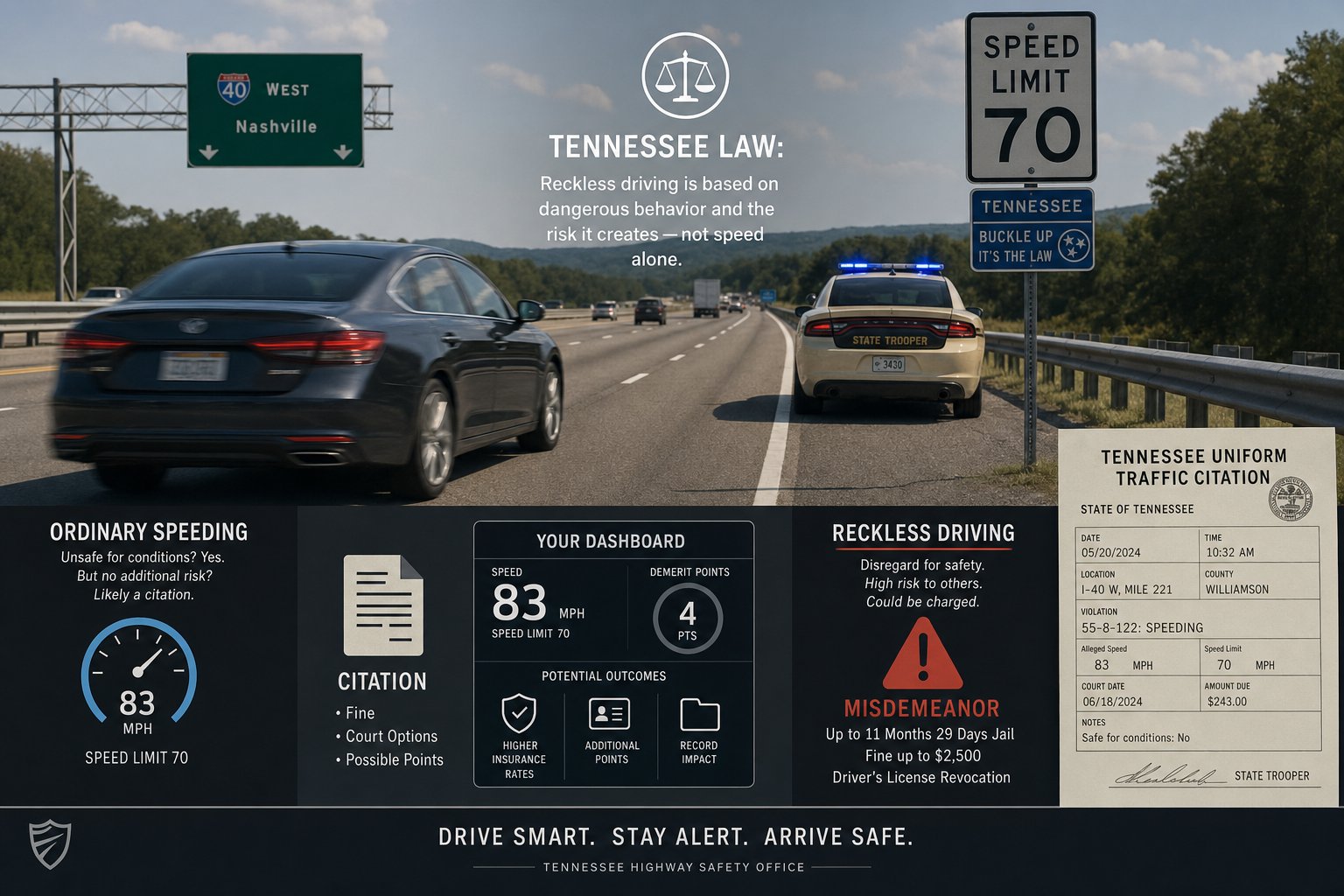
A speeding ticket and a reckless driving charge are not the same in Tennessee. Speeding is usually a traffic violation. Reckless driving is a criminal offense.
Tennessee uses a behavior-based rule for reckless driving. Under TCA § 55-10-205, the question is whether you drove with willful or wanton disregard for the safety of people or property. That means the law does not give one fixed Tennessee reckless driving speed limit.
So, there is no statute that says, for example, “85 mph is always reckless.” Instead, the officer, prosecutor, and court look at what happened as a whole. Speed matters, but so do your actions and the road around you.
Standard speeding usually means you drove above the posted limit. That may lead to a Tennessee traffic ticket, fines, court costs, and demerit points on your driving record. A reckless driving charge is more serious because it can be filed as a Class B misdemeanor.
That difference matters. A misdemeanor can affect more than your wallet. It can affect your record, your license, and sometimes your job.
Tennessee road limits also vary by road type. Many interstates are posted up to 70 mph, while some other public roads may be lower. But the posted speed alone does not answer the reckless driving question. The issue is whether the speed and your conduct together created a serious safety problem.
#
Speeding can cross into reckless driving in Tennessee when the facts suggest more than a simple mistake. In real-world cases, 25 to 30 mph or more over the speed limit is often where officers and prosecutors start treating speed as reckless driving territory.
Still, that is a practical guideline, not a statutory bright line. Tennessee law does not say that a fixed number automatically becomes reckless driving in every case. A driver going far over the limit on an empty, dry interstate may be treated differently than a driver doing the same speed in traffic, near workers, or by a school.
That is why the charge can change based on the setting. A basic speeding stop may stay a speeding case. But if the speed is very high and the driving looked dangerous, the officer may write reckless driving instead.
This is also where many drivers get caught off guard. They expect a normal speeding ticket and then see a criminal charge on the citation. If that happens, read the ticket closely, note any court date, and do not assume it works like an ordinary infraction.
##
Some facts make a reckless driving charge more likely:
- Very high speed, often around 25 to 30+ mph over
- Speeding in a school zone
- Speeding in a construction zone
- Weaving through traffic
- Tailgating at high speed
- Racing or trying to pass in a risky way
- Driving too fast in heavy traffic
- Losing control or nearly causing a crash
- Endangering walkers, cyclists, or other drivers
In short, speed alone may start the problem, but dangerous behavior often pushes it into reckless driving.
#
A Tennessee reckless driving conviction can carry much heavier consequences than a normal speeding ticket. It is a Class B misdemeanor. That means it is a criminal charge, not just a traffic infraction.
Under Tennessee law, penalties can include up to 6 months in jail and up to a $500 fine, along with court costs. Courts do not have to impose the maximum in every case, but the risk is there. That is one reason many people speak with a traffic attorney when reckless driving is charged.
License points matter too. Reckless driving commonly carries 7 demerit points. Standard speeding can also add points, though usually fewer than reckless driving. The Tennessee Department of Safety and Homeland Security warns that drivers who reach 12 points in 12 months may face a suspension process.
Points can stay on your record for years. Insurance companies may also review convictions and adjust rates. And because reckless driving is criminal, it may show up in background checks.
A few long-term risks include:
- More points with future Tennessee traffic ticket cases
- Trouble if you are already near suspension with TDOSHS
- Higher insurance costs
- A criminal record tied to reckless driving
- More serious effects for CDL and work drivers
If your citation says reckless driving, treat it as a serious matter from the start.
#
If you get a Tennessee speeding or reckless driving ticket, the first step is simple: do not ignore it. Check the charge, the court date, and the location listed on the citation.
If the ticket is for speeding, you may have more routine options. If it is for reckless driving, remember that you may be dealing with a criminal case. That is a key difference.
A few smart next steps are:
- Read the citation carefully
- Keep track of any court appearance requirement
- Contact the Clerk of Court if you need basic case details
- Check the local Tennessee court system information for procedures
- Consider speaking with a traffic attorney, especially for reckless driving
An attorney may review issues such as the officer’s observations, speed measurement, and whether the facts support a reckless driving charge. That does not guarantee a result, but it can help you understand the case and your options.
Also, do not assume paying the ticket is always the best move. Paying can amount to a guilty plea in many cases. That matters much more when the charge is reckless driving.
If you are ordered to complete a class, follow the court’s instructions closely. Courts can set their own rules on deadlines, accepted providers, and whether online completion counts.
#
Traffic school can sometimes help after a Tennessee speeding or reckless driving case, but it depends on the court and the case. You should never assume a course will dismiss a ticket or remove points automatically.
In Tennessee, defensive driving courses often come up in two forms:
- A 4-hour course, often used for court-ordered ticket diversion in some cases
- An 8-hour TDOSHS-approved course, often used when a driver is near suspension or has a state requirement
Whether a court accepts a course for a speeding ticket, a reckless driving case, or a plea agreement varies by county and judge. Also, whether the court accepts online completion varies. Always confirm with your specific court before you enroll.
For busy drivers, online courses can still be a practical option when allowed. Driving Logic offers a Tennessee defensive driving course built for flexible use on your phone, tablet, or computer. If you need a class and want a simple next step, you can review the options at Driving Logic.
Before you sign up, verify:
- Which course length the court wants
- Whether online completion is accepted
- Your deadline
- Where your certificate must be sent
- Whether the requirement is court-based or TDOSHS-based
That quick check can save time and avoid problems later.
This is general information, For case-specific guidance, especially on a reckless driving charge, consult a qualified Tennessee traffic attorney and confirm all course requirements with your court or TDOSHS.
FAQ
Can a Tennessee driver education course dismiss my ticket?
Only if your court allows that result. Tennessee courts and local instructions control whether a course affects a ticket, points, or court requirement.
Can I take the course online?
Maybe. Some Tennessee courts accept online courses, while others may require a specific format, so confirm with the court before enrolling.
Does the course remove points from my record?
Do not assume it removes points automatically. Any point or ticket benefit depends on the court, TDOSHS rules, and the facts of your case.
What should I check before enrolling?
Check your ticket, court notice, clerk instructions, deadline, and whether online completion is accepted. Then choose a course that matches those requirements.
Conclusion
Tennessee has no fixed mph that automatically equals reckless driving; the charge turns on dangerous behavior, though very high speed can support it. Check exactly what your citation alleges, since reckless driving is a misdemeanor, not a standard speeding ticket. When the charge is criminal, a Tennessee attorney is worth a call.
Take the Tennessee driver education course online with Driving Logic when you are ready to begin.
Related Articles
- Tennessee Speeding Ticket: Costs, Points, and What to Know
- Tennessee Reckless Driving vs. Speeding Ticket: Key Differences
- Tennessee Speeding Ticket Fines: What Affects the Cost?
- Tennessee First-Time Speeding Ticket: What to Expect
Sources
- Tennessee Department of Safety and Homeland Security — Defensive Driving Schools
- Tennessee Department of Safety and Homeland Security — Driver Improvement / Traffic School
- Tennessee Code Annotated — Reckless Driving, TCA § 55-10-205
- Tennessee Department of Safety and Homeland Security
Billy Forte is the owner of Driving Logic, a state-approved driver improvement course provider serving Tennessee and other U.S. states. Driving Logic offers online driver education, defensive driving, and traffic school courses for drivers handling court, ticket, insurance, and state requirements.
This article is general information, not legal advice. Tennessee court rules, TDOSHS requirements, deadlines, insurance decisions, and case facts can differ. Use official Tennessee court and state sources for current requirements, and consult a qualified Tennessee attorney for legal guidance specific to your situation.