
Updated June 2026 · Reviewed by Billy Forte
Should you pay your Tennessee speeding ticket, go to court, or ask about driving school? Usually, pay if you accept the charge and want the case closed fast, go to court if you want to contest it or ask for a different result, and ask about driving school only if your court allows it. In Tennessee, paying a traffic ticket is usually a guilty plea, and that can add demerit points to your record with the Tennessee Department of Safety and Homeland Security (TDOSHS). If you miss the pay deadline or skip a required court date, you can face added penalties, court action, and possible license trouble.
This article covers Tennessee requirements only.
Key Facts
- Paying has consequences: Paying a ticket can mean accepting the violation and points.
- Contesting is court-based: Contesting requires following court procedures and deadlines.
- Driving school varies: Some courts may allow a course, but acceptance is not automatic.
- Deadlines matter: Your citation, court notice, or clerk instructions control timing.
- No legal advice: Use official court sources or an attorney for case-specific guidance.
#
A Tennessee traffic ticket is more than a bill. It is a court case, and your response affects your record, your time, and sometimes your license.
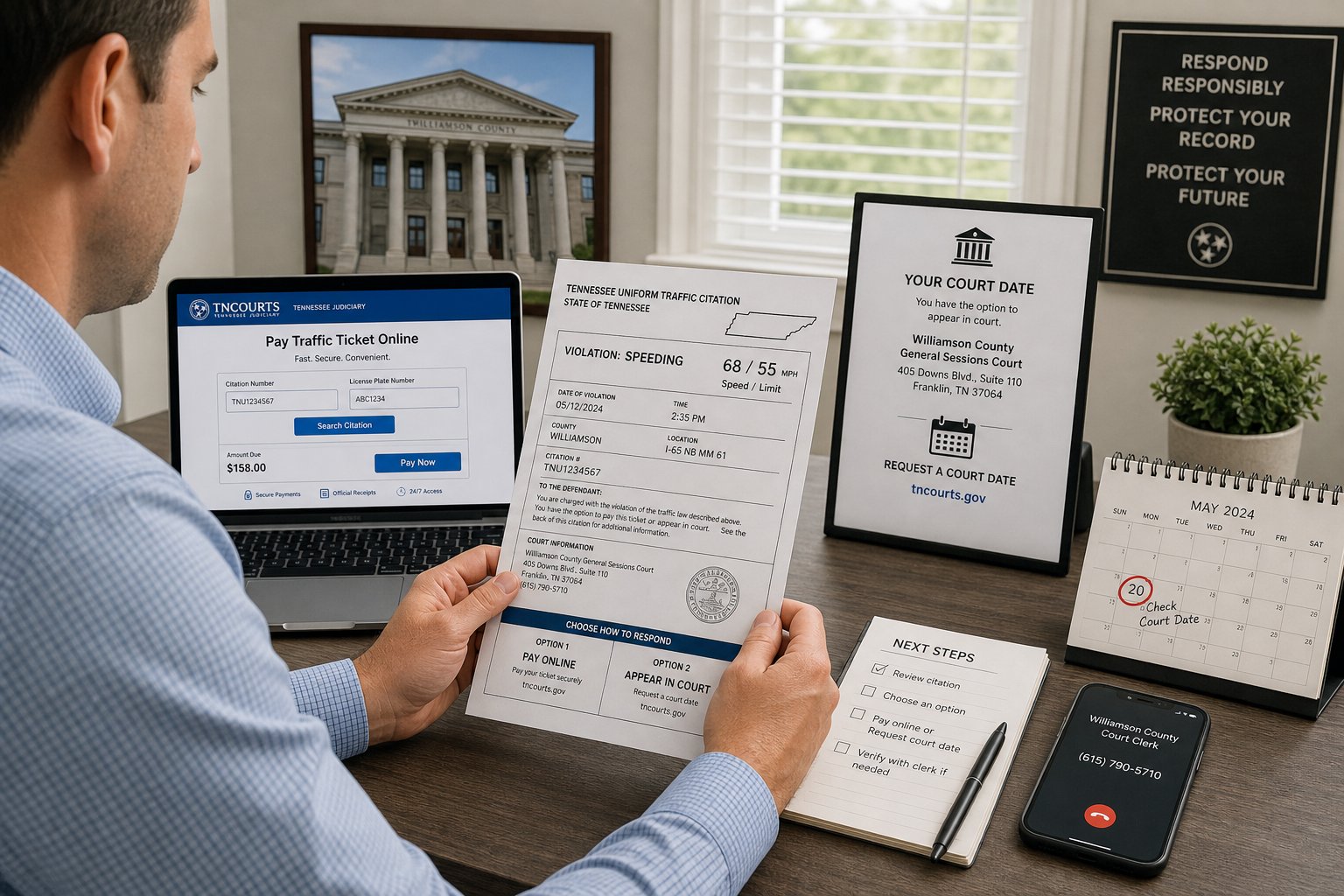
For most routine speeding violations, you usually have two basic paths. You can pay the ticket or appear in court. In some courts, there is also a third path: ask whether the judge will allow traffic school or another diversion-style outcome.
If you are asking about tennessee speeding ticket pay or court, the key point is simple. Paying usually ends the case without a court appearance, but it is commonly treated as a guilty plea. Going to court keeps your options open, but it takes more time and does not guarantee a better result.
In Tennessee, speeding is often handled as a traffic offense, but facts matter. A higher speed, a work zone, a crash, or a related charge can change the stakes. Some cases can involve more serious charges, including reckless driving, which may be charged under the Tennessee Code Annotated and may be a Class B misdemeanor under some facts. That is one reason not to assume every ticket works the same way.
Your ticket should list a court date, payment instructions, or both. Read it closely. Then check the local court website or call the Clerk of Court to confirm what options apply in your county. Tennessee courts do not all use the exact same process.
A few courts spell this out clearly. Clarksville says you may pay eligible tickets online, by mail, or in person, but warns that missing the deadline can bring added penalties and collection costs. Jackson says if you want to plead not guilty, or if you want to request driving school, you must appear before the judge. Nashville also allows online payment for many cases and notes card processing fees may apply through the system.
So your first step is not to guess. It is to figure out whether your ticket is payable, whether you must appear, and whether your court even offers a driving school option through the judge or clerk.
#
Paying the ticket usually makes sense when your main goal is speed and closure. If you do not want to take time off work, gather evidence, or appear in court, payment is often the simplest path.
For many standard speeding citations, paying can be done online, by mail, or in person, depending on the court. Some Tennessee courts, including Nashville and Clarksville, provide online payment options for eligible cases. That can be useful if you just want the matter finished.
Paying may fit your situation if:
- You agree you were speeding
- You do not plan to challenge the officer’s account
- You are not trying to ask for traffic school
- You want to avoid another trip to court
- The record impact is not your top concern
But simple does not always mean best. Before you pay, look at the full cost. The total may include the fine, court costs, and payment processing fees. For example, Nashville notes a 2.25% non-refundable processing fee for debit or credit card payments through its system.
Also, make sure the ticket is actually payable without appearing. Some citations require a court date, and some fact patterns are not handled like routine infractions. If your ticket involves a required appearance, do not assume online payment is enough.
If your main priority is time, payment is often the fastest answer. Still, you should weigh that against points, record effects, and whether your court might allow a school option instead.
##
Paying usually means you are pleading guilty. That matters because a guilty plea can lead to demerit points on your driving record reported to TDOSHS.
You also give up the chance to stand before the judge and ask for a different result. In some courts, that could include asking about traffic school, a reduction, or another outcome based on your record and the facts. Jackson’s court information is a useful example: it says that if traffic school is granted, the ticket would not be sent to Nashville and would not go on the driving record. That is very different from simply paying.
Once you pay, you usually lose leverage. You cannot go back and ask the court to treat the case like a contested hearing you never requested. That is why payment makes sense mainly when you are comfortable accepting the citation as charged.
#
Going to court may be the better option when the ticket’s long-term effect matters more than convenience. If you want to contest speeding ticket Tennessee style, court is the path that keeps that choice open.
You may want to appear if:
- You believe the ticket is wrong
- You want to plead not guilty
- You want the judge to hear your side
- You want to ask whether traffic school is allowed
- The charge is serious enough that points or a record hit could hurt you
Court can lead to several possible outcomes. The judge may dismiss the case, reduce the charge, allow a school option, or find you guilty as charged. There is no guaranteed result. The outcome depends on the facts, the court, your record, and what the judge allows.
This matters even more if the citation is tied to a higher speed, a work-zone issue, an accident, or a charge like reckless driving. Those cases can carry more risk than a basic payable speeding ticket. If the case is complex, speaking with a traffic attorney is often wise.
Jackson’s court process shows why appearance can matter. The court states that a person who wants to plead not guilty, or plead guilty and request driving school, must appear before the judge on the assigned date. In other words, some options do not exist unless you show up.
You should come prepared. Bring the ticket, any photos, witness details, and questions for the clerk if you have them. Also, be realistic. Court can take time, and it may still end in a conviction with fines and costs. But if your main concern is your record or keeping your options open, appearing in court may be worth it.
#
Traffic school can sometimes help, but only if your specific Tennessee court allows it. You should never assume a course will dismiss a ticket or reduce points.
In Tennessee, readers often mean a defensive driving course when they say traffic school. Two course lengths may matter:
- 4-hour course: often used when a court orders or allows a ticket-diversion style option
- 8-hour course: often tied to TDOSHS-approved needs when a driver is near suspension
Those are not interchangeable in every case. The right course depends on what the court or TDOSHS requires.
And here is the most important part: whether a defensive driving course can dismiss a ticket, reduce points, or keep the citation off your record depends entirely on the specific Tennessee court and the facts of your case. Some courts may allow it. Some may not. Some may require you to appear first. Some may have eligibility rules based on your recent record.
Jackson says judges generally allow traffic school only if there has not been a citation within the last year, and it lists a local course fee. Clarksville also says eligibility should be confirmed with the court clerk. That tells you two things. First, courts vary. Second, you need court-specific answers.
If you are thinking about an online course, confirm that your court will accept online completion before you enroll. Court acceptance of online traffic school is not automatic in every Tennessee case.
If the court tells you a defensive driving course will satisfy its requirement, you can review the TennesDriving Logic. The site is built for busy drivers who want a flexible course they can complete on almost any device, but you still need to match the course to your court or TDOSHS requirement before signing up.
#
The deadline on your ticket is not flexible just because you are unsure what to do. If you miss it, the problem can get bigger fast.
A Tennessee speeding ticket will usually show either a payable date, a court date, or both. If you plan to pay, do it by the stated deadline and in the approved way. If the ticket requires a court appearance, you need to appear unless the court tells you otherwise.
Missing a deadline can lead to:
- Late penalties
- Failure-to-appear consequences
- Added collection costs
- Contempt of court issues in some situations
- Possible license trouble
That is not just theory. Clarksville warns that missing the court date or failing to pay on time can trigger additional penalties and collection costs. Those extra consequences can make a simple ticket much more expensive.
Fees can also change the math of your decision. The total can include the fine, court costs, and payment fees. Nashville notes a 2.25% non-refundable processing fee for card payments. Other courts may have different systems, so always check the local court’s payment page.
For court dates and payment rules, start with your ticket, then verify details through your local court or the Tennessee court system. For license and record questions, use the Tennessee Department of Safety and Homeland Security.
If you are not sure whether your case is payable, call the clerk before the deadline. A quick check is much safer than guessing.
#
The best option depends on what matters most to you. For most drivers, the real trade-off is speed now versus possible record benefits later.
If your priority is time, paying is usually fastest. You avoid a court trip, and the case ends sooner. That said, paying is usually a guilty plea, so you should be comfortable with the likely record impact before you choose it.
If your priority is your driving record, court may be better. It gives you the chance to contest the charge or ask whether the judge allows traffic school. That does not promise dismissal, reduced points, or a lower charge. It only gives you the chance to ask.
If your priority is total cost, compare all parts of the case:
- Fine amount
- Court costs
- Card or online processing fees
- Lost work time for court
- Possible course fee if school is allowed
Also think about your recent history. A clean record may make a school request more realistic in some courts. A prior citation may limit that option. And if the charge looks more serious than basic speeding, especially if TCA or misdemeanor language appears on the ticket, get legal help.
A simple way to decide is this:
- Pay if you accept the charge and want the fastest close
- Go to court if you want to contest it or ask for another result
- Ask about traffic school only after confirming your court’s rules and whether online completion counts
If your court or TDOSHS requires a course, you can review the Tennessee defensive driving options from Driving Logic. Before you enroll, confirm the exact course length and format your court will accept.
Tennessee traffic rules, court procedures, and case outcomes vary by county, court, and facts. For legal advice on a Tennessee traffic ticket, especially a charge such as reckless driving or any case with a required court appearance, talk with a licensed Tennessee attorney.*
FAQ
Can a Tennessee driver education course dismiss my ticket?
Only if your court allows that result. Tennessee courts and local instructions control whether a course affects a ticket, points, or court requirement.
Can I take the course online?
Maybe. Some Tennessee courts accept online courses, while others may require a specific format, so confirm with the court before enrolling.
Does the course remove points from my record?
Do not assume it removes points automatically. Any point or ticket benefit depends on the court, TDOSHS rules, and the facts of your case.
What should I check before enrolling?
Check your ticket, court notice, clerk instructions, deadline, and whether online completion is accepted. Then choose a course that matches those requirements.
Conclusion
With a Tennessee traffic ticket you generally have three paths — pay it, contest it, or ask the court about driving school — and each has different consequences for your record. Read your citation and call the Clerk of Court before the deadline to learn what applies. Paying is the fastest option but also the one that adds points.
Take the Tennessee driver education course online with Driving Logic when you are ready to begin.
Related Articles
- Tennessee Speeding Ticket: Costs, Points, and What to Know
- Tennessee Reckless Driving vs. Speeding Ticket: Key Differences
- Tennessee Speeding Ticket Fines: What Affects the Cost?
- Tennessee First-Time Speeding Ticket: What to Expect
Sources
- Tennessee Department of Safety and Homeland Security — Defensive Driving Schools
- Tennessee Department of Safety and Homeland Security — Driver Improvement / Traffic School
- Tennessee Code Annotated — Reckless Driving, TCA § 55-10-205
- Tennessee Department of Safety and Homeland Security
Billy Forte is the owner of Driving Logic, a state-approved driver improvement course provider serving Tennessee and other U.S. states. Driving Logic offers online driver education, defensive driving, and traffic school courses for drivers handling court, ticket, insurance, and state requirements.
This article is general information, not legal advice. Tennessee court rules, TDOSHS requirements, deadlines, insurance decisions, and case facts can differ. Use official Tennessee court and state sources for current requirements, and consult a qualified Tennessee attorney for legal guidance specific to your situation.