
Updated June 2026 · Reviewed by Billy Forte
The Indiana Driver Safety Program is a BMV-approved 4-hour course that may be required by the BMV or a court, or taken voluntarily for a 4-point credit. This article is for Indiana drivers who need a simple answer before choosing, completing, or submitting a Driver Safety Program course. You will learn what the rule means, what to check first, and how to avoid the most common mistakes.
This article covers Indiana requirements only.
Key Facts
- Course length: Indiana BMV-approved DSP courses are at least 4 hours.
- 4-point credit: The BMV applies a 4-point credit for successful completion of a BMV-approved DSP, when eligible.
- Credit timing: The voluntary 4-point credit may only be applied once every 3 years.
- Record impact: DSP completion does not remove a citation, conviction, or violation from your driver history.
- Formats: Indiana DSP curriculum may be available online, by DVD, or in a classroom through approved providers.
If you need the official online option, you can start the Indiana Driver Safety Program after confirming it fits your BMV notice, court order, or voluntary credit goal.
What The Indiana Driver Safety Program Is And When You May Need It
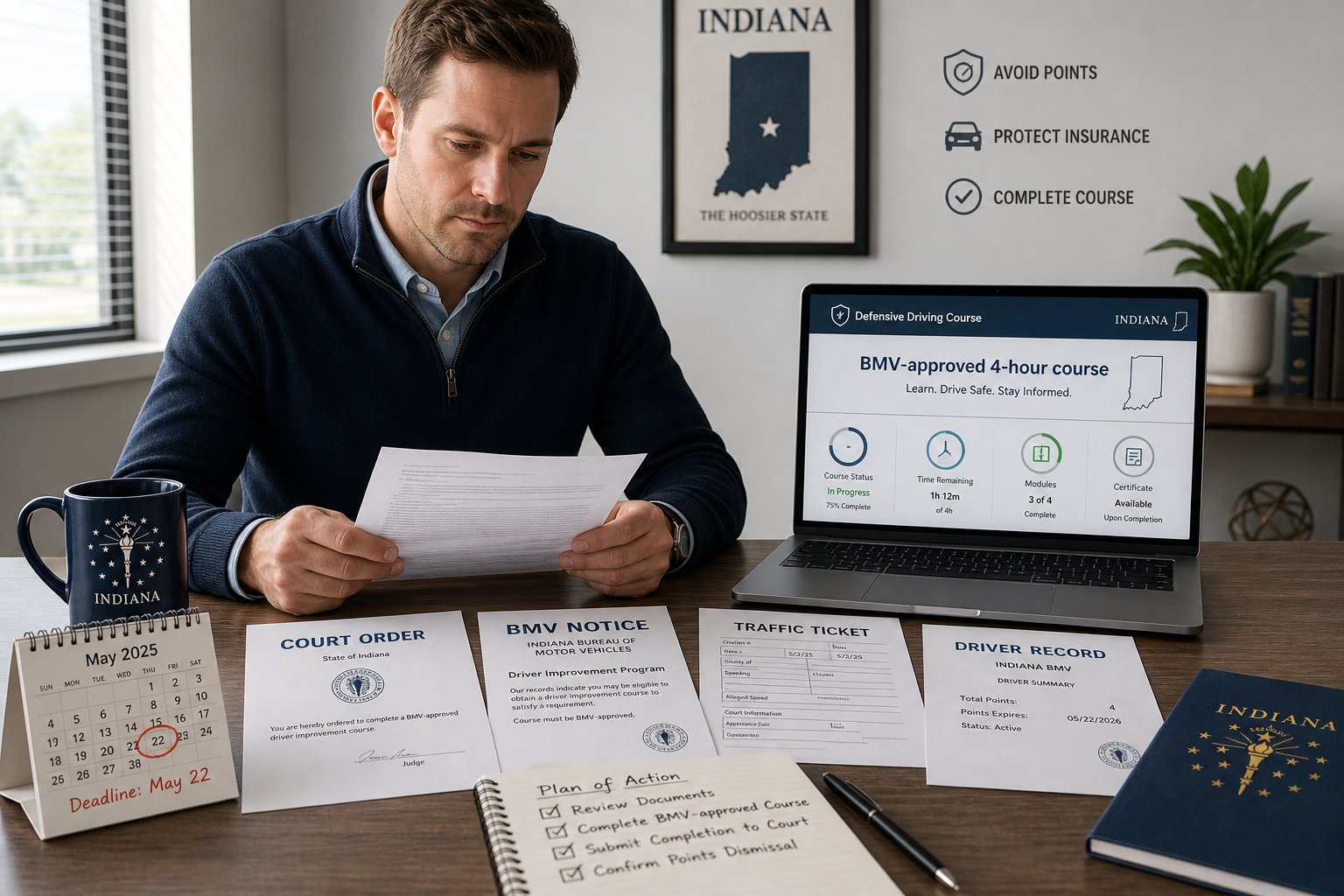
The Indiana Driver Safety Program, often called the DSP or a defensive driving course, is a state-approved traffic safety class for Indiana drivers. In most cases, the version people mean is the BMV-approved 4-hour course.
You may need it for one of four common reasons:
- A court ordered it after a ticket or traffic case
- The Indiana BMV ordered it based on your record or a notice it sent you
- You want a voluntary 4-point credit on your Indiana driving record
- You want to ask your insurer about a discount after course completion
The reason matters because it changes what counts as success. If your goal is a court order, you need to follow the exact terms in the order. If your goal is a BMV notice, you need to finish the right course by the deadline. And if your goal is the 4-point credit, you need a BMV-approved course and you must meet the state’s eligibility rules.
This is where many drivers get tripped up. They hear “defensive driving” and assume any traffic school will work. That is not always true in Indiana. The safer move is to use a provider that clearly states the course is approved by the Indiana BMV and to match the course to your notice or court paper.
Indiana rules and requirements can depend on the BMV notice, court order, ticket, driver record, license status, and the facts of your case. So read every document closely and keep the deadline in front of you.
Who Is Eligible And What Benefits The Program Can Provide
Many Indiana drivers can take a driver safety program Indiana course, but the benefit you get depends on why you take it. The course itself is broad in use, yet the result is not the same for every driver.
If you take the course voluntarily, the main benefit is usually the 4-point credit on your Indiana Official Driver Record. That credit can help lower your active point total. But it does not remove the conviction tied to a ticket, and it does not make the violation disappear.
If you take the course because of a court order or BMV order, the benefit is compliance. In plain terms, you complete what was required. That can matter a lot if your notice says the course is needed by a certain date.
Possible benefits may include:
- A 4-point credit if you qualify and take the course voluntarily
- Meeting a court or BMV requirement
- A possible insurance discount, if your insurer offers one
- Better review of safe driving habits and risk awareness
Some providers state that Indiana drivers as young as 14 may be allowed to take a course in some situations. Still, age alone does not answer everything. Your notice, your court, and your driving history still matter.
If you want the strongest chance of getting the right result, confirm both approval and purpose before you enroll.
How The Program Affects Points, Driving Records, And Driver Education Requirements
The key fact is simple: the Indiana driver safety program can add a 4-point credit to your driving record when you are eligible, but it does not erase the ticket, the conviction, or the listed violation. That difference is easy to miss, and it matters.
Indiana uses demerit points on your driving record. Those points can affect your standing with the Indiana BMV. A voluntary DSP completion may reduce the point total by adding a credit of four points to the record. According to provider and state guidance, that credit is available once every three years.
So what does that mean in real life? If a moving violation put points on your record, the DSP credit may offset part of that total. But the original case still remains part of the record. You should not treat the course as a way to “wipe out” a ticket.
For some drivers, the course is also part of a larger driver improvement requirement. A court may order it after an offense. The BMV may require it after repeat issues or based on point history. Some sources also note that drivers with high point totals over a set period may face added BMV review.
Helpful state sources include the Indiana BMV driver safety information and the Indiana Administrative Code.
If your notice mentions education requirements, follow the exact wording on that document.
How To Choose A BMV-Approved Provider And Take The Course Online
The best provider is a BMV-approved provider that clearly matches your Indiana requirement and lets you finish the course on a schedule you can manage. That sounds obvious, but this is where bad choices create delays.
Before you sign up, check these points:
- The provider says the course is approved by the Indiana BMV
- The course matches your need, such as court ordered or voluntary point credit
- The provider explains how completion reporting works
- You can access the course on your phone, tablet, or computer
- The provider gives clear help if you need your certificate fast
Online courses are popular because they are easier to fit into a work week. Most let you sign in, complete lessons at your own pace, and stop and start as needed. That is useful when you have a deadline but not much free time.
For drivers who want a simple online option, the Indiana Driver Safety Program is built for quick access and flexible scheduling. Still, you should always confirm that the exact course you choose fits your BMV notice or court order.
You can also review state law and rules through the Indiana Code website and official BMV pages before enrolling.
What To Expect From The Course, Time Requirement, And Final Steps
Most Indiana DSP courses are 4 hours long. That is the standard detail many drivers want first, especially if they are trying to fit the class into a busy week.
The course usually covers safe driving habits, traffic laws, judgment, crash prevention, and risk awareness. The format can vary by provider. Some use mostly reading. Others use video, short quizzes, or a mix of both.
In many cases, you should expect:
- A 4-hour time requirement
- Short lessons broken into sections
- Quiz questions during the course
- A final exam
- A passing score that some providers list as 80%
Do not assume every provider works the same way. The state requirement may be the same, but the user experience can be very different. One course may feel clean and easy to follow. Another may be slow or hard to use on a phone.
Your last steps usually include finishing every required lesson, passing the final test if one applies, and making sure your completion is recorded. Save screenshots, emails, or your certificate if the provider sends them. A little proof can save a lot of stress if your deadline is close.
After You Finish: Certificate Delivery, BMV Reporting, And Court Submission
After you finish the course, you should receive a certificate of completion or similar proof from the provider. That is your first record that the class is done.
Next comes reporting. Many providers state that they report successful completion to the Indiana BMV. Even so, do not assume that reporting alone solves every case. If a court ordered the course, you may still need to file or deliver the certificate to the court yourself.
That is a common point of confusion. The BMV and the court are not always doing the same thing. A provider may send data to one system, while your judge or clerk still expects your certificate by a set date.
A smart checklist after completion looks like this:
- Save your certificate right away
- Confirm whether the provider reports to the Indiana BMV
- Check your BMV notice or court paperwork for extra steps
- Submit the certificate to the court if your order requires it
- Allow time for processing before your deadline
If you need a fast online option, review the Indiana course details at Driving Logic and verify the reporting steps before you enroll.
Common Problems To Avoid When Completing An Indiana Driver Safety Program
Most problems with the Indiana DSP are simple mistakes. The trouble is that simple mistakes can still cause a missed deadline or a rejected completion.
The first problem is choosing a course that is not BMV-approved. A generic traffic school may sound right but fail to meet Indiana’s rules. Always verify approval first.
The second problem is assuming the course fixes more than it does. The DSP can provide a 4-point credit when you qualify. It does not guarantee ticket dismissal, charge reduction, point removal from the conviction, license reinstatement, or insurance savings.
Other common issues include:
- Missing a court or BMV deadline
- Failing to read the exact terms of a court order
- Not sending the certificate to the court when required
- Assuming the provider reported completion without checking
- Waiting too long to enroll when your schedule is tight
If your goal is speed and convenience, start with a BMV-approved option and keep copies of every email and document. Busy drivers often do best with an online course they can finish in short blocks rather than a fixed classroom session.
FAQ
Does the Indiana Driver Safety Program remove a ticket?
No. DSP completion does not remove a citation, conviction, or violation from your driver history. The BMV may apply a 4-point credit to your Indiana Official Driver Record when you complete a BMV-approved DSP and meet the rules.
How long is the Indiana Driver Safety Program?
BMV-approved DSP courses are a minimum of 4 hours. The course can be offered online, by DVD, or in a classroom through approved providers.
How often can I get the 4-point credit?
The 4-point credit may only be applied once every three years. Completing another course may extend the credit period, but it does not erase a ticket.
Can I take the course online?
Yes. Indiana BMV-approved providers may offer online DSP courses. Make sure the provider is approved before enrolling.
Conclusion
Indiana Driver Safety Program: the Complete Guide is easier to handle when you know the course purpose, the BMV rules, and your deadline. The most important point is that the Indiana DSP can provide a 4-point credit when eligible, but it does not erase the ticket or conviction. Before you enroll, confirm that your provider is BMV-approved and that the course fits your notice, court order, or voluntary goal.
When you are ready, take the Indiana Driver Safety Program course online.
Related Articles
- How the 4-Hour Indiana Driver Safety Program Works Online
- How to Take the Indiana Driver Safety Program Online
- Indiana BMV-Approved Driver Safety Program: What It Means and How to Verify
- Indiana Driver Safety Program Certificate: What It Is and How to Submit It
Sources
- Indiana BMV — Citation Points and Driver Safety Program
- Indiana BMV — Driver Record Points
- myBMV — Indiana BMV Online Services
- Indiana Code and Administrative Rules
Billy Forte is the owner of Driving Logic, a state-approved driver improvement course provider serving Indiana and other U.S. states. Driving Logic offers online driver safety and driver improvement courses for drivers handling BMV notices, court orders, and state requirements.
This article is general information, not legal advice. Indiana BMV rules, court orders, deadlines, provider reporting, insurance decisions, and case facts can differ. Use official Indiana BMV and court sources for current requirements, and consult a qualified Indiana attorney for legal guidance specific to your situation.