
Updated June 2026 · Reviewed by Billy Forte
An Indiana speeding ticket can lead to fines, court costs, and 2, 4, or 6 Indiana BMV demerit points, and your main options are to pay it, contest it in court, or in some cases take a BMV-approved Driver Safety Program for a 4-point credit if you qualify. The total cost is not one fixed statewide amount because fines and court costs vary by county, court, speed, and charge, and some cases can require a court appearance instead of simple payment. If the facts suggest reckless driving under Indiana Code 9-21-8-52, which has no fixed mph cutoff, the case can be more serious than a basic speeding infraction, and around 26+ mph over is a common practical trigger for closer review.
This article covers Indiana requirements only.
Key Facts
- Common point range: Indiana speeding convictions commonly carry 2, 4, or 6 BMV points depending on speed and violation details.
- Costs vary: The fine, court costs, county, and violation type can change the total amount owed.
- DSP credit: A BMV-approved Indiana Driver Safety Program can provide a 4-point credit when eligible.
- Record impact: DSP completion does not erase the speeding conviction or violation.
- Next step: Read the citation and court instructions before paying, contesting, or choosing a course.
If you need a BMV-approved online option, review the Indiana Driver Safety Program course and compare it with your ticket, court notice, or BMV requirement.
What Happens After You Get An Indiana Speeding Ticket
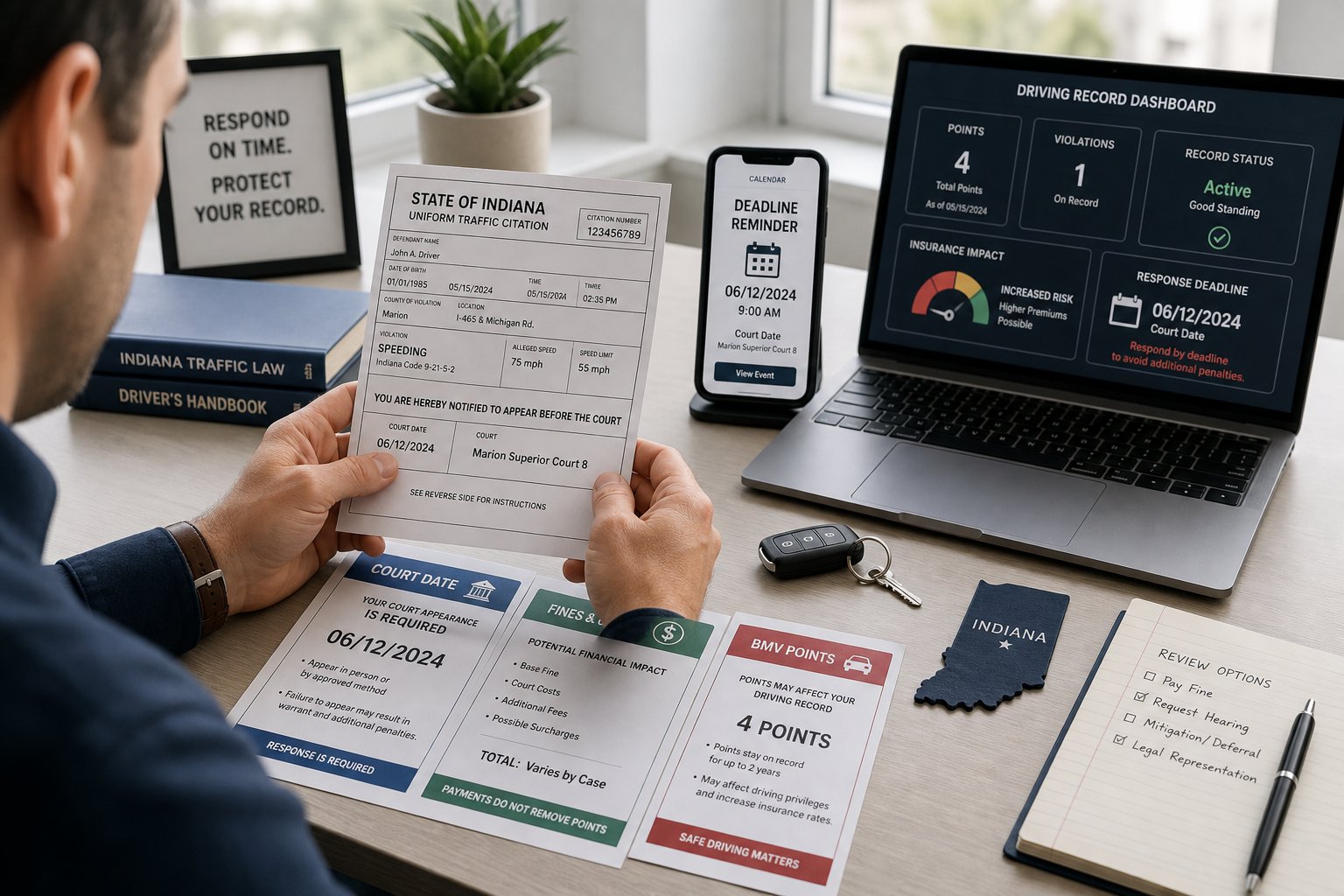
After you get an Indiana speeding ticket, the clock starts right away. Your citation usually shows the charge, the court, the deadline, and whether you must appear in court. Read both sides of the ticket if you have a paper copy.
Most speeding cases are handled as a Class C infraction. That means the case is not usually criminal by itself, but it can still cost you money and put BMV points on your driving record. If you simply pay the ticket when payment is allowed, that usually counts as admitting the violation.
The main risks are straightforward:
- Fines and court costs
- Demerit points on your Indiana driving record
- Possible insurance rate increases
- More serious action if you ignore the ticket
And you should not ignore deadlines. Indiana courts and the Indiana Bureau of Motor Vehicles can take missed responses seriously. Depending on the case, failure to respond can lead to added penalties and even license trouble.
If the officer wrote facts that go beyond routine speeding, the case may be treated more seriously. Under Indiana Code 9-21-8-52, reckless driving is based on the driver’s behavior, not one fixed speed threshold. In practice, very high speeds, unsafe passing, traffic conditions, or a crash can push the case beyond a simple speeding ticket.
A good first step is simple: check the deadline, the county, and whether the citation says payment is allowed or a court date is required.
How To Check Your Ticket Details And Court Requirements
Your ticket tells you what you need to do next. Look for the ticket number, case number, county, court name, offense, and any date tied to payment or appearance. If one detail looks unclear, do not guess.
Many Indiana courts use local online systems for citation lookup. If you cannot find the ticket or you lost it, start with the county where the stop happened. Then contact the clerk or court listed for that county. Some counties let you search by name, date of birth, or ticket number.
Use official sources when possible:
- The Indiana Judicial Branch case search tools
- Your county clerk or city court website
- Information from the Indiana BMV
Check for these points before you act:
- Is payment allowed?
- Is there a mandatory court appearance?
- What is the due date?
- Is the charge simple speeding, or something more serious?
This matters because two tickets can look similar but have very different rules. A routine speeding citation may be payable online. A higher-speed case, a missed court date, or a charge tied to unsafe driving may require you to appear.
If your notice from the Indiana BMV, the court, or the ticket itself gives instructions, follow those exact instructions. Requirements can depend on the BMV notice, court order, citation, driver record, license status, court, judge, and case facts.
When Payment Is Allowed Vs. When A Court Appearance Is Mandatory
If payment is allowed, you can usually resolve the ticket by paying the amount listed through the court. But payment is not just a money step. It usually works like a guilty plea, so the court reports the case and the Indiana BMV can assess demerit points.
That is why many drivers ask, how much is a speeding ticket in Indiana? The honest answer is that there is no single statewide price. The base fine and the court costs can differ by county, court, and charge level. Speed also matters. So does whether the case stays a basic infraction or turns into a more serious offense.
A court appearance is more likely when:
- The ticket says appearance required
- The charge is not payable by schedule
- The facts suggest reckless driving or another serious offense
- You already missed a deadline or hearing
Indiana does not set one fixed mph number that automatically makes every case reckless driving. The legal standard focuses on unsafe driving behavior under IC 9-21-8-52. Still, around 26 mph or more over can draw closer attention in practice, especially with bad road conditions, heavy traffic, or other risky conduct.
If you want to contest the ticket, do not pay it first. Paying usually closes that option. Instead, follow the court’s process for appearing or entering a not-guilty plea by the deadline.
Ways To Pay An Indiana Speeding Ticket
If your citation is payable, Indiana courts often let you pay in one of three common ways. The correct method depends on the court listed on the ticket, not on a single statewide payment portal for every case.
Online, By Mail, Or In Person
Online payment is often the fastest option. Many county and city courts let you search by ticket number, name, or date of birth. Start with the court named on the citation or with the Indiana courts case system if your local court uses it.
By mail is still accepted in many places. If you mail payment, use the exact address and instructions on the ticket or court notice. Include the correct identifying details so the court can apply the payment to the right case.
In person payment may be possible at the clerk’s office or court office listed on the citation. This can help if you need to confirm the balance or ask whether the case is payable.
A few key points matter here:
- The total may include fine plus court costs
- Local rules can change the payment process
- Missing the deadline can create bigger problems
Worksite camera Safe Zones tickets can follow a different process through INDOT, with payment methods listed on that notice rather than a standard court ticket.
Before you pay, confirm the amount from the official court source. Then save your receipt and case record for your files.
How Speeding Ticket Points Affect Your Indiana License And Insurance
Indiana uses a demerit point system, and speeding points depend on how far over the limit you were. Under the Indiana BMV schedule, the common speeding point levels are:
- 1 to 15 mph over: 2 points
- 16 to 25 mph over: 4 points
- 26+ mph over: 6 points
You can review the point schedule through the Indiana BMV and related state rules in the Indiana Administrative Code.
These demerit points matter because they can build up fast. In general, points stay active for two years from the date of the conviction for suspension purposes. If you reach 18 or more points within two years, the Indiana BMV can take action. That may include a warning, probation, a hearing, or suspension, depending on the record.
Insurance is a separate issue. The court does not set your premium, but a speeding conviction can still affect what you pay because insurers often review moving violations and point-related risk. A low-level ticket may have a smaller effect than a high-speed ticket, but there is no universal insurance result.
One more key point: a course does not erase the conviction. If you later complete a voluntary Driver Safety Program, it may earn a 4-point credit if you qualify, but it does not remove the underlying violation from your record.
When A Driver Safety Or Defensive Driving Course May Help
A driver safety course may help in Indiana when the court or the Indiana BMV allows or requires it. Indiana’s official option is the BMV-approved Driver Safety Program (DSP). It is generally a 4-hour course, and if you are eligible to take it voluntarily, it can give you a 4-point credit against your active point total.
That credit can help offset demerit points from a speeding conviction. But it is important to be precise: the DSP does not remove the ticket, does not erase the conviction, and does not guarantee any insurance change or court result.
Eligibility and requirements vary. They can depend on:
- A notice from the Indiana BMV
- A court order or judge’s direction
- Your driver record and recent violations
- Your license status
- The specific facts of your case
Indiana BMV information on the program is available through the Driver Safety Program page. In general, a voluntary DSP credit is available only at certain intervals, commonly once every three years when the state allows it.
If you need a flexible online option, you can review the Indiana Driver Safety Program at Driving Logic. It is built for busy drivers who want to complete a required course on their own schedule from any device.
This information is general only and is not legal advice.
FAQ
Can an Indiana speeding ticket add points?
Yes. Indiana speeding convictions can add BMV demerit points based on the violation and speed range. Check your citation and BMV record for the exact effect.
Can DSP help after a speeding ticket?
A BMV-approved DSP may provide a 4-point credit when eligible. It does not erase the ticket or conviction.
Should I pay my Indiana speeding ticket right away?
Read the ticket and court instructions first. Paying may resolve the case, but contesting or asking about court options is a separate legal decision.
Where do I check my Indiana driving record?
Use Indiana BMV or myBMV resources to review official record information. Keep copies of court, payment, and course records.
Conclusion
Indiana Speeding Ticket: Costs, Points, and What to Know is easier to handle when you know the Indiana BMV point rules, court deadline, and the limits of the Driver Safety Program. The DSP may provide a 4-point credit when eligible, but it does not erase the ticket, conviction, or violation. Review your citation or court notice before you act.
Take the Indiana Driver Safety Program course online when you are ready to begin.
Related Articles
- Indiana Speeding Ticket Fines: What Affects the Cost?
- When Does an Indiana Speeding Ticket Become Reckless Driving?
- 20 Over Speeding Ticket in Indiana: What to Know About Cost and Points
- Indiana Speeding Ticket: What to Know Before You Pay or Contest It
Sources
- Indiana BMV — Citation Points and Driver Safety Program
- Indiana BMV — Driver Record Points
- myBMV — Indiana BMV Online Services
- Indiana Code and Administrative Rules
Billy Forte is the owner of Driving Logic, a state-approved driver improvement course provider serving Indiana and other U.S. states. Driving Logic offers online driver safety and driver improvement courses for drivers handling BMV notices, court orders, and state requirements.
This article is general information, not legal advice. Indiana BMV rules, court orders, deadlines, provider reporting, insurance decisions, and case facts can differ. Use official Indiana BMV and court sources for current requirements, and consult a qualified Indiana attorney for legal guidance specific to your situation.