
Updated June 2026 · Reviewed by Billy Forte
A Missouri speeding ticket’s cost depends mainly on how far over the limit you were, whether it was charged under state or local law, and the county court costs added to the base fine. Check your ticket for the alleged speed and the charging authority, and note that at 26 mph or more over the limit the risk of a more serious charge rises. If the court or Fine Collections Center authorizes a Driver Improvement Program for your ticket, completing it may help with points, but it does not lower the fine itself.
This article covers Missouri requirements only.
Key Facts
- The final conviction controls point impact.
- Form 899 helps identify Missouri DOR point values.
- Payment can create a record and point consequence.
- DIP requires court or FCC authorization.
- Insurance effects are decided by the insurer, not the course provider.
How Much A Missouri Speeding Ticket Usually Costs
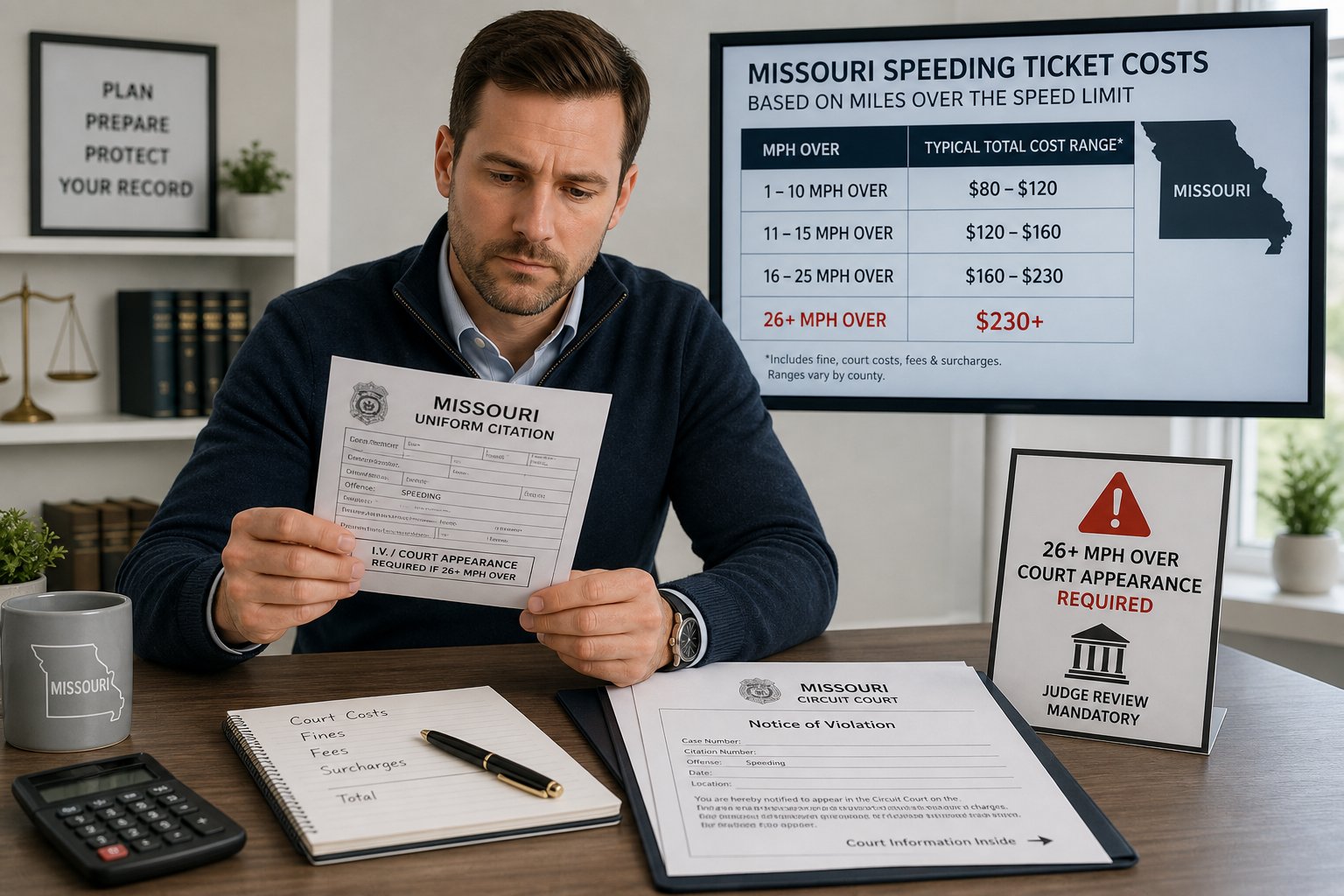
The short answer is that missouri speeding ticket cost depends first on how far over the limit you were going, but many drivers see totals in the $80 to $230+ range for basic speeding.
Here are the common ranges often seen in Missouri courts for a standard speeding ticket:
- 1–5 mph over: about $80–$120
- 6–10 mph over: about $90–$135
- 11–15 mph over: about $110–$150
- 16–19 mph over: about $150–$175
- 20–25 mph over: about $225–$230+
- 26+ mph over: often court appearance required and higher exposure
Those numbers usually include both the fine and at least some court-related charges. But they are not fixed statewide. Missouri does not use one single price chart for every city and county. Local courts often set their own schedules, and court costs can change the total a lot.
If you are asking how much is a 20 over speeding ticket in missouri, the practical answer is often around $225 to $230 or more before you even think about points, insurance, or legal help. And if the speed is high enough, the case may stop being a simple pay-and-move-on ticket.
That matters most at 26 mph over the limit. At that point, the risk of a more serious charge, such as careless and imprudent driving or even a reckless-driving-type issue, can go up depending on the facts and the court. Check the exact charge and amount on your ticket and the court notice tied to it.
What Changes The Final Price Of Your Ticket
The posted amount on the ticket is not always the full story. Speed, place, and case facts all change the final number.
The biggest factor is simple: how fast you were going. A few mph over usually means the lowest fine tier. A much higher speed can push the case into a more serious bracket. In some courts, very high speed means you cannot just prepay it.
Location matters too. A Missouri traffic ticket in one county can cost more than a similar ticket in another. That is because court costs vary, and local courts use different schedules. A ticket from a city or county court may look different from one tied to the state system or the Fine Collections Center (FCC).
Other common price changes include:
- School zones
- Construction or work zones
- Accidents or unsafe driving facts
- Prior violations on your record
- Mandatory court appearance rules
Some courts add zone-related increases. In many schedules, those add-ons are around $25, though exact rules vary. And if the facts suggest more than basic speeding, the charge could change to careless and imprudent driving, which can raise both risk and cost.
For case and record details, the Missouri Department of Revenue (DOR) keeps point and driver record information at Missouri DOR. For law text, Missouri statutes are available through Missouri Revised Statutes.
Points, Insurance Increases, And Other Hidden Costs
The fine is only the first cost. The bigger hit often comes from demerit points and higher insurance.
In Missouri, a speeding moving violation can add:
- 3 points for a speeding ticket from the Missouri State Highway Patrol
- 2 points for many municipal speeding cases
Those points matter because they sit on your driving record and can affect what the Missouri Department of Revenue (DOR) does next if more tickets stack up. A single ticket may not seem huge. But several moving violations in a short time can lead to suspension risk, reinstatement fees, and other trouble.
Insurance can cost even more than the ticket. One speeding ticket may raise rates by about 20% to 40%. For many drivers, that can mean roughly $300 to $500 more per year for several years. Over time, the real cost of a Missouri speeding ticket can climb well past $1,000.
This is why paying fast is not always the cheap option. The court amount may look manageable. Your insurer may see it very differently.
The hidden costs may include:
- Higher insurance premiums
- More risk if you get another ticket
- Possible license action after more points
- Reinstatement fees if your license is later suspended
- High-risk insurance in some cases
That long tail is what catches people off guard.
When Paying The Ticket Can Cost More Than You Expect
If your ticket is payable, sending payment usually means you plead guilty. That is the key fact many drivers miss.
Once you pay, the case may close fast. But the record effect can last much longer. Points can be reported, and your insurer may treat the ticket as a sign of higher risk. So the lowest upfront path can become the most costly one later.
For many drivers, the long-term cost of paying a ticket can include:
- The fine itself
- Court costs
- Point impact on your Missouri record
- Insurance increases for years
- Added risk if another moving violation happens soon
That is why a $120 or $230 ticket can turn into a $1,000 to $2,000 problem over time.
In some cases, drivers compare that with the cost of legal help. A Missouri traffic attorney may charge around $150 to $300+ in some routine cases, though fees vary. That is not always the right move, and outcomes are never guaranteed. Still, if avoiding points is possible through a lawful amendment or local practice, the long-term math may change.
If your speed was high, if the ticket involves a zone, or if you already have points, pause before paying. Read the ticket terms, the court instructions, and any deadline very carefully.
How To Pay Or Contest A Missouri Speeding Ticket
You usually have two paths: pay the ticket or contest the charge. The right option depends on whether the ticket is payable and what risk comes with it.
If the Missouri traffic ticket is marked payable, courts often allow payment:
- Online
- By mail
- By phone
- In person
Your ticket or court website should list the amount, due date, and payment rules. Follow the notice closely. Do not miss a deadline. Ignoring a ticket can lead to more fines, a possible warrant, or license trouble.
If you want to contest it, you usually must appear on the court date shown unless the court allows another process or an attorney appears for you. Some drivers fight the charge because of the facts. Others try to seek a reduction to a non-moving violation. That kind of result depends on the court, the prosecutor, the county, your record, and the case facts.
Possible outcomes may include:
- The original charge stands
- A lower fine
n- A different charge
- A non-moving amendment in some cases
- A dismissal in limited situations
For statutes and rules, start with Missouri Revised Statutes. For record and point questions, use Missouri DOR.
When Traffic School Or Driver Improvement May Help
A Driver Improvement Program, often called DIP, may help in some Missouri cases. But it is not automatic.
This point is critical: a DIP course only affects your case if the court or the Fine Collections Center (FCC) authorizes it, and rules can change by county and case type. You should never assume that taking a class by yourself will reduce points or change ticket status.
When approved, a DIP may help by:
- Supporting a court requirement
- Helping satisfy an FCC or court instruction
- Showing compliance in a pending case
- Sometimes helping with a requested outcome tied to local practice
That does not mean guaranteed point removal, dismissal, or dismissal-like results. Missouri courts control their own process. Some counties are stricter than others.
If you were going 20 over, 25 over, or more, the need for approval matters even more. At 26+ mph over, the case may carry a greater risk of a serious treatment, including concerns about careless and imprudent driving. Even then, DIP can still be worth asking about if the court or FCC allows it.
If you need an online course option, Driving Logic offers a Missouri DIP path built for busy drivers on any device. Before you enroll, confirm that your court or FCC has approved that step. You can review the course details at Driving Logic’s Missouri DIP page.
How To Choose The Best Next Step For Your Situation
The best next step depends on speed, points, and long-term cost. Start with the number that matters most: what happens after the fine.
If the ticket is for a low speed and you have a clean record, paying may seem easiest. But if points could affect your license or insurance, that fast choice may cost more later. This is especially true for younger drivers, CDL holders, and people who already pay high insurance rates.
Look at these factors:
- How many mph over the limit you were
- Whether it was a school or work zone
- Whether you already have demerit points
- Whether the ticket is marked payable or requires court
- Whether the court or FCC may allow a DIP
A simple way to compare options is this:
- Pay the ticket: lower upfront cost, possible higher long-term cost
- Contest or negotiate: more effort and maybe more upfront cost, but sometimes less record damage
- Ask about DIP authorization: may help if the court or FCC approves it
If your case involves 20+ mph over, prior violations, or zone facts, take extra care before you act. High-speed cases can carry more risk, and 26+ mph over is a key threshold where the case may get more serious.
This information is general only and not legal advice.
FAQ
Can the Missouri Driver Improvement Program erase my ticket?
No. The Missouri Driver Improvement Program does not erase a ticket or conviction by itself. It may help with points only when the court or Fine Collections Center authorizes it and the Missouri DOR accepts the completion.
Do I need court approval before taking DIP?
Usually, yes. For a ticket or point-related case, confirm authorization with the court or Fine Collections Center before enrolling, then note the completion deadline and where proof must be sent. Taking a course without authorization may not help your record.
Does Missouri use DMV or DOR for points?
Missouri uses the Department of Revenue, often called DOR, for driver records and points. Many people say DMV, but Missouri’s agency is DOR.
Where should I check my deadline?
Check your ticket, court notice, Fine Collections Center notice, or Missouri DOR correspondence for the completion deadline, appearance date, reporting destination, and whether DIP is authorized. Those documents control your next step.
Conclusion
A Missouri speeding ticket should be reviewed before payment because the record impact can last longer than the fine. Check the charge, points, deadline, and DIP authorization first. If DIP is authorized, complete it on time and save proof.
Related Articles
- Missouri Speeding Ticket: Costs, Points, and What to Know
- Missouri Speeding Ticket Options: Pay, Contest, or Request DIP
- How Does a Missouri Speeding Ticket Affect Your Car Insurance?
- Careless and Imprudent Driving in Missouri: What It Is and What It Means
Sources
- Missouri DOR — Tickets and Points FAQ
- Missouri DOR — Form 899, Driver Record Traffic Violation Descriptions and Points Assessed
- Missouri DOR — Driver License
- Missouri Revised Statutes § 304.010 — Speed Limits
- Missouri Revised Statutes § 304.012 — Careless and Imprudent Driving
Billy Forte is the owner of Driving Logic, a state-approved driver improvement course provider serving Missouri and other U.S. states. Driving Logic offers online driver improvement courses for drivers handling court, point, and state requirements.
This article is general information, not legal advice. Missouri DOR rules, court procedures, deadlines, insurance decisions, and case facts can differ. Use official Missouri DOR and court sources for current requirements, and consult a qualified Missouri attorney for legal guidance specific to your situation.