
Updated October 2026 · Reviewed by Billy Forte
A Missouri traffic violation background check can draw on two official sources: your Missouri Department of Revenue (DOR) driving record and the State Highway Patrol’s criminal history repository. The non-personal part of your driving record shows speeding tickets and other violations, while your personal details stay closed unless the requester is exempt under federal law or has your consent. Under state law, speeding and careless and imprudent driving are misdemeanors, and the Patrol’s files keep state misdemeanor charges.
Key Facts
- Driving record: shows tickets and other violations. See the DOR driving record.
- Personal details: closed unless the requester is exempt under the DPPA or has your consent. See who can see it.
- Criminal side: speeding and careless and imprudent driving are misdemeanors under state law. See is a ticket a crime.
- Patrol records: a name search shows only open records. See criminal history.
- The DIP: keeps points off one court-ordered ticket, but the conviction stays. See the DIP and checks.
Three Places a Ticket Can Appear
A traffic ticket can leave a trace in more than one place. Each one is kept by a different office, with different access rules.
| Record | Who keeps it | What it holds | Access limit |
|---|---|---|---|
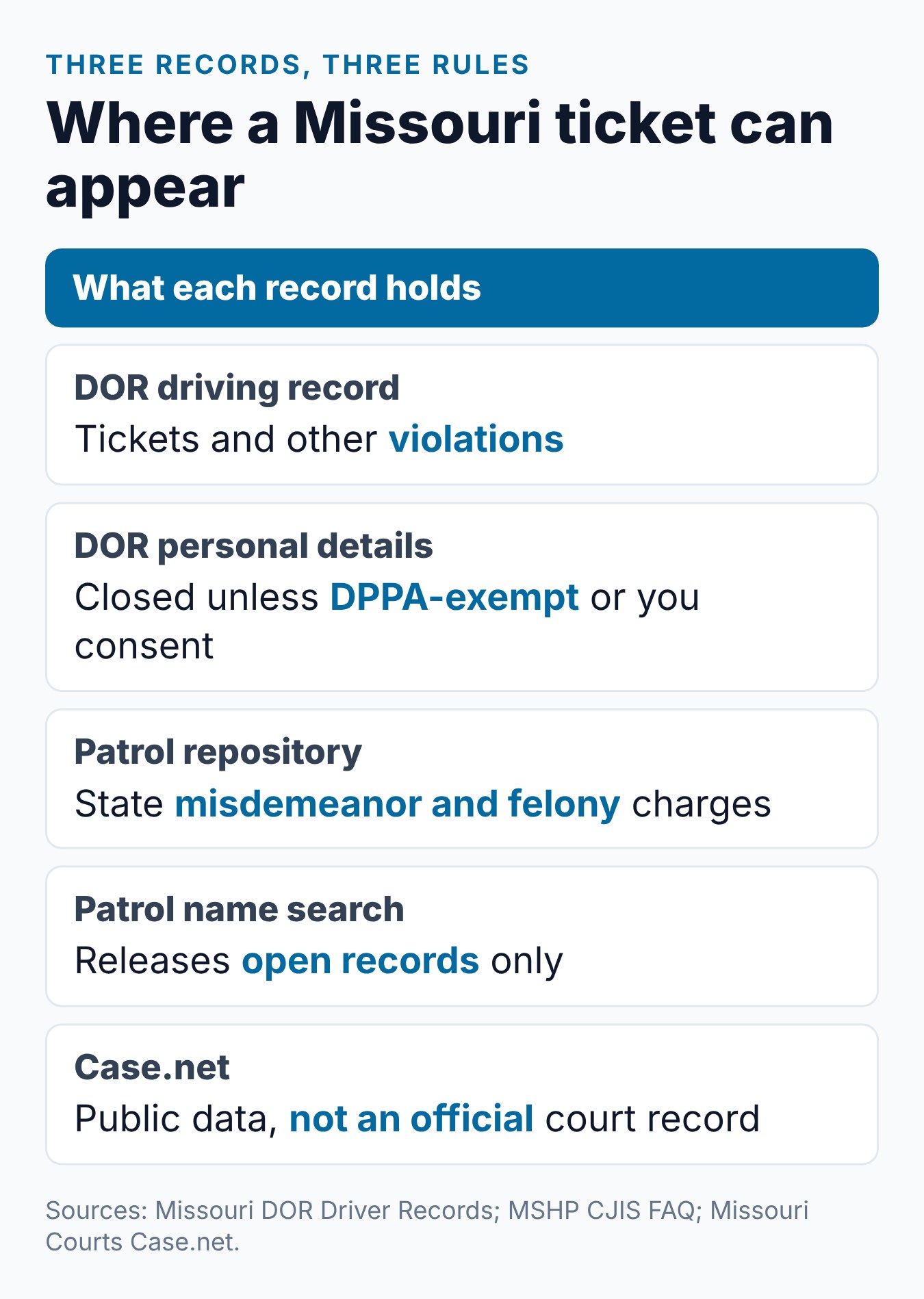
| Driving record | Missouri DOR | Driving history, such as speeding tickets and other violations | Personal details only under the DPPA or with your consent |
| Criminal history | Missouri State Highway Patrol | State misdemeanor and felony charges, plus selected city ordinance violations | A name search returns only open records |
| Court case data | Missouri courts, through Case.net | Public case information from courts on the statewide system | Not an official court record |
Which one a background check uses depends on who runs it and what it covers. The sections below explain each record.
The DOR Driving Record
The DOR keeps your driving record. Courts must send it convictions for moving violations “within seven days” under RSMo 302.225.
The DOR Driver Records page offers records with and without personal information. A copy without those details covers driving history only. The DOR names “speeding tickets” and other violations as examples.
Points follow convictions. Under RSMo 302.302, points are assessed “only after a conviction or forfeiture of collateral.” Speeding is 3 points under state law and 2 under a city or county ordinance.
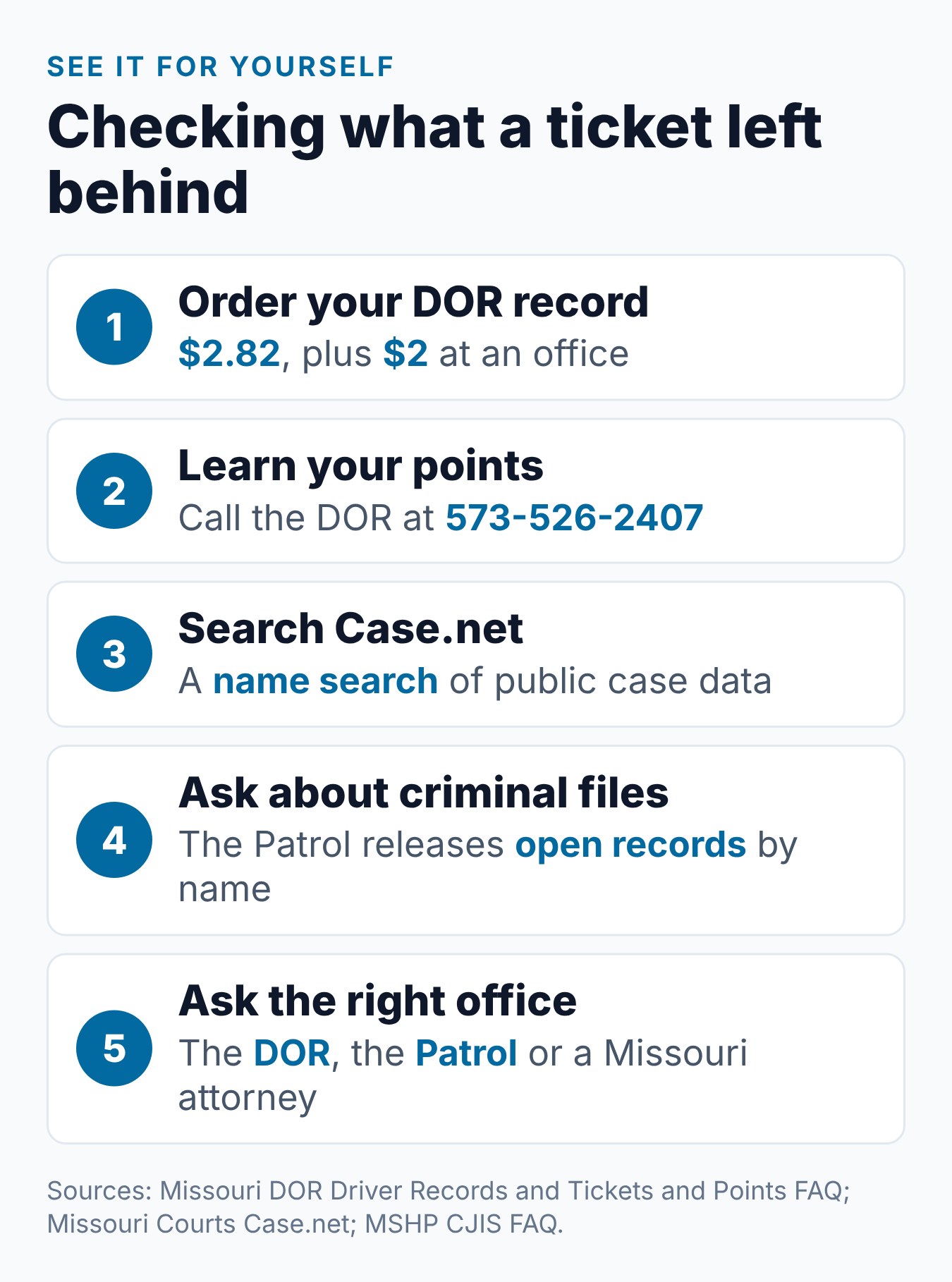
To see what your own record shows, order a copy for $2.82. Our guide to your Missouri driving record explains each way to order it.
Who Can See Your Personal Information
Your personal details on a DOR record are protected. Under the DOR rule, a requester must be “exempt under the federal Driver Privacy Protection Act (DPPA)” to see that part.
That leaves two ways for someone else to see that part of your record:
- A DPPA exemption. The requester must fit one of the federal exemptions.
- Your consent. You agree to the release.
Form 4681, the record holder’s request form, shows how consent works. To get another person’s record, you need their signature and a notary. The form says it “must be completed, signed and notarized or the request will be denied.”
Missouri Traffic Violation Background Check: Is a Ticket a Crime?
Under state law, speeding and careless and imprudent driving are both misdemeanors. That matters because a misdemeanor is a criminal charge, not just a points matter.
Speeding. RSMo 304.010 makes speeding a class C misdemeanor. At 20 mph or more over the limit, it is a class B misdemeanor.
Careless and imprudent driving. RSMo 304.012, titled “Motorists to exercise highest degree of care,” makes a violation a class B misdemeanor. It is a class A misdemeanor if an accident is involved.
The maximum penalties come from two other statutes:
- Class C: up to $750 under RSMo 558.002 and up to 15 days in jail under RSMo 558.011.
- Class B: up to $1,000 and up to 6 months.
- Class A: up to $2,000 and up to 1 year.
These are the highest amounts the law allows. The court on your ticket decides your case.
The Highway Patrol’s Criminal History Repository
The Missouri State Highway Patrol runs the state’s criminal history repository. Its CJIS FAQ says, “The Repository not only maintains state charges (misdemeanors and felonies), but also maintains selected ordinance violations reported by municipalities.”
Agencies must send some arrests to the Patrol. The FAQ says they must submit information on “all felony and aggravated misdemeanor arrests, including all alcohol and drug related traffic offenses.”
A public name search has a limit. The FAQ says, “Only open records will be released with a name search.”
The Patrol FAQ we read does not say whether every speeding or careless driving case is reported there. We did not confirm the reporting rules for those charges. If this matters for a job, ask the Patrol or a Missouri attorney about your own case.
City Tickets and the Criminal Side
Some tickets are written under a city or county ordinance, not state law. The Patrol keeps only “selected ordinance violations reported by municipalities,” so a city ticket may be handled differently from a state charge.
State law also sets apart a “minor traffic violation” in RSMo 479.350. It is a city or county ordinance case that meets all of these terms:
- No accident or injury.
- No commercial motor vehicle.
- Zero to 4 points.
- Not more than 19 mph over the limit.
- Not in a construction zone or school zone.
For these cases, RSMo 479.353 caps the fine plus court costs at $225. The points still go on your DOR record after a conviction: 2 for city or county speeding.
Court Case Information on Case.net
Missouri courts also post case data online. The Case.net page calls it “the Missouri Judiciary’s case information portal.”
Two limits apply. Case.net “will only return information open to the public,” and it “is not considered an official court record.” It also shows only courts on the statewide case system, so some city courts may not appear.
Paying a Ticket Is a Conviction
Paying a ticket ends the case with a conviction. Under Supreme Court Rule 38.10, full payment before the first court date “constitutes a guilty plea and waiver of trial.”
For a moving violation, that conviction then goes to the DOR and onto your driving record. Whether to pay, contest or ask about other options is a choice to discuss with the court or a Missouri attorney.
What the DIP Changes and What It Does Not
The Driver Improvement Program (DIP) changes points, not convictions. Under RSMo 302.302, the DOR accepts it “in lieu of the assessment of points” for one ticket, only when the court on that ticket orders and verifies it.
The Missouri Safety Center process sheet is blunt: the program “WILL NOT remove the ticket.” A driving record check can still find the conviction.
The DIP never applies to anyone who has or must have a commercial driver license (CDL). Federal law backs this up. Under 49 CFR 384.226, a state “must not mask” a CDL holder’s conviction, whatever vehicle was used.
Suspensions Show Up Too
A driving record shows more than tickets. The DOR reinstatement page says the reasons for a suspension “will be listed on your driver record under “Department Actions.””
Points can lead there. Under RSMo 302.304, 8 points in 18 months brings a suspension, and higher totals bring a revocation.
Driving while suspended adds its own trouble. It carries 12 points, and under RSMo 302.321 a first offense is a class D misdemeanor.
Tickets Written in Other States
If you hold a Missouri license, a ticket from elsewhere can land on your Missouri record. The DOR FAQ says its staff “will post the ticket to that person’s Missouri driver record.” The violation conviction code sets the points.
Insurance Companies and Your Record
Insurers also look at your driving record. The Missouri Department of Commerce and Insurance (DCI) tips page says, “Nothing affects your auto insurance rates more than your driving record.”
How Long a Ticket Can Show
On the DOR record, the timing follows DOR rules. Per the DOR FAQ, a ticket conviction may come off the record once three years have passed since the conviction.
Some convictions must stay listed permanently. Our guide on how long a ticket stays on your record covers each time frame.
Questions to Ask Before a Check
You can ask the person running a check a few plain questions. The answers tell you which record to look at first:
- Which record will you check: the DOR record, the Patrol files or court data?
- Will you ask for my personal details on the DOR record?
- Do you need my consent, and in what form?
- How far back does your check look?
Then order your own DOR record, so you know what it shows.
What We Found on the Official Pages
On the Missouri DOR and State Highway Patrol pages we checked on October 27, 2026, both named clear limits on access. The DOR Driver Records page tied personal details to the federal DPPA. The Patrol CJIS FAQ limited name searches to open records.
Neither page mentioned the Driver Improvement Program. Neither page said how an employer must use what it finds.
Common Mistakes
Each item is checked against a statute, court rule or official page:
- Calling a ticket “just a fine.” Under state law, speeding and careless and imprudent driving are misdemeanors.
- Thinking anyone can pull your personal details. The DPPA limits that part of the record.
- Thinking paying ends it quietly. Full payment before court is a guilty plea.
- Expecting the DIP to hide a ticket. The conviction stays on the record.
- Treating Case.net as the official record. The courts say it is not.
- Waiting for a ticket to vanish. The DOR says removal “may” happen 3 years after the conviction.
How Requirements Can Vary
Missouri’s point values, suspension levels and Driver Improvement Program rules come from Missouri law (RSMo 302.302 and 302.304) and apply statewide. Whether a court orders the DIP for your ticket, and how your case is handled, is up to the court on your ticket. Fines and court costs depend on the court and the charge.
Laws, forms and court practice can change. Check your ticket, any court order, the Missouri DOR website and the Missouri Revised Statutes before you enroll or pay.
Frequently Asked Questions
Will a speeding ticket show up on a job background check in Missouri?
It can, depending on which record the check uses. A non-personal DOR driving record shows speeding tickets. The Patrol’s files keep state misdemeanor charges, but the sources we checked do not say whether every speeding case is reported there.
Is a speeding ticket a misdemeanor in Missouri?
Under state law, yes. RSMo 304.010 makes speeding a class C misdemeanor, or class B at 20 mph or more over the limit.
Can an employer see my Missouri driving record?
An employer can see your personal details only with a DPPA exemption or your consent. A record without personal details shows driving history, such as speeding tickets.
What does a Highway Patrol name search show?
The Patrol FAQ says only open records are released with a name search.
Does the DIP remove a ticket from my record?
No. A court-ordered DIP keeps points off that one ticket. The conviction still shows on your driving record.
Does a city ticket count the same as a state ticket?
Not for points. City or county speeding is 2 points, and state-law speeding is 3. The Patrol keeps only selected city ordinance cases.
Does paying a Missouri ticket count as a conviction?
Yes. Under Rule 38.10, full payment before the first court date is a guilty plea and waiver of trial.
Conclusion
A Missouri traffic ticket can show on your DOR driving record, and state traffic charges are misdemeanors that the Patrol’s files may hold. Order your own record, check Case.net and ask the DOR, the Patrol or a Missouri attorney about your own case. If the court on your ticket has ordered the DIP and you qualify, take the Missouri Driver Improvement Program online.
Related Articles
- Missouri Driver License Points System Explained
- Your Missouri Driving Record: How to Get It and What It Shows
- How Long Does a Speeding Ticket Stay on Your Missouri Driving Record?
Sources
- Missouri DOR — Driving Records
- Missouri DOR — Form 4681, Request from Driver License Record Holder (PDF)
- Missouri DOR — License Reinstatement Requirements
- Missouri State Highway Patrol — CJIS FAQs
- Missouri Revised Statutes 302.304 — Points, suspension and revocation
- Missouri Revised Statutes 302.321 — Driving while revoked or suspended
- Missouri Revised Statutes 479.350 — Minor traffic violation definitions
- Missouri Revised Statutes 479.353 — Limits on fines and costs
- Missouri DCI — Tips on Lowering Premiums
- Missouri Revised Statutes 304.010 — Speed limits
- Missouri Revised Statutes 304.012 — Motorists to exercise highest degree of care
- Missouri Revised Statutes 558.002 — Fines for misdemeanors and felonies
- Missouri Revised Statutes 558.011 — Sentences of imprisonment
- Missouri Revised Statutes 302.302 — Point system
- Missouri Revised Statutes 302.225 — Courts to report convictions to the Department of Revenue
- Missouri DOR — Tickets and Points FAQs
- Missouri DOR — Form 899, Violation Descriptions and Points Assessed (PDF)
- Missouri Courts — Case.net
- Missouri Supreme Court Rule 38.10 — Circuit Violations Bureau
- Missouri Safety Center — Driver Improvement Program Process (PDF)
- 49 CFR § 384.226 — Prohibition on masking convictions
Billy Forte is the owner of Driving Logic, a driver improvement course provider serving Missouri and other U.S. states.
This article is general information, not legal advice. Driver Improvement Program rules, point values, fines and penalties depend on your ticket, court and case facts, and they can change. Use official Missouri DOR, Missouri Revised Statutes and court sources, and consult a qualified Missouri attorney for advice about your own case.