
Updated June 2026 · Reviewed by Billy Forte
The penalties for reckless driving in Tennessee can include a Class B misdemeanor, possible jail time, fines, court costs, and 6 demerit points, and a driving course may help only if the court orders it or accepts it as part of your case. Under Tennessee Code Annotated § 55-10-205, reckless driving means driving with willful or wanton disregard for the safety of people or property, which is more serious than a standard Tennessee traffic ticket. Tennessee drivers should also know that 6 points can move you close to the 12-point level that may trigger action by the Tennessee Department of Safety and Homeland Security, and any online defensive driving course should be cleared with your court first because acceptance rules vary by judge and county.
This article covers Tennessee requirements only.
Key Facts
- Reckless-driving standard: Tennessee law focuses on willful or wanton disregard for safety.
- No fixed mph rule: A high speed can matter, but the statute does not set one automatic threshold.
- Criminal risk: Reckless driving can be treated differently from a standard speeding ticket.
- Course role: A driver education course may help only if the court accepts or orders it.
- No guarantee: The course does not erase charges, convictions, points, or court requirements.
#
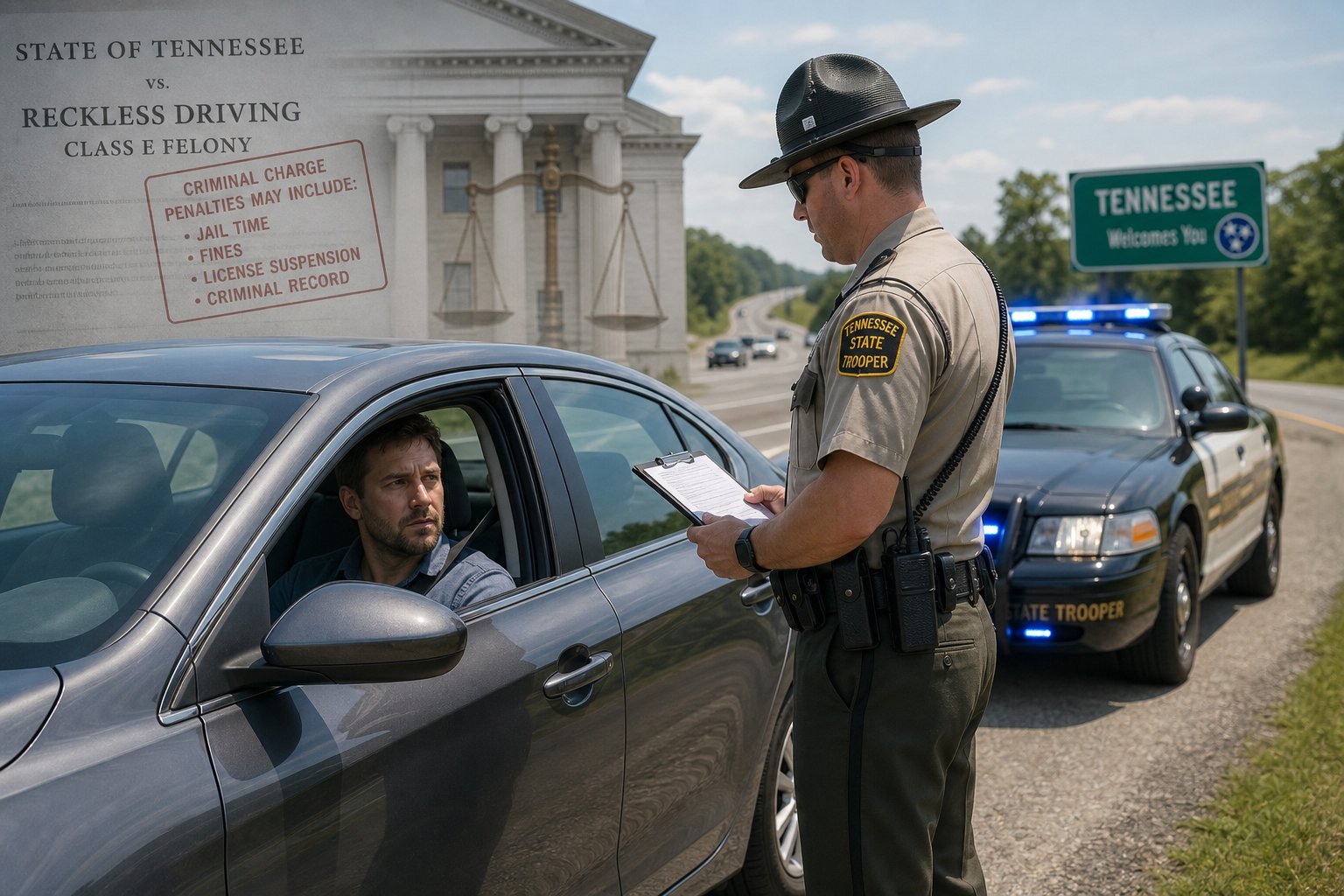
Reckless driving in Tennessee is a criminal charge. That is the key point. Under TCA reckless driving law, the state says a person commits the offense by driving with willful or wanton disregard for the safety of persons or property.
That wording matters. It means the state must claim more than a simple mistake. In plain terms, the officer or prosecutor is saying your driving showed a serious lack of care and created danger.
Under Tennessee Code Annotated § 55-10-205, the focus is not only on speed. It is also about how you drove and whether the conduct looked deliberate, extreme, or plainly unsafe.
A lot of drivers think all moving violations work the same way. They do not. A normal speeding ticket is usually a traffic infraction. Reckless driving Tennessee cases are different because they can carry criminal penalties. That can affect your record in ways a basic speeding citation may not.
You may also see the charge after an officer believes your actions put others at risk, even if no crash happened. So, the state does not need broken property or injuries in every case to file the charge.
If your citation says reckless driving, read it carefully. Then check your court date with the Tennessee court system or the Clerk of Court listed on the ticket.
#
Speeding and reckless driving are not the same thing. Speeding usually means you drove over the posted limit. Reckless driving means the state believes your driving crossed into dangerous conduct.
That line can get blurry in real life. A driver going a little over the limit may get a speeding ticket. But a driver going far over the limit while weaving through traffic, tailgating, or ignoring road conditions may face a reckless driving charge instead.
The difference often comes down to two things:
- The facts of the driving
- The level of danger
- The officer’s view of your intent or disregard
For example, speeding on an open road in clear weather may be charged one way. The same speed in heavy traffic, rain, or near a school zone may be treated much more seriously.
And there is another big difference. A speeding ticket is usually not a crime. Reckless driving is generally charged as a Class B misdemeanor in Tennessee. That means the case may involve criminal court issues, not just a fine.
This is why you should not assume a reckless driving ticket can be handled like an ordinary citation. If you are not sure what your ticket means, look at the exact charge listed and confirm your court duty before you decide what to do next.
#
Police often charge reckless driving when the conduct looks dangerous, not just fast. In Tennessee, the facts around the stop usually shape the charge.
Common situations include:
- Excessive speeding
- Rapid lane changes in traffic
- Following too closely at high speed
- Driving too fast for rain, fog, or other conditions
- Passing in an unsafe way
- Running through traffic in a way that creates obvious risk
Not every one of these actions will always lead to a reckless driving charge. Still, they are the kinds of facts officers often describe in reports.
Road conditions matter too. A speed that seems manageable on a dry, empty road may look reckless during a storm or in stop-and-go traffic. That is because Tennessee law focuses on safety and danger, not just the number on the speedometer.
In some cases, drivers are surprised by the charge because there was no crash. But an officer does not need a wreck to believe your driving put people or property at risk.
If you want to understand why your Tennessee traffic ticket was written this way, get a copy of the citation and, if possible, the police report. Those details usually explain what conduct led the officer to call it reckless rather than simple speeding.
#
A reckless driving conviction in Tennessee can carry both court penalties and driving record consequences. For a first offense with no injury, it is generally treated as a Class B misdemeanor.
That can mean:
- Possible jail time
- Fines
- Court costs
- A criminal conviction
- 6 demerit points on your driving record
Those 6 points matter a lot. Tennessee drivers can face license action if they build up too many points. Since 12 points can put you near suspension trouble with the Tennessee Department of Safety and Homeland Security, one reckless driving conviction alone can move you halfway there.
You can review driver services information through the TDOSHS. The agency handles many license and record matters for Tennessee drivers.
There may also be insurance effects, employer concerns, or added trouble for drivers who already have past tickets. But the exact result depends on your record, your court, and the final outcome of the case.
Can a defensive driving course help? Maybe, but never assume it will. Some courts may order a 4-hour Tennessee defensive driving course for ticket diversion. In other situations, an 8-hour TDOSHS-approved course may be used for drivers near suspension. Still, whether a course helps with dismissal, points, or sentencing depends fully on the court and judge.
#
The state must prove more than the fact that you were driving. In a Tennessee reckless driving case, the prosecution generally must show two main things: that you operated a motor vehicle and that you did so with willful or wanton disregard for safety.
That second part is the hard part. It is not enough for the state to suggest you made a small error. The case usually turns on whether your conduct looked seriously unsafe and whether the proof supports that claim.
Evidence may include:
- The officer’s testimony
- Radar or pacing evidence
- Dash cam or body cam video
- Witness statements
- Road and weather conditions
- Your own statements during the stop
Sometimes the whole case depends on how clearly the facts show danger. If the proof is weak, unclear, or incomplete, that can matter a lot.
Still, you should not try to guess how a judge will view the evidence. Reckless driving is a criminal matter, so it is often smart to speak with a Tennessee traffic attorney, especially if the charge could affect your job, license, or insurance.
If you need records for your case, ask the Clerk of Court about hearing dates, filing rules, and how to get available documents.
#
Some reckless driving charges are challenged because the facts do not clearly show reckless conduct. That does not mean results are automatic. It means the exact details matter.
Common defense themes may include:
- The driving was careless, but not reckless
- The officer’s account was incomplete or mistaken
- Video does not match the report
- The stop itself may be disputed
- The road, traffic, or speed facts were different than claimed
In some cases, a prosecutor or court may agree to reduce a charge to a lesser traffic offense. But that depends on the county, the court, the judge, the prosecutor, and the evidence. You should never expect a reduction.
The same caution applies to driving school. A Tennessee defensive driving course can sometimes be useful as mitigation. It may also be required by the court. But it does not does not guarantee dismissal, lower points, or a reduced charge.
And if you want to take an online course, confirm first that your specific court will accept online completion. Rules can differ across Tennessee courts.
Because this is a criminal charge, talking with a lawyer is often the safest step when you want advice on defenses or possible case outcomes.
#
Do not treat a reckless driving citation like a minor ticket. In Tennessee, paying a ticket can sometimes act like a guilty plea, so read the citation closely and follow every deadline and court instruction.
A practical first step list looks like this:
- Check the exact charge on the ticket
- Look for the court date and appearance requirement
- Contact the Clerk of Court if anything is unclear
- Get a copy of the police report if available
- Consider speaking with a Tennessee traffic attorney
- Ask the court whether a driving course is required or allowed
If the court mentions a course, ask which one fits your case. In Tennessee, that may be a 4-hour course often used for court matters or an 8-hour TDOSHS-approved course for drivers dealing with point or suspension concerns. But again, acceptance is up to the court or agency involved.
If you need a flexible option, Driving Logic’s Tennessee defensive driving course is built for busy drivers who want to complete requirements online on their own schedule. Before you enroll, confirm with your court that an online course will satisfy your specific order or case.
That last step matters as much as the course itself.
*This information is general education only and is
FAQ
Can a Tennessee driver education course dismiss my ticket?
Only if your court allows that result. Tennessee courts and local instructions control whether a course affects a ticket, points, or court requirement.
Can I take the course online?
Maybe. Some Tennessee courts accept online courses, while others may require a specific format, so confirm with the court before enrolling.
Does the course remove points from my record?
Do not assume it removes points automatically. Any point or ticket benefit depends on the court, TDOSHS rules, and the facts of your case.
What should I check before enrolling?
Check your ticket, court notice, clerk instructions, deadline, and whether online completion is accepted. Then choose a course that matches those requirements.
Conclusion
Reckless driving in Tennessee is a Class B misdemeanor under TCA § 55-10-205, carrying points, possible jail exposure, and a criminal record. Because it is a criminal charge, read your court paperwork carefully and consider speaking with a Tennessee attorney. Defensive driving may be part of a resolution only if the court allows it.
Take the Tennessee driver education course online with Driving Logic when you are ready to begin.
Related Articles
- Tennessee Speeding Ticket: Costs, Points, and What to Know
- Tennessee Reckless Driving vs. Speeding Ticket: Key Differences
- Tennessee Speeding Ticket Fines: What Affects the Cost?
- Tennessee First-Time Speeding Ticket: What to Expect
Sources
- Tennessee Department of Safety and Homeland Security — Defensive Driving Schools
- Tennessee Department of Safety and Homeland Security — Driver Improvement / Traffic School
- Tennessee Code Annotated — Reckless Driving, TCA § 55-10-205
- Tennessee Department of Safety and Homeland Security
Billy Forte is the owner of Driving Logic, a state-approved driver improvement course provider serving Tennessee and other U.S. states. Driving Logic offers online driver education, defensive driving, and traffic school courses for drivers handling court, ticket, insurance, and state requirements.
This article is general information, not legal advice. Tennessee court rules, TDOSHS requirements, deadlines, insurance decisions, and case facts can differ. Use official Tennessee court and state sources for current requirements, and consult a qualified Tennessee attorney for legal guidance specific to your situation.