
Updated June 2026 · Reviewed by Billy Forte
A Tennessee defensive driving course is a state-approved class for drivers who are told by a court or the Tennessee Department of Safety and Homeland Security to complete it, or who choose it for an insurance discount. Tennessee usually uses two course lengths: a 4-hour course that some courts allow for ticket diversion and an 8-hour TDOSHS-approved course for some drivers who are close to suspension from points. Whether a course can help dismiss a ticket, reduce points, or be taken online depends on your exact court, case, and order, so you must check with the Clerk of Court or TDOSHS before you enroll.
This article covers Tennessee requirements only.
Key Facts
- Course purpose: Tennessee defensive driving may be used for court, TDOSHS, ticket, point, or insurance-related needs when accepted.
- Course length: Tennessee drivers may see 4-hour or 8-hour requirements depending on the court or TDOSHS notice.
- Approval matters: Follow the specific court order, TDOSHS notice, or provider approval instructions before enrolling.
- Online option: Online completion may be available, but court acceptance can depend on the specific court or order.
- Certificate: Keep your completion certificate and submit it to the office named in your paperwork.
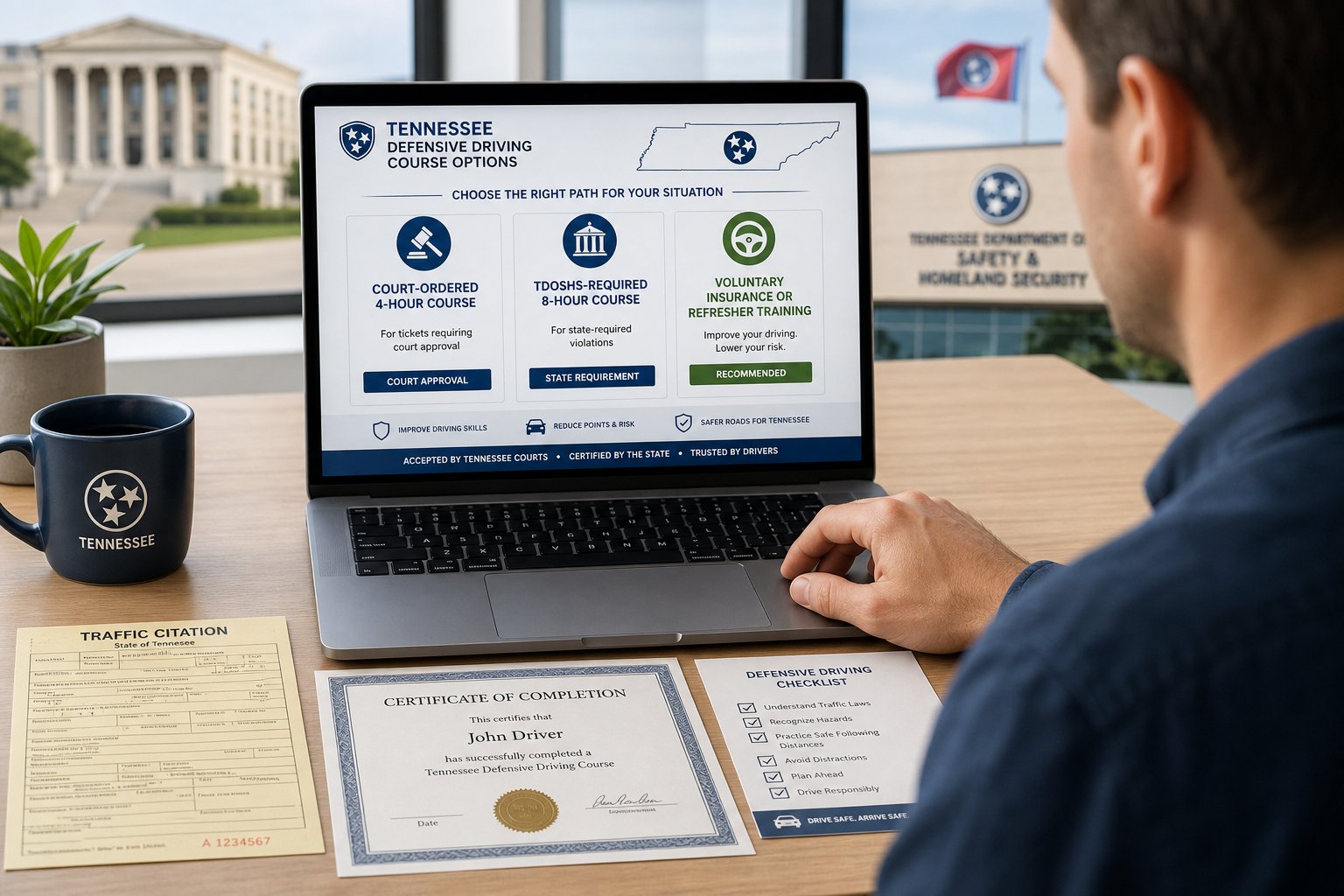
Who May Need A Defensive Driving Course In Tennessee
You may need a defensive driving course TN for three main reasons: a court tells you to take one, TDOSHS requires one, or you want one for insurance or a refresher. The reason matters because it affects the course length, the provider you can use, and where you send your completion certificate.
If your case starts in court, a judge may let you take a 4-hour course instead of moving straight to a conviction. But that is never automatic. Some courts allow it only for certain moving violations, first-time issues, or drivers with a clean recent record.
If your case comes from the Tennessee Department of Safety and Homeland Security, the process is different. TDOSHS may require an 8-hour defensive driving course as part of a driver improvement action when you are near the state point limit that can lead to suspension. In that setting, the course is tied to a state process, not just a local court option.
Some drivers also take a tennessee defensive driving course on their own. That can make sense if:
- Your insurer offers a discount for approved driver safety training
- You want a refresher after a ticket or crash
- You have a teen driver in the family and want better hazard awareness
- You want to improve basic traffic safety habits
Still, voluntary use is not the same as court approval. A course you take on your own will not change a ticket unless the court says it will.
When It Is Court-Ordered, State-Required, Or Recommended
A court-ordered course usually starts with your citation and court date. In many Tennessee courts, traffic school is offered only if the judge approves it in your case. Some courts may allow a ticket dismissal, some may reduce points, and some may simply require the class as one part of a larger order.
That is why you should confirm four things before signing up:
- Whether your court accepts a defensive driving course
- Whether the court accepts online completion
- Whether the court requires a 4-hour or another format
- How and when to file your certificate with the Clerk of Court
State-required courses are different. TDOSHS may send a notice when your driving record reaches a level that puts your license at risk. In those cases, the state may require an 8-hour TDOSHS-approved class as an alternative tied to driver improvement rules. You can review state information through the Tennessee Department of Safety and Homeland Security.
A course may also be recommended, but not required. That often comes up for insurance savings or skill review. If insurance is your goal, ask your company first whether it honors the course you plan to take.
How An Online Tennessee Defensive Driving Course Works
An online Tennessee course is usually built for drivers who need flexibility. You register, complete the lessons on your phone or computer, and finish within the allowed time. That is often easier than sitting in a classroom for half a day or more.
The first step is approval. Before you enroll, make sure the course fits your reason for taking it. If your case is in court, ask the Clerk of Court whether the judge accepts that provider and whether online completion is allowed. Many Tennessee courts vary on this point, so do not assume one county handles it like another.
After that, the process is simple:
- Create an account
- Choose the correct Tennessee course length
- Work through each lesson at your own pace
- Complete any quizzes or final exam if required
- Download or print your completion certificate
- Submit it to the court or TDOSHS as instructed
Good online courses save your place if you need breaks. That matters if you are fitting the class around work, school, or family time. Driving Logic, for example, focuses on mobile access and flexible pacing so you can finish in smaller blocks instead of all at once.
Still, fast does not mean careless. You need to follow the exact instructions in your notice or court order. Some courts want you to bring the certificate in person. Others may require upload, mail, or filing before a hearing date. If your course is for a TDOSHS matter, follow the state instructions in your referral paperwork.
If you need to check broader court information, start with the Tennessee court system.
What The Course Usually Covers
A Tennessee defensive driving course usually covers the habits and rules that help prevent crashes. The goal is simple: lower risk by helping you spot trouble early and make safer choices.
Most courses start with core traffic safety topics. These often include Tennessee traffic laws, road signs, lane use, right-of-way rules, and the everyday mistakes that lead to tickets and crashes. You may also cover how speed, space, and attention affect stopping distance and reaction time.
Many state-approved or court-accepted programs also teach common high-risk behaviors, such as:
- Speeding
- Distracted driving
- Following too closely
- Improper turns
- Left-of-center driving
- Right-of-way violations
The course may also cover how your body and mood affect driving. Fatigue, stress, anger, and alcohol or drug use can all reduce judgment. Even simple things, like rushing or using a phone at a red light, can grow into bigger risks fast.
Vehicle safety is another common part of the class. That may include seat belts, airbags, anti-lock brakes, tire condition, mirror use, and basic pre-trip checks. In short, the course is not just about tickets. It is about avoiding the chain of small mistakes that often comes before a crash.
Tennessee laws and driver duties are grounded in state law, and you can look up statutes in the Tennessee Code Annotated. For a driver, though, the real value is practical: better choices behind the wheel.
From Collision Prevention To Sharing The Road
Collision prevention is the heart of the course. You learn how to scan ahead, leave space, and react early instead of hard braking at the last second. Those small habits often matter more than raw driving skill.
Most courses teach space management in clear steps. Keep a safe following distance. Check mirrors often. Watch cross traffic at lights and side streets. Slow down sooner in rain, fog, or heavy traffic.
Sharing the road is another major topic. Tennessee drivers must adjust around many road users, not just cars. A course may review how to drive safely near:
- Large trucks and buses
- Motorcycles
- School buses
- Emergency vehicles under Move Over rules
- Cyclists and pedestrians
- Farm or slow-moving vehicles
- Work zones and railroad crossings
This part of the class tends to be very practical. For example, blind spots near trucks are much larger than many drivers think. And a stopped school bus is not just an inconvenience: it creates a high-risk zone where children may enter the road fast.
The same idea applies in bad weather. A wet road, low light, or glare can turn a normal drive into a hazard. Defensive driving teaches you to adjust early, not after the car starts sliding.
Common Questions About Eligibility, Exams, And Driving Record Impact
Eligibility depends on why you are taking the course and who is requiring it. A court may limit traffic school based on the type of citation, your recent history, or local policy. Some courts do not allow it for CDL holders, and some may only allow it once within a set period.
The biggest mistake drivers make is assuming all courts accept the same course. They do not. If you want to use an online provider, ask your specific court first. In Tennessee, online acceptance varies by court, so confirm before you spend time or money.
Exams also vary. Some courses include short quizzes after each unit. Others include a final exam. The provider should explain that before you start. If the course is state-approved or court-accepted, follow the rules exactly and finish every required part.
What happens to your driving record depends on the reason for the class:
- Court case: the court may dismiss the ticket, reduce points, or require the course without either result
- TDOSHS referral: the state may allow the course as part of a driver improvement process near suspension
- Voluntary course: it may help with an insurance discount, but only if your insurer accepts it
And one key point matters here: a class does not guarantee a clean record. Court outcomes depend on the specific Tennessee court and your case. TDOSHS outcomes depend on the state process and your notice.
If you need a course provider built for busy schedules, you can review the Tennessee defensive driving course at Driving Logic. Check with your court or TDOSHS first, then enroll in the course length they require.
Before You Enroll, Check These Items
Before you choose a Tennessee defensive driving course, match the course to the reason you need it. A court ticket program, a TDOSHS driver-improvement requirement, and an insurance-discount request can each have different rules.
Check these items before you pay:
- The course length listed in your paperwork
- Whether the court or TDOSHS accepts online completion
- The deadline to finish the course
- Where the certificate must be sent
- Whether the course affects points, a ticket, or only an insurance request
This step helps prevent the most common mistake: completing a real course that does not match the requirement in your notice.
FAQ
Can I take a Tennessee defensive driving course online?
Sometimes. Online acceptance depends on the court, TDOSHS notice, insurer, or program that requires the course. Check your paperwork before enrolling.
Does the course remove a ticket from my record?
Not automatically. Court or TDOSHS outcomes depend on the reason you take the course, your paperwork, and whether the course is accepted for that use.
Do I need a 4-hour or 8-hour course?
Your court order or TDOSHS notice should tell you the required course length. Do not assume a 4-hour and 8-hour course are interchangeable.
Conclusion
The right Tennessee defensive driving course is the one that matches why you need it — a court diversion, a TDOSHS driver-improvement requirement, or an insurance discount. Each path sets its own course length, deadline, and certificate destination, so read your order or notice before enrolling. When the requirement is clear, the course itself is the easy part.
Take the defensive driving course tn online when you are ready to begin.
Related Articles
- Tennessee 4-Hour vs. 8-Hour Defensive Driving Course: Which One Do You Need?
- How to Take the Tennessee Defensive Driving Course Online
- Tennessee State-Approved Defensive Driving Course: What It Means and How to Verify
- Tennessee Defensive Driving Course Cost: What to Expect
Sources
- TDOSHS — Defensive Driving Schools
- TDOSHS — Driver Improvement / Traffic School
- DrivingLogic Course Page
Billy Forte is the owner of Driving Logic, a state-approved driver improvement course provider serving Tennessee and other U.S. states. Driving Logic offers online driver education, defensive driving, and traffic school courses for drivers handling court, state, and insurance-related requirements.
This article is general information, not legal advice. Tennessee court rules, TDOSHS requirements, deadlines, insurance decisions, and case facts can differ. Use official Tennessee court and state sources for current requirements, and consult a qualified Tennessee attorney for legal guidance specific to your situation.