
Updated June 2026 · Reviewed by Billy Forte
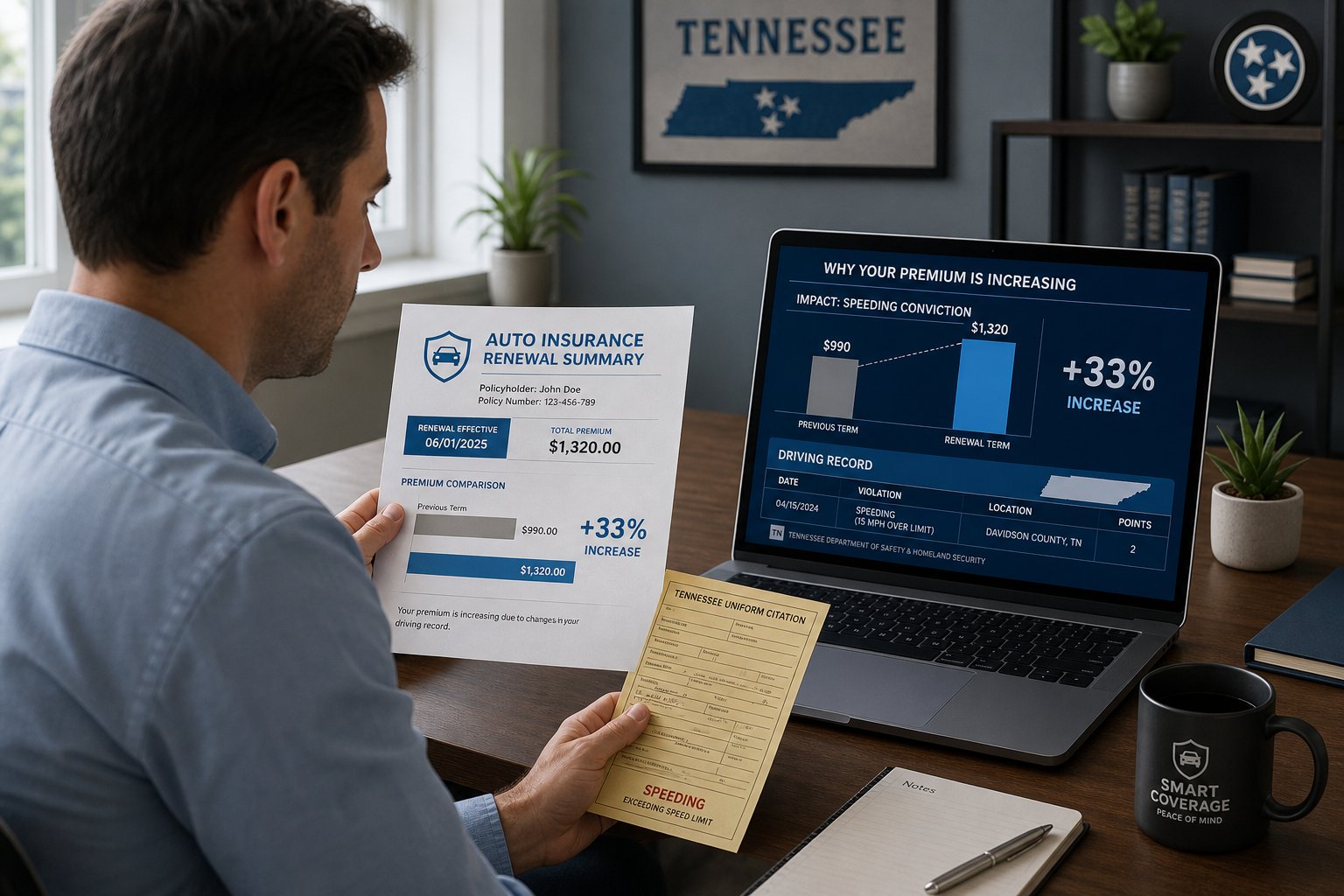
A Tennessee speeding ticket often raises your car insurance by about 30% to 40%, but the exact increase depends on your insurer, your speed, and your driving record. Many insurers do not change your rate right away, but the ticket can affect your premium at your next renewal after the conviction is reported. In Tennessee, a speeding conviction can stay on your driving record for 2 years, and serious or repeat violations can lead to much larger increases.
This article covers Tennessee requirements only.
Key Facts
- Insurance varies: Each insurer decides how a Tennessee speeding ticket affects rates.
- Convictions matter: A conviction on your record can be visible to insurers.
- Severity matters: Higher speeds and repeat violations can carry more risk.
- Course role: Driving school may help only if the court allows a resolution that avoids or limits the conviction.
- Confirm first: Ask your court and insurer before relying on a course for insurance impact.
If your court allows online completion, review the Tennessee driver education course before your deadline.
#
A Tennessee traffic ticket for speeding can raise your insurance because insurers see it as a sign of higher risk. In many cases, the increase shows up when your policy renews, not in the middle of your term. A common estimate for a speeding ticket insurance increase in Tennessee is around 30% to 40%, though some drivers may see less and others much more.
What matters most is the conviction, not just the stop. If you pay the ticket, that usually counts as a guilty plea. Once the conviction is reported, your insurer may review it during renewal.
Tennessee speeding convictions are commonly reported through the state driving record system. The Tennessee Department of Safety and Homeland Security (TDOSHS) keeps those records, and insurers use them when they price policies. You can review Tennessee driver services through TDOSHS.
For many drivers, the ticket stays relevant in two ways:
- It can remain on a Tennessee driving record for 2 years
- It can affect insurance pricing for a longer period under an insurer’s rules
- It can combine with older violations and make the rate jump worse
That is why one ticket can feel small in court but expensive at renewal. If the case is handled through a court-approved driving school option, when available, that may help protect your rates. But courts differ, and you should always confirm the result with the court and your insurer before assuming anything.
#
The size of your rate increase depends on several facts, not one fixed Tennessee rule. Two drivers can get similar speeding tickets and still get very different premiums.
Insurers often look at:
- How fast you were going over the limit
- Your past driving history
- Your age and years of driving experience
- How many recent claims or tickets you have
- The company’s own pricing and underwriting rules
A lower-speed violation may bring a smaller jump than a very high-speed case. If the ticket involves facts close to reckless driving, the increase can be much steeper. In Tennessee, reckless driving can be treated far more seriously than a basic speeding offense.
Your record matters a lot too. If this is your first ticket in years, your insurer may be more forgiving. If you already have moving violations, an at-fault crash, or prior points, the company may place you in a higher-risk tier.
Insurance companies also do not all react the same way. One carrier may raise your premium sharply, while another may stay more moderate. That is why it is smart to ask your insurer how a Tennessee speeding conviction is treated under your policy. Ask whether the company reviews only convictions, how long it surcharges for them, and whether any safe-driver discount will be lost.
#
A Tennessee speeding ticket can cost more than the fine. It can bring court costs, demerit points, and added insurance expense. The exact fine can vary by court and county, so you should check your citation and the Clerk of Court for the amount due.
Tennessee uses a point system for moving violations. The state tracks those points through TDOSHS, and too many points can lead to license action. You can review the state rules in the Tennessee Code Annotated and court information through the Tennessee court system.
Repeat violations usually make everything worse:
- More points can build up fast
- Insurance rates can rise more after each new ticket
- You may lose access to better pricing tiers
- Serious cases can trigger court dates or stronger penalties
Some speeding cases can become much more serious under TCA depending on the facts. If the conduct supports a reckless driving charge, the offense may be treated as a Class B misdemeanor instead of a routine traffic matter. That can have a much bigger effect on insurance than a standard speeding citation.
So, even if the base fine looks manageable, the real cost may be the long tail: points, record impact, and higher premiums over time.
#
After a Tennessee speeding ticket, you generally have a few paths. The right one depends on what the citation says, what the court allows, and whether you must appear.
Common options include:
- Pay the fine, which often means pleading guilty
- Go to court and contest the ticket
- Ask the court whether traffic school or defensive driving is available
- Speak with a lawyer if the charge is serious or you have prior violations
Do not ignore the ticket, a court date, or any order on the citation. Missing a deadline can make the problem worse.
If the court offers a diversion or school option, ask for the details in writing if possible. In some Tennessee courts, a 4-hour course may be used for ticket diversion. In other settings, an 8-hour TDOSHS-approved course may be used when a driver is near suspension. These are not the same thing, and the result depends on the court and your case.
Also, do not assume an online course will be accepted. Some courts accept online completion, while others may have different rules. Always confirm with your specific court before taking an online course.
If the ticket is tied to very high speed, repeat conduct, or facts close to reckless driving, it is often worth getting legal help before you choose a plea.
#
You may not be able to erase the impact of a ticket, but you can often reduce the damage. The best first step is to keep a clean record after the citation.
Insurers usually care about patterns. One old ticket may hurt less over time, but a second ticket can push rates much higher. That is why avoiding another violation matters so much.
You can also try practical cost cuts:
- Compare quotes from other insurers at renewal
- Ask about lost and available discounts
- Review whether your deductibles still fit your budget
- Bundle policies if that lowers the total cost
- Keep continuous coverage without gaps
It also helps to ask direct questions. Call your insurer and ask whether the conviction changes your tier, removes a safe-driver discount, or affects future renewals.
If you need a court-approved or state-required course, Driving Logic offers Tennessee options built for busy drivers. The courses are mobile-friendly, flexible, and designed to help you finish fast. You can review the available Tennessee defensive driving course at Driving Logic.
Even then, remember this key point: insurance discounts and rating treatment depend on the insurer and your driving history. Confirm any possible savings with your insurance company before you count on them.
##
A traffic school or defensive driving course may help in some Tennessee cases, but it does not does not guarantee dismissal, point reduction, or an insurance discount. Everything depends on the court, the case, and the insurer.
In Tennessee, you may hear about two course lengths:
- 4-hour course: often used for court-ordered ticket diversion in some courts
- 8-hour course: often tied to TDOSHS-approved requirements for drivers near suspension
If a court lets you resolve a ticket through school, that may help protect your insurance rates because a conviction may be avoided or handled differently. But that outcome is not automatic. You must confirm what the court will report, whether points apply, and whether online completion is accepted.
Some insurers also offer defensive driving discounts, but not all do. Eligibility can depend on your age, policy, and record. So before you enroll, ask two questions: Will my court accept this course? and Will my insurer recognize it for any discount?
#
A basic speeding ticket can raise rates, but some other Tennessee violations can cost even more. Insurers often see these offenses as stronger signs of risk.
Violations that may trigger larger increases include:
- Reckless driving
- Following too closely
- Improper lane use
- Improper passing
- Failure to obey traffic signals or instructions
- Distracted driving-related offenses
- DUI and other major violations
The biggest jumps usually follow offenses tied to danger, impairment, or repeated bad driving. A reckless driving conviction is especially serious in Tennessee because it can be charged as a Class B misdemeanor under state law. That is a much different risk signal than an ordinary speeding citation.
And the insurance effect can stack. For example, if you already have a speeding conviction and then add another moving violation, your insurer may not just add a small surcharge. It may move you out of a preferred tier or decide not to renew on the same terms.
That is why it helps to act early after any ticket. Check your court options. Review your driving record. Ask your insurer how the violation is classified. If a course is allowed, confirm whether it can help in your case before you sign up.
This information is general and Court procedures, reporting, point treatment, and insurance effects can vary by court, insurer, and case. Confirm your options with the Clerk of Court, TDOSHS, your insurer, or a qualified Tennessee attorney if needed.
FAQ
Can a Tennessee driver education course dismiss my ticket?
Only if your court allows that result. Tennessee courts and local instructions control whether a course affects a ticket, points, or court requirement.
Can I take the course online?
Maybe. Some Tennessee courts accept online courses, while others may require a specific format, so confirm with the court before enrolling.
Does the course remove points from my record?
Do not assume it removes points automatically. Any point or ticket benefit depends on the court, TDOSHS rules, and the facts of your case.
What should I check before enrolling?
Check your ticket, court notice, clerk instructions, deadline, and whether online completion is accepted. Then choose a course that matches those requirements.
Conclusion
A Tennessee speeding ticket can raise your insurance for years, often more than the fine itself, once the conviction appears on your record. Ask whether your court allows driving school to avoid points, and check how your insurer treats the violation. Keeping the conviction off your record is usually what protects your rate.
Take the Tennessee driver education course online with Driving Logic when you are ready to begin.
Related Articles
- Tennessee Speeding Ticket: Costs, Points, and What to Know
- Tennessee Reckless Driving vs. Speeding Ticket: Key Differences
- Tennessee Speeding Ticket Fines: What Affects the Cost?
- Tennessee First-Time Speeding Ticket: What to Expect
Sources
- Tennessee Department of Safety and Homeland Security — Defensive Driving Schools
- Tennessee Department of Safety and Homeland Security — Driver Improvement / Traffic School
- Tennessee Code Annotated — Reckless Driving, TCA § 55-10-205
- Tennessee Department of Safety and Homeland Security
Billy Forte is the owner of Driving Logic, a state-approved driver improvement course provider serving Tennessee and other U.S. states. Driving Logic offers online driver education, defensive driving, and traffic school courses for drivers handling court, ticket, insurance, and state requirements.
This article is general information, not legal advice. Tennessee court rules, TDOSHS requirements, deadlines, insurance decisions, and case facts can differ. Use official Tennessee court and state sources for current requirements, and consult a qualified Tennessee attorney for legal guidance specific to your situation.