
Updated June 2026 · Reviewed by Billy Forte
Indiana does not set one fixed miles-per-hour number that automatically makes speeding reckless driving. This article is for Indiana drivers who need a clear explanation before responding to a ticket, court notice, or BMV record issue. You will learn what the rule means, where the Driver Safety Program may fit, and what to check before your next step.
This article covers Indiana requirements only.
Key Facts
If you need a BMV-approved online option, review the indiana reckless driving speed before your deadline.
In practical terms, drivers searching for what speed is considered reckless driving in indiana should read the court paperwork and BMV record together before choosing the next step.
- No fixed mph: Indiana does not create one statutory reckless-driving speed threshold.
- Behavior matters: Speed, traffic, weather, and danger to others can all matter.
- Practical risk: Very high speed may be treated more seriously by police or prosecutors.
- DSP role: DSP can address driver-safety points when eligible, not guarantee a case result.
- Check paperwork: Use the charge and court notice to understand your situation.
What Reckless Driving Means Under Indiana Law
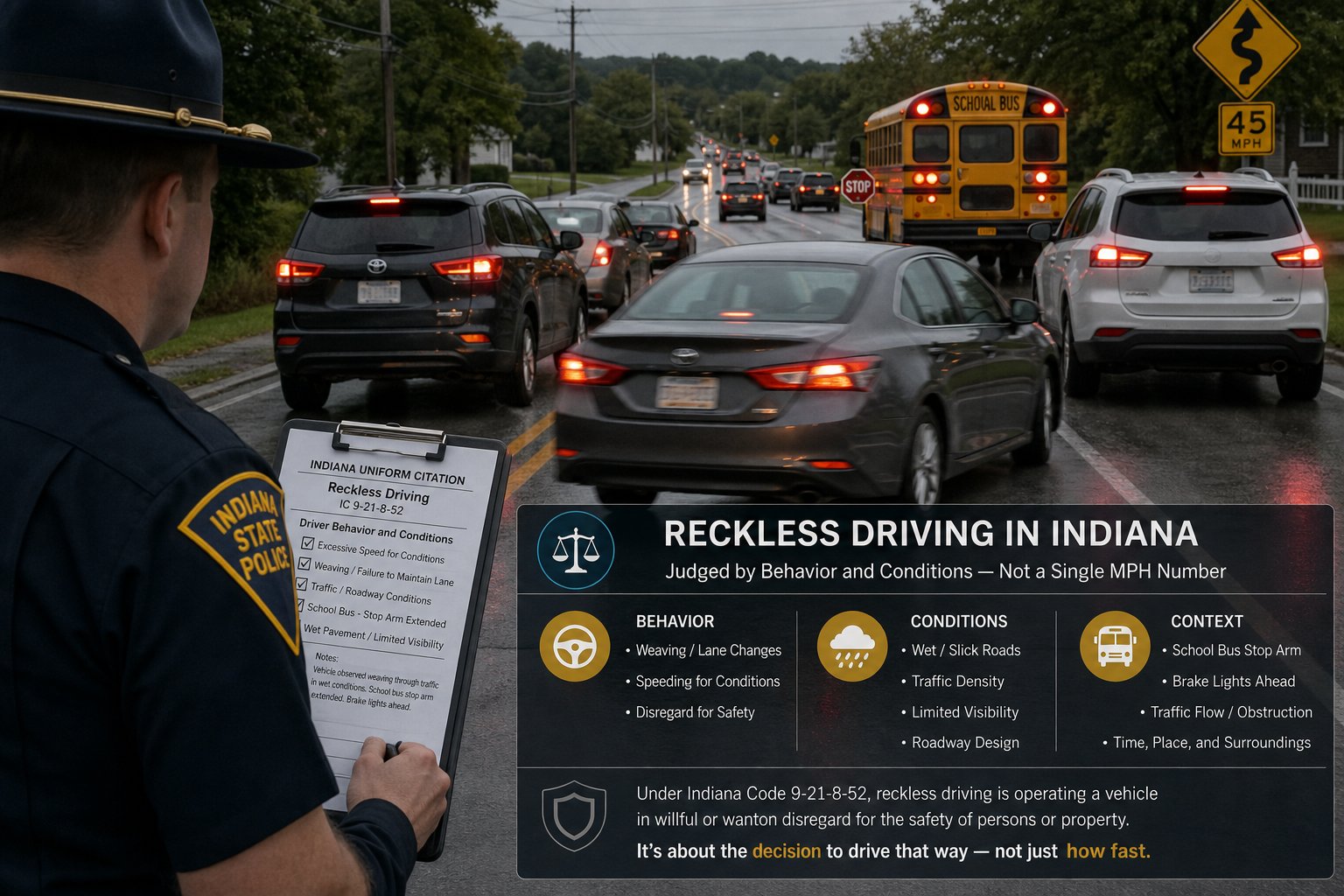
Indiana does not define reckless driving by a single mph number. Instead, the law looks at how you drove and whether your speed or actions put other people at risk.
Under Indiana Code 9-21-8-52, reckless driving can include driving at an unreasonably high rate of speed that endangers safety. It can also include driving at an unreasonably low speed if that blocks the normal flow of traffic. So the legal standard is behavioral, not mechanical.
That matters because two drivers going the same speed may be treated differently. For example, 80 mph on a dry, open interstate is not judged the same way as 80 mph in heavy rain, near stopped traffic, or on a crowded city road. Prosecutors and officers look at the full setting.
Indiana law also lists other conduct that can support a reckless driving charge, such as:
- Weaving in and out of traffic
- Passing from the rear on a hill or curve with limited sight distance
- Failing to give way to an overtaking vehicle
- Passing a stopped school bus with its arm extended
For many drivers, the biggest surprise is this: speed alone can become reckless driving if the speed is high enough and the situation is dangerous enough. The Indiana Bureau of Motor Vehicles, courts, and police are not just checking your mph. They are judging whether the way you drove created a real safety risk.
If you want the exact legal wording, review the statute itself and related Indiana traffic rules through the Indiana General Assembly and the Indiana BMV.
When Speeding Becomes Reckless Driving In Indiana
The short answer is simple: Indiana reckless driving speed is not a fixed statutory threshold. The law does not say that 20, 25, or 30 mph over the limit automatically becomes reckless driving.
Still, in day-to-day practice, many drivers and lawyers see a pattern. Around 26+ mph over the posted limit is often where a speeding case starts getting treated more seriously and may be charged as reckless driving, usually as a Class C misdemeanor. That is a practical guideline, not a bright-line rule.
Why there is no single mph rule
Indiana uses the phrase “unreasonably high rate of speed”. That gives police and prosecutors room to look at context, including:
- Traffic density
- Weather conditions
- Time of day
- Road design and visibility
- School zones or neighborhood streets
- Whether you were weaving, tailgating, or passing aggressively
Because of that, even a lower speed can look reckless if the road is slick, crowded, or full of pedestrians. And a higher speed may still begin as a standard speeding citation if the officer believes the risk was lower.
What this means in real life
If you were clocked far over the limit, do not assume it is “just speeding.” Read the citation closely. The charging language matters. A reckless driving charge can carry criminal penalties, demerit points, and possible license consequences that are very different from a routine infraction.
It is also worth checking your notice from the court or the Indiana BMV. In some cases, a driver may be ordered or encouraged to complete a BMV-approved Driver Safety Program (DSP). Indiana’s official DSP is a 4-hour course, but whether it helps depends on the court order, BMV notice, your driver record, license status, and the facts of the case.
Common Driving Behaviors Often Charged Alongside Excessive Speed
Excess speed often comes with other driving behavior that makes the case look worse. In Indiana, that extra behavior can be the reason a prosecutor sees the conduct as reckless instead of ordinary speeding.
Common examples include:
- Weaving through traffic
- Following too closely
- Aggressive lane changes
- Passing on curves or hills
- Blocking the normal flow of traffic
- Refusing to yield to a passing vehicle
- Passing a stopped school bus
These facts matter because reckless driving is about danger, not only speed. A driver going 82 in a 55 while darting between cars creates a very different picture from a driver moving with light traffic on a clear highway.
Police reports often focus on details like sudden lane moves, hard braking by other drivers, near misses, or limited visibility. Weather can also raise the risk. Rain, fog, ice, or darkness can turn a speed that seems manageable into an unreasonably high rate of speed under Indiana law.
This is also why two tickets for the same measured speed can lead to different outcomes. One may stay a speeding infraction. The other may become reckless driving because of the surrounding behavior.
If your paperwork mentions more than speed, pay close attention to every allegation. Those added details often drive the charging decision and may affect penalties, BMV demerit points, and whether a court is open to a Driver Safety Program option.
Penalties, License Consequences, And When Charges Get More Serious
A basic reckless driving charge in Indiana is commonly treated as a Class C misdemeanor, which can carry up to 60 days in jail and up to a $500 fine. But the real impact often goes beyond the court fine.
For license purposes, reckless driving is a serious issue. The Indiana BMV treats it as a major offense, and it can add 6 demerit points to your record under BMV point schedules and related rules. You can review official point information through the Indiana BMV and related state rules in the Indiana Administrative Code.
Important point: taking a Driver Safety Program does not erase the conviction or remove the violation. If you are eligible, it may provide a 4-point credit that reduces your point total. That is different from deleting the ticket.
When the case can get more serious
Penalties can increase if the event involved damage or injury. Depending on the facts, the charge level may rise beyond the base misdemeanor offense. Courts may also suspend driving privileges in some situations, and repeated major offenses can lead to much longer license trouble.
What happens next depends on several facts:
- Your exact charge
- Whether there was a crash
- Your driver record
- Your license status
- The court and judge
- Any Indiana BMV notice you received
If a court or notice requires a BMV-approved Driver Safety Program, use the exact instructions given and follow all deadlines.
What To Do After A Reckless Driving Stop Or Crash
Start with the basics and protect the record. If you are stopped, give your license, registration, and insurance when asked, and stay calm.
You do not need to argue roadside. And you should not say things like “I was driving recklessly” or “I know I was way over.” Short, polite answers are usually best.
Right after the stop, write down facts while they are fresh:
- Where the stop happened
- Traffic and weather conditions
- Road signs and speed limit signs
- Whether visibility was clear or limited
- What the officer said
- Names of any witnesses
If there was a crash, call 911 and make sure a report is made. Get medical care if needed. Then save anything that may matter later, such as photos, dashcam video, and witness contact information.
Also, read every paper you receive. Your next steps may depend on the citation, a court order, or a notice from the Indiana Bureau of Motor Vehicles. Do not ignore required court dates, filing deadlines, or BMV instructions.
In some cases, a driver may be told to complete the Indiana Driver Safety Program. That is the state-approved 4-hour DSP, but whether it is required or useful depends on the notice, the court, your record, and the case facts.
If your notice allows or requires online completion, you can review the Indiana Driver Safety Program at Driving Logic and make sure the course matches the order or BMV requirement.
How To Reduce The Damage And Avoid Future Reckless Driving Problems
The first goal is to limit new problems. The second is to keep one bad stop from turning into a bigger license issue.
If you have been charged, read the exact allegation and follow every deadline. Requirements can depend on the Indiana BMV notice, court order, ticket, driver record, license status, court, judge, and the facts of the case.
A few practical steps can help:
- Keep copies of every notice and court document
- Check whether a court or BMV notice mentions the DSP
- Verify any due dates before you act
- Track your driver record with the Indiana BMV
- Slow down more in rain, traffic, school zones, and neighborhoods
- Leave more space so you are not tailgating
- Use cruise control when it makes sense on open roads
For some drivers, a BMV-approved Driver Safety Program may be part of the path forward. Indiana’s official DSP is 4 hours, and it may help satisfy a court or BMV requirement when accepted. It does not guarantee dismissal, point removal, or any specific outcome.
If you need a flexible online option, Driving Logic’s Indiana Driver Safety Program is built for busy drivers who want to complete their course on their schedule from almost any device.
The safest long-term move is simple: treat speed as only one part of the risk. In Indiana, reckless driving is often about the whole driving pattern, not just the number on the speedometer.
FAQ
Is there a set reckless driving speed in Indiana?
No. Indiana law does not set one fixed mph number that automatically makes speeding reckless driving. The issue is whether the driving created danger under the facts.
Can very high speed still lead to reckless driving?
Yes. Very high speed can be one reason an officer or prosecutor treats conduct as reckless. Traffic, weather, road layout, and risk to others can also matter.
Can the Indiana DSP fix a reckless-driving charge?
No. The DSP does not fix or dismiss a reckless-driving charge. It may provide a 4-point credit when eligible, but court outcomes are separate.
Should I ignore a court date if I take DSP?
No. Taking a course does not replace a court date unless the court says so. Follow the court notice exactly.
Conclusion
What Speed Is Considered Reckless Driving in Indiana? depends on the exact Indiana charge, court paperwork, and BMV record impact. The Indiana Driver Safety Program may provide a 4-point credit when eligible, but it does not erase reckless driving, dismiss a charge, or guarantee a court result. Check your citation, court notice, and BMV record before deciding what to do next.
Take the Indiana Driver Safety Program course online when you are ready to begin.
Related Articles
- Reckless Driving in Indiana: Penalties, Points, and Driver Safety Options
- What Is Reckless Driving in Indiana? IC § 9-21-8-52 Explained
- Indiana Reckless Driving First Offense: What to Know
- Indiana Reckless Driving vs. Speeding Ticket: Key Differences
Sources
- Indiana BMV — Citation Points and Driver Safety Program
- Indiana BMV — Driver Record Points
- Indiana Code — Title 9 Motor Vehicles
- Indiana Code and Administrative Rules
Billy Forte is the owner of Driving Logic, a state-approved driver improvement course provider serving Indiana and other U.S. states. Driving Logic offers online driver safety and driver improvement courses for drivers handling BMV notices, court orders, and state requirements.
This article is general information, not legal advice. Indiana BMV rules, court orders, deadlines, provider reporting, insurance decisions, and case facts can differ. Use official Indiana BMV and court sources for current requirements, and consult a qualified Indiana attorney for legal guidance specific to your situation.