
Updated May 2026 · Reviewed by Billy Forte
Yes. In Florida, traffic school, a defensive driving course, and a BDI course usually mean the same FLHSMV-approved 4-hour Basic Driver Improvement course. The name often changes based on the reason you need it, such as a ticket election, a court order, or an insurance request, but the approved 4-hour course is the same product when your case calls for BDI. Your deadline, reporting steps, and even your eligibility can still vary by citation type, county, court, judge, and the facts of your case.
Key Facts
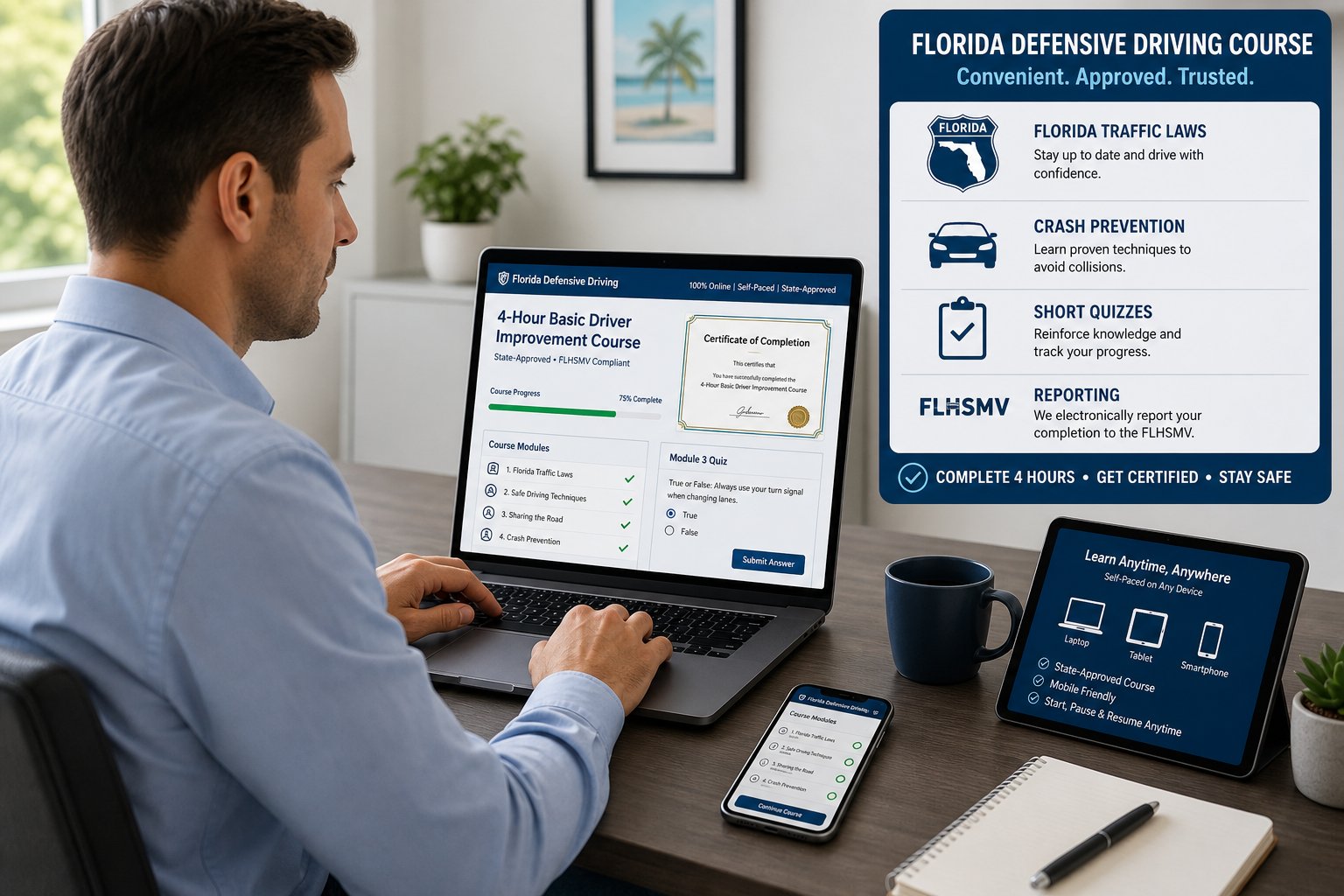
- Short answer: Yes — in Florida, all three terms refer to the same 4-hour FLHSMV-approved course
- FLHSMV official name: Basic Driver Improvement (BDI) course
- Why different names: The name changes based on who requires it — court, clerk, insurer, or state
- Duration: 4 hours regardless of what the course is called
- Approval required: The provider must be FLHSMV-approved for the certificate to count
- What changes: The reason you take it, the reporting path, and the deadline — not the course itself
How Florida Defensive Driving Courses Work
A Florida defensive driving course is a state-approved traffic safety class. In many cases, people also call it traffic school or a BDI course. For Florida ticket cases, those names often point to the same 4-hour Basic Driver Improvement class approved by the Florida Department of Highway Safety and Motor Vehicles.
That course can be taken online or in a classroom through an approved provider. Most busy drivers choose an online course because it is easier to fit into a workday, a lunch break, or a late night hour. You sign up, complete the lessons, pass the required checks or test if your provider uses one, and then get a completion certificate.
The course itself is practical. It usually covers:
- Florida traffic laws
- Safe following distance
- Speed and space control
- Crash prevention habits
- Alcohol and drug effects
- Driver attitude and risk awareness
The main point is simple. Florida uses these courses to improve safety and, in some cases, to satisfy a court or clerk requirement.
And here is the key point many drivers miss: Florida traffic school, defensive driving, and BDI are often just different names for the same 4-hour course. People say “traffic school” after a ticket. Insurers may say “defensive driving.” Florida records often use Basic Driver Improvement or BDI. The important part is not the nickname. The important part is taking the exact FLHSMV-approved course type your case requires.
Who Needs A Florida Defensive Driving Course And When It Is Required
You may need a Florida course for several different reasons. The right answer depends on why you were told to take it.
One common reason is a non-criminal moving violation. In many cases, eligible drivers can elect a 4-hour BDI course to avoid points on the license for that citation. Florida law on traffic citations and elections is tied to rules under Florida Statute 318.14. But your local process still matters, so check your county clerk instructions too.
Another reason is a court order. A judge may require a course after a more serious event or after repeat violations. In those cases, the course may not be the 4-hour BDI at all. It may be an 8-hour or 12-hour class instead.
You may also need a course if you are:
- Applying for your first Florida license
- Trying to reinstate driving privileges
- Seeking a hardship license
- Trying to qualify for an insurance discount
That is why the phrase defensive driving course Florida can mean different things in real life. Some drivers need the standard 4-hour BDI. Others need IDI, ADI, or TLSAE.
Before you enroll, confirm three things:
- The exact course name
- Your deadline
- Who must receive proof of completion
You can usually find case details through your county Clerk of Court.
The Main Florida Course Types Explained
Florida does not use one course for every situation. The state has several course types, and each one serves a different purpose. That is where many drivers get tripped up.
If your notice says traffic school, defensive driving, or BDI after a regular moving ticket, it usually means the same 4-hour Basic Driver Improvement course. But if the court or FLHSMV says IDI, ADI, or TLSAE, you must take that exact program.
A quick breakdown helps.
4-Hour BDI, 8-Hour IDI, 12-Hour ADI, And TLSAE
4-Hour BDI is the course most people mean when they say Florida traffic school or defensive driving. It is commonly used for eligible moving violations. It may help you avoid points for the covered ticket, subject to Florida rules and your case status.
8-Hour IDI stands for Intermediate Driver Improvement. Courts often use it for more serious driving issues or repeat problems. It is not the same as the 4-hour BDI.
12-Hour ADI means Advanced Driver Improvement. This course is often required for drivers dealing with suspension, revocation, habitual traffic offender status, or hardship license steps.
TLSAE stands for Traffic Law and Substance Abuse Education. New drivers often need this 4-hour course before getting a first license.
Here is the simple version:
- BDI = usually ticket election / traffic school / defensive driving
- IDI = usually court-ordered for higher-risk cases
- ADI = usually suspension or reinstatement related
- TLSAE = first-time license education
So, are they all the same? No. But traffic school, defensive driving, and BDI are the same Florida 4-hour course when your case calls for BDI.
How To Complete Your Requirement Online Without Delays
The fastest way to finish is to choose the right approved course the first time. Most delays happen because drivers pick the wrong class or assume all Florida courses are interchangeable.
Start with your paperwork. Look for the exact course name on your citation, court notice, clerk instructions, or FLHSMV notice. If it says BDI, Basic Driver Improvement, traffic school, or defensive driving for a standard moving ticket, that usually points to the same 4-hour class. If it says IDI, ADI, or TLSAE, do not substitute another course.
Then choose a FLHSMV-approved provider. A provider like Driving Logic focuses on flexible online completion, short allowed course timing, and quick access across devices. That matters if your schedule is packed.
To avoid delays, follow this order:
- Confirm your required course type.
- Check your county or court reporting rules.
- Register with an approved provider.
- Finish all lessons and required checks.
- Save, print, or submit your certificate as instructed.
Also confirm whether the school reports completion for you or whether you must send the certificate yourself. Never assume. A completed course does not help much if the right office never gets proof.
If you already know you need the 4-hour Florida BDI course, you can take the course online at Driving Logic and keep the process simple.
Deadlines, Court Reporting, Certificates, And Common Mistakes
Deadlines matter as much as course choice. For many ticket cases, you must make your election within a set time after the citation, often 30 days, and then finish the course by the deadline given by the clerk or court. Florida procedures can vary, so always read the citation and local instructions closely.
For official county handling, use your local clerk through the Florida Court Clerks & Comptrollers system. For state-approved school lists and driver improvement details, use FLHSMV.
After completion, you will usually receive a certificate. Some schools report electronically. Others may require you to upload, email, mail, or hand-deliver proof. Your case is still your responsibility, even if a provider offers reporting.
Common mistakes include:
- Missing the election deadline
- Taking the wrong course type
- Waiting until the last day to start
- Assuming the provider always reports for you
- Failing to confirm the clerk or court received proof
- Using BDI too often when Florida limits apply
Florida rules also limit how often some drivers may elect the 4-hour BDI option for citation purposes. That is another reason to verify your eligibility before signing up.
If anything on your notice is unclear, check with the clerk or court before you enroll. One small mismatch can waste time and money.
What You Gain From Completing The Right Course
The right course can help you meet a legal requirement and move on faster. It can also give you practical driving habits that lower risk on the road.
If you complete the correct Florida defensive driving course for your case, possible benefits may include:
- Meeting a court or clerk requirement
- Avoiding points for an eligible ticket election
- Helping protect against related insurance effects in some cases
- Qualifying for a fine reduction where allowed
- Supporting license reinstatement steps for ADI cases
- Meeting first-license education rules through TLSAE
But the benefit depends on the right course for the right reason. A 4-hour BDI may help in a regular moving ticket case. It will not replace a 12-hour ADI if FLHSMV or the court requires ADI.
There is also a safety value. Good courses review:
- Hazard spotting
- Better following distance
- Safer speed choices
- Better lane changes and scanning
- Risk awareness around alcohol and fatigue
These are not flashy lessons. Still, they matter. Small driving choices prevent expensive problems.
For many busy drivers, the real win is simple: you meet the requirement without losing a full day in a classroom. If your notice calls for the 4-hour BDI course, MyDrivingLogic.com gives you an online option that fits around real life.
How County Rules Can Vary
Florida BDI requirements follow state law under Florida Statute 318.14, but how elections are processed, what fees apply, and when certificates must be filed can vary by county clerk, court, and judge. Before you enroll, confirm the specific deadlines and filing steps with the Clerk of Court in the county listed on your citation.
FAQ
Is Florida traffic school the same as a defensive driving course?
Yes. In Florida, traffic school and a defensive driving course typically refer to the same 4-hour FLHSMV-approved Basic Driver Improvement (BDI) course. The name depends on the context — courts, clerks, and insurers each use different terms for the same class.
Is BDI the same as traffic school in Florida?
Yes. BDI stands for Basic Driver Improvement and is the official Florida term for the course that courts and clerks often call traffic school. The content and duration are identical — 4 hours from an FLHSMV-approved provider.
Does it matter which term my court order or citation uses?
The term matters for understanding why you need the course, but the course itself is the same. What matters most is that you use an FLHSMV-approved provider and that your certificate is filed with the right office by the right deadline.
Can I use a defensive driving course from another state for a Florida ticket?
No. Florida requires an FLHSMV-approved course for Florida BDI elections and court orders. A course approved in another state generally does not satisfy the Florida requirement.
Why does my citation say “traffic school” but the provider says “BDI”?
Different parts of the Florida system use different terminology. Your citation, court order, and provider may all describe the same course with different words. As long as the provider is FLHSMV-approved and the course is 4 hours, the certificate should satisfy the requirement — but confirm with your clerk or court if you are uncertain.
Conclusion
In Florida, traffic school, defensive driving, and BDI all point to the same course. What changes is the reason you are taking it, where your certificate must go, and what deadline applies. Confirm your specific requirement with the Clerk of Court before you enroll.
Take the Florida BDI course online at Driving Logic
Related Articles
- Florida Basic Driver Improvement (BDI) Course: The Complete Guide
- How the 4-Hour Florida BDI Course Works Online
- FLHSMV-Approved BDI Providers: What It Means and How to Verify Your Course
- How to Take the Florida BDI Course Online
Sources
- FLHSMV — Basic Driver Improvement Course Providers
- FLHSMV — Driver Improvement Schools
- Florida Statute 318.14 — Noncriminal Traffic Infractions
- Florida Clerks of Court
Billy Forte is the owner of Driving Logic, a state-approved driver improvement course provider serving Florida and other U.S. states. Driving Logic offers FLHSMV-approved online BDI courses for drivers handling traffic tickets, court orders, and state requirements.
This article is general information, not legal advice. Eligibility, deadlines, court acceptance, and filing steps depend on the citation type, county, court, judge, and the facts of your case. Use official Florida court and state sources for current requirements, and consult a qualified Florida attorney for legal guidance specific to your situation.