
Updated June 2026 · Reviewed by Billy Forte
If a Florida court ordered you to take a driver improvement course, you must complete the exact course in your order by the court’s deadline and send proof to the court or Clerk of Court. This is not the same as the normal ticket election under Florida Statute 318.14, where some drivers choose traffic school within 30 days and pay an election fee. If you miss a court order, the court can take more action in your case, and your license or record may not be cleared until you meet all court and FLHSMV steps.
Key Facts {#key-facts}
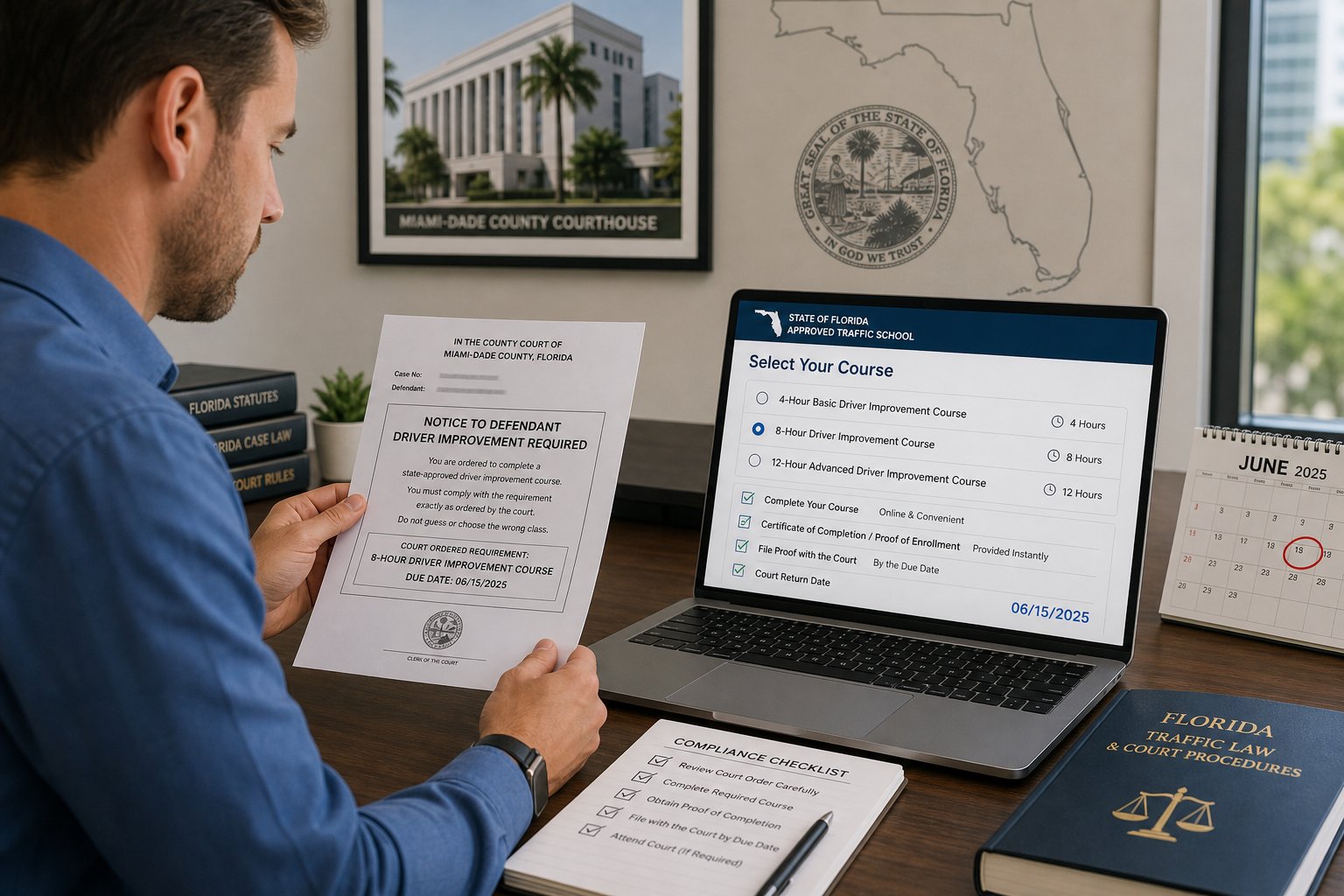
- What it is: A judge orders you to complete a Florida BDI course as part of a court ruling
- Different from election: You did not choose it — the court required it; different rules apply
- Provider: Must use an FLHSMV-approved BDI provider; online is typically accepted unless the order specifies otherwise
- Deadline: The court order sets the deadline — follow it exactly
- Certificate: File your completion certificate with the court or clerk as the order instructs
- Failure to comply: Not completing the course as ordered can result in additional court action
What Florida Court-Ordered Driver Improvement Means
A Florida court-ordered driver improvement course is traffic school a judge or court tells you to take. In Florida, this often means an FLHSMV-approved course such as Basic Driver Improvement, also called BDI, traffic school, or a defensive driving course. The key point is simple: the court order controls, not your own choice.
That matters because many drivers mix this up with the voluntary ticket election process. Under Florida Statute 318.14, some drivers can elect traffic school within 30 days, pay the fine and any election fee, and ask for adjudication withheld if they qualify. But a court order is different. The judge or court sets the deadline, the course type, and any extra steps.
Your paperwork may tell you to:
- take a specific course length
- complete it by a set date
- file proof with the Clerk of Court
- appear again in court
- meet other case terms before the matter is closed
In other words, court ordered traffic school in Florida is not something you should guess at. Read every page from the court. Check the county clerk site if the order is not clear. Florida clerks can be found through the Florida Court Clerks & Comptrollers directory.
Also, do not assume the course alone fixes the case. Some courts want the certificate filed by you. Others may also require fees, a compliance hearing, or other case steps.
Who Is Required To Take A Driver Improvement Course
You may be required to take a driver improvement course when a court, judge, or Florida agency says so. The reason depends on the ticket, your record, the county, and the facts of the case. So, two drivers with similar tickets may not get the same result.
Common situations include:
- a judge orders traffic school after a moving violation
- you got multiple citations in 12 months
- the case involves aggressive driving or street racing
- you must meet terms tied to a suspended license
- FLHSMV sends a notice tied to a crash or driving record issue
For many readers, the confusion starts with the difference between electing traffic school and being ordered to take it. Florida allows some drivers to make a ticket election under FLHSMV traffic school rules. That option has limits, including the 8-election lifetime limit and the 12-month frequency limit. If you already used the election too recently, or too many times, the court may handle the case another way.
A court order may also appear after you contest a ticket, miss a step, or resolve a case in court. In some cases, the court uses driver improvement as part of a sentence, probation term, or reinstatement path. Because of that, always match your next step to the exact order in your case. If your order names a course, use that course name, not a similar one.
Which Florida Course You May Be Ordered To Complete
Florida courts can order more than one kind of driver improvement course. The right one depends on what happened in your case. The most common issue is that people sign up for the wrong class because they see the words traffic school and assume all courses are the same. They are not.
The order may require:
- 4-hour Basic Driver Improvement (BDI)
- 8-hour Intermediate Driver Improvement (IDI)
- 8-hour Aggressive Driver Improvement
- 12-hour Advanced Driver Improvement (ADI)
The safest move is to compare the exact words in your court order with the provider’s course list. If the order is vague, check with the court or Clerk of Court before you enroll.
Basic Driver Improvement Vs. Advanced Driver Improvement
BDI is the standard 4-hour course. It is often used for minor moving violations, some crash-related notices, or traffic school requirements tied to a citation. In Florida, BDI, traffic school, and a defensive driving course usually mean the same approved 4-hour class.
ADI is a 12-hour course. It is used for more serious record or license issues, often linked to suspension, revocation, or reinstatement steps. If your order says ADI, a 4-hour BDI course will not meet that requirement.
So read the course title with care. A short course cannot replace a longer one just because both are called driver improvement.
Other State-Required Courses That Are Sometimes Confused With Court-Ordered Programs
Some Florida courses sound similar but serve different purposes. That creates problems when drivers rush to enroll.
Examples include:
- 8-hour Aggressive Driving or Street Racing courses
- special courses for driving while license suspended cases
- courses aimed at drivers under a certain age or case type
These are not interchangeable with BDI or ADI unless the court says they are. Use the exact wording from your order and confirm the provider is approved by the Florida Department of Highway Safety and Motor Vehicles.
How The Online Course Process Works From Start To Certificate
The online process is usually simple, but you still need to match the course to your order. Start with an FLHSMV-approved provider. Then choose the course named by the court, register, and complete all required hours.
Most online courses let you work at your own pace. You can log in on a phone, tablet, or computer. That helps if you are busy and need to split the class into short sessions.
In most cases, the steps look like this:
- Read your court order and check the deadline.
- Pick the correct Florida-approved course.
- Create your account and enter your details carefully.
- Finish the lessons, timers, quizzes, and any final test.
- Save or print your completion certificate.
Some course types have quizzes or a final exam. Some 4-hour course formats may differ. But you should expect timed content, identity checks, and a record of completion.
If you want a fast online option, Driving Logic’s Florida BDI course is built for people who want a flexible format on any device. Still, speed only helps if you choose the right course and finish before the court’s date.
Before you start, make sure your name, case details, and birth date match your paperwork. Small errors can delay your certificate and cause filing problems with the court.
What Happens After You Complete The Course
After you finish the course, keep the certificate and follow the court’s filing rules. Completion is not always the last step. In many cases, you must submit proof to the court or Clerk of Court listed on your case.
Your next steps may include:
- download or print the certificate
- upload, mail, or hand-deliver it if the court requires that
- confirm the clerk marked your case as compliant
- check whether FLHSMV updated your record
- complete any added fees or reinstatement steps
Some providers report course completion electronically, but you should not assume that satisfies a court order by itself. The order may require you to file proof directly with the court. If your case involves suspension or reinstatement, FLHSMV may also require separate steps. You can review official course and record information through FLHSMV.
If you still need a state-approved 4-hour course, you can take it online through Driving Logic at MyDrivingLogic.com. Just make sure the course matches your exact order before you enroll.
And one last point: keep copies of everything. Save the certificate, payment record, and any court receipt. If the court later asks for proof, those records can save time.
How County Rules Can Vary
Florida traffic school election rules follow state law under Florida Statute 318.14, but how elections are processed, what fees apply, and what deadlines the clerk sets can vary by county. Before you act, confirm the specific process with the Clerk of Court in the county listed on your citation.
FAQ
What is Florida court-ordered driver improvement?
Court-ordered driver improvement means a judge has required you to complete a Florida Basic Driver Improvement (BDI) course as part of the court ruling in your case. It differs from the voluntary traffic school election — you did not choose it, and the terms are set by the court order.
How is court-ordered BDI different from electing traffic school?
When you elect traffic school, you voluntarily choose to complete a BDI course in exchange for adjudication withheld on an eligible citation. Court-ordered BDI is a requirement imposed by a judge as part of a ruling. The election limits do not apply in the same way to court-ordered completions.
Can I take a court-ordered BDI course online?
In most cases, yes. Online FLHSMV-approved BDI courses are commonly used for court-ordered completions. However, review your specific court order to confirm whether online completion is explicitly allowed or whether any specific provider or format is required.
What happens after I complete the court-ordered BDI course?
File your completion certificate with the court, clerk, or the office specified in your court order. Do not assume the provider automatically reports to the court — follow the order specific instructions for proof submission.
What is the deadline for completing court-ordered BDI?
The court order will specify the deadline. Follow it exactly. If you believe you cannot meet the deadline, contact your attorney or the court before the deadline passes.
What happens if I do not complete the court-ordered BDI?
Failure to comply with a court order can result in contempt of court, additional penalties, or other court action. Take the deadline seriously and complete the course as required.
Conclusion
Court-ordered driver improvement in Florida must be completed exactly as the court specifies — provider, deadline, and filing method all matter. Review your order carefully, use an FLHSMV-approved provider, and file your certificate with the right office by the required date.
Related Articles
- How to Elect Traffic School in Florida: The Complete Election Guide
- What Florida Traffic Violations Qualify for Traffic School Election?
- Florida Traffic School Election Deadline: 30 Days to Act
- How Many Times Can You Use Traffic School in Florida? The 8-Election Lifetime and 12-Month Rule
Sources
- Florida Statute 318.14 — Noncriminal Traffic Infractions
- Florida Statute 318.14 — Noncriminal Traffic Infractions
- FLHSMV — Basic Driver Improvement Course Providers
- FLHSMV — Driver Improvement Schools
- Florida Clerks of Court
Billy Forte is the owner of Driving Logic, a state-approved driver improvement course provider serving Florida and other U.S. states. Driving Logic offers FLHSMV-approved online BDI courses for drivers handling traffic tickets, court orders, and state requirements.
This article is general information, not legal advice. Eligibility, deadlines, court acceptance, and filing steps depend on the citation type, county, court, judge, and the facts of your case. Use official Florida court and state sources for current requirements, and consult a qualified Florida attorney for legal guidance specific to your situation.