
Updated June 2026 · Reviewed by Billy Forte
You can get a copy of your Florida driving record from the Florida Department of Highway Safety and Motor Vehicles through the FLHSMV MyDMV tools, by mail, or in person, and it can show your license status, traffic violations, demerit points, suspensions, and traffic school entries. Florida also offers different record types, including shorter history reports and longer records with more detail, so the best choice depends on why you need it. If you took a Florida BDI course, which is the same as traffic school or a defensive driving course, the record may show that case as adjudication withheld instead of a conviction when you were eligible and completed it on time.
This article covers Florida requirements only.
Key Facts
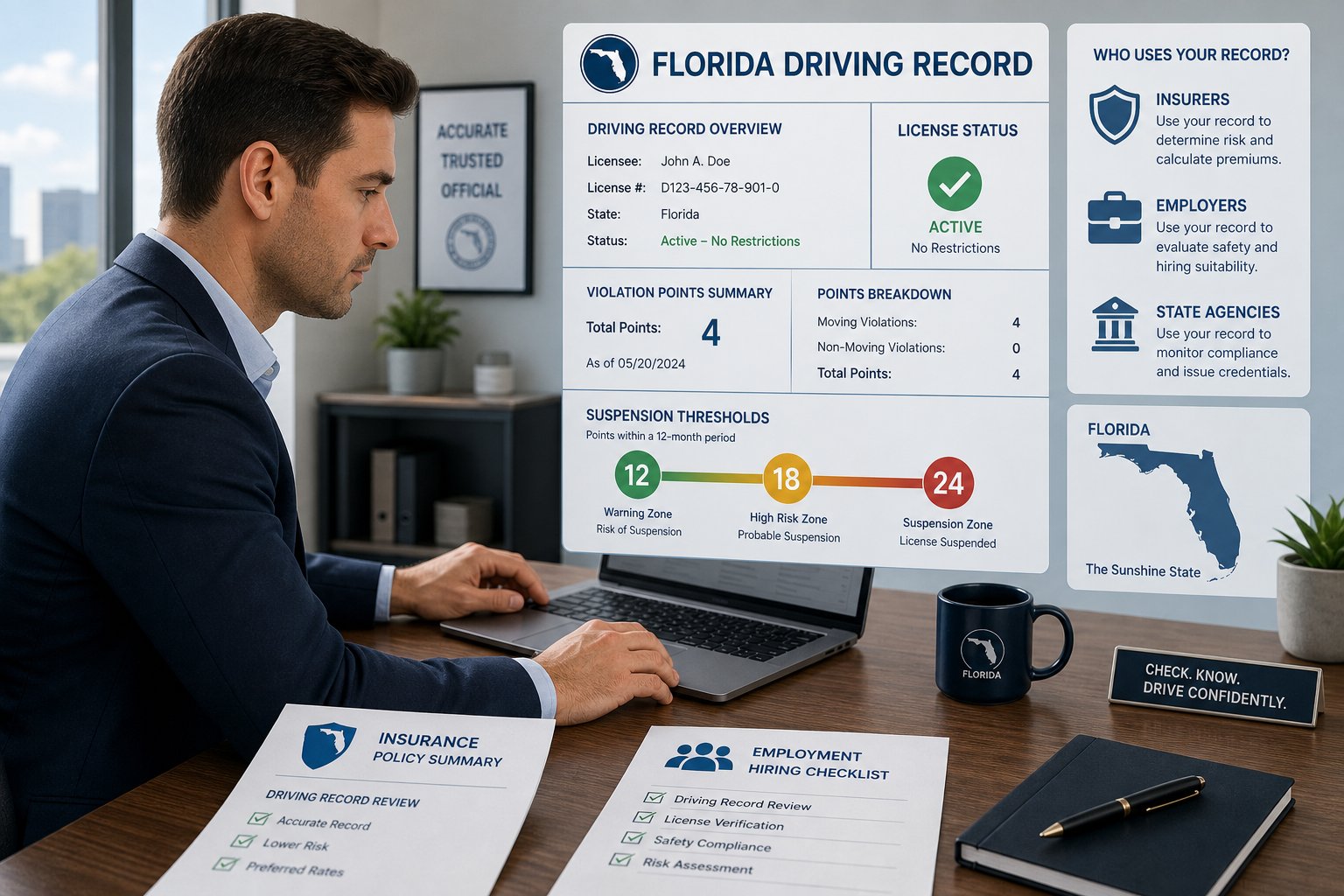
- Point suspension: Florida may suspend a license at 12 points in 12 months, 18 points in 18 months, or 24 points in 36 months.
- Record check: Use official FLHSMV tools or an official driver record request to confirm what is actually on your record.
- Offense dates: Florida computes point-suspension periods using the offense dates of convictions.
- BDI limit: An eligible BDI election can help prevent points on a current citation, but it does not erase old points.
- Clerk rules: Election deadlines, certificate filing, and court instructions can vary by county and citation.
If your goal is to prevent new points on an eligible current citation, review the Florida Basic Driver Improvement course before your clerk or court deadline.
A Florida driving record is your official state driving history. It is also called a motor vehicle record, or MVR. In Florida, it comes from the Florida Department of Highway Safety and Motor Vehicles (FLHSMV).
Your record matters because other people use it to make decisions. That often includes insurers, employers, courts, and state agencies. A small item on your record can affect more than most drivers expect.
A Florida driving record can help show:
- Whether your license is valid
- Traffic violation points on your record
- Convictions for moving violations
- License suspension or revocation history
- Restrictions or endorsements on your license
- Traffic school or BDI entries
- Some crash entries tied to citations
For example, Florida uses a point system for many moving violations. If you reach the 12-point threshold within 12 months, the state can suspend your license. The 18-point threshold within 18 months can trigger a longer suspension, and the 24-point threshold within 36 months can trigger an even longer one.
Employers often check your record if driving is part of the job. Insurers may look for recent violations, claims-related risk signals, and license problems. Courts may review your history when handling a new citation.
So if you got a ticket, changed jobs, or want to confirm your license status, checking your record is a smart step. If you only need your current status, you can use the free FLHSMV Driver License Check tool. But if you need the full details, you will need to order an official record.
The 3 Types Of Florida Driving Records
Florida offers several versions of your driving history. The main difference is how far back the record goes and how much detail it includes. If you order the wrong one, you may miss information an employer, court, or insurer wants to see.
3-Year Record
The 3-year personal record is the shortest common option. It usually shows your recent driving history, current license status, basic license details, recent violations, and related entries from the last three years.
This is often enough if you just want to check recent tickets, point activity, or a traffic school update. It may also show restrictions, endorsements, and some notices tied to your license.
7-Year Record
The 7-year full record goes farther back. It includes the same general categories as the 3-year version, but with more history.
This can matter if an employer or insurer wants a longer view of your record. If you had older violations, a suspension, or repeated traffic cases, a 7-year record may show a pattern that a shorter report will not.
Complete Record
The complete record is the most detailed option. In practice, Florida records often go back about 11 years on this version, though the exact content can depend on the state file.
This record can include older infractions not shown on shorter records, plus many out-of-state items reported to Florida. It is the safest choice if you need the fullest picture for a court matter, a serious job review, or your own records.
In many cases, you can also request a certified record. A certified copy is an official state-certified version of the record you order. That matters when a court, employer, or agency needs proof that the record is official, not just a plain copy.
What Information Appears On A Florida Driving Record
A Florida driving record can show a lot more than tickets. The exact details depend on the type of record and how it is delivered, but the core items are fairly consistent.
Most records can include:
- Your name and date of birth
- License number and class
- Original issue date and renewal history
- Restrictions and endorsements
- Current license status
- Suspensions, revocations, cancellations, or disqualifications
- Traffic violations and court outcomes
- Demerit points and other traffic violation points
- Crash entries linked to citations
- Traffic school completions
If you are asking, “What does my Florida driving record actually show after a ticket?” the short answer is this: it usually shows the violation, what happened in court, and whether points were added.
That court outcome is important. A case may appear as a conviction or as adjudication withheld. In Florida, if you were eligible to elect a BDI course, also called traffic school or a defensive driving course, and you completed the FLHSMV-approved 4-hour course on time, the case often appears as adjudication withheld instead of a conviction.
That does not mean the ticket disappears from every version of your record. It means the disposition is different. And eligibility, deadlines, and rules can depend on the citation type, county, court, judge, and the facts of your case.
What do employers and insurers usually look at? Most often:
- Recent moving violations
- Point totals and repeat offenses
- Any license suspension history
- DUI-related entries or serious violations
- Whether your license is valid
If you are checking your record after traffic school, look closely at the case disposition. If the entry does not match what you expected, contact the court listed on the citation or the local Florida Clerk of Court office for the case details.
How To Get Your Florida Driving Record Online Or Through The State
You can get your Florida driving record in a few ways. The easiest first step is to decide whether you need free status only or an official paid record copy.
If you only want to see whether your license is valid, use the free FLHSMV Driver License Check. That is the closest thing to florida driving record online free, but it is only a status check. It does not give you the full record with violations, points, and history.
If you need a full record, use the state’s FLHSMV MyDMV portal or an FLHSMV-approved record request path. You may also request records by mail.
Online through FLHSMV or an approved state path
This is usually the fastest option. You choose the record type you need, verify your identity, and pay the state fee and any service charge shown during the order process.
Florida commonly lists these state record fees:
- 3-year record: about $8
- 7-year record: about $10
- Complete record: about $10
- Certified record: higher than a plain copy, depending on the request format
Fees can change, so check FLHSMV before you order.
By mail
You can also request your record by mail from the FLHSMV Bureau of Records in Tallahassee. This usually requires the state request form, your identifying information, and the proper fee.
Mail requests often take around 10 business days to process, not counting mailing time. That can be fine for planning ahead, but not for urgent court deadlines.
Which record should you order?
A 3-year record is often enough for personal review. A 7-year full record may fit employer or insurance needs. A complete or certified record is better when a court or agency wants the most complete official copy.
If your citation involved a school election under Florida Statute 318.14, confirm the court’s deadline and filing steps before you act. Do not miss a required court date or clerk deadline.
If you still need to complete a Florida BDI course, you can take the FLHSMV-approved 4-hour course online through Driving Logic. It works on your schedule, on almost any device, and is built for busy drivers who need a simple way to finish the requirement.
Not legal advice. Florida traffic rules, record entries, school eligibility, and court procedures can change and may depend on your county, citation, judge, and case facts.
FAQ
How do I get my Florida driving record?
Request your driving record from FLHSMV at flhsmv.gov. You can order it online, submit a request by mail to the FLHSMV office, or visit a county tax collector office that provides FLHSMV services in person.
What does a Florida driving record show?
A Florida driving record shows your moving violation convictions, the point value for each violation, license status (valid, suspended, or revoked), any license suspensions or revocations, endorsements (such as motorcycle), and restrictions. It does not typically include records expunged by a court.
What is the difference between a 3-year and a complete Florida driving record?
The 3-year record shows moving violations and convictions for the most recent 3 years — the period most relevant to the point system. The complete record shows the longer history that FLHSMV retains. Insurance companies and employers may request either type.
How much does a Florida driving record cost?
A 3-year driving record from FLHSMV typically costs approximately $10. A complete driving record typically costs approximately $25. Fees may change — confirm current fees at flhsmv.gov before ordering.
Who can access my Florida driving record?
You have the right to request your own record. Law enforcement and courts access records through official channels. Insurers may review your record with your consent. Employers requiring driving may request records with proper authorization under federal law.
Does getting my own driving record affect my license or insurance?
No. Requesting your own Florida driving record is a personal inquiry and does not affect your license, your point total, or your insurance rates.
Conclusion
Your Florida driving record is the authoritative source for your point total, violation history, and license status. Order it from FLHSMV before making any decisions about traffic school elections or license actions — knowing your exact situation saves time and prevents mistakes.
Take the Florida BDI course online at Driving Logic
FAQ
How do I get my Florida driving record?
Request your driving record from FLHSMV at flhsmv.gov. You can order it online, submit a request by mail to the FLHSMV office, or visit a county tax collector office that provides FLHSMV services in person.
What does a Florida driving record show?
A Florida driving record shows your moving violation convictions, the point value for each violation, license status (valid, suspended, or revoked), any license suspensions or revocations, endorsements (such as motorcycle), and restrictions. It does not typically include records expunged by a court.
What is the difference between a 3-year and a complete Florida driving record?
The 3-year record shows moving violations and convictions for the most recent 3 years — the period most relevant to the point system. The complete record shows the longer history that FLHSMV retains. Insurance companies and employers may request either type.
How much does a Florida driving record cost?
A 3-year driving record from FLHSMV typically costs approximately $10. A complete driving record typically costs approximately $25. Fees may change — confirm current fees at flhsmv.gov before ordering.
Who can access my Florida driving record?
You have the right to request your own record. Law enforcement and courts access records through official channels. Insurers may review your record with your consent. Employers requiring driving may request records with proper authorization under federal law.
Does getting my own driving record affect my license or insurance?
No. Requesting your own Florida driving record is a personal inquiry and does not affect your license, your point total, or your insurance rates.
Conclusion
Your Florida driving record is the authoritative source for your point total, violation history, and license status. Order it from FLHSMV before making any decisions about traffic school elections or license actions — knowing your exact situation saves time and prevents mistakes.
Take the Florida BDI course online at Driving Logic
Related Articles
- Florida Driver License Points System: Suspensions, Point Values, and BDI Options
- Will My Florida Traffic Violations Show Up on a Background Check?
- Florida License Suspension for Points: What Happens and Reinstatement Options
- How Long Does a Speeding Ticket Stay on Your Florida Driving Record?
Sources
- Florida Statute 322.27 — Driver License Suspension and Point System
- Florida Statute 318.14 — Traffic Infractions and BDI Election
- FLHSMV — Driver Improvement Schools
- FLHSMV — Driver License Check
- Florida Clerks of Court
Billy Forte is the owner of Driving Logic, a state-approved driver improvement course provider serving Florida and other U.S. states. Driving Logic offers FLHSMV-approved online BDI courses for drivers handling traffic tickets, court orders, and state requirements.
This article is general information, not legal advice. Eligibility, deadlines, court acceptance, license consequences, insurance decisions, and filing steps depend on the citation type, county, court, judge, and facts of your case. Use official Florida court and state sources for current requirements, and consult a qualified Florida attorney for legal guidance specific to your situation.