
Updated June 2026 · Reviewed by Billy Forte
A Florida traffic ticket can affect your home-state license because Florida reports many convictions to your state, and your state may add points or other penalties under its own laws. If you pay a Florida speeding ticket, that usually counts as a conviction, and if you ignore it, Florida can report the failure to comply and trigger a suspension issue through interstate systems used by many states. If you elect Florida traffic school through the Clerk of Court, that election is reported in Florida only, but your home state may still handle your driving record under its own rules and policies.
This article covers Florida requirements only.
Key Facts
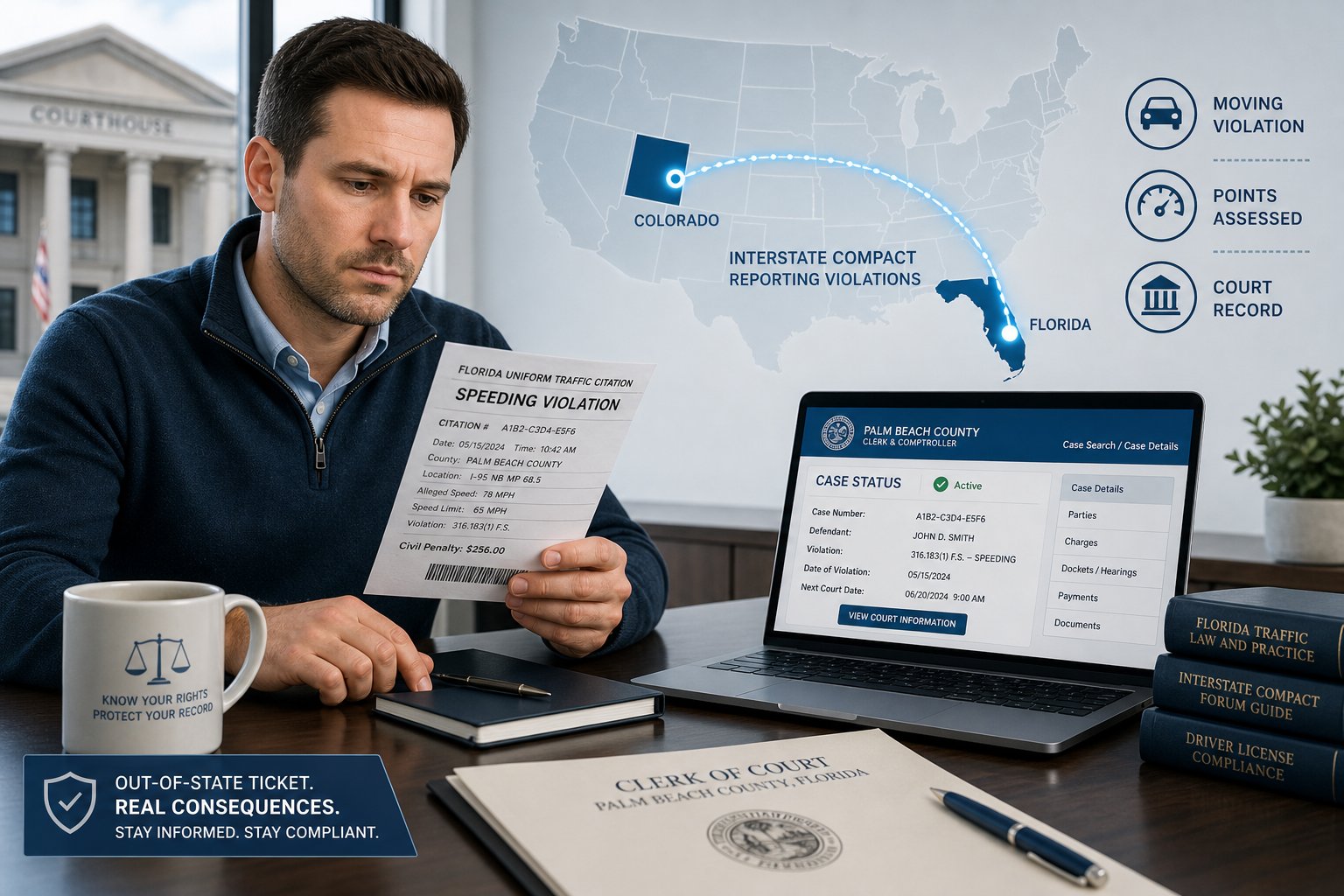
- Interstate reporting: Florida may report the violation to your home state through the Non-Resident Violator Compact or AAMVA
- Home state impact: Your home state’s DMV may assess points or penalties based on Florida’s report
- Fine still applies: You owe the Florida fine regardless of where you live
- Ignoring it: Failing to pay can trigger a license hold or suspension through interstate agreements
- Traffic school option: Out-of-state drivers can elect Florida BDI online — same process, same deadlines
- Contest option: You can contest remotely in some Florida counties; contact the Clerk of Court for the issuing county
Key Facts
- Interstate reporting: Florida may report the violation to your home state through the Non-Resident Violator Compact or AAMVA
- Home state impact: Your home state’s DMV may assess points or penalties based on Florida’s report
- Fine still applies: You owe the Florida fine regardless of where you live
- Ignoring it: Failing to pay can trigger a license hold or suspension through interstate agreements
- Traffic school option: Out-of-state drivers can elect Florida BDI online — same process, same deadlines
- Contest option: You can contest remotely in some Florida counties; contact the Clerk of Court for the issuing county
How Florida Handles An Out-Of-State Speeding Ticket
Florida treats an out of state driver Florida traffic ticket much like it treats a resident’s ticket. You still must respond by the deadline on the citation. In most cases, that means you must pay, contest, or make a valid ticket election through the local Clerk of Court.
A Florida speeding ticket is usually a moving violation. That matters because moving violations can lead to demerit points, reporting, and insurance issues. The ticket will list the county, the response date, and whether a mandatory court appearance is required.
If the citation says you must appear, do not skip court. Some cases involve speed levels or facts that require a hearing. Rules can depend on the citation type, county, court, judge, and your case facts.
Florida law and court process are handled through the county where the ticket was issued. So your first step is usually to check the county Clerk’s payment and election page. You can also review general Florida driver information from the Florida Department of Highway Safety and Motor Vehicles.
For many standard citations, your main choices are:
- Pay the fine
- Contest the ticket
- Elect a driver improvement option if allowed
If you are not local, you may still be able to handle much of the process without returning to Florida. But that depends on the county and whether the court requires you in person.
How Florida Shares Ticket Information With Your Home State
Florida does not keep the ticket issue inside Florida. If there is a conviction, Florida can send that result to your home state through interstate reporting systems. The key one is the Driver License Compact.
Under that system, a state can report traffic convictions to the state that issued your license. Then your home DMV decides what to do with it. In plain terms, a Florida speeding ticket out of state can follow you home.
Florida also participates with systems used when drivers fail to take care of tickets. If you ignore the citation, your home state may be notified that you did not comply. In many cases, that can lead to a hold or suspension until the matter is cleared.
This is why ignoring the ticket is risky. It is often worse than the original fine.
A few important points:
- Florida reports the case result, not your home state’s penalty
- Your home state applies its own rules for points or action
- A failure to respond can create separate problems beyond the ticket itself
You can look up county handling through the Florida Clerks of Court system. For the legal framework on traffic citations, Florida Statute 318.14 is the main starting point.
What Happens To Your License, Points, And Driving Record
What happens next depends on both Florida and your home state. Florida records the citation outcome. Then your state may add points, enter the violation on your record, or take other action based on its own law.
If you pay the ticket, that usually means a conviction. Florida can report that conviction. Your home state may then treat it as if the speeding happened there.
That means one driver may get points, while another driver from a different state may get a different result. The same Florida ticket does not always lead to the same home-state penalty.
Here is the simple version:
- Paying usually means a reportable conviction
- Contesting may lead to dismissal, reduction, or a different outcome
- Ignoring can lead to suspension trouble in Florida and at home
Florida uses the term demerit points, but your state may use different point values. Also, adjudication withheld is not the same as a dismissal. In Florida, a ticket election tied to traffic school may allow adjudication to be withheld in eligible cases. But that does not mean your home state must ignore the event.
For out-of-state drivers, that is the key issue. Florida may handle the case one way, while your own DMV handles your record another way. If you hold a CDL, the stakes can be even higher because commercial driving rules can limit options and add reporting concerns.
Will A Florida Speeding Ticket Raise Your Insurance Rates
It can. Insurance companies usually care more about the violation itself than the state where it happened. If your insurer sees a reported speeding conviction, your rate may change at renewal.
There is no fixed rule for every driver. Some insurers weigh one minor ticket lightly. Others react more if you already have prior violations, a recent claim, or a high-speed citation.
A few factors often matter:
- Whether the ticket becomes a conviction
- How fast over the limit the citation says you were
- Your past driving history
- Your insurer’s rating rules
- Whether your home state record shows points or a moving violation
This is why paying fast is not always the cheapest path. The fine may be only part of the cost. A conviction on your record can matter longer than the court payment.
Still, no article can tell you that your premium will go up for sure. Insurers set rates under their own filing rules and underwriting models. What you can say with confidence is this: a reported speeding conviction can affect insurance, and the risk is often higher if your record already has problems.
Your Options After Getting The Ticket
You usually have three paths after a Florida traffic ticket: pay it, fight it, or elect traffic school if allowed. The best fit depends on the ticket, your record, your home state, and whether court is required.
If your citation allows a ticket election, that election is made through the Clerk of Court within 30 days. In Florida, the BDI course, traffic school, and defensive driving course often mean the same thing: the FLHSMV-approved 4-hour basic driver improvement course.
But there is a big limit for out-of-state drivers. Electing Florida traffic school is generally reported to Florida only. It does not automatically control what your home state puts on your driving record.
Also, when Florida allows that election, you still must pay:
- The ticket fine
- An election fee, often about $16 to $20
- Any court costs required by the county
Eligibility is not automatic. It can depend on the violation type, county, your election history, court rules, and case facts. If the citation requires court, a simple online election may not apply.
If you need an approved Florida BDI course, Driving Logic offers online completion built for busy schedules.
Paying Vs. Fighting The Citation
Paying is the fastest option, but it usually means you accept the violation. For most drivers, that creates a conviction that Florida can report to the home state.
That may be fine if the ticket is minor and your record is clean. But it may not be the best move if points could put your license at risk or if insurance costs matter.
Fighting the citation means asking for a hearing or using a Florida traffic attorney to help contest the charge. In some cases, that can lead to a dismissal, a reduced charge, or another outcome that may help your record. No result is guaranteed.
Fighting may be worth a closer look if:
- The alleged speed was high
- You already have points
- You drive for work
- You hold a commercial license
- The ticket requires court anyway
If the citation says a court appearance is mandatory, take that seriously. Follow the notice. Check the county Clerk’s instructions, and get legal help if needed. That one step can prevent a small ticket from becoming a bigger license problem.
When Traffic School May Help And When It May Not
Florida traffic school can help in some cases, but it is not a cure-all for out-of-state drivers. The main benefit in Florida is usually a withhold of adjudication for an eligible ticket election. That is useful, but it is not a dismissal.
For eligible cases, you must make the election through the Clerk within 30 days and complete the approved course as ordered. You still pay the fine and the election fee. If you miss the deadline, the option may be lost.
What traffic school may help with:
- Meeting a Florida court or clerk requirement
- Supporting a Florida ticket election
- Getting adjudication withheld in eligible Florida cases
What it may not help with:
- Blocking your home state from acting under its own law
- Erasing a mandatory court appearance
- Changing a county rule or judge’s order
That is the part many visitors miss. Florida may mark the case one way, but your DMV may still decide how to post it.
If you were told to complete the Florida BDI course, you can take it online through MyDrivingLogic.com. It works on your phone, tablet, or computer, and it is built for people who need a simple, approved option.
Not legal advice.
How County Rules and Fines Can Vary
Florida traffic ticket fine amounts, court costs, and surcharges vary significantly by county. The base fine for a speeding violation is set by state law under Florida Statute 318.18, but county and local surcharges, court costs, and administrative fees can substantially increase the total amount due. Check with the Clerk of Court in the county where the ticket was issued for the exact total amount and any local requirements before paying or electing traffic school.
FAQ
Will a Florida traffic ticket affect my out-of-state driver’s license?
It may. Florida participates in interstate compacts that allow states to share traffic violation information. Your home state may receive notice of the Florida violation and apply its own rules — which could include points, fines, or other penalties on your home state license.
Do I have to pay a Florida traffic ticket if I live in another state?
Yes. The fine is owed to Florida regardless of where you live. Failing to pay can result in a hold on your driving privileges in Florida and, through interstate compacts, may affect your home state license as well.
Can I elect traffic school for a Florida ticket if I live out of state?
Yes. Out-of-state drivers can elect traffic school through the Florida Clerk of Court and complete an FLHSMV-approved BDI course online from any location. The same 30-day election window and completion deadline apply.
Can I contest a Florida traffic ticket without traveling back to Florida?
Some Florida courts allow written or attorney-only appearances for certain hearings. Contact the Clerk of Court in the county that issued the ticket to understand what options are available for contesting remotely.
What if I ignore a Florida traffic ticket from out of state?
Ignoring a Florida ticket can result in Florida suspending your Florida driving privileges and reporting the non-payment to your home state through the Non-Resident Violator Compact. Your home state may then suspend your license until the Florida obligation is satisfied.
How do I find the Clerk of Court for the Florida county that issued my ticket?
The county is listed on your citation. Find the clerk contact information through the Florida Clerks of Court statewide directory at flclerks.com. Most county clerks have online payment and election options available.
Conclusion
A Florida traffic ticket does not disappear because you live in another state. Pay the fine, consider electing traffic school to protect your Florida record, and check with your home state DMV to understand how the violation may be reported and what it means for your license at home.
Take the Florida BDI course online at Driving Logic
Related Articles
- Florida Traffic Ticket: Costs, Points, and Traffic School Options
- Florida Speeding Ticket Cost: What Affects the Total?
- Florida Red Light Camera Tickets: Do They Add Points to Your License?
- Florida Traffic Ticket Options: Pay, Elect Traffic School, or Contest
Sources
- FLHSMV — Driver Improvement Schools
- FLHSMV — Basic Driver Improvement Course Providers
- Florida Statute 318.14 — Noncriminal Traffic Infractions
- Florida Statute 322.27 — Authority of Department to Suspend or Revoke License
- Florida Clerks of Court
Billy Forte is the owner of Driving Logic, a state-approved driver improvement course provider serving Florida and other U.S. states. Driving Logic offers FLHSMV-approved online BDI courses for drivers handling traffic tickets, court orders, and state requirements.
This article is general information, not legal advice. Eligibility, deadlines, court acceptance, and filing steps depend on the citation type, county, court, judge, and the facts of your case. Use official Florida court and state sources for current requirements, and consult a qualified Florida attorney for legal guidance specific to your situation.