
Updated June 2026 · Reviewed by Billy Forte
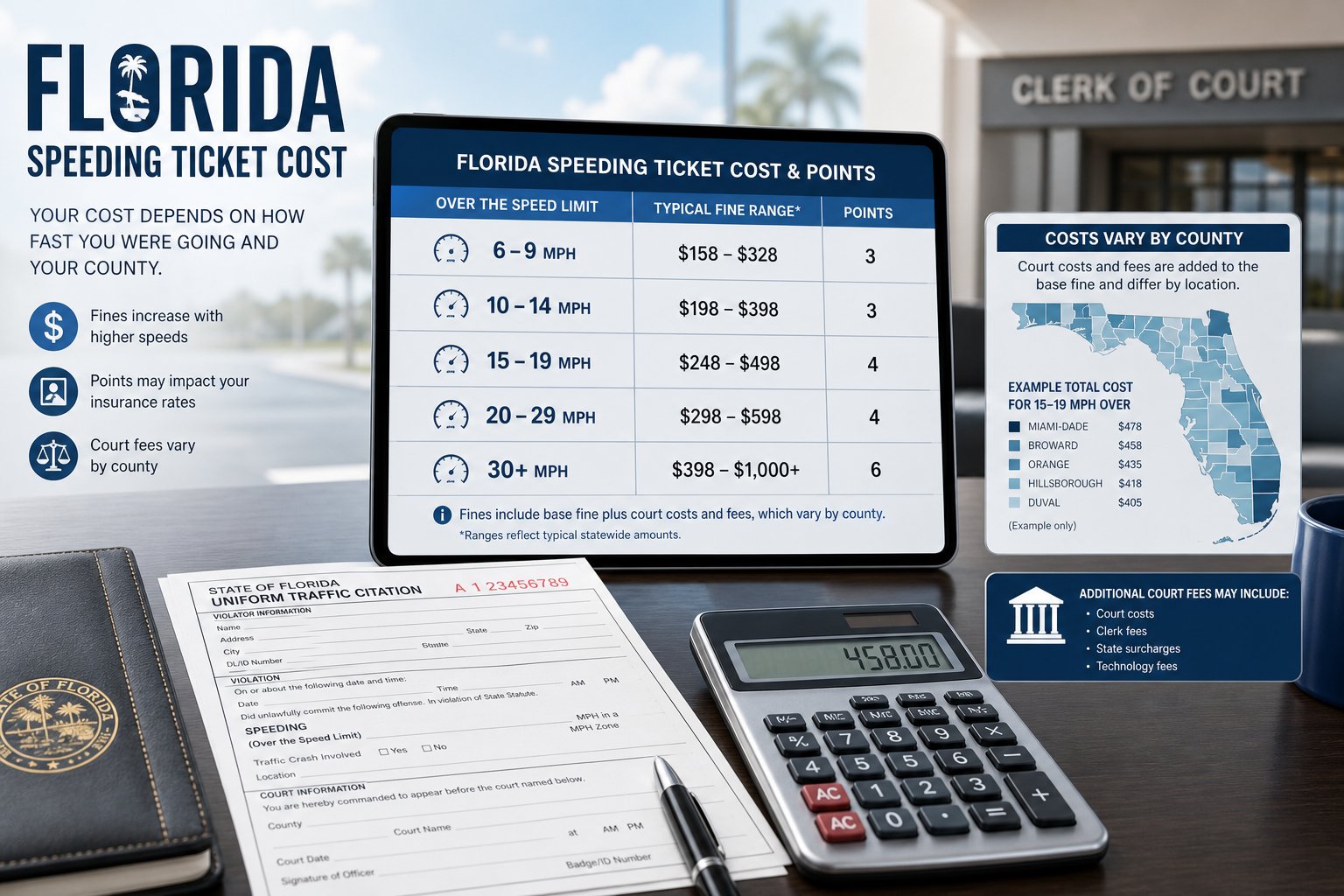
A Florida speeding ticket usually costs about $150 to $300 or more on a normal road, but the total can be higher based on how fast you were going and where you got the ticket. Florida law sets base fines by speed range, then county court costs and other fees are added, so the amount on your citation is often much more than the base fine alone. In school zones, work zones, and some high-speed cases, the penalty can increase sharply, and you often must act within 30 days through the clerk or court listed on the ticket.
This article covers Florida requirements only.
Key Facts
- Base fine: Set by Florida Statute 318.18 based on how far over the limit you were driving
- Surcharges and fees: Court costs and local surcharges added on top — total is often 2 to 4 times the base fine
- School and work zones: Fines may be doubled when school is in session or workers are present
- Points: 3 points for under 15 mph over; 4 points for 15 mph or more over the speed limit
- Traffic school option: Electing BDI withholds adjudication — keeps points off your record for that citation
- Confirm with the clerk: The exact total due varies by county — always check before paying
Key Facts
- Base fine: Set by Florida Statute 318.18 based on how far over the limit you were driving
- Surcharges and fees: Court costs and local surcharges added on top — total is often 2 to 4 times the base fine
- School and work zones: Fines may be doubled when school is in session or workers are present
- Points: 3 points for under 15 mph over; 4 points for 15 mph or more over the speed limit
- Traffic school option: Electing BDI withholds adjudication — keeps points off your record for that citation
- Confirm with the clerk: The exact total due varies by county — always check before paying
How Much A Florida Speeding Ticket Usually Costs
If you’re asking how much is a speeding ticket in Florida, the short answer is: it depends on the speed and the county, but many drivers end up paying around $150 to $300+ for a standard speeding citation.
Florida law sets a base fine schedule for noncriminal speeding violations. Under Florida Statutes section 318.18, the base fine is generally:
- 6–9 mph over: $25
- 10–14 mph over: $100
- 15–19 mph over: $150
- 20–29 mph over: $175
- 30 mph or more over: $250
That sounds simple, but it’s not the full Florida speeding ticket cost. Counties add court costs, service charges, and other assessments. That’s why the amount printed on one ticket in one county may be different from a similar ticket in another.
For many tickets in the 10–29 mph over range, the real amount due often lands in the $200 to $300 range after added fees. County clerks often publish schedules showing those totals, and they can change.
Your citation should show where to pay or respond. You can also confirm the exact amount with the county clerk or court handling the case, not just a statewide chart. That matters because the citation, county, court, and case type can all affect what you owe.
What Makes The Fine Higher Than The Base Amount
The biggest reason drivers get surprised is that the base fine is only part of the bill. Florida traffic tickets usually include extra charges that can equal or even exceed the base amount.
Common add-ons include:
- Court costs
- County surcharges
- State assessments
- Other fees tied to the type of violation or location
So even if the legal base fine is modest, your total due may feel much larger. And that’s before you think about indirect costs like missed work, travel to court, or insurance changes.
Another factor is how far over the speed limit you were. The base fine goes up by speed bracket, and very high speeds can bring more serious consequences than a simple payable ticket. In some cases, a clerk schedule may not be the end of it because a hearing can be required.
County rules also matter. One Florida county may publish a different payable amount than another for the same basic speeding range because local fee schedules are not identical. You may also see higher totals in places with enhanced penalty zones or special assessments.
That’s why it’s smart to look at the exact instructions on your citation and then verify details through the county clerk, court, or official county traffic page before you choose how to respond.
When School Zones, Construction Zones, And Super Speeder Rules Apply
Special zones can raise the cost fast. In Florida, school zones and construction zones often carry tougher penalties than regular roads.
In a school zone, fines are commonly doubled, and even a small amount over the limit can be costly. Some schedules show 1–5 mph over in a school zone at $50 or more before you even get into larger speeding ranges. The reason is simple: the law treats these areas as higher risk.
In a construction or work zone, fines can also be doubled, especially when workers or equipment are present. If your citation came from a posted work zone, don’t assume the normal amount applies.
Florida also has situations that work like super speeder cases, even if that exact nickname is not always used in the statute. Very high speeds can trigger mandatory court appearances, higher fines, or more serious charges. A ticket for 30+ mph over may not be something you can handle the same way as a lower-speed citation. In some fact patterns, an officer may write a more serious charge such as reckless driving instead of, or plus to, a standard speeding infraction.
You can review the official penalty language in Florida Statutes and check your county clerk’s traffic page for local payable amounts. If your ticket mentions a school zone, work zone, hearing date, or mandatory appearance, follow those instructions closely.
How License Points And Insurance Increases Add To The Real Cost
The fine is only the first layer. The real cost of a speeding ticket can be much higher because of license points and possible insurance increases.
According to Florida traffic rules, speeding convictions often add 3 or 4 points to your driving record, depending on the speed involved. The Florida Highway Safety and Motor Vehicles site explains how points can lead to license consequences if they build up over time. One ticket may not suspend your license, but several can create a much bigger problem.
Insurance is where many drivers feel the biggest hit. A single speeding ticket can affect your premium for years, and even a moderate rate increase can add up to far more than the fine itself. Estimates vary by insurer, driver history, speed, and location, but the long-term cost can easily reach hundreds or even thousands of dollars.
That’s why drivers often focus only on the amount due to the clerk and miss the wider picture. A $200-ish ticket is frustrating. But if it also adds points and raises your insurance, the total effect can be much worse.
If you’re eligible for a lawful option that may reduce the impact, such as a Florida Basic Driver Improvement course in the right case, it can be worth looking at carefully. But eligibility, deadlines, and results depend on the citation, county, court, judge, and case type.
Your Options After Getting A Florida Speeding Ticket
After you get a speeding ticket in Florida, you usually have a few basic options. The exact choices depend on the citation and the county handling it, but the most common paths are:
- Pay the ticket
- Elect traffic school, if allowed
- Request a hearing or contest the ticket
If you simply pay the ticket, that usually means you are resolving it as charged. In many cases, that also means points may be assessed if the offense is point-bearing.
If the citation allows it, you may be able to choose traffic school instead. Florida courts and clerks often refer to this as a Basic Driver Improvement (BDI) election. The Florida Courts system and county clerk traffic pages can help you confirm what applies in your case.
You can also choose to contest the ticket. Some drivers do that on their own, while others hire a traffic attorney. Whether that makes sense depends on the speed alleged, the county, the hearing requirements, and the possible effects on your record.
The big thing is timing. In many cases, you must respond within 30 days of the citation. Missing that deadline can create extra fees or license problems through the FLHSMV.
When Traffic School Can Help You Save Money And Avoid Points
If you are eligible, a Florida BDI course can sometimes reduce the damage from a speeding ticket. In many cases, electing traffic school leads to about an 18% fine reduction, and if the court withholds adjudication, points may not be added for that citation. Florida rules also generally limit how often you can make that election: once every 12 months and no more than five times in your lifetime.
That said, traffic school is not available for every ticket, and it does not guarantee the same outcome in every case. Serious charges, court-ordered situations, or specific clerk instructions may change what is allowed.
If your citation and county instructions allow it, you can review Driving Logic’s Florida Basic Driver Improvement course as an online option built for busy schedules and fast completion.
How County Fees, Deadlines, And Payment Choices Can Affect What You Owe
Florida ticket costs are not truly one-size-fits-all. County fees, deadlines, and payment methods can change the amount you owe and the options you have.
Many county clerks publish traffic fine schedules online. For example, counties such as Palm Beach, Pasco, and Alachua may show different total amounts for similar speeding ranges because their added costs and local schedules differ. That’s why the most reliable number is the one listed by the county clerk or court handling your case.
Deadlines matter just as much as dollars. For many noncriminal traffic citations, you generally must pay, elect school, or request a hearing within 30 days. If you miss the deadline, the case can become more expensive and more complicated. Late fees, collection issues, or even license suspension steps may follow depending on the case status and FLHSMV reporting.
Payment choices can matter too. Some counties offer:
- Online payment portals
- Mail-in options
- In-person payment
- Payment plans in limited situations
- Traffic school election forms that change the amount due
If your county allows a BDI election, the clerk may show a reduced amount tied to that choice. But don’t assume the same process applies everywhere. Eligibility, deadlines, fees, court procedures, and clerk instructions can depend on the citation, county, court, judge, and case type.
Check the official county clerk or court site listed on your ticket, read every instruction, and respond before the deadline. Not legal advice.
How County Rules and Fines Can Vary
Florida traffic ticket fine amounts, court costs, and surcharges vary significantly by county. The base fine for a speeding violation is set by state law under Florida Statute 318.18, but county and local surcharges, court costs, and administrative fees can substantially increase the total amount due. Check with the Clerk of Court in the county where the ticket was issued for the exact total amount and any local requirements before paying or electing traffic school.
FAQ
How much does a Florida speeding ticket actually cost?
The total cost of a Florida speeding ticket includes the base fine, court costs, and local surcharges. The base fine varies by how far over the speed limit you were driving and is set by Florida Statute 318.18. After adding court costs and surcharges, the actual amount paid is often two to four times the base fine. Confirm the exact total with the Clerk of Court in the county where the ticket was issued.
Does the speed over the limit affect the fine?
Yes. Florida speeding fines increase with the degree of the violation. Driving significantly over the limit results in a higher base fine. School zone and work zone violations may double the fine.
What are the surcharges and court costs added to a Florida speeding ticket?
In addition to the base fine, Florida adds state and local surcharges, court costs, and administrative fees. These vary by county but substantially increase the amount owed beyond the stated fine.
Can I lower the total cost by electing traffic school?
Electing traffic school does not reduce the fine you owe — you still pay the citation fine and an election fee to the clerk. However, it withholds adjudication, which means no points are added to your record. That can prevent longer-term costs like insurance rate increases or suspension-related expenses.
What happens to my insurance if I pay a Florida speeding ticket?
Paying the fine results in adjudication and points on your record. Whether and how much your insurance rate increases depends on your insurer, your policy, and how many violations you already have. Electing traffic school may limit this impact in some cases — confirm with your insurer.
Does a Florida speeding ticket in a school zone cost more?
Yes. Florida law provides for increased fines in school zones when school is in session or children are present. Work zone fines may also be doubled when workers are present. These apply regardless of whether you elect traffic school.
Conclusion
The total cost of a Florida speeding ticket is always higher than the stated fine — often significantly so after court costs and surcharges are added. Electing traffic school keeps points off your record and can reduce long-term costs, even though it does not reduce the fine itself. Confirm the exact total with the clerk before making any decision.
Take the Florida BDI course online at Driving Logic
Related Articles
- Florida Traffic Ticket: Costs, Points, and Traffic School Options
- Florida Red Light Camera Tickets: Do They Add Points to Your License?
- Florida Traffic Ticket Options: Pay, Elect Traffic School, or Contest
- Florida Speeding Ticket Fines: What Affects the Cost?
Sources
- FLHSMV — Driver Improvement Schools
- FLHSMV — Basic Driver Improvement Course Providers
- Florida Statute 318.14 — Noncriminal Traffic Infractions
- Florida Statute 322.27 — Authority of Department to Suspend or Revoke License
- Florida Clerks of Court
Billy Forte is the owner of Driving Logic, a state-approved driver improvement course provider serving Florida and other U.S. states. Driving Logic offers FLHSMV-approved online BDI courses for drivers handling traffic tickets, court orders, and state requirements.
This article is general information, not legal advice. Eligibility, deadlines, court acceptance, and filing steps depend on the citation type, county, court, judge, and the facts of your case. Use official Florida court and state sources for current requirements, and consult a qualified Florida attorney for legal guidance specific to your situation.