
Updated June 2026 · Reviewed by Billy Forte
Florida school zone and work zone speeding tickets can carry higher fines than regular speeding tickets, and a paid ticket can still add points unless a valid option such as a Basic Driver Improvement election applies in your case. In Florida, school-zone penalties are enhanced under state law, and some school-zone camera violations start as a civil notice to the registered owner before they turn into a traffic citation if they are not handled on time. Work-zone penalties can also increase when workers are present or as listed on the citation, and your eligibility, deadlines, fees, and court steps can depend on the county, court, judge, citation type, and the clerk’s instructions.
This article covers Florida requirements only.
Key Facts
- School zone fine: Typically doubled when school is in session or children are present in the zone
- Work zone fine: Typically doubled when workers are present in the active work zone
- Points: Standard point values still apply — 3 points for under 15 mph over; 4 points for 15 mph or more over
- Traffic school option: Eligible school zone and work zone speeding citations may qualify for traffic school election
- Election deadline: Standard 30-day window from the citation date still applies
- Confirm eligibility: The specific citation type and county rules determine whether election is available — check with the Clerk of Court
Key Facts
- School zone fine: Typically doubled when school is in session or children are present in the zone
- Work zone fine: Typically doubled when workers are present in the active work zone
- Points: Standard point values still apply — 3 points for under 15 mph over; 4 points for 15 mph or more over
- Traffic school option: Eligible school zone and work zone speeding citations may qualify for traffic school election
- Election deadline: Standard 30-day window from the citation date still applies
- Confirm eligibility: The specific citation type and county rules determine whether election is available — check with the Clerk of Court
How Florida School Zone Speed Limits And Enforcement Work
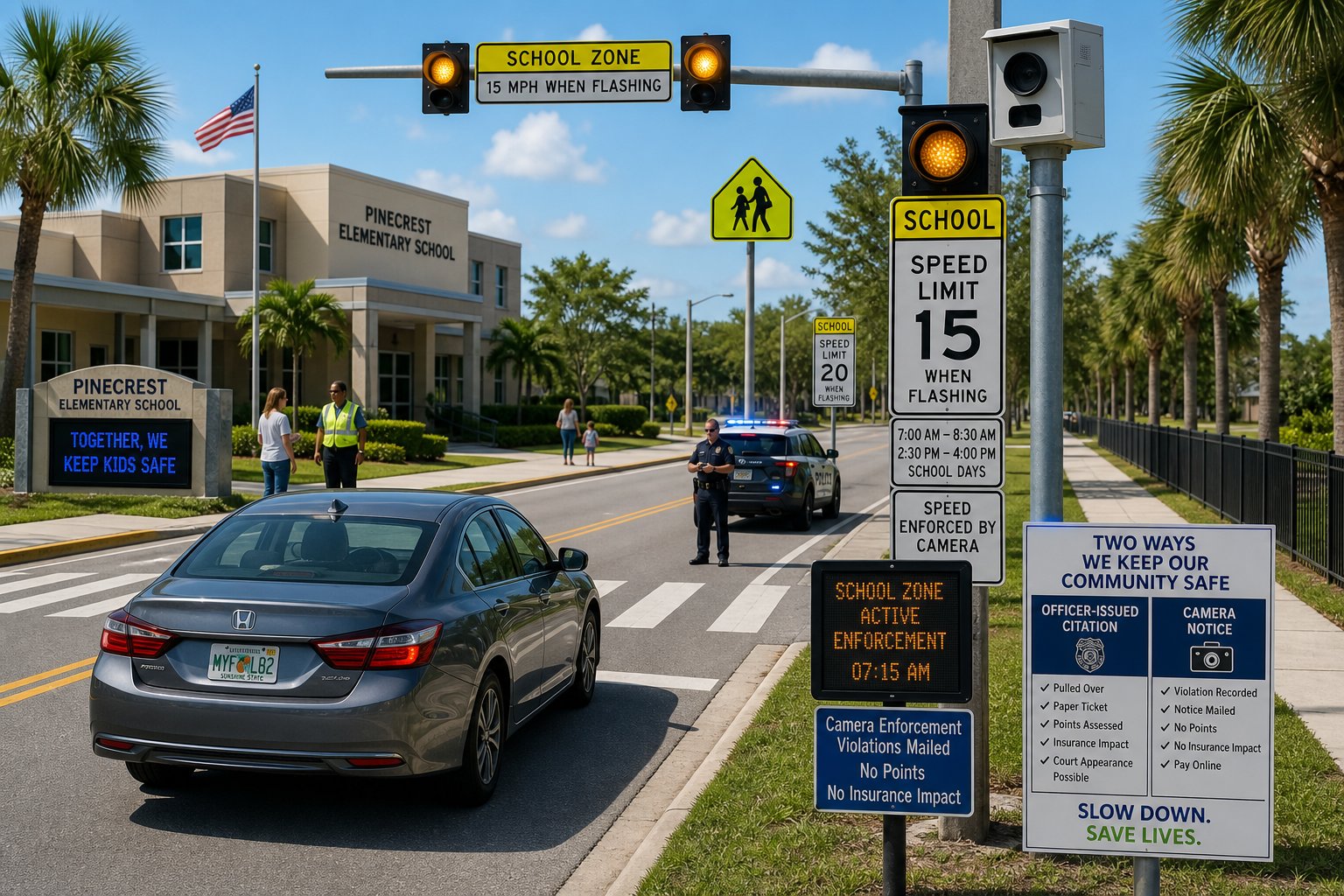
Florida treats school zones differently from ordinary roads because the reduced speed limit applies only during specific times and under posted conditions. Under Florida Statutes section 316.1895, a school-zone speed limit is generally enforced during the periods set by law and local posting, including around the start and end of the school day. If the zone uses flashing lights, drivers should assume the lower limit is active when those lights are operating.
That timing point matters. A driver may pass the same road twice in one day and face two different legal speed limits. If the regular road speed is 35 mph, but the posted school-zone limit drops to 20 mph during active school-zone hours, the ticket is based on the lower active limit, not the normal roadway limit.
Enforcement can happen in more than one way:
- A law enforcement officer can stop you and issue a citation.
- Some areas may use school-zone speed cameras where authorized.
- The violation may depend on posted signs, flashing lights, and the exact time of day.
Because of that, details on the citation matter. Check the listed location, the time, the posted speed, and whether the zone was active. If it was a camera-based matter, the notice should usually identify the date, time, place, and image evidence. Florida court and clerk procedures are not uniform in every county, so always review the citation and any local instructions closely.
Penalties For A School Zone Speeding Ticket In Florida
A school zone speeding ticket Florida drivers receive can cost more than a standard speeding ticket because Florida law allows enhanced penalties in school zones. Reported fine examples tied to section 316.1895 include:
- $50 for 1–9 mph over
- $200 for 10–14 mph over
- $300 for 15–19 mph over
- $350 for 20–29 mph over
- $500 for 30 mph or more
Actual amounts due can still vary because courts and clerks may add required costs and fees. So the amount printed on your citation or court paperwork is the number that controls your case.
Points are a separate issue from fines. In many moving-violation cases, paying the ticket counts as an admission or conviction for traffic purposes, and points may be reported to the Florida Department of Highway Safety and Motor Vehicles (FLHSMV) depending on the violation and outcome. You can review licensing information through FLHSMV.
That does not mean every driver has the same result. Whether points are assessed, whether court is required, and whether any school-election option is available can depend on the citation, your prior elections, the county, the judge, and the kind of ticket issued. A school-zone camera notice may also follow a different path than an officer-issued moving violation.
And if you are also searching for a work zone speeding ticket Florida issue, the big idea is similar: fines can be higher than normal, especially when workers are present or the statute and citation call for enhanced penalties.
When A School Zone Speeding Case Can Become More Serious
Some school-zone cases stay at the citation level. Others become more serious fast.
The biggest factor is usually how far over the limit the driver was alleged to be going. Higher speeds can trigger larger fines, mandatory court appearance requirements, and greater risk of added penalties. In extreme situations, the facts can raise questions beyond simple speeding, including potential reckless-driving exposure depending on the conduct alleged.
Repeat issues can also matter. A driver with prior traffic history may face less flexibility than someone with a clean record. That does not mean the outcome is fixed, but it can affect whether a clerk, hearing officer, or judge allows certain options.
Other facts can make the case worse too:
- Children or crossing activity were present
- The zone was clearly marked and flashing
- The speed alleged was far above the posted school-zone limit
- There was an accident or near miss
- The driver missed a required court date or deadline
If the citation orders a court appearance, take that seriously. Do not assume you can simply pay it online. Some school-zone cases require you to appear or respond in the way the court directs. The Florida Courts system and local clerk websites can help you find county-specific information, but the exact rules may still vary by court and case type.
If your paperwork mentions mandatory appearance, enhanced penalties, or a criminal-type charge instead of a standard infraction, it is wise to read every line carefully and respond exactly as instructed.
What Happens If You Pay The Ticket Or Ignore It
If you pay the ticket, that is often treated as admitting the infraction for traffic purposes. In many cases, that means the case closes as a conviction and any applicable points can be reported to FLHSMV. For a school-zone speeding ticket, that can leave you with both the fine and the license impact.
A lot of drivers pay quickly just to move on. Sometimes that is the right practical choice. But before you do, check whether the citation or county instructions list any other lawful option, such as requesting a hearing or, in some cases, electing a course if permitted.
If you ignore the ticket, the problem usually gets worse, not better. Missing a deadline can lead to a license suspension for failure to comply, added obligations, and more complicated court handling. If the court ordered you to appear and you do not, the consequences can be even more serious.
That is why the safest approach is simple:
- Read the citation fully
- Check the response deadline
- Follow the clerk or court instructions
- Verify whether your case is a moving violation, camera notice, or mandatory-appearance matter
Because Florida procedures vary, do not rely on a friend’s experience in another county. Your case may have different deadlines, fees, and response options. If you are unsure what type of notice you received, start with the citation itself and the issuing county’s clerk or court website.
Your Options To Fight The Ticket Or Reduce The Impact
You usually have a few possible paths, but the right one depends on the kind of ticket and what the paperwork says. In Florida, common options may include paying the citation, requesting a hearing, contesting the allegation, or using a traffic-school election if your case qualifies.
If you plan to fight the ticket, facts matter. Drivers often focus on issues like:
- Was the school zone active at that time?
- Were the signs visible and clear?
- Were flashing lights working properly, if used?
- Is the location listed correctly?
- Was the speed reading accurate?
- Do photos, dashcam footage, or witness statements support your account?
These are not magic defenses, and they do not guarantee a dismissal. But they are the kinds of practical issues that can matter in a hearing.
Keep your records. Save the citation, envelope, photos, screenshots, and any camera or dash footage. If the case involves a camera notice, review the notice closely for the vehicle plate, date, time, and location.
When Traffic School May Help
A Florida Basic Driver Improvement (BDI) course may help in some traffic cases, but you should not assume it is automatically available for every school-zone violation. Eligibility can depend on your prior elections, the type of citation, whether the case requires court, and local handling. Some sources note that a judge is not required to offer traffic school for a school-zone ticket.
If your citation or court allows a BDI election, the course may help reduce the impact of the case in the way Florida law permits. It does not guarantee dismissal, point removal in every situation, or any specific insurance result.
If you need an online option, you can review the Florida Basic Driver Improvement course through DrivingLogic and compare it with your citation instructions before enrolling.
School Zone Cameras, Photo Enforcement, And What To Check On A Notice
School-zone camera enforcement in Florida can look different from a standard officer-issued speeding ticket. In many programs, the registered owner first receives a Notice of Violation when the vehicle is recorded above the threshold set by law or local authority, often more than 10 mph over in the school zone. That notice may offer choices such as paying, requesting a hearing, or submitting an affidavit if another person was driving, depending on the program rules.
A notice should be reviewed carefully. Check for:
- The date and time of the event
- The exact location
- The vehicle information and plate
- The speed alleged and posted limit
- Photo or video access information
- Response deadline and hearing instructions
These details matter because camera cases are document-driven. If something is wrong, that may affect how you respond. But do not guess. Use the instructions on the notice and the issuing local authority’s website.
Also, understand the difference between a civil notice and a later citation. Some school-zone camera matters begin as a civil notice and can escalate if not handled by the deadline. That is one reason drivers should act promptly and keep copies of all submissions.
For background, review official state and local materials, such as FLHSMV, Florida Courts, the Florida Legislature’s statutes site, and the county clerk or court page listed on your paperwork.
This article is for general information only and is not legal advice.
How County Rules and Fines Can Vary
Florida traffic ticket fine amounts, court costs, and surcharges vary significantly by county. The base fine for a speeding violation is set by state law under Florida Statute 318.18, but county and local surcharges, court costs, and administrative fees can substantially increase the total amount due. Check with the Clerk of Court in the county where the ticket was issued for the exact total amount and any local requirements before paying or electing traffic school.
FAQ
Are Florida speeding fines higher in school zones?
Yes. Florida law provides for increased fines for speeding violations in school zones when school is in session or children are present. The fine is typically doubled compared to the standard fine for the same speed over the limit.
Are work zone speeding fines higher in Florida?
Yes. Florida law provides for increased fines in active work zones when workers are present. Like school zone violations, the fine is typically doubled. The presence of workers at the time of the violation is generally required for the enhanced fine to apply.
Do school and work zone speeding tickets add more points to my license?
No. The point values for speeding violations are the same regardless of whether the ticket occurred in a school or work zone — 3 points for speeds under 15 mph over the limit and 4 points for 15 mph or more over. The zone affects the fine amount, not the point value.
Can I elect traffic school for a school zone or work zone speeding ticket in Florida?
In most cases, yes — if the citation is for a noncriminal moving violation that would otherwise qualify for a traffic school election under Florida Statute 318.14. The school or work zone designation affects the fine amount, not necessarily the eligibility for election. Confirm with the Clerk of Court before assuming eligibility.
What is the election deadline for a school zone or work zone speeding ticket?
The standard election deadline of approximately 30 days from the citation date applies. Contact the Clerk of Court as soon as possible to confirm the exact deadline for your citation.
What should I do first after getting a school zone or work zone speeding ticket?
Check your citation for the exact violation charged and any special instructions. Contact the Clerk of Court in the county where the ticket was issued to confirm the total fine amount, the election deadline, and whether your specific citation qualifies for a traffic school election.
Conclusion
School zone and work zone speeding tickets in Florida carry higher fines than standard speeding violations, but the same point values and traffic school options generally apply. If you want to keep points off your record, confirm eligibility with the Clerk of Court and act within the 30-day election window.
Take the Florida BDI course online at Driving Logic
Related Articles
- Florida Traffic Ticket: Costs, Points, and Traffic School Options
- Florida Speeding Ticket Cost: What Affects the Total?
- Florida Red Light Camera Tickets: Do They Add Points to Your License?
- Florida Traffic Ticket Options: Pay, Elect Traffic School, or Contest
Sources
- FLHSMV — Driver Improvement Schools
- FLHSMV — Basic Driver Improvement Course Providers
- Florida Statute 318.14 — Noncriminal Traffic Infractions
- Florida Statute 322.27 — Authority of Department to Suspend or Revoke License
- Florida Clerks of Court
Billy Forte is the owner of Driving Logic, a state-approved driver improvement course provider serving Florida and other U.S. states. Driving Logic offers FLHSMV-approved online BDI courses for drivers handling traffic tickets, court orders, and state requirements.
This article is general information, not legal advice. Eligibility, deadlines, court acceptance, and filing steps depend on the citation type, county, court, judge, and the facts of your case. Use official Florida court and state sources for current requirements, and consult a qualified Florida attorney for legal guidance specific to your situation.