
Updated June 2026 · Reviewed by Billy Forte
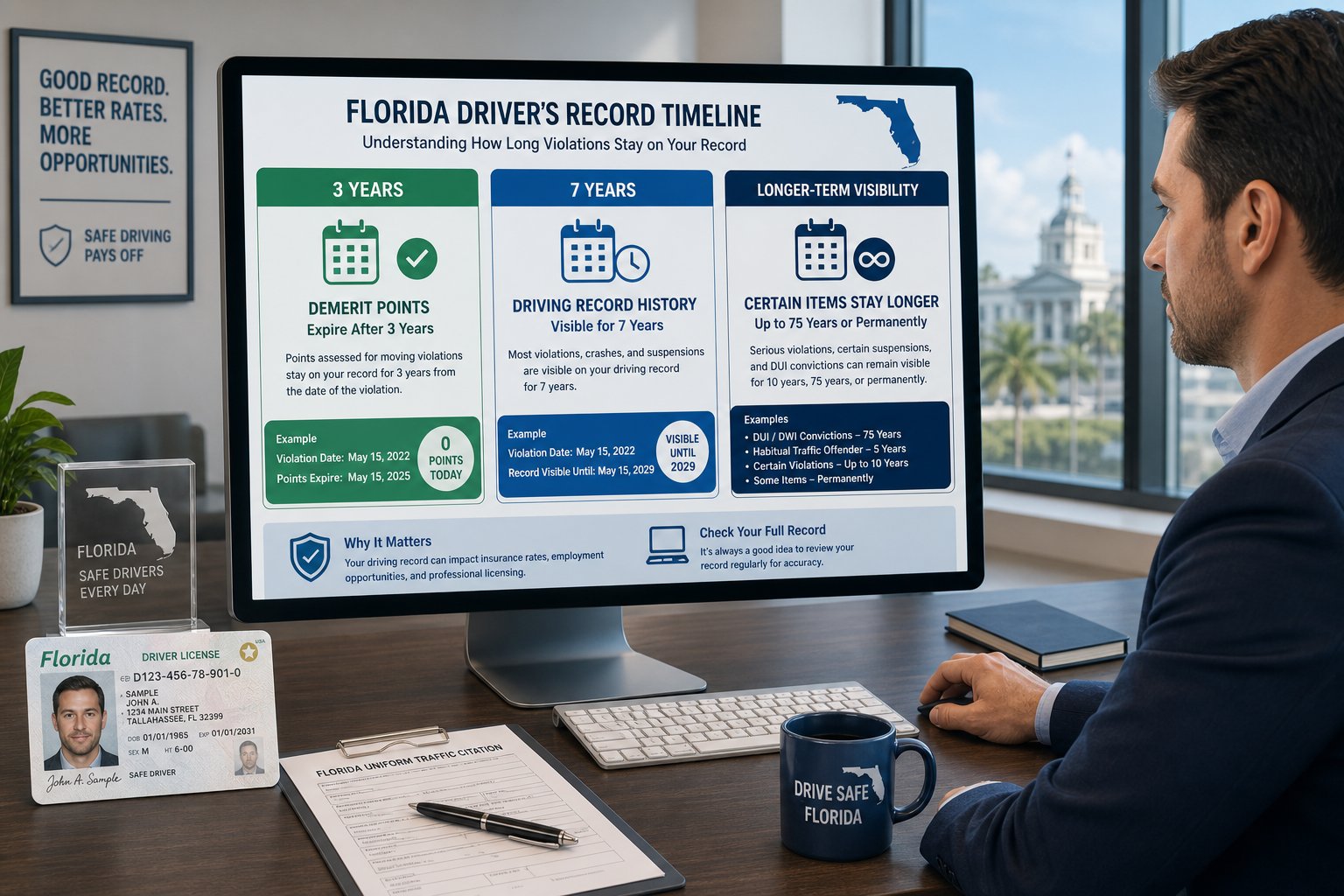
A Florida speeding ticket usually stays on your driving record for at least 3 years for points, but the ticket or conviction can stay visible longer. Florida demerit points from a speeding ticket stay on the record for 36 months from the conviction date, while a fuller driving record can show the violation for 7 years or more depending on the record type and offense. If you are eligible and choose a Florida Basic Driver Improvement course, also called traffic school or a defensive driving course, the case may be handled with adjudication withheld so it does not appear as a conviction, though insurance companies may still look back beyond 3 years.
This article covers Florida requirements only.
Key Facts
- Point suspension: Florida may suspend a license at 12 points in 12 months, 18 points in 18 months, or 24 points in 36 months.
- Speeding points: Less than 15 mph over is generally 3 points; 15 mph or more over is generally 4 points; speeding resulting in a crash is 6 points.
- Offense dates: Florida computes point-suspension periods using the offense dates of convictions.
- BDI limit: An eligible BDI election can help prevent points on a current citation, but it does not erase old points.
- Clerk rules: Election deadlines, certificate filing, and court instructions can vary by county and citation.
If your goal is to prevent new points on an eligible current citation, review the Florida Basic Driver Improvement course before your clerk or court deadline.
Florida points usually stay on your record for 3 years. That is the short answer most drivers need.
For a standard speeding ticket, the demerit points stay for 36 months. Florida measures that from the conviction date for point purposes. That matters because the court date and the date you got the ticket are not always the same.
But points and the ticket itself are not the same thing. A 3-year personal record is often used for point totals and some basic checks. A 7-year full record can show more history. In many cases, the ticket or conviction can remain visible well past the 3-year point window.
That is why the answer to how long does ticket stay on record florida has two parts:
- Points: usually 3 years
- Conviction entry: often longer
- Serious offenses: much longer, sometimes decades
For common moving violations like speeding, failure to yield, or careless driving, the record entry may be seen for 3 to 5 years or more, depending on who is checking and which record they pull. For DUI and some criminal traffic cases, the impact can last far longer.
The official record is handled by the Florida Department of Highway Safety and Motor Vehicles. If you need to check what is on your record, getting your own copy is the safest place to start.
What Shows Up On A Florida Driving Record
A Florida driving record can show much more than one speeding ticket. It is a history of your driving status and traffic cases.
A typical record may include:
- Moving violations, like speeding or running a red light
- Non-moving violations, in some cases
- Traffic violation points
- License suspension, revocation, or cancellation entries
- Court actions tied to a citation
- Serious offenses, such as DUI or reckless driving
- Driver improvement course completion in some situations
This is where many drivers get confused. They think if points drop off after 3 years, the whole event disappears. Often, it does not. The point total may age out, but the case history can still show on a full record.
Florida offers different record types through FLHSMV. A short record may show less history. A full record may show much more. Employers, insurers, and courts may not all look at the same version.
If you took BDI, which is the same as traffic school or a defensive driving course in Florida, the case may show a result like adjudication withheld instead of a conviction. That difference is important. A withheld adjudication can help you avoid points for an eligible civil traffic infraction, but it does not mean the stop never happened.
If you need county case details, you can often find them through the Florida Clerk of Court system.
Civil Infractions Vs. Criminal Traffic Offenses In Florida
Most speeding tickets in Florida are civil traffic infractions. That means they are not criminal charges.
Civil infractions usually lead to a fine, court costs, and possibly points. Common examples include:
- Speeding
- Red light violations
- Failure to yield
- Careless driving
These cases can still raise insurance costs and add points. But they do not usually carry jail time.
Criminal traffic offenses are different. They are more serious and can stay on your record much longer. Examples can include DUI, reckless driving in some cases, leaving the scene of a crash, and some charges for driving while license suspended.
Criminal cases can bring:
- Higher fines
- Probation
- Court supervision
- Possible jail
- Long-term record impact
This difference matters because the answer to how long does speeding ticket stay on florida record is not the same as the answer for DUI. A normal speeding ticket often has a 3-year point impact. A criminal traffic case can affect your record for many years, and sometimes for life in practice.
Florida traffic procedure is shaped in part by Florida Statute 318.14, which covers how many traffic citations are handled. Still, the exact result can depend on the citation type, county, court, judge, and your case facts.
How Points Work And When A Suspension Can Happen
Florida uses a point system for many traffic violations. A speeding ticket often adds 3 or 4 points, depending on the speed involved.
Those points stay active on your driving record for 36 months. During that time, they count toward a possible license suspension.
The main Florida point thresholds are:
- 12 points in 12 months: 30-day suspension
- 18 points in 18 months: 3-month suspension
- 24 points in 36 months: 1-year suspension
This is why one ticket may not seem like a big deal, but several in a short time can turn into a real problem. The point system is cumulative.
And timing matters. If you already have recent points, a new speeding ticket can push you over the line. That can happen even if each ticket alone seems minor.
For eligible drivers, a Basic Driver Improvement election can help avoid points on one qualifying civil ticket. In Florida, BDI, traffic school, and defensive driving course usually mean the same FLHSMV-approved 4-hour course. If accepted, it can lead to adjudication withheld, which means no conviction and no points for that ticket.
Still, not every ticket qualifies. Rules can depend on the county, the court, your driving history, and the type of citation. So read the ticket and court notice closely, then confirm the deadline with the Clerk of Court.
How A Ticket Can Affect Insurance Rates And Driving Costs
A ticket can cost you more than the fine. Insurance is often the bigger long-term expense.
Many insurers review 3 to 5 years of driving history when setting rates. So even after your Florida demerit points age off at 3 years, the underlying ticket or conviction may still affect what you pay.
This is the key split:
- Points affect your Florida driving status for 3 years
- Convictions may affect insurance longer
- Serious offenses can affect rates for far longer
For example, one speeding ticket may raise rates for a few years. Multiple moving violations can lead to much higher premiums. In some cases, a company may decide not to renew your policy.
That is one reason drivers look hard at all legal options after getting a ticket. If you are eligible to elect BDI and receive adjudication withheld, that may help because the case does not appear as a conviction. But insurance companies use their own rating rules, and they may review more than one source.
Beyond insurance, a ticket can also affect other costs:
- Extra fees tied to reinstatement after suspension
- Lost time from court or classes
- Job concerns for drivers with employer checks
So the ticket itself is only part of the total cost.
What To Do After Getting A Ticket In Florida
Do not ignore a Florida traffic ticket. In many cases, you must act within 30 days.
Your usual options are:
- Pay the ticket
- Elect a Basic Driver Improvement course, if eligible
- Ask for a hearing and contest it in court
- Get legal help for serious or criminal traffic charges
If you pay the ticket, that is usually treated as a conviction. Points are then added if the offense carries points.
If you elect BDI, and the court allows it, you take a Florida-approved 4-hour course. In Florida, people often call this traffic school or a defensive driving course, but it is the same BDI option. For an eligible case, that can lead to adjudication withheld, which means no conviction and no points.
If you contest the ticket, the court could dismiss it, reduce it, or withhold adjudication. Outcomes vary. They depend on the citation, the county, the judge, and the facts.
Start with the instructions on your citation and verify your deadline through the local Clerk of Court. If you need an online Florida BDI course, you can take one through Driving Logic, which is built for busy drivers who want flexible access on any device and fast proof of completion.
Can A Florida Ticket Be Removed From Your Record?
Usually, you cannot erase a final traffic conviction from your Florida driving record. That is the hard truth.
What you often can do is prevent the conviction from being entered in the first place. That can happen if:
- The court dismisses the ticket
- You receive withhold of adjudication
- You elect traffic school when allowed
That is why fast action matters. Once you simply pay a ticket, the case often becomes a conviction, and that record can stay visible long after the 3-year point period ends.
There are narrow cases where some records may be sealed or expunged through the court system, but that is limited and usually does not apply to a standard final traffic conviction. Serious cases also follow different rules.
So if your main question is, how long does a Florida speeding ticket stay on my driving record, the practical answer is this: the points usually stay for 3 years, but the ticket or conviction can remain on the record much longer. If you qualify for BDI or win in court, you may avoid a conviction entry for that ticket.
Check the official rules with FLHSMV, review your county court instructions, and make sure any course you take is approved. This article is general information only and not legal advice.
FAQ
How long does a speeding ticket stay on your record in Florida?
For point accumulation purposes, a speeding ticket affects your Florida driving record for 3 years from the violation date. The actual violation entry may remain on your FLHSMV driving record for a longer period depending on the type of record requested.
When does the 3-year period start for a Florida speeding ticket?
The 3-year clock starts on the date the violation occurred — not when you paid the ticket or when it was adjudicated in court.
Does a Florida speeding ticket stay on my record if I elected traffic school?
Electing traffic school and completing a BDI course withholds adjudication — no points are added for that citation. The election itself and the withheld adjudication may still appear on your FLHSMV record, but without a point entry. Your insurance may or may not treat a withheld adjudication the same as a conviction.
How long do insurers look at a Florida speeding ticket?
Insurance companies set their own lookback periods, commonly 3 to 5 years for standard violations, and sometimes longer for serious violations or accidents. This may extend beyond the 3-year point window.
Is there a difference in how long a criminal speeding charge stays on record vs. a civil infraction?
Yes. A civil speeding infraction follows FLHSMV’s record retention schedule, with points affecting your record for 3 years. A criminal charge becomes part of your criminal record and stays indefinitely without expungement.
Can I get a speeding ticket removed from my Florida driving record?
Civil traffic infraction convictions are generally not removable from your FLHSMV driving record before the natural retention period expires. Points drop off after 3 years from the violation date; the record entry may remain longer.
Conclusion
A Florida speeding ticket affects your point total for 3 years from the violation date, but the record entry may stay on file longer. Traffic school election withholds the adjudication and prevents points from being added — the most practical step available if the citation qualifies and you act within the election window.
Take the Florida BDI course online at Driving Logic
FAQ
How long does a speeding ticket stay on your record in Florida?
For point accumulation purposes, a speeding ticket affects your Florida driving record for 3 years from the violation date. The actual violation entry may remain on your FLHSMV driving record for a longer period depending on the type of record requested.
When does the 3-year period start for a Florida speeding ticket?
The 3-year clock starts on the date the violation occurred — not when you paid the ticket or when it was adjudicated in court.
Does a Florida speeding ticket stay on my record if I elected traffic school?
Electing traffic school and completing a BDI course withholds adjudication — no points are added for that citation. The election itself and the withheld adjudication may still appear on your FLHSMV record, but without a point entry. Your insurance may or may not treat a withheld adjudication the same as a conviction.
How long do insurers look at a Florida speeding ticket?
Insurance companies set their own lookback periods, commonly 3 to 5 years for standard violations, and sometimes longer for serious violations or accidents. This may extend beyond the 3-year point window.
Is there a difference in how long a criminal speeding charge stays on record vs. a civil infraction?
Yes. A civil speeding infraction follows FLHSMV’s record retention schedule, with points affecting your record for 3 years. A criminal charge becomes part of your criminal record and stays indefinitely without expungement.
Can I get a speeding ticket removed from my Florida driving record?
Civil traffic infraction convictions are generally not removable from your FLHSMV driving record before the natural retention period expires. Points drop off after 3 years from the violation date; the record entry may remain longer.
Conclusion
A Florida speeding ticket affects your point total for 3 years from the violation date, but the record entry may stay on file longer. Traffic school election withholds the adjudication and prevents points from being added — the most practical step available if the citation qualifies and you act within the election window.
Take the Florida BDI course online at Driving Logic
Related Articles
- Florida Driver License Points System: Suspensions, Point Values, and BDI Options
- Florida Teen and Young Driver Point Rules: Lower Thresholds
- Will My Florida Traffic Violations Show Up on a Background Check?
- Your Florida Driving Record: How to Get It and What It Shows
Sources
- Florida Statute 322.27 — Driver License Suspension and Point System
- Florida Statute 318.14 — Traffic Infractions and BDI Election
- FLHSMV — Driver Improvement Schools
- FLHSMV — Driver License Check
- Florida Clerks of Court
Billy Forte is the owner of Driving Logic, a state-approved driver improvement course provider serving Florida and other U.S. states. Driving Logic offers FLHSMV-approved online BDI courses for drivers handling traffic tickets, court orders, and state requirements.
This article is general information, not legal advice. Eligibility, deadlines, court acceptance, license consequences, insurance decisions, and filing steps depend on the citation type, county, court, judge, and facts of your case. Use official Florida court and state sources for current requirements, and consult a qualified Florida attorney for legal guidance specific to your situation.