
Updated June 2026 · Reviewed by Billy Forte
Indiana driver record points usually stay active for two years from the conviction date, but the conviction record can last longer. This article is for Indiana drivers who need a clear answer before choosing a course, responding to a notice, or checking their record. You will learn what the rule means, how the Driver Safety Program fits in, and what to check before your next step.
This article covers Indiana requirements only.
Key Facts
- Active period: Indiana points usually stay active for 2 years from conviction.
- Record history: The conviction can remain visible longer than the active point period.
- DSP credit: A DSP credit can help reduce active point totals.
- No deletion: DSP does not remove the conviction.
- Check record: Your Indiana BMV record is the best source for your dates.
How The Indiana Driver’s License Point System Works
If you need the approved online option, review the how long do points stay on your license in indiana before your deadline.
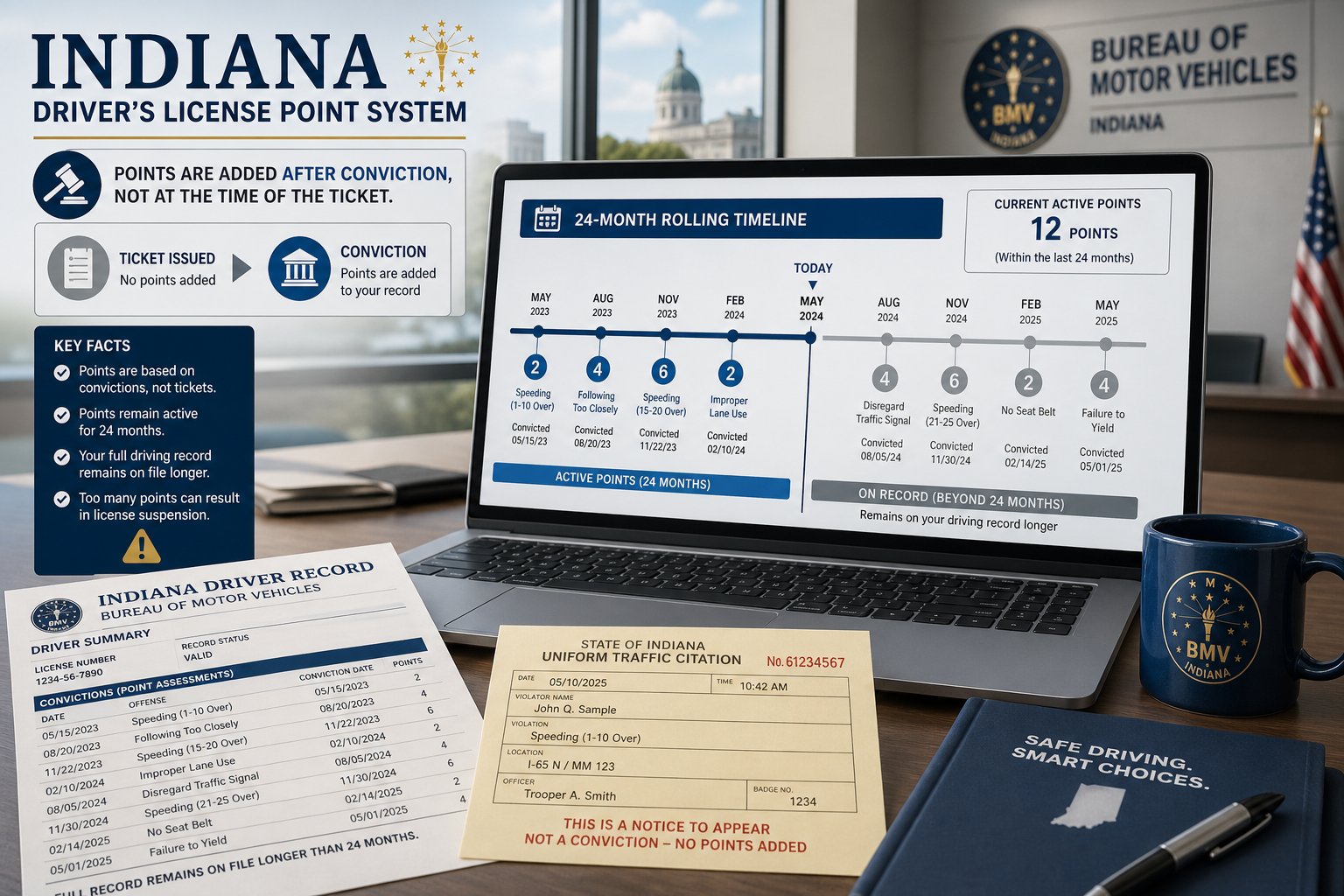
Indiana uses a demerit point system to track moving traffic convictions. In simple terms, the Indiana Bureau of Motor Vehicles adds points after a conviction, not when the officer first writes the ticket.
That difference matters. A citation alone does not mean points are already on your record. Points usually appear when you:
- pay the ticket and admit the violation
- are found responsible in court
- plead guilty to the offense
The Indiana BMV assigns point values based on the violation. Many common traffic offenses fall in the 2 to 8 point range. More serious conduct usually means more points.
The BMV also keeps a longer history of violations on your driving record. So if you are asking when do points fall off your license in Indiana, the key split is this:
- active points count for 2 years from the conviction date
- the underlying conviction may stay visible much longer
Indiana also looks at your point total over a 24-month rolling period. That means the state is not just looking at one calendar year or one license renewal cycle. It is always looking back 24 months from the present date to see how many active points you have.
This is why timing matters. Two old convictions may still count if both fall inside that rolling window. And one new ticket can push your total higher than you expected.
If your BMV notice, court order, or citation gives specific terms, follow those terms closely. Your options can depend on the notice, the court, the judge, your license status, and the facts of the case.
How Long Points Stay On Your Indiana Driving Record
The direct answer is simple: Indiana demerit points stay active for 2 years from the conviction date. That is the main rule drivers need to know.
So, how long do points stay on your license in Indiana? For BMV point-count purposes, the answer is 24 months after conviction. If you were convicted on June 10, , those points stay active until June 10, 2028.
But there is an important second part. The conviction itself may remain on your driving record longer. In many cases, entries can remain visible for about 10 years, and some offenses can remain even longer. That means the active points may expire, but the record of the violation does not necessarily disappear at the same time.
This is where many drivers get confused. “Points” and “record history” are related, but they are not the same thing.
What expires after 2 years
- the active demerit points tied to the conviction
- the points counted in the BMV’s 24-month suspension review
What may stay longer
- the traffic conviction itself
- the fact that the violation happened
- the record entry on your driving history
Indiana also allows some drivers to lower the effect of active points with the BMV-approved Driver Safety Program (DSP). This official course is 4 hours long. Completing it gives you a 4-point credit on the Indiana Official Driver Record. That credit can reduce your point total during the 2-year active period, but it does not remove the conviction and does not erase the underlying violation.
You can review the rules through the Indiana BMV driver safety and record resources and the Indiana Administrative Code.
Common Indiana Traffic Violations And Their Point Values
Indiana point values depend on the offense. The BMV publishes schedules for many common moving violations, and the assigned number helps determine your total risk for warning letters or a license suspension.
Here are common examples often seen on Indiana records:
- Speeding 1 to 15 mph over: 2 points
- Speeding 16 to 25 mph over: 4 points
- Speeding 26+ mph over: 6 points
- Disregarding a stop sign or signal: 4 points
- Improper U-turn: 4 points
- Following too closely: 4 points
- Unsafe lane movement: 4 points
- Reckless driving: 6 points
- Driving while suspended: 8 points
Those values show how fast points can add up. A pair of moderate speeding cases and one stop-sign conviction could place you near a warning range in less than two years.
The key detail is that points are tied to the conviction, not just the stop. So if your case is reduced, dismissed, or handled through an approved local deferral, the point impact may be different.
That is why it helps to read the ticket and any court notice carefully. The outcome can depend on:
- the court handling the case
- whether a judge allows a deferral
- the county program rules
- your prior driving record
- your current license status
For official point schedules and statutes, review Indiana’s legal sources such as the Indiana Code and BMV materials. If your citation lists a specific offense name, match that exact charge to the official source instead of guessing from a general label.
What Happens If You Get Too Many Points
Too many active points can lead to warnings, hearings, and suspension action by the Indiana BMV. The state uses your 24-month rolling point total to decide when to step in.
Indiana may send a warning letter around 14 to 18 points. That does not always mean your license is suspended, but it is a sign your record is getting close to a serious threshold.
At about 20 points within 24 months, the BMV may start an administrative hearing process and an automatic suspension can follow. Suspension time can increase as your total rises.
In practical terms, that means a driver with several convictions close together may face trouble even if each ticket seemed minor on its own. Four-point and six-point violations stack quickly.
A few things can affect what happens next:
- your exact point total
- the dates of each conviction
- whether you already received a BMV notice
- whether a court imposed separate terms
- whether you earned a 4-point credit through the DSP
That DSP credit can matter a lot. If you complete the BMV-approved Driver Safety Program, the Indiana Official Driver Record can show a 4-point credit. It reduces the total points the BMV sees during the active period, but again, it does not delete the conviction.
If you receive a BMV warning, hearing notice, suspension letter, or court order, read it closely and act by the stated deadline. Requirements can depend on the notice, your driver record, the court, the judge, and the facts in your case.
How To Check Your Indiana License Points And Suspension Status
You can check your Indiana driving record through the Indiana BMV online portal. That is usually the fastest way to see whether points are active and whether your license status shows a problem.
Indiana offers a free viewable driver record online. That can help you confirm recent activity, suspension status, and other record details. If you need a formal copy, you can also order an official driver record, which is commonly about $4, online or by mail using State Form 53789.
When you check your record, look for these details:
- each listed conviction date
- the offense description
- active point totals
- any suspension or reinstatement status
- whether a 4-point credit appears on the official record
The conviction date is especially important because that date controls the 2-year active point period. If you are trying to figure out when do points fall off your license in Indiana, counting from the conviction date is the right starting point.
Use official sources when possible:
If your record shows a suspension, do not assume it is an error without checking the notice details. A suspension can involve BMV action, a court order, unpaid items, or other case-specific facts.
How To Reduce Or Avoid Points After A Ticket
In Indiana, the best way to reduce point impact depends on your case. Some drivers can lower their point total, and some may avoid points if the case is resolved a different way.
One common option is the Driver Safety Program (DSP). This is the Indiana BMV-approved course, and it is 4 hours long. If you complete it and qualify, you can receive a 4-point credit on the Indiana Official Driver Record.
That credit is helpful, but it has limits:
- it reduces the point total
- it does not remove the conviction
- it does not erase the violation
- it is generally available once every 3 years
Another possible option is a deferral program offered through some Indiana courts or counties. If you complete a valid deferral, the violation may be dismissed based on that local program’s rules. But those programs are not the same in every county, and they can depend on the court, judge, ticket, driver record, and case facts.
Sometimes the only other path is time. If there is already a conviction, active points usually expire 2 years from the conviction date.
If you need a state-approved online course, you can review the Indiana Driver Safety Program at Driving Logic. For busy drivers, an online option can be easier to fit into a workweek.
Should You Pay The Ticket Or Fight It
Paying the ticket usually means admitting the violation. In many cases, that leads to a conviction and the matching demerit points.
Fighting the ticket can sometimes lead to a better outcome. Depending on the court and facts, it may result in:
- a reduced charge with fewer points
- a non-moving violation
- a local deferral option
- time to complete a required program
That does not mean fighting always works, and no result is guaranteed. But paying too fast can close off options.
Check the deadline on the citation and any court notice. If the Indiana BMV or a court requires the Driver Safety Program, or if you want to earn a 4-point credit on the Indiana Official Driver Record, you can start the approved online Indiana DSP through MyDrivingLogic.com.
This article also relates to searches for indiana bmv points expiration, but the safe answer depends on the Indiana BMV record, conviction date, and any court or BMV notice.
FAQ
Can the Indiana DSP help with points?
Yes, an approved Indiana Driver Safety Program may provide a 4-point credit when you qualify. It does not erase the conviction or violation.
Does the DSP remove a ticket from my record?
No. The DSP does not remove a ticket, conviction, or violation from your Indiana driving record.
Where should I check my Indiana points?
Use your Indiana BMV driving record to check your current point status, conviction dates, and license status.
What if I have a court order or BMV notice?
Follow the exact deadline and instructions in the court order or BMV notice. Do not rely only on general article guidance.
Conclusion
How Long Do Points Stay on Your Indiana Driving Record? is easier to manage when you check your Indiana BMV record, understand what the points mean, and know what the Driver Safety Program can and cannot do. The Indiana DSP may provide a 4-point credit when eligible, but it does not erase a ticket, conviction, or violation. Before you act, compare your record, BMV notice, or court papers with official instructions.
Take the Indiana Driver Safety Program course online when you are ready to begin.
Related Articles
- Indiana BMV Points System Explained
- Indiana Driver Safety Program and Points: What It Can and Cannot Do
- Indiana DSP 4-Point Credit: How It Works
- How to Check Your Points on an Indiana Driver’s License
Sources
- Indiana BMV — Citation Points and Driver Safety Program
- Indiana BMV — Driver Record Points
- Indiana BMV — Driver Records
- Indiana Code and Administrative Rules
Billy Forte is the owner of Driving Logic, a state-approved driver improvement course provider serving Indiana and other U.S. states. Driving Logic offers online driver safety and driver improvement courses for drivers handling BMV notices, court orders, and state requirements.
This article is general information, not legal advice. Indiana BMV rules, court orders, deadlines, provider reporting, insurance decisions, and case facts can differ. Use official Indiana BMV and court sources for current requirements, and consult a qualified Indiana attorney for legal guidance specific to your situation.