
Updated June 2026 · Reviewed by Billy Forte
You can check your Indiana driver license points by reviewing your Indiana BMV driving record. This article is for Indiana drivers who need a clear answer before choosing a course, responding to a notice, or checking their record. You will learn what the rule means, how the Driver Safety Program fits in, and what to check before your next step.
This article covers Indiana requirements only.
Key Facts
- Best source: Use your Indiana BMV driver record to check points.
- Look for dates: Conviction dates affect active point timing.
- Status matters: Your record may show license or suspension status.
- DSP credit: A 4-point DSP credit may appear when processed.
- Do not guess: Check the record before relying on memory.
What Indiana License Points Mean And Why They Matter
If you need the approved online option, review the how to check points on license indiana before your deadline.
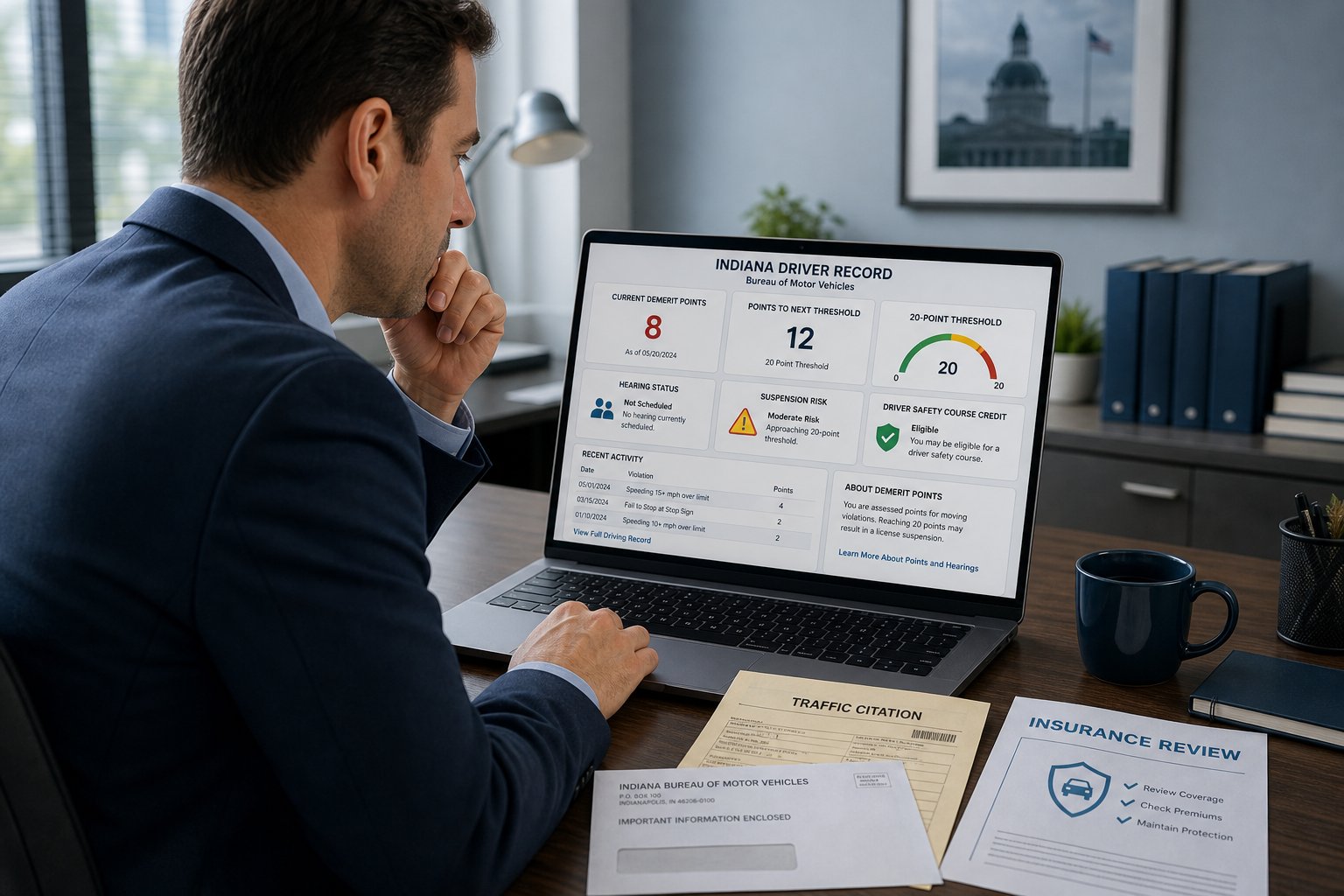
Indiana uses demerit points to track moving violations on your driving record. The Indiana BMV does not add points just because you got a ticket. Points usually post only after there is a conviction or another reportable outcome tied to the case.
That detail matters. Many drivers panic after a citation and assume their point total already changed. Often, it has not. First, the court case or traffic matter has to be processed.
The point system helps the Indiana Bureau of Motor Vehicles measure driving risk. A higher point total can trigger more attention from the BMV. It can also affect your license status, especially if you collect several violations in a short time.
Here is why Indiana license points matter:
- They can trigger warning letters from the BMV.
- They can lead to an administrative hearing.
- They can cause a license suspension if you hit the threshold.
- They may matter to insurers when they review your driving history.
- They can lead to a Driver Safety Program order in some cases.
Indiana uses a 20-point threshold within 24 months as a major line for suspension action. That is why checking your Indiana BMV driving record points is worth doing after a conviction, after several tickets, or when you get a notice from the BMV.
And if the BMV orders a course, Indiana’s official option is a BMV-approved Driver Safety Program (DSP). That is a 4-hour course. Completing an approved DSP can earn a 4-point credit, but it does not erase the conviction or remove the violation from your record.
You can review the state rules in the Indiana Administrative Code and Indiana BMV driving record pages.
How To Check Points On Your Indiana License Through Your Driver Record
The fastest answer to how to check points on license Indiana is simple: pull your Indiana driver record through the BMV. For most people, the easiest route is online through myBMV.
Online through myBMV
Indiana lets you view a Viewable Driver Record (VDR) online. This option is commonly used because it is quick and available without waiting for mail. The VDR shows your current record information, including your point total.
Basic steps usually look like this:
- Go to the Indiana BMV driving record page.
- Sign in through myBMV or follow the prompt to access your record.
- Select the option to view your driver record.
- Review the point total and listed violations.
Official Driver Record by request
If you need a certified copy, request an Official Driver Record (ODR). Indiana allows this online for a small fee, commonly about $4, according to BMV materials. A certified record may be useful if a court, employer, or agency asks for an official version.
Indiana also offers a mail option. If you do not know your license number, the BMV notes that you can use State Form 53789 to request the record by mail. That can help if your card is missing or your number is not handy.
Before you rely on any record for a case, check the exact requirements in your BMV notice, court order, citation, or hearing notice. Those details can depend on your case facts and license status.
What Your Indiana Driver Record Shows
Your Indiana driver record gives you more than just a point total. It gives you a snapshot of your license and key history that the BMV keeps on file.
A standard Indiana driving record may show:
- Your name and personal identifying information
- License number
- License type or class
- Current license status
- Expiration date
- Current demerit point total
- Convictions and violation dates
- Points tied to listed violations
For many drivers, the most important line is the current points total. But the dates matter too. Indiana points are tied to conviction timing, and the BMV uses those dates when it looks at totals within a set period.
Your record can also help you spot mistakes. For example, you may see a conviction date you did not expect, or a status issue that needs follow-up. If something looks wrong, contact the Indiana BMV and compare the record to your ticket, court paperwork, or notice.
Indiana materials also indicate that parts of the driving history may remain visible for about 10 years, even though active points do not last that long. So a violation may still appear on the record after the points tied to it are no longer active.
If you hold a commercial license, or if your job depends on driving, read the full record carefully. A low point total does not always mean low impact. Some violations carry consequences beyond demerit points.
Common Indiana Traffic Violations And Point Values
Indiana assigns different point values based on the violation. Lower-level moving violations usually carry fewer points. More serious conduct usually carries more.
The exact list is set by state rules, and the best source is the BMV and Indiana law. Still, these examples show the pattern:
- Minor speeding: lower point range
- Improper lane use: lower point range
- Disregarding a traffic signal or sign: higher than minor equipment issues
- Faster speeding levels: more points than slight speeding
- Reckless driving: high point value
- OWI-related offenses: very serious consequences, often beyond points alone
This is why two tickets are not always equal. A small speeding conviction and a reckless driving conviction can affect your record very differently.
Also, some drivers focus only on the citation name. That is not enough. What matters for points is the actual reported conviction and how Indiana classifies it.
If you want the official schedule, review the Indiana BMV materials and the state rules in the Indiana Administrative Code. You can also check relevant statutes through the Indiana General Assembly.
If your record shows a violation you do not understand, compare three things side by side:
- The ticket or citation
- The court outcome
- Your BMV driving record
That helps you see whether the point entry matches the final case result.
How Many Points Can Lead To Penalties, Suspension, Or Revocation
In Indiana, point totals can lead to a warning first and then to suspension action if the total gets high enough. The key benchmark many drivers need to know is 20 points in 24 months.
Based on Indiana BMV guidance, the system works roughly like this:
- 14 to 18 points: warning notice
- 20 points in 24 months: administrative hearing and 1-month suspension
- 22 points: 2-month suspension
- Higher totals can lead to longer suspensions
- 42 or more points: up to 12-month suspension
That does not mean every case feels automatic from your side. Notices, hearing rights, and case details still matter. But the BMV point schedule is what drives the penalty framework.
This is one reason busy drivers should check their record after each conviction, not just once a year. A second or third ticket within a short time can change your position fast.
Also, revocation is not the same as a point-based suspension. Some serious offenses can affect your ability to drive in ways that go beyond the normal demerit point chart.
If you get a BMV warning, hearing notice, suspension notice, or course order, read it closely. The exact steps can depend on the Indiana BMV notice, court order, citation, driver record, license status, court, judge, and case facts. Do not ignore deadlines or required court appearances.
If your total is near 20, check your record again and keep copies of any notices you receive.
How Long Points Stay On Your Record And Whether You Can Reduce The Impact
In Indiana, active points stay on your record for 2 years from the conviction date. That is the main rule most drivers need to know.
But there is an important second point. Even after active points age out, the conviction itself may remain visible on your driver record for much longer, often up to 10 years on the history shown by the BMV. So the points and the record entry are not the same thing.
You may be able to reduce the impact of points in a few ways:
- Wait for the 2-year point period to pass
- Complete a BMV-approved Driver Safety Program for a 4-point credit
- In some cases, ask about a local deferral program before a conviction is entered
The DSP point credit has limits. Indiana’s official course is the BMV-approved Driver Safety Program (DSP), and it is a 4-hour course. The credit can usually be used only once every 3 years. Also, the DSP does not remove the conviction and does not erase the violation. It gives a 4-point credit against your point total.
If you need a state-approved online option, Driving Logic’s Indiana Driver Safety Program is built for busy schedules and works on most devices. Before you enroll, confirm that the course meets the need listed in your BMV notice, court order, or ticket.
And if you already completed a DSP in the last three years, verify whether another credit is available before signing up.
When To Contact The Indiana BMV Or Get Help After A Ticket
You should contact the Indiana BMV or get more help when your record shows a serious point issue, a license status problem, or a formal notice that needs action. Waiting too long can make the problem harder to fix.
Reach out if you have any of these:
- 14 or more points on your record
- A warning notice from the BMV
- A suspension notice
- A notice requiring a Driver Safety Program
- Multiple tickets in the last 12 to 24 months
- A CDL or job that depends on driving
Start with the official source. The Indiana BMV can explain record request options, status issues, and general next steps. If your matter involves a hearing, possible suspension, or serious charge, you may also need to speak with a traffic or criminal defense lawyer.
Court-related requirements can vary. What you must do may depend on the notice you received, the court, the judge, the citation, the record, and the facts of the case. So do not assume another driver’s result applies to you.
If your notice says you must complete a course, use the exact type ordered. If you need an online Indiana DSP option that fits a tight schedule, review the course details at MyDrivingLogic.com.
This article is for general information only and is not legal advice.
FAQ
Can the Indiana DSP help with points?
Yes, an approved Indiana Driver Safety Program may provide a 4-point credit when you qualify. It does not erase the conviction or violation.
Does the DSP remove a ticket from my record?
No. The DSP does not remove a ticket, conviction, or violation from your Indiana driving record.
Where should I check my Indiana points?
Use your Indiana BMV driving record to check your current point status, conviction dates, and license status.
What if I have a court order or BMV notice?
Follow the exact deadline and instructions in the court order or BMV notice. Do not rely only on general article guidance.
Conclusion
How to Check Your Points on an Indiana Driver’s License is easier to manage when you check your Indiana BMV record, understand what the points mean, and know what the Driver Safety Program can and cannot do. The Indiana DSP may provide a 4-point credit when eligible, but it does not erase a ticket, conviction, or violation. Before you act, compare your record, BMV notice, or court papers with official instructions.
Take the Indiana Driver Safety Program course online when you are ready to begin.
Related Articles
- Indiana BMV Points System Explained
- Indiana Driver Safety Program and Points: What It Can and Cannot Do
- Indiana DSP 4-Point Credit: How It Works
- How Long Do Points Stay on Your Indiana Driving Record?
Sources
- Indiana BMV — Citation Points and Driver Safety Program
- Indiana BMV — Driver Record Points
- Indiana BMV — Driver Records
- Indiana Code and Administrative Rules
Billy Forte is the owner of Driving Logic, a state-approved driver improvement course provider serving Indiana and other U.S. states. Driving Logic offers online driver safety and driver improvement courses for drivers handling BMV notices, court orders, and state requirements.
This article is general information, not legal advice. Indiana BMV rules, court orders, deadlines, provider reporting, insurance decisions, and case facts can differ. Use official Indiana BMV and court sources for current requirements, and consult a qualified Indiana attorney for legal guidance specific to your situation.