
Updated June 2026 · Reviewed by Billy Forte
If a court ordered you to take a Driver Safety Program in Indiana, you usually need to finish a BMV-approved 4-hour course by the deadline in your court order and then make sure proof of completion goes where the order says. If you also have an Indiana BMV notice, that notice may give you a 90-day window, and missing it can lead to a license suspension. A completed BMV-approved Driver Safety Program can place a 4-point credit on your Indiana driver record, but it does not erase the ticket, conviction, or underlying violation.
This article covers Indiana requirements only.
Key Facts
- Court order: A court can require an Indiana Driver Safety Program as part of a traffic case.
- BMV approval: Use a BMV-approved DSP if you need BMV credit or BMV reporting.
- 4-point credit: A completed approved DSP may add a 4-point credit to your Indiana Official Driver Record.
- No record erase: The DSP does not erase the ticket, conviction, or violation.
- Deadline: Your court order or clerk instructions control the completion and filing deadline.
What The Indiana Driver Safety Program Is And Who May Be Required To Take It
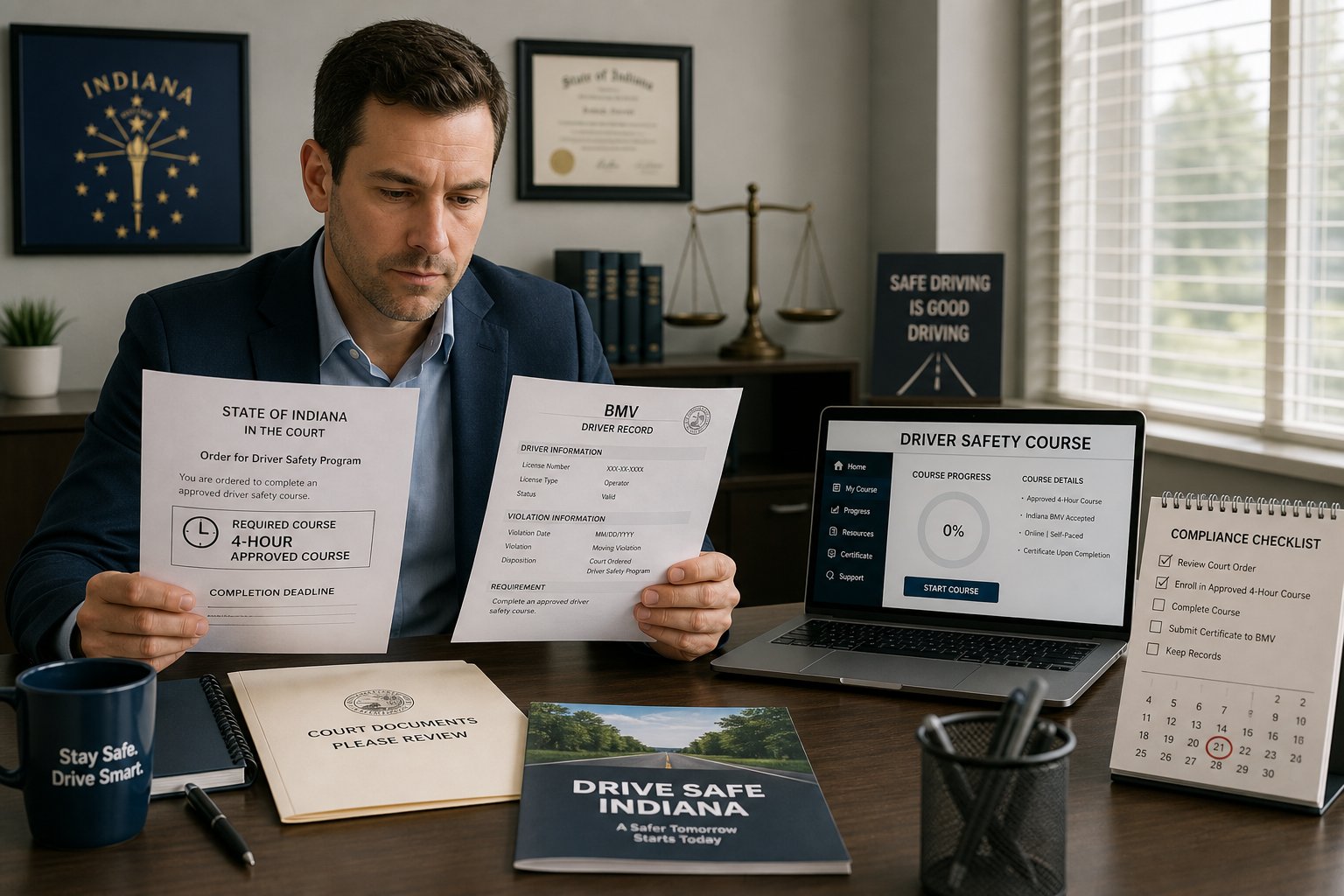
The Indiana Driver Safety Program (DSP) is the state’s official traffic safety course. It is a 4-hour course regulated by the Indiana Bureau of Motor Vehicles. You may see it called traffic school or defensive driving, but for Indiana, the key issue is whether it is a BMV-approved course.
A court may order this program after a traffic case. The Indiana BMV may also require it after certain driving events on your record. And some drivers take it on their own to seek a 4-point credit.
Indiana rules allow or require DSP in several situations, including these:
- Drivers under 21 with two or more traffic offenses
- Drivers under 18 with two or more traffic offenses, collisions, or both
- Drivers with two or more traffic offenses within 12 months
- Drivers who want a point credit, if they qualify
The exact reason matters. Your duty may come from a court order, a BMV notice, or both. Your ticket, case facts, license status, and driver record can all affect what you must do.
That is why you should read every paper closely. Look for the completion deadline, the name of the required program, and whether the court wants a certificate sent to the court, the BMV, or both.
You can verify Indiana’s program rules on the Indiana BMV Driver Safety Program page and in the Indiana Administrative Code rules for driver safety programs.
Court-Ordered Vs. BMV-Required: Why The Reason You’re Taking It Matters
The reason you are taking the course changes what counts as compliance. That is the part many drivers miss.
If the program is BMV-required, you must follow the BMV notice. Indiana materials commonly state a 90-day completion period. If you do not finish in time, the BMV can suspend your license.
If the program is court-ordered, the judge’s order controls what you must do for the case. Some court orders are very specific. Others only say to complete a driver safety or defensive driving class. But if you want the 4-point credit on your BMV record, the course must be BMV-approved.
So a court order and a BMV requirement are not always the same thing:
- A court order may satisfy a case condition
- A BMV notice deals with your driving privilege and record
- A non-approved class may help only if the court accepts it
- A BMV-approved Driver Safety Program is needed for BMV credit
This is where your paperwork matters most. Check the court order, any BMV notice, your citation, and any clerk instructions. If the order requires filing proof with the court, do that. If the BMV requires completion, make sure the provider reports to the BMV.
For the legal framework, review Indiana Code and Indiana BMV guidance before you enroll.
How The Program Affects Points, Citations, And Your Driving Record
A completed BMV-approved DSP can place a 4-point credit on your Indiana driver record. That credit lowers your active point total. It does not remove the conviction, citation history, or the violation itself.
That point is easy to get wrong. Many drivers think the course wipes the record clean. It does not. Instead, Indiana applies a credit against points on the Official Driver Record.
Here is what that usually means:
- You may receive a 4-point credit after successful completion
- The credit can be used once every 3 years
- If you take another course within 3 years, it may extend the credit period rather than add another 4 points
- The conviction or underlying ticket is not erased by the course alone
Can the course help with a ticket? Sometimes, but it depends on the court, judge, case facts, and how the case is handled. You should not assume ticket dismissal or a charge reduction. Follow the exact court order and any filing steps the court requires.
For many drivers, the biggest benefit is simple: the course may help with BMV compliance and may reduce the point total used by Indiana. You can check the current point system details with the Indiana BMV point schedule and driver safety information.
What To Know Before You Choose A Driver Safety Program Provider
Choose the provider based on your exact requirement, not just price or speed. If you need BMV credit or must satisfy a BMV notice, the course should be Indiana BMV-approved.
That is the first question to ask. The second is how completion gets reported. A good provider should clearly explain whether it reports electronically to the Indiana BMV and whether it gives you a certificate for court use.
Before you sign up, check these points:
- Is it an Indiana BMV-approved course?
- Is it the full 4-hour Driver Safety Program?
- Does the provider report completions to the BMV?
- Can you download or print a certificate if the court wants proof?
- Is the course online and self-paced?
- Is support available if your case has a deadline issue?
For busy drivers, online access matters. A course that works on your phone, tablet, or laptop is easier to finish. That is one reason many people use an online provider like court ordered driver safety program indiana, which is built for flexible scheduling and quick completion.
Still, speed is not the only issue. Make sure the provider fits your court order or BMV notice first. Then keep a copy of your registration and any completion record.
Online Course Rules, Timing, Final Exam, And Completion Deadlines
Indiana’s Driver Safety Program is generally a 4-hour course, and many approved providers offer it online. Most online formats are self-paced, so you can log in, stop, and come back later.
That flexibility helps, but the clock still matters. If your BMV notice gives you 90 days, or your court order gives a set date, you need to finish early enough for reporting and processing. Waiting until the last day is risky.
Many providers include a final exam or post-test at the end. Passing rules vary by provider. One common example is an 80% passing score, with retakes allowed, but you should check the provider’s own rules before you start.
A few practical tips help avoid trouble:
- Start as soon as you get the order or notice
- Confirm the exact completion deadline
- Save your login details
- Finish with enough time for BMV processing
- Print or save your completion proof
If your case is about court ordered defensive driving Indiana, do not assume the online course alone completes every court step. Some courts still want a certificate filed with the clerk or brought to a hearing. Read the court order line by line, and if anything is unclear, contact the court clerk for the filing rules.
How Proof Of Completion Gets Reported And When Credit Appears
After you finish a BMV-approved course, the provider usually sends your completion to the Indiana BMV electronically. Many providers say this happens within 1 business day, but the BMV may take longer to show the result on your record.
A common processing estimate is 7 to 10 business days before compliance or the 4-point credit appears. That is why finishing close to the deadline can cause problems, even if you complete the course on time.
You should also keep your own proof. In many cases, you can print a certificate or completion page. That can matter if:
- The court wants proof filed in the case
- The clerk asks for the original certificate
- Your BMV record has not updated yet
- You need to show you completed the course before a hearing
The filing path depends on the order. Some drivers only need provider reporting to the BMV. Others must also send or file proof with the court. Do not guess.
After you finish, check your provider confirmation, watch your BMV record, and follow any court filing step listed in your paperwork. If you want an online option, court ordered driver safety program indiana offers Indiana courses with completion proof and flexible access.
Common Mistakes That Can Delay Acceptance Or Credit
Most problems come from simple mix-ups. The big one is taking the wrong class.
If you need BMV compliance or want the 4-point credit, a course that is not BMV-approved may not count for that purpose. A court may accept a different class in some cases, but you should never assume that without clear court instructions.
Other common mistakes include:
- Missing the 90-day window in a BMV notice
- Finishing too late for BMV processing time
- Forgetting to send the certificate to the court when required
- Entering the wrong personal data when registering
- Expecting the course to erase points, tickets, or convictions
- Taking another DSP within 3 years and expecting a second extra 4-point credit
One more issue comes up often: drivers ignore one paper because they finished the course. That is risky. If the court also ordered a hearing, filing, or appearance, you still need to follow that instruction.
The safest approach is simple. Match the course to the court order or BMV notice, finish early, save your proof, and confirm where it must go. That prevents most delays.
Drivers may search for this topic using terms like court ordered driver improvement indiana, court ordered dsp indiana, indiana court ordered driver safety. In practice, the key issue is still the same: match the course to the Indiana BMV notice, court order, or record goal before you rely on it.
FAQ
Can a court order me to take the Indiana Driver Safety Program?
Yes. An Indiana court may require a Driver Safety Program as part of a traffic case or as an alternative to another consequence. Follow the wording in the court order and confirm whether proof must be filed with the clerk.
Does a court-ordered DSP remove my ticket?
No. The course does not erase the ticket, conviction, or violation. It may satisfy a court requirement and may add a 4-point credit when the course is BMV-approved and you are eligible.
Does the course have to be BMV-approved?
Use a BMV-approved course if you need BMV credit or BMV reporting. A court may have its own instructions, so check the order before enrolling.
Can I take a court-ordered DSP online?
Usually yes if the court allows online completion and the provider is accepted for your requirement. Read the court order before choosing a format.
Conclusion
Court-Ordered Driver Safety Program in Indiana: What to Do comes down to the rule in your own Indiana BMV notice, court order, citation, or driver record goal. The Indiana Driver Safety Program can help with BMV compliance and may add a 4-point credit when eligible, but it does not erase the ticket or conviction. Confirm your deadline, choose a BMV-approved provider, and keep proof after you finish.
Take the court ordered driver safety program indiana online with Driving Logic when you are ready to begin.
Related Articles
- Indiana Driver Safety Program: The Complete Guide
- BMV-Ordered Driver Safety Program in Indiana: Points, Notice, and 90-Day Deadline
- Indiana BMV Final Notice: What It Means and What to Do
- Indiana Driver Safety Program for Teens and Young Drivers
Sources
- Indiana BMV — Citation Points and Driver Safety Program
- myBMV — Indiana BMV Online Services
- Indiana Code
- Indiana Administrative Code
Billy Forte is the owner of Driving Logic, a state-approved driver improvement course provider serving Indiana and other U.S. states. Driving Logic offers online driver safety and driver improvement courses for drivers handling BMV notices, court orders, and state requirements.
This article is general information, not legal advice. Indiana BMV rules, court orders, deadlines, provider reporting, insurance decisions, and case facts can differ. Use official Indiana BMV and court sources for current requirements, and consult a qualified Indiana attorney for legal guidance specific to your situation.