
Updated June 2026 · Reviewed by Billy Forte
In Indiana, a defensive driving course and the Driver Safety Program usually mean the same BMV-approved 4-hour course. This article is for Indiana drivers who need a simple answer before choosing, completing, or submitting a Driver Safety Program course. You will learn what the rule means, what to check first, and how to avoid the most common mistakes.
This article covers Indiana requirements only.
Key Facts
- Course length: Indiana BMV-approved DSP courses are at least 4 hours.
- 4-point credit: The BMV applies a 4-point credit for successful completion of a BMV-approved DSP, when eligible.
- Credit timing: The voluntary 4-point credit may only be applied once every 3 years.
- Record impact: DSP completion does not remove a citation, conviction, or violation from your driver history.
- Formats: Indiana DSP curriculum may be available online, by DVD, or in a classroom through approved providers.
If you need the official online option, you can start the Indiana defensive driving course after confirming it fits your BMV notice, court order, or voluntary credit goal.
What The Indiana Driver Safety Program Is And Who Should Take It
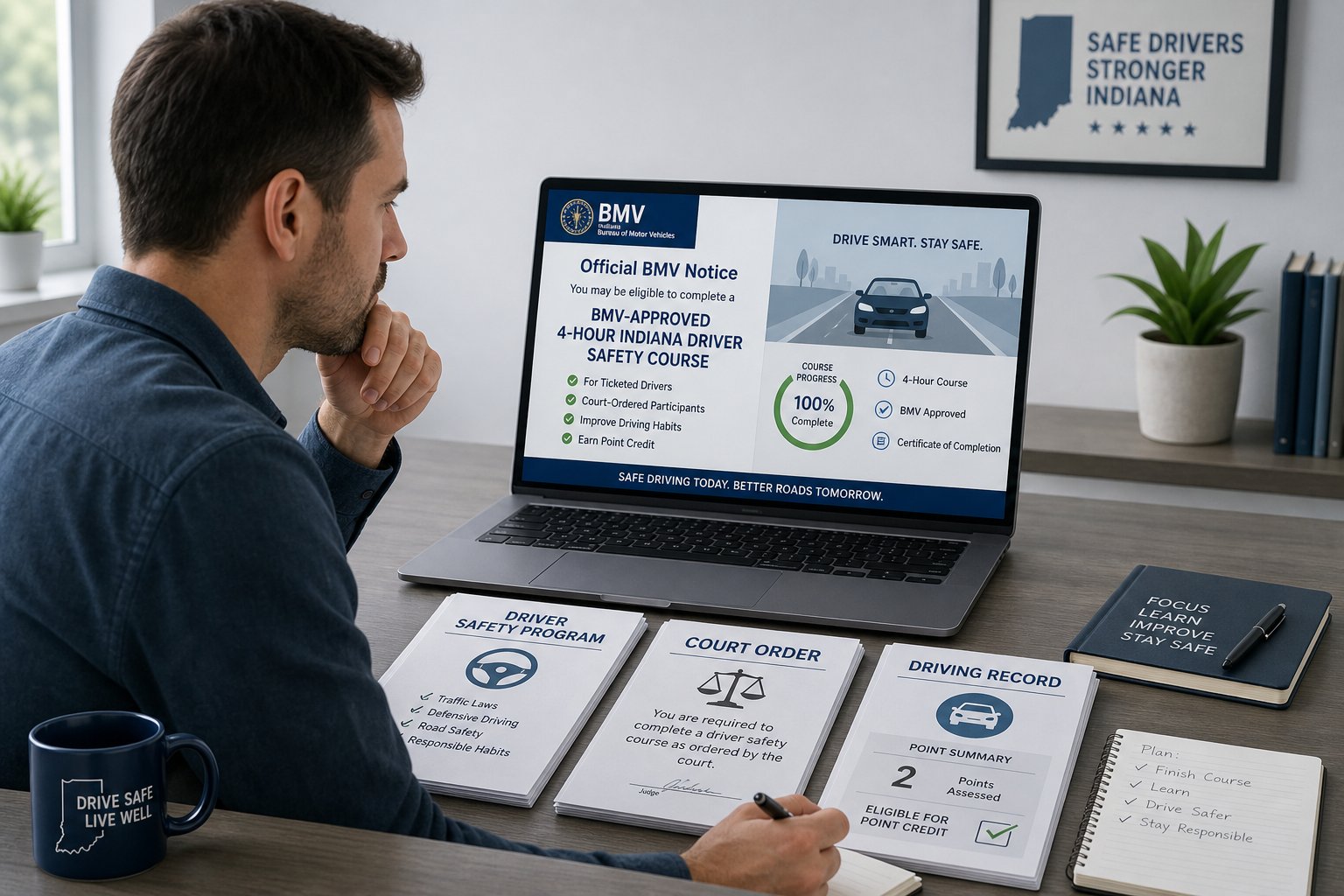
The Indiana Driver Safety Program is a BMV-approved course for drivers who already know how to drive but need safer driving review. In plain terms, when people search for a defensive driving course Indiana drivers can take, they are usually talking about this same program.
Indiana uses the official name Driver Safety Program because that is the name used by the Indiana BMV and state rules. So you may see these terms used almost as equals:
- Driver Safety Program
- DSP
- Indiana defensive driving course
- BMV-approved 4-hour course
That naming matters. If a BMV notice or court order tells you to complete the program, you should make sure the course is an actual BMV-approved DSP, not just any traffic school.
Who should take it? Several groups may need or want it.
- Drivers ordered by the Indiana BMV
- Drivers ordered by a court or judge
- Drivers with recent tickets who want the 4-point credit if eligible
- Drivers trying to lower risk on their driving record
Indiana states that drivers convicted of two or more traffic offenses in 12 months may be required to complete the program. For some drivers under 21, the same rule can apply, and not finishing within 90 days can lead to suspension under BMV rules. Courts may also order the course as part of a case outcome or as a step tied to license status.
You can also take the course on your own. That does not mean every court or case will treat it the same way. Still, for many drivers, the program is a practical step because it is short, state recognized, and focused on safer habits rather than first-time driver training.
For the official program description, check the Indiana BMV Driver Safety Program page and the related Indiana Administrative Code rules.
How An Indiana Defensive Driving Course Helps With Points, Court Requirements, And Driving Records
An Indiana defensive driving course helps mainly by giving an eligible driver a 4-point credit on the BMV record. That is one of the biggest reasons people take the DSP.
But there is an important limit: the course does not erase the ticket, conviction, or violation. It does not remove the offense from your driving record. Instead, it adds a 4-point credit that reduces your total point count. That difference matters.
Indiana allows that 4-point credit once every 3 years. In some cases, another course completion may extend the credit period, but you should not assume you can stack unlimited new credits whenever you want. Check the official rules and your own record before relying on timing.
The course may also help if you have a:
- BMV notice requiring completion
- Court order tied to a ticket or case
- Risk of added demerit points leading to probation or suspension
In some cases, completing the DSP can help you meet a court or BMV requirement and reduce pressure on your license status. That does not mean a guaranteed dismissal, charge reduction, insurance discount, or reinstatement. Outcomes can depend on the court, judge, citation, driver record, and other case facts.
If your paperwork says you must complete a course, follow the exact terms on the notice. The BMV and courts care about whether the course is approved, whether it is finished on time, and whether the right provider reports it.
You can read the point system details on the Indiana BMV point schedule page and in Indiana Code.
How To Complete The Course Online From Start To Finish
If you need the Driver Safety Program, the online path is usually the fastest and simplest option. For busy drivers, it is easier than trying to fit a classroom into a workweek.
The basic process is straightforward.
- Choose a BMV-approved provider
- Register with your correct driver information
- Complete the online lessons
- Pass the final exam
- Keep your certificate if a court or insurer asks for it
When you sign up, use the same personal details that match your license and case records. Small errors can slow reporting. That includes your name, date of birth, and other identifying information requested by the provider.
A provider offering an Indiana defensive driving course online can make completion easier if it fits your BMV notice or court order. That can help if you need to work around shifts, family time, or a court deadline.
Still, speed should not mean guesswork. Make sure the course is labeled for Indiana and clearly states that it is a BMV-approved DSP. If you have a BMV notice or court order, compare the provider details with your paperwork.
Finish the lessons carefully and do not wait until the last minute if you have a deadline. Reporting and processing can take extra time even after you complete the course.
What To Expect From Course Length, Format, And The Final Exam
Indiana’s official Driver Safety Program is a 4-hour course minimum. If a site promises something much shorter for BMV credit, that is a warning sign.
Indiana allows several formats, including:
- Online
- Classroom
- DVD
Online is often the easiest format because it is self-paced. You can usually log in, complete part of the course, log out, and return later. For many drivers, that is the difference between getting it done and putting it off.
The course content focuses on safer driving choices, traffic risks, and habits that lower repeat violations. It is not a basic learner class.
Most online DSP courses end with a final exam. Read the provider instructions so you know the passing rules and any retake terms. The state requires the approved course structure, and the provider should explain the final step clearly before you begin.
How Completion Is Reported And When Your Certificate Matters
After you pass, the provider usually reports completion to the Indiana BMV by electronic means. That reporting is what allows the BMV to apply the 4-point credit when you are eligible.
The BMV advises allowing about 7 to 10 business days for processing. So even if you finish quickly, your record may not update the same day.
Your certificate of completion still matters in some cases. Keep a copy if:
- A court asks you to show proof
- Your lawyer asks for it
- An insurer requests course proof
- You need your own records in case of a reporting issue
If you are working under a court order or a hard deadline, confirm whether the court wants the certificate filed directly, brought to court, or simply kept available. Do not assume BMV reporting alone satisfies every court instruction.
How To Choose A BMV-Approved Indiana Defensive Driving Course
The best course is a BMV-approved Indiana defensive driving course that clearly says it is the Driver Safety Program. That is the first filter.
A provider can look polished and still not be the right fit for BMV or court credit. So check the details before you pay.
Look for these basics:
- Clear statement that the course is Indiana BMV-approved
- Course name tied to Driver Safety Program or DSP
- The required 4-hour format
- Electronic reporting to the BMV
- Easy access on phone, tablet, or computer
Indiana also sets a maximum price of $55 for the DSP. If you see a price above that for the state course itself, that should raise questions.
Good providers also explain practical things upfront. For example, they should tell you how reporting works, how long processing may take, and how to access your certificate. Those details matter when a deadline is close.
For drivers who want a flexible option, Driving Logic offers an online Indiana Driver Safety Program built for quick access and simple completion. Before you enroll, match the course to your BMV notice, court order, or case facts so you choose the right option the first time.
You can also verify current state information through the Indiana BMV and review the governing law in Indiana Code Title 9.
Indiana Point Basics, Timing Deadlines, And Common Mistakes To Avoid
Indiana uses a point system for traffic violations, and those points can affect your license status. In general, moving violations carry 2 to 10 points based on severity.
Points stay active for 2 years from the conviction date. If your point total gets too high, the BMV can place you on probation or move toward suspension. The BMV notes that 18 or more points in 2 years can put your license at risk.
That is why the 4-point credit from the Driver Safety Program matters. It can reduce the active point total, but it does not erase the violation behind those points.
Common mistakes are easy to make, especially when you are rushed.
- Ignoring a BMV notice and missing the deadline
- Taking a course that is not BMV-approved
- Assuming every court will accept any certificate the same way
- Waiting too long for BMV processing after completion
- Thinking the DSP removes a conviction from your record
- Assuming you can get a new 4-point credit whenever you want
Some drivers also miss the rule that a BMV-required course may need to be done within 90 days. That is a serious issue because failure to complete it can lead to suspension in cases covered by BMV rules.
If you have a ticket, notice, or court date, read every line carefully. Compare the deadline on your paperwork with the time needed to complete the course and allow for BMV reporting. If you want a flexible online option, you can review the Indiana Driver Safety Program course.
FAQ
Does the Indiana DSP remove points?
No. The DSP does not remove the conviction or violation. The BMV may apply a 4-point credit to your Official Driver Record when you complete a BMV-approved course and meet the rules.
Can I take the Indiana Driver Safety Program online?
Yes. Indiana BMV-approved providers may offer online courses. Verify the provider is approved before you enroll.
How long does the course take?
Indiana BMV-approved Driver Safety Program courses are at least 4 hours long. Your provider may divide the course into smaller sections.
Do I need to send my certificate to the court?
Maybe. If a court ordered the course, follow the court order or clerk instructions. BMV reporting and court filing are not always the same step.
Conclusion
Indiana Defensive Driving Course vs. Driver Safety Program: Same Thing? is easier to handle when you know the course purpose, the BMV rules, and your deadline. The most important point is that the Indiana DSP can provide a 4-point credit when eligible, but it does not erase the ticket or conviction. Before you enroll, confirm that your provider is BMV-approved and that the course fits your notice, court order, or voluntary goal.
When you are ready, take the Indiana defensive driving course online.
Related Articles
- Indiana Driver Safety Program: The Complete Guide
- Indiana BMV-Approved Driver Safety Program: What It Means and How to Verify
- Is the Indiana Driver Safety Program Online Legit?
- Indiana Driver Safety Program Online vs. In Person
Sources
- Indiana BMV — Citation Points and Driver Safety Program
- Indiana BMV — Driver Record Points
- myBMV — Indiana BMV Online Services
- Indiana Code and Administrative Rules
Billy Forte is the owner of Driving Logic, a state-approved driver improvement course provider serving Indiana and other U.S. states. Driving Logic offers online driver safety and driver improvement courses for drivers handling BMV notices, court orders, and state requirements.
This article is general information, not legal advice. Indiana BMV rules, court orders, deadlines, provider reporting, insurance decisions, and case facts can differ. Use official Indiana BMV and court sources for current requirements, and consult a qualified Indiana attorney for legal guidance specific to your situation.