
Updated June 2026 · Reviewed by Billy Forte
An Indiana Driver Safety Program may help with an insurance discount, but any discount depends on your insurance company. This article is for Indiana drivers who need a simple answer before choosing, completing, or submitting a Driver Safety Program course. You will learn what the rule means, what to check first, and how to avoid the most common mistakes.
This article covers Indiana requirements only.
Key Facts
- Insurance is separate: Any insurance discount depends on the insurer, not the BMV.
- Ask first: Contact your insurance company before relying on a discount.
- Course length: Indiana BMV-approved DSP courses are at least 4 hours.
- 4-point credit: The BMV applies a 4-point credit for successful completion of a BMV-approved DSP, when eligible.
- Credit timing: The voluntary 4-point credit may only be applied once every 3 years.
- Record impact: DSP completion does not remove a citation, conviction, or violation from your driver history.
If you need the official online option, you can start the Indiana Driver Safety Program insurance discount after confirming it fits your BMV notice, court order, or voluntary credit goal.
What An Indiana Defensive Driving Insurance Discount Is
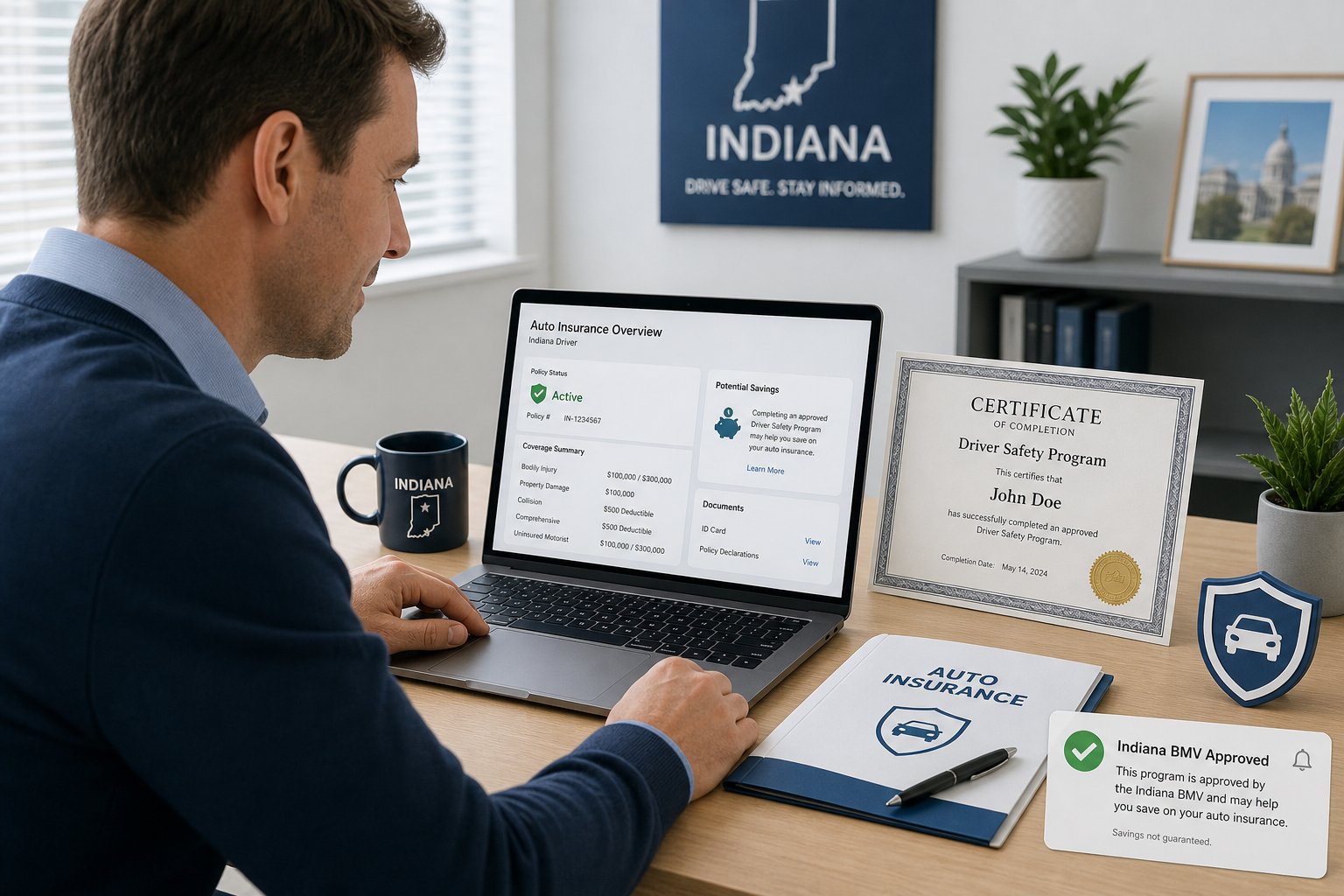
An Indiana defensive driving insurance discount is a lower auto insurance rate that some companies may offer after you complete a qualifying safe driving course. In Indiana, that often means a BMV-approved Driver Safety Program, also called the DSP.
The key point is simple: the discount is optional for the insurer. Indiana does not require every company to reduce your premium just because you finished a course. That is why you should confirm the rules with your own insurer before you sign up.
This is also different from a court or BMV requirement. You may take the DSP because of a BMV notice, a court order, a ticket, or because you want the 4-point credit allowed under Indiana BMV rules. Or you may take it on your own and then ask your insurer if it counts for a discount. Those are related issues, but they are not the same thing.
A few terms matter here:
- Indiana BMV: the Indiana Bureau of Motor Vehicles
- Driver Safety Program (DSP): the official BMV-approved course
- 4-hour course: the usual minimum course length
- 4-point credit: a credit that reduces your point total
- Demerit points: points tied to moving violations on your driving record
The Indiana BMV explains the Driver Safety Program on its official Driver Safety Program page. The state also lays out program rules in the Indiana Administrative Code and related laws at the Indiana General Assembly site.
So, if your goal is an insurance discount, think of the DSP as a possible way to qualify, not a promise of savings.
Who Usually Qualifies For A Discount In Indiana
Many Indiana drivers may qualify for a discount, but the real answer depends on the insurance company. Some insurers offer discounts to drivers of many ages. Others focus more on groups that often pay higher rates, such as younger drivers or older drivers.
Indiana also has special attention on older drivers. Some companies offer a senior discount for drivers age 60 and up who complete an approved course. But even then, the exact rule can vary by insurer, so it is still smart to ask first.
You may be more likely to qualify if:
- You complete a BMV-approved course
- You finish the full 4-hour course
- You have a valid Indiana policy with a company that offers the discount
- You submit the completion certificate the way your insurer requires
Your situation may be more complex if you are taking the course because of a court order, a BMV notice, or a traffic case. In those cases, the course may help satisfy a state or court requirement, but that still does not mean your insurer must give a discount.
Your driving record, license status, and case facts can matter too. A recent citation, a probationary status issue, or a court deadline may affect what you need to do next. Also, some courts and judges may require a certain provider or a certain filing method.
Before you enroll for insurance savings, ask your insurer four things:
- Do you offer a defensive driving insurance discount in Indiana?
- Does a BMV-approved Driver Safety Program qualify?
- How long does the discount last?
- How should I send proof of completion?
That short call can save time and help you avoid taking the wrong course.
How Much You Might Save And How Long The Discount Can Last
The amount you might save varies a lot. Some Indiana insurers may offer a modest rate cut, while others may offer more. A common example is up to 10% on certain coverages, but that is not universal.
Across the market, defensive driving discounts often fall in a wider range, sometimes around 5% to 25%, depending on the insurer, the driver, and the policy. But you should treat that as a broad industry range, not a promise for your own policy.
Several things can affect the amount:
- Your age and driving history
- The type of coverage on your policy
- Whether the insurer recognizes the course you chose
- Whether the discount applies to all coverages or only some
The discount often lasts for a set period. With some companies, that period may be about three years. After that, you may need to retake an approved course if the insurer allows renewal.
Do not confuse the insurance discount with Indiana BMV point credit rules. Under Indiana BMV policy, a driver may be able to earn a 4-point credit by completing the DSP within the allowed time frame. But that point credit is a BMV matter. It does not mean your insurer must reduce your premium, and it does not erase a conviction from your driving record.
If you want reliable numbers, the best source is your own insurer. Ask for the exact percentage, the term length, and whether the course must be from a specific provider or official list.
How The Course Works Online
The online Indiana Driver Safety Program is built for convenience. In most cases, it is self-paced, fully online, and designed to meet the state minimum time requirement of 4 hours.
That matters if your schedule is tight. You can usually log in from a phone, tablet, or computer, complete sections in parts, and return later. For busy drivers, that is a lot easier than sitting in a classroom.
If you are choosing a course for Indiana, make sure it is BMV-approved. That is the first filter. If your goal is an insurance discount, ask your insurer if that same course also works for their discount program.
Indiana rules also matter for price. For BMV-approved defensive driving courses, the fee is generally capped by state rule. You can review Indiana BMV materials and state rules before you register.
Driving Logic and MyDrivingLogic.com focus on fast, flexible online completion for drivers who need a course that fits real life. If you want to take the Indiana Driver Safety Program online, check the provider details, confirm insurance eligibility with your carrier, and then enroll with a course that meets Indiana requirements.
What The Course Typically Covers
Most Indiana DSP courses cover the same core safety topics. The goal is to help you spot risk sooner and make safer choices behind the wheel.
Common topics include:
- Defensive driving habits
- Hazard recognition
- Safe following distance
- Right-of-way rules
- Traffic signs and basic traffic laws
- Distracted, impaired, and aggressive driving risks
- Night driving and bad weather driving
The course may also include short quizzes after each chapter. These are usually there to show that you completed and understood the material. Course format can vary, so read the provider details before you start.
How To Submit Your Certificate To Your Insurance Company
Once you finish the course, you should receive a certificate of completion. The provider may offer it by download, email, mail, or another delivery method.
Your next step is to submit that certificate exactly the way your insurance company wants it. Some insurers let you upload it through an online portal. Others want it emailed to an agent or mailed in. A few course providers may report completion directly to certain insurers, but you should never assume that happens automatically.
A simple process usually looks like this:
- Finish the full course.
- Save your certificate.
- Contact your insurer or agent.
- Ask how they want proof sent.
- Keep a copy for your records.
This is especially important if you also have a BMV notice, a court order, or a pending citation. You may need to send proof to more than one place, and each one may have a different deadline or rule. Your court, judge, or case paperwork controls what is required in that matter.
If your insurer approves the discount, ask when it starts and how long it stays active. Also ask whether you need to renew it later with another course.
Important Limits To Know Before You Enroll
The biggest limit is this: not every insurer offers an Indiana defensive driving insurance discount. And even when a company does offer one, the amount, terms, and approved course list may vary.
That means you should not enroll only because you expect automatic savings. First, confirm:
- Whether your insurer offers the discount
- Whether a BMV-approved Driver Safety Program counts
- Whether your age or record affects eligibility
- How much the discount may be
- How long it may last
There is another limit that causes confusion. The Indiana DSP can provide a 4-point credit under BMV rules in some cases, but that credit is separate from insurance pricing. It reduces the point total used by the BMV. It does not remove the ticket, remove the conviction, or wipe the underlying violation from your driving record.
Also, if you got a ticket or court paperwork, your requirements may depend on the citation, court, judge, license status, and the facts of your case. Do not ignore a BMV notice, court order, deadline, or required hearing while you wait to see if a course helps.
If you want a fast online option, you can review the Indiana course at Driving Logic. Just make sure you confirm with your insurer first if your main goal is an insurance discount.
FAQ
Does the Indiana DSP remove points?
No. The DSP does not remove the conviction or violation. The BMV may apply a 4-point credit to your Official Driver Record when you complete a BMV-approved course and meet the rules.
Can I take the Indiana Driver Safety Program online?
Yes. Indiana BMV-approved providers may offer online courses. Verify the provider is approved before you enroll.
How long does the course take?
Indiana BMV-approved Driver Safety Program courses are at least 4 hours long. Your provider may divide the course into smaller sections.
Do I need to send my certificate to the court?
Maybe. If a court ordered the course, follow the court order or clerk instructions. BMV reporting and court filing are not always the same step.
Conclusion
Can the Indiana Driver Safety Program Lower Your Car Insurance? is easier to handle when you know the course purpose, the BMV rules, and your deadline. The most important point is that the Indiana DSP can provide a 4-point credit when eligible, but it does not erase the ticket or conviction. Before you enroll, confirm that your provider is BMV-approved and that the course fits your notice, court order, or voluntary goal.
When you are ready, take the Indiana Driver Safety Program course online.
Related Articles
- Indiana Driver Safety Program: The Complete Guide
- How Often Can You Take the Indiana Driver Safety Program?
- How Much Does the Indiana Driver Safety Program Cost?
- Indiana BMV-Approved Driver Safety Program: What It Means and How to Verify
Sources
- Indiana BMV — Citation Points and Driver Safety Program
- Indiana BMV — Driver Record Points
- myBMV — Indiana BMV Online Services
- Indiana Code and Administrative Rules
Billy Forte is the owner of Driving Logic, a state-approved driver improvement course provider serving Indiana and other U.S. states. Driving Logic offers online driver safety and driver improvement courses for drivers handling BMV notices, court orders, and state requirements.
This article is general information, not legal advice. Indiana BMV rules, court orders, deadlines, provider reporting, insurance decisions, and case facts can differ. Use official Indiana BMV and court sources for current requirements, and consult a qualified Indiana attorney for legal guidance specific to your situation.