
Updated June 2026 · Reviewed by Billy Forte
Indiana Driver Safety Program online and in-person options can both work if the provider is BMV-approved and the format fits your requirement. This article is for Indiana drivers who need a simple answer before choosing, completing, or submitting a Driver Safety Program course. You will learn what the rule means, what to check first, and how to avoid the most common mistakes.
This article covers Indiana requirements only.
Key Facts
- Online option: Online DSP can be valid when offered by a BMV-approved provider.
- In-person option: Classroom format may fit drivers who prefer scheduled instruction.
- Course length: Indiana BMV-approved DSP courses are at least 4 hours.
- 4-point credit: The BMV applies a 4-point credit for successful completion of a BMV-approved DSP, when eligible.
- Credit timing: The voluntary 4-point credit may only be applied once every 3 years.
- Record impact: DSP completion does not remove a citation, conviction, or violation from your driver history.
If you need the official online option, you can start the Indiana Driver Safety Program online after confirming it fits your BMV notice, court order, or voluntary credit goal.
What The Indiana Driver Safety Program Is And Who Should Take It
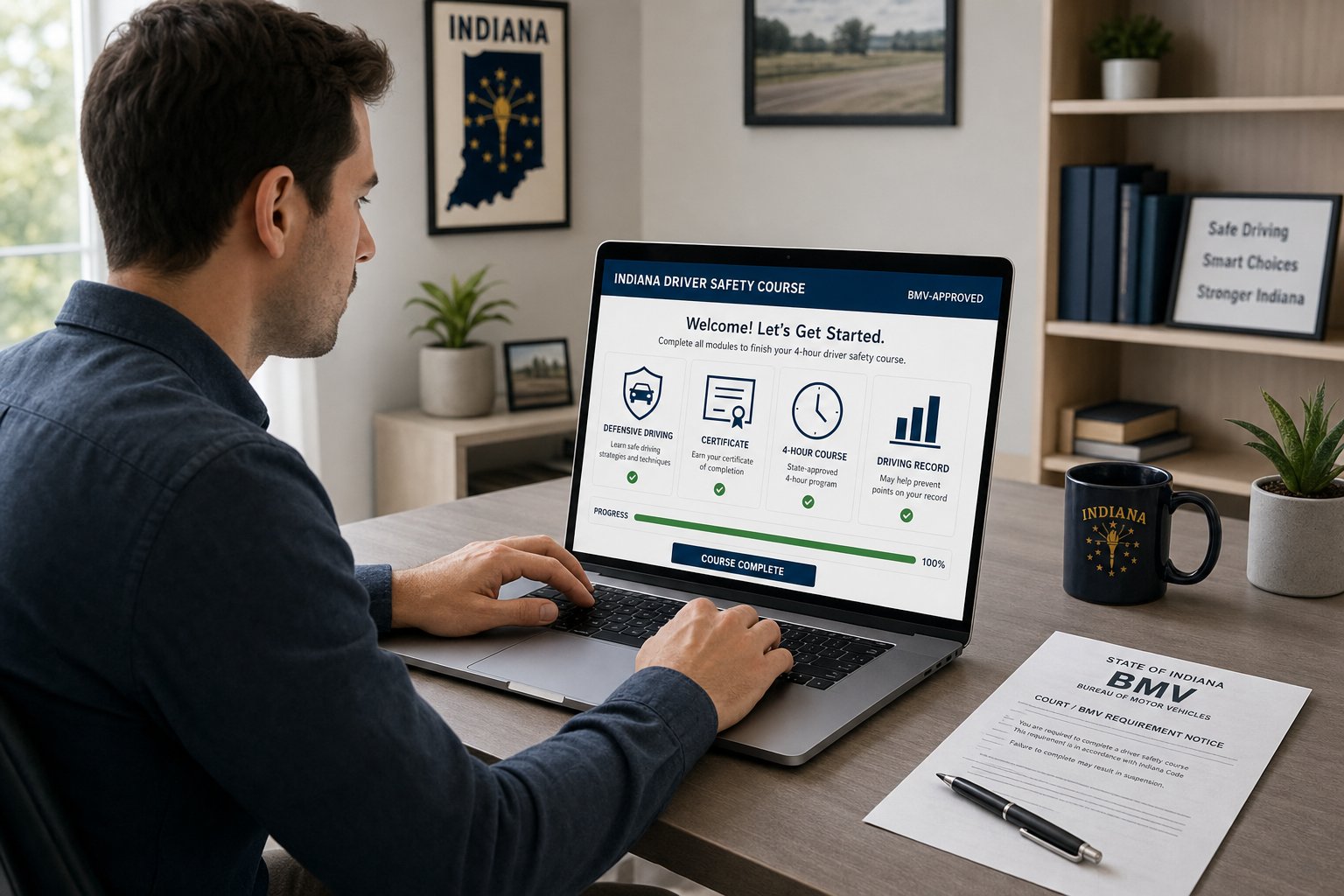
The Indiana Driver Safety Program, often called DSP, is a BMV-approved course for Indiana drivers. It is also called a defensive driving course in many places. In most cases, it is a 4-hour course.
You may take it for different reasons. Some drivers take it because the Indiana BMV tells them to. Others take it because a court order requires it. Some drivers also take it to qualify for a 4-point credit on their driving record when they are eligible.
The course is meant to improve safe driving habits. It also gives the BMV a way to respond before point totals create bigger license problems. That is why DSP often comes up after traffic violations or a pattern of risky driving.
When Drivers Are Ordered To Complete DSP
Indiana drivers can be ordered to complete DSP by the Indiana Bureau of Motor Vehicles or by a court. The exact reason depends on the driver’s record, age, and case facts.
Based on Indiana BMV guidance, DSP may be required if:
- You have two or more traffic convictions in 12 months
- You are under 21 and have multiple traffic offenses
- You are under 21 and have multiple accidents or other record issues
- A court uses DSP as part of resolving a ticket or to help avoid harsher action
If the BMV requires the course, it usually sends a BMV notice. That notice matters. It may give you about 90 days to finish the program. If you miss the deadline, your license may be suspended.
A court order can work differently. One court may want proof sent to the clerk. Another may want you to bring the certificate to a hearing. So always read the ticket, notice, or order closely. Your requirement can depend on the court, judge, citation, license status, and your full driver record.
For the official rules and current program details, check the Indiana BMV Driver Safety Program page and the Indiana Code site.
How The Online Indiana DSP Works From Start To Certificate
The online version is built for speed and flexibility. You register with a BMV-approved provider, complete the required lessons, finish the final steps, and get proof of completion.
Most drivers start by choosing an approved online school. That step matters because not every traffic school counts for Indiana DSP. The course must be an official BMV-approved course for Indiana.
Then you work through the material. Most online DSP courses are self-paced. That means you can log in from your phone, tablet, or computer and stop when needed. If your day gets busy, you can come back later and keep going.
In general, the process looks like this:
- Register with an approved Indiana DSP provider
- Confirm the course matches your BMV notice or court order
- Complete the 4-hour course content
- Finish any quizzes and the final exam if required
- Download or print your certificate
- Wait for provider reporting to the Indiana BMV
Some providers, including Indiana Driver Safety Program online, also offer quick access across devices and fast certificate delivery. That can help if you have a short deadline.
Online courses often feel easier to fit into real life than classroom sessions. You do not have to drive to a site, wait for a start time, or spend extra time in a room for a fixed block. But the key point is this: online and in-person formats only count if they are approved and accepted for your case.
What To Expect In The Course, Including Time, Format, And Final Steps
The Indiana DSP is usually a 4-hour course. That is the basic time requirement whether you take it online or, if available, in a classroom.
The format is where the biggest difference shows up. With indiana driver safety program online options, you usually read lessons, watch videos, answer quiz questions, and move at your own pace. With a classroom course, you must attend at a scheduled place and time, and the pace is set by the instructor.
In-person classroom DSP may still exist through some approved providers, but it is often less common and harder to find than online options. If you are searching for a driver safety program near me indiana, start with the Indiana BMV list of approved providers and then check whether each school offers live classroom sessions, online study, or both.
Here is what many drivers can expect in the course:
- Basic traffic safety rules
- Risk awareness and crash prevention topics
- Lessons about choices that lead to violations
- Short quizzes during the course
- A final exam at the end
Most approved online courses do not include a road test. The focus is on course completion, not behind-the-wheel driving.
After you finish, save your certificate right away. Many providers let you download it at once and also email a copy. Then the provider reports your completion to the BMV, but posting on your record can still take 7 to 14 business days in some cases. You can review provider details and BMV program information on the Indiana BMV website.
Indiana Point Credit, Driving Record Impact, And What The Course Will Not Do
Passing the Indiana DSP can give you a 4-point credit on your driving record if you are eligible. That credit can help reduce your active point total, which may help lower the risk of a suspension based on points.
But there is one point many drivers miss: the course does not erase the ticket, conviction, or violation from your record. It adds a credit against points. It does not wipe away the event that caused the points.
That difference matters. If you were hoping the course would make a citation disappear, that is usually not how Indiana handles DSP. The BMV point system and court outcomes are separate issues.
A few key limits apply:
- The 4-point credit does not remove the underlying conviction
- The credit is generally available once every 3 years
- Taking the course does not guarantee a court will dismiss a ticket
- Taking the course does not guarantee lower insurance rates
- Taking the course does not guarantee license reinstatement
If a court offers DSP as part of a case result, follow that order exactly. Some courts may accept a BMV-approved course as part of a traffic case, while others may set extra rules.
You can review the state framework in the Indiana Administrative Code and the Indiana Code website. If you want to confirm how a new course completion may affect your record, check your Official Driver Record through the Indiana BMV after the posting period has passed.
How To Choose A BMV-Approved Online Provider And Avoid Delays
The safest choice is a BMV-approved online provider with clear reporting rules. That helps you avoid the most common problem: finishing a course that does not count.
Start with the official Indiana BMV resources. Look for a provider that is approved for the Driver Safety Program, not just a general driving class. Then compare the parts that affect speed and proof.
Check these details before you enroll:
- BMV approval for Indiana DSP
- Online format availability
- Required course length of 4 hours
- How fast the provider sends completion to the BMV
- Whether you get an instant certificate by download or email
- Whether the provider explains what to do for a court order
If you need a provider with a simple online process, Indiana Driver Safety Program online offers an Indiana course built for fast completion and quick proof delivery.
Timing matters too. Even if a provider reports electronically within about 72 hours, the BMV may still take longer to post the credit. That is why waiting until the last minute can create stress.
Try to finish one to two weeks before any BMV or court deadline when possible. Also, keep a copy of your certificate in case the BMV, clerk, or court asks for proof before the record updates. If you are comparing options, start with the Indiana BMV Driver Safety Program page and verify approval first.
What Happens After Completion If You Need Proof For The BMV Or A Court
After you complete the course, you usually need two things: proof for yourself and proof for the agency that required it. Do not assume those are the same step.
For the Indiana BMV, many approved providers send your completion electronically. In some cases, you may also need to keep your certificate in case the BMV asks for it or the posting is delayed. Indiana BMV materials also note that drivers may email a certificate to [email protected] if needed for point credit support.
For a court, the rule may be different. A provider can issue your certificate, but the court may still expect you to file it, upload it, email it, or bring it to the clerk. Some courts want proof before a hearing date. Others want it by a due date listed on the ticket or order.
A good post-course checklist is simple:
- Download and save the certificate
- Print a copy if your court uses paper filing
- Check your BMV notice or court order for delivery instructions
- Confirm whether a hearing or court appearance is still required
- Review your driving record after 7 to 14 business days
If you still need to complete the course, take the Indiana Driver Safety Program online.
FAQ
Does the Indiana DSP remove points?
No. The DSP does not remove the conviction or violation. The BMV may apply a 4-point credit to your Official Driver Record when you complete a BMV-approved course and meet the rules.
Can I take the Indiana Driver Safety Program online?
Yes. Indiana BMV-approved providers may offer online courses. Verify the provider is approved before you enroll.
How long does the course take?
Indiana BMV-approved Driver Safety Program courses are at least 4 hours long. Your provider may divide the course into smaller sections.
Do I need to send my certificate to the court?
Maybe. If a court ordered the course, follow the court order or clerk instructions. BMV reporting and court filing are not always the same step.
Conclusion
Indiana Driver Safety Program Online vs. In Person is easier to handle when you know the course purpose, the BMV rules, and your deadline. The most important point is that the Indiana DSP can provide a 4-point credit when eligible, but it does not erase the ticket or conviction. Before you enroll, confirm that your provider is BMV-approved and that the course fits your notice, court order, or voluntary goal.
When you are ready, take the Indiana Driver Safety Program online.
Related Articles
- Indiana Driver Safety Program: The Complete Guide
- How the 4-Hour Indiana Driver Safety Program Works Online
- How to Take the Indiana Driver Safety Program Online
- Is the Indiana Driver Safety Program Online Legit?
Sources
- Indiana BMV — Citation Points and Driver Safety Program
- Indiana BMV — Driver Record Points
- myBMV — Indiana BMV Online Services
- Indiana Code and Administrative Rules
Billy Forte is the owner of Driving Logic, a state-approved driver improvement course provider serving Indiana and other U.S. states. Driving Logic offers online driver safety and driver improvement courses for drivers handling BMV notices, court orders, and state requirements.
This article is general information, not legal advice. Indiana BMV rules, court orders, deadlines, provider reporting, insurance decisions, and case facts can differ. Use official Indiana BMV and court sources for current requirements, and consult a qualified Indiana attorney for legal guidance specific to your situation.