
Updated June 2026 · Reviewed by Billy Forte
Yes, your teen may need to take the Indiana Driver Safety Program if the Indiana BMV sends a notice, a court orders it, or your teen is under 21 and has two or more traffic convictions within 12 months. Indiana’s official course is a BMV-approved Driver Safety Program (DSP), and for young drivers it is a 4-hour class that can add a 4-point credit to the driving record after completion. The exact rule depends on the BMV notice, court order, ticket, driver record, license status, court, judge, and case facts, and missing the 90-day window can lead to a suspension.
This article covers Indiana requirements only.
Key Facts
- Young drivers: Indiana has special DSP rules for drivers under 21 and under 18.
- Offense triggers: Multiple traffic offenses can trigger a required DSP.
- Course length: Approved DSP courses are at least 4 hours.
- Record credit: A completed BMV-approved DSP may add a 4-point credit when eligible.
- Not driver ed: DSP is not the same as teen driver education.
What The Indiana Teen Driver Safety Program Is
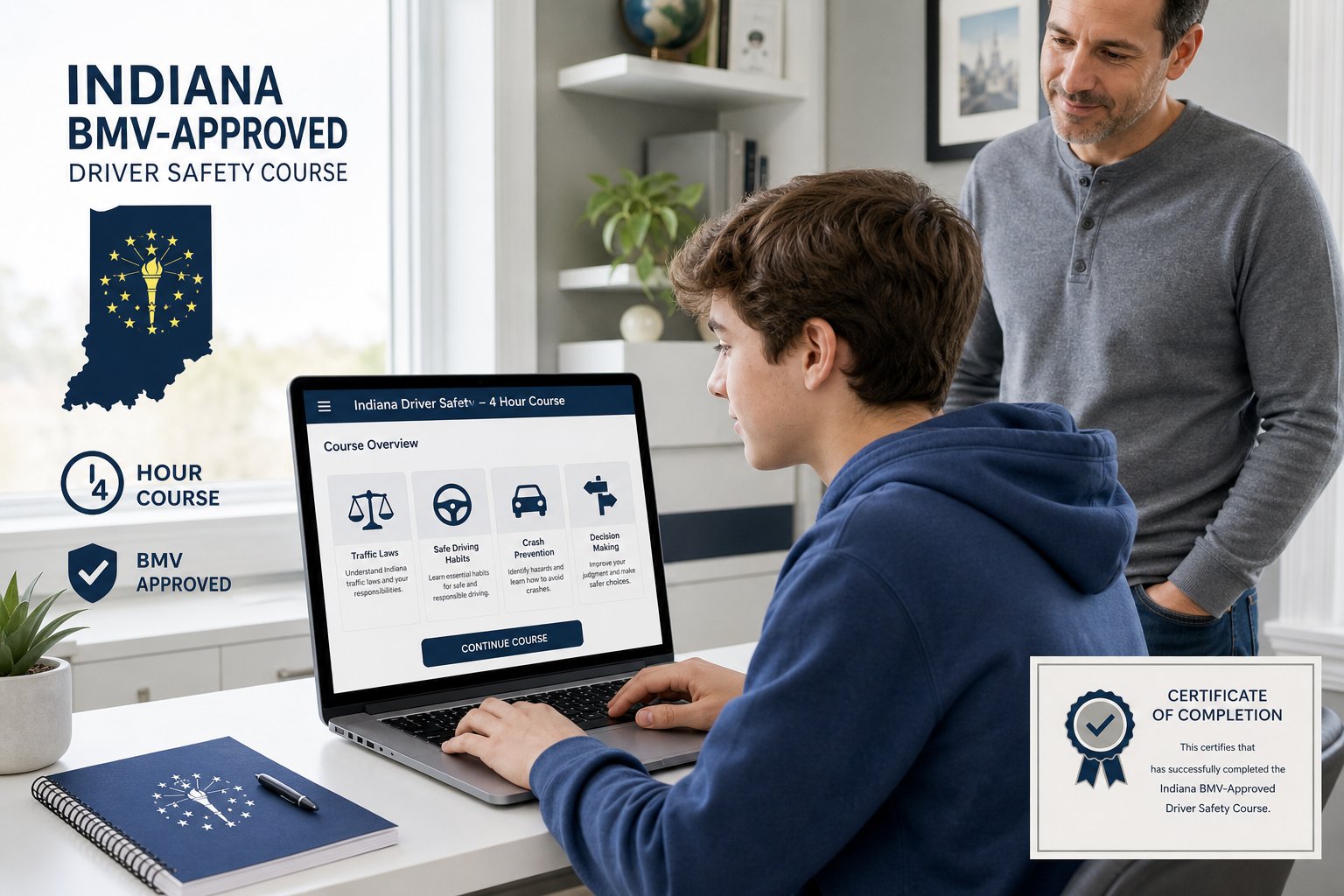
The Indiana Teen Driver Safety Program is not basic driver training. It is the Indiana Bureau of Motor Vehicles’ BMV-approved Driver Safety Program, often called the DSP, for licensed drivers who need a defensive driving course.
For teens and young drivers, the key fact is simple: this is a 4-hour course. It focuses on safe driving habits, crash prevention, traffic laws, and decision-making behind the wheel. It does not teach first-time driving skills like parking, lane changes, or permit basics.
Indiana allows the course in approved formats such as online, classroom, or other BMV-approved delivery methods. Many busy families pick the online option because it is easier to fit around school, sports, and work.
The course content is regulated by the state. That matters because only a BMV-approved course counts for a BMV requirement, a court order, or a 4-point credit on the record. A random defensive driving class will not do the same job.
A few core points matter most:
- It is a 4-hour Indiana DSP
- It is for licensed drivers, not permit training
- It may be required by the Indiana BMV or a court
- It may also be taken voluntarily
- It can add a 4-point credit, but it does not erase a conviction
Indiana also caps the fee for approved DSP providers. Under state rules, the maximum fee is $55.
For the current program rules, see the Indiana BMV Driver Safety Program page and the Indiana Administrative Code rules for the program.
Who May Be Required Or Allowed To Take It
Some teens must take the DSP. Others may choose to take it.
The main Indiana young driver BMV requirement is stricter for drivers under 21 than many parents expect. Based on Indiana BMV program rules, a driver under 21 who is convicted of two or more traffic offenses within 12 months can be required to complete the Driver Safety Program within a 90-day window. If the teen does not finish by the deadline in the BMV notice, the license may be suspended.
A teen may also need the course if a court order requires it. Judges can order a driver safety course in some traffic cases. In that situation, the court order controls what your teen must do, along with any BMV requirement that also applies.
The course is not only for required cases. Indiana drivers, including young drivers, may also take a DSP voluntarily. Many do this to earn the 4-point credit if they are eligible.
Parents should pay close attention to the exact paperwork. Requirements can depend on:
- The Indiana BMV notice
- A court order
- The ticket or citation
- The teen’s driver record
- The teen’s current license status
- The court, judge, and case facts
And one detail matters a lot: do not assume adult rules apply the same way. For younger drivers, Indiana uses a lower conviction threshold before requiring the program.
You can review official state materials through the Indiana BMV and the Indiana General Assembly code site.
How The Program Helps Your Indiana Driving Record
The biggest record benefit is the 4-point credit. When your teen completes a BMV-approved course, Indiana can apply that credit to the official driving record.
But here is the part many people miss: the DSP does not remove the traffic conviction, the citation, or the underlying violation. It only reduces the total point impact by adding a credit. That means the record still shows what happened, but the points can be offset.
For a young driver, that can matter. Indiana tracks demerit points, and point totals can affect warnings, probation, or suspension risk depending on the record and the case facts. A 4-point credit may help lower the total shown on the record after it is processed.
There are limits, though. Indiana allows the credit once every three years. If a driver takes another course within that period, the new course does not stack another extra 4-point credit on top of the first one. Instead, the timing resets under the state’s rules.
That means parents should think about timing before signing up for a voluntary course. If your teen already has a BMV notice or a completion deadline, finishing the required course on time matters more than trying to guess at future point strategy.
Use the official state pages to confirm current rules and timing, including the Indiana BMV Driver Safety Program information and related Indiana code materials.
Teen Driver Safety Program Vs. Teen Driver Education
These are two very different things, even though the names sound close.
The Teen Driver Safety Program is a 4-hour defensive driving course for drivers who are already licensed. It is used for a BMV requirement, a court order, or a voluntary 4-point credit.
Teen Driver Education is the training used to help a new driver learn how to drive. In Indiana, that usually means a formal course with 30 hours of classroom instruction and 6 hours of behind-the-wheel training through a licensed driver education school. That path connects to permit and licensing steps, not to a point credit on a driving record.
A quick way to separate them:
- Driver Safety Program: for licensed drivers, 4 hours, defensive driving, point credit, court/BMV use
- Driver Education: for learning to drive, classroom plus driving time, permit/license preparation
This difference matters because families often sign up for the wrong course. If your teen got a BMV notice or a court order for the Indiana Driver Safety Program, regular driver ed will not usually satisfy that requirement.
If your teen is already licensed and needs to deal with points, convictions, or a state deadline, make sure the provider offers the BMV-approved DSP and not beginner training. Before you enroll, check the provider against the official Indiana BMV approved program information.
How To Complete An Indiana Teen Driver Safety Program Online
The online process is usually simple. First, enroll with a BMV-approved provider. Then complete the 4 hours of course work. After that, finish the final exam and keep your completion proof.
Most providers break the course into short modules. That helps if your teen needs to stop and start between classes, work shifts, or family plans. The full course still has to meet the Indiana minimum time requirement.
A typical online flow looks like this:
- Choose a BMV-approved course
- Create an account and register
- Complete all required lessons
- Take the final exam
- Download or save the certificate
- Watch for BMV reporting and record updates
Many Indiana DSP final exams are short and multiple choice. The exact provider process can vary, but the usual format is around 10 questions with an 80% passing score. Some providers allow retakes.
If you need speed and flexibility, an online option may fit best. Driving Logic at teen driver safety program indiana offers online state-approved courses designed for busy drivers who want to finish on any device and get fast proof of completion when allowed.
Still, speed does not replace accuracy. Match the course to the exact notice or order, and make sure the provider is approved by the Indiana BMV.
Choosing A BMV-Approved Provider And What To Expect
The most important rule is this: only a BMV-approved provider counts for Indiana DSP purposes. If the school is not on the state list, the course may not satisfy a BMV requirement, a court order, or the record credit rule.
Before you enroll, confirm that the provider appears on the official Indiana list. Then review the basics.
What you should expect:
- 4 hours of required content
- Lessons on traffic laws and safe driving habits
- Quizzes or knowledge checks
- A final exam
- A certificate sent by email, download, or print option
- A fee that does not exceed $55 under Indiana rules
Some providers also offer mobile-friendly access. That can help teens finish on a phone, tablet, or laptop. But the better question is not just whether it works on a device. Ask whether it is easy to pause, resume, and finish within your completion deadline.
If your teen has a 90-day window from a BMV notice, do not wait until the last week. Time can be lost to registration issues, reporting delays, or confusion about where to send the certificate.
Use the state’s own sources to verify approval and course rules, including the Indiana BMV Driver Safety Program page.
What Happens After You Finish The Course
Finishing the class is not always the last step. After completion, the provider usually reports the result electronically to the Indiana BMV. That can happen within 24 hours or may take a few business days, depending on the provider.
After the report reaches the state, the BMV still needs time to process it. The 4-point credit may take about 7 to 10 business days, and sometimes up to 14 business days, to show on the record.
In some cases, the driver may also need to send the certificate if the BMV instructs that step. Indiana materials note that you may need to email proof to [email protected] to help make sure the credit is applied or the requirement is matched correctly.
If your teen took the course because of a court order, the court may also require its own proof. Do not assume the BMV report alone satisfies the court.
Most of all, watch the deadline. If a teen under 21 is required to complete the DSP and misses the 90-day window, the license may be suspended.
If you need a fast online option, you can start the Indiana Driver Safety Program through teen driver safety program indiana and keep a copy of every notice, deadline, and completion record.
This information is general education only and is not legal advice.
Drivers may search for this topic using terms like indiana teen driver license points, under 21 driver safety program indiana, indiana bmv under 21 dsp. In practice, the key issue is still the same: match the course to the Indiana BMV notice, court order, or record goal before you rely on it.
FAQ
Do Indiana teen drivers have different DSP rules?
Yes. Indiana has special rules for young drivers, including drivers under 21 and under 18. Multiple offenses can trigger a required Driver Safety Program.
Is DSP the same as teen driver education?
No. DSP is a driver safety course for driving record or court/BMV requirements. Teen driver education teaches new drivers how to drive.
Can a teen take the Indiana DSP online?
Yes, if the provider is BMV-approved and the format fits the requirement. Parents and teens should read the BMV notice or court order first.
Does DSP remove a teen driver’s violation?
No. DSP completion does not erase the violation or conviction. It may add a 4-point credit when eligible and may satisfy a requirement.
Conclusion
Indiana Driver Safety Program for Teens and Young Drivers comes down to the rule in your own Indiana BMV notice, court order, citation, or driver record goal. The Indiana Driver Safety Program can help with BMV compliance and may add a 4-point credit when eligible, but it does not erase the ticket or conviction. Confirm your deadline, choose a BMV-approved provider, and keep proof after you finish.
Take the teen driver safety program indiana online with Driving Logic when you are ready to begin.
Related Articles
- Indiana Driver Safety Program: The Complete Guide
- What Happens If You Don’t Complete a Court-Ordered DSP in Indiana?
- How to Submit Your Indiana DSP Certificate to the Court or BMV
- Indiana Reckless Driving and the Driver Safety Program: What to Know
Sources
- Indiana BMV — Citation Points and Driver Safety Program
- myBMV — Indiana BMV Online Services
- Indiana Code
- Indiana Administrative Code
Billy Forte is the owner of Driving Logic, a state-approved driver improvement course provider serving Indiana and other U.S. states. Driving Logic offers online driver safety and driver improvement courses for drivers handling BMV notices, court orders, and state requirements.
This article is general information, not legal advice. Indiana BMV rules, court orders, deadlines, provider reporting, insurance decisions, and case facts can differ. Use official Indiana BMV and court sources for current requirements, and consult a qualified Indiana attorney for legal guidance specific to your situation.