
Updated June 2026 · Reviewed by Billy Forte
The Indiana DSP 4-point credit lowers the active point total on your Indiana Official Driver Record when you complete an approved course and qualify. This article is for Indiana drivers who need a clear answer before choosing a course, responding to a notice, or checking their record. You will learn what the rule means, how the Driver Safety Program fits in, and what to check before your next step.
This article covers Indiana requirements only.
Key Facts
- Credit amount: Indiana DSP can provide a 4-point credit.
- Timing rule: The voluntary credit may be limited to once every 3 years.
- Record impact: The credit lowers active point totals but does not delete convictions.
- Provider approval: Use a BMV-approved provider.
- Processing: BMV processing can take time after provider reporting.
What The Indiana Driver Safety Program Is And When It Applies
If you need the approved online option, review the indiana dsp 4 point credit before your deadline.
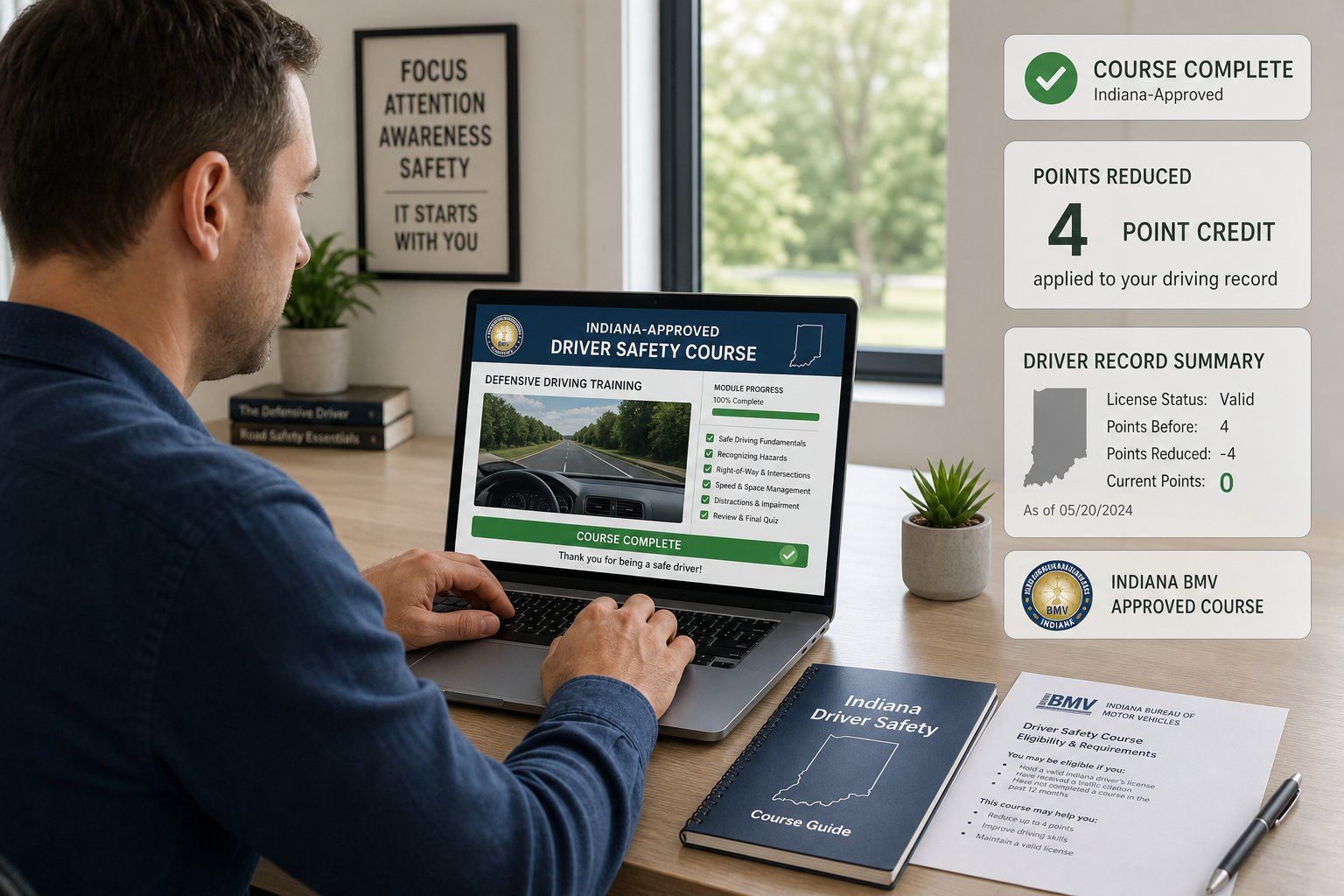
The Indiana Driver Safety Program (DSP) is the state’s approved defensive driving course. In Indiana, it is a BMV-approved program. It is often taken online, but Indiana has also allowed other formats in some cases, such as classroom or DVD through approved providers.
The main point is simple. The course can serve two different jobs.
- It can meet a requirement from the Indiana BMV or a court.
- It can also earn a 4-point credit on the Indiana Official Driver Record.
That 4-point credit matters if you have demerit points from traffic convictions. Indiana uses a point system, and too many points can lead to more action by the Indiana Bureau of Motor Vehicles, including suspension issues. So, the DSP is often used by drivers who want to lower their effective point total in a lawful way.
The course is also meant to teach safer driving habits. That is why Indiana calls it a Driver Safety Program, not just traffic school. When the course is taken for credit, the provider must be BMV-approved. If the course is not approved by the state, you should not assume it will count for your record.
In many cases, the course is 4 hours long. That is the key time fact most drivers need to know before they sign up. Still, the reason you are taking it matters. Your notice, ticket, court order, license status, driving record, and case facts can all affect what counts and what deadline applies.
Who Can Take Indiana DSP For A 4-Point Credit Or A Requirement
In general, any Indiana driver may take a BMV-approved Driver Safety Program and receive the 4-point credit on the Indiana Official Driver Record, if the timing rules are met. That means you do not always need a court order or a BMV notice to take the class.
But some drivers are told they must take it.
According to Indiana BMV rules, the BMV may require DSP when a driver has enough recent traffic convictions to trigger action. The common rule is:
- Age 21 or older: 2 or more traffic convictions within 12 months
- Under age 21: 2 or more traffic convictions
A judge may also order the course in a traffic case. That is different from a voluntary course. If a court orders DSP, you need to follow the court’s exact terms.
This is where many drivers get tripped up. A court may want proof by a certain date. The BMV may also have its own requirement. Sometimes both are in play at once.
So, before you enroll, check:
- Your Indiana BMV notice, if you got one
- Your court order or ticket paperwork
- Your current driving record
- Your deadline
- Whether the course is BMV-approved
If your goal is the driver safety program point credit Indiana drivers ask about most, approval is the key issue. A non-approved course may not give you the state credit you expect.
How Indiana’s Point System And The 4-Point Credit Work
Indiana gives demerit points for traffic convictions. When you complete a BMV-approved DSP, the state adds a 4-point credit on the Indiana Official Driver Record. That credit reduces your point total, but it does not remove the conviction itself.
That distinction is important.
If you were convicted of a traffic offense, the violation still stays on your driving record. The course does not dismiss the ticket. It does not erase the case. Instead, it works as a point offset.
A simple example helps:
- You have 6 demerit points on your record
- You complete a BMV-approved Driver Safety Program
- Indiana applies a 4-point credit
- Your effective point total becomes 2
This can help if you are trying to avoid a suspension risk tied to point totals. Indiana uses a 20-point threshold in its point system, so a credit can matter a lot for some drivers.
There is also a timing rule. The 4-point credit can be applied once every 3 years. That means you cannot keep stacking more and more credits by taking course after course. Indiana treats it as a single credit period, not a repeated point wipe.
Some state sources also explain that another course within that period may affect the credit period, but it does not create an extra stack of points. So the safe takeaway is this: one 4-point credit at a time, once every 3 years.
You can review Indiana’s rules through the Indiana BMV Driver Safety Program page and state law sources such as the Indiana Administrative Code and the Indiana Code.
When DSP Is BMV-Required Vs Court-Ordered
A BMV-required DSP and a court-ordered DSP are not always the same thing. The difference affects what you need to finish, who must receive proof, and whether the 4-point credit applies.
A BMV-required DSP comes from the Indiana BMV based on your driving record. If the BMV sends you a notice, you need to complete the required course that meets BMV standards. In many cases, finishing that course both satisfies the BMV requirement and qualifies you for the 4-point credit on the Indiana Official Driver Record, if you are otherwise eligible.
A court-ordered DSP comes from a judge in a traffic case. The court may order a driving course as part of the case result. But the key issue is this: the 4-point credit applies only if the course is a BMV-approved DSP. A court may accept a course for its own purpose even if it does not produce the state point credit.
That is why the exact wording matters.
Check whether your paperwork says:
- Driver Safety Program
- Defensive driving course
- Traffic school
- BMV-approved program
- Specific provider or proof rules
If you have both a BMV notice and a court order, do not assume one completion handles both. Often it can, but only if the course and reporting meet both sets of rules. Read the notice and order closely, and follow every deadline and appearance requirement.
Deadlines, BMV Notices, And What Happens If You Miss Them
If the Indiana BMV requires you to complete the Driver Safety Program, the deadline is usually 90 days from the notice date. That 90-day window is a major rule, and missing it can lead to a license suspension.
The process usually starts with a mailed BMV notice. That notice tells you that the state requires the course because of your record. Once the notice is issued, the clock starts.
If you do not complete the DSP in time, Indiana may suspend your license until:
- You finish the required course, and
- The BMV processes the completion
Processing is not always instant. Even after you pass the course, it can take about 7 to 10 business days, and sometimes up to 14 business days, for the BMV to show the result on your record.
That delay matters. If your deadline is close, waiting too long to enroll can create a problem even if you finish the class. The provider may report fast, but BMV posting time is its own step.
Also, your case may have more than one deadline. You could have:
- A BMV notice deadline
- A court deadline
- A hearing date
- A required court appearance
Do not ignore any of them. If you received a notice or order, read it line by line and act early enough for processing time. That is the safest way to avoid a preventable suspension.
How The Online DSP Course Works From Start To Finish
The online Indiana DSP is usually straightforward. You register with a BMV-approved provider, complete the 4-hour course, pass any required test, and the provider reports your completion.
Most providers follow a similar flow:
- Register online
- Enter your name, license details, and sometimes ticket or case details
- Complete the lessons and short quizzes
- Take the final test, if required
- Receive a completion record or certificate
- The provider reports your course to the BMV
Some providers describe a final exam with multiple-choice questions and a passing score, but course details can vary by provider and approval terms. So, use the instructions on your selected provider’s site.
For busy drivers, the big benefit of online study is flexibility. You can usually log in from a phone, tablet, or computer and work in parts instead of sitting in a classroom. That fits the Driving Logic model well. On Driving Logic’s Indiana Driver Safety Program page, you can review the online option and see if it matches your notice or court needs.
Before you start, make sure the provider is approved for Indiana DSP. That matters more than convenience. A short sign-up is nice, but state approval is what makes the completion useful for a BMV requirement or a valid 4-point credit on the Indiana Official Driver Record.
What You Receive After Completion And How To Confirm Your Credit
After you complete the Indiana DSP, you should receive a certificate or completion confirmation for your records. If your course was court-related, you may need that proof for the court. If it was BMV-related, the provider often reports completion directly to the state.
Still, do not assume the credit posted right away.
A practical check plan is:
- Wait about 7 to 10 business days after completion
- Review your Indiana Official Driver Record
- Look for the course completion and the 4-point credit
You can get driver record information through the Indiana BMV. If the credit does not appear after the normal processing period, Indiana sources say you may need to contact your provider and, in some cases, send proof to [email protected].
Remember what you are confirming. You are looking for a 4-point credit on the Indiana Official Driver Record. You are not looking for the ticket to disappear. The conviction may still show, because the DSP credit reduces the point total rather than removing the violation.
If you need a fast online option, review the Indiana course at MyDrivingLogic.com. Then save your completion proof and check your record after the BMV has had time to post it.
This information is general only and is not legal advice.
FAQ
Does the Indiana DSP remove points?
No. The Indiana DSP can add a 4-point credit when eligible, but it does not remove the conviction or violation from your record.
How often can I get the 4-point credit?
The voluntary 4-point credit is generally limited by Indiana timing rules. Check your BMV record and the date of your last course completion before relying on a new credit.
Can a court still order DSP if I already took it?
Yes. A court or the BMV may still require DSP completion even if you are not eligible for a new voluntary credit.
Does the course erase my ticket?
No. The course does not erase the ticket, conviction, or violation. It affects points only in the limited way Indiana allows.
Conclusion
Indiana DSP 4-Point Credit: How It Works is easier to manage when you check your Indiana BMV record, understand what the points mean, and know what the Driver Safety Program can and cannot do. The Indiana DSP may provide a 4-point credit when eligible, but it does not erase a ticket, conviction, or violation. Before you act, compare your record, BMV notice, or court papers with official instructions.
Take the Indiana Driver Safety Program course online when you are ready to begin.
Related Articles
- Indiana Driver Safety Program and Points: What It Can and Cannot Do
- Indiana BMV Points System Explained
- How Long Do Points Stay on Your Indiana Driving Record?
- How to Check Your Points on an Indiana Driver’s License
Sources
- Indiana BMV — Citation Points and Driver Safety Program
- Indiana BMV — Driver Record Points
- Indiana BMV — Driver Records
- Indiana Code and Administrative Rules
Billy Forte is the owner of Driving Logic, a state-approved driver improvement course provider serving Indiana and other U.S. states. Driving Logic offers online driver safety and driver improvement courses for drivers handling BMV notices, court orders, and state requirements.
This article is general information, not legal advice. Indiana BMV rules, court orders, deadlines, provider reporting, insurance decisions, and case facts can differ. Use official Indiana BMV and court sources for current requirements, and consult a qualified Indiana attorney for legal guidance specific to your situation.