
Updated June 2026 · Reviewed by Billy Forte
Yes, your teen may need a Virginia Driver Improvement Clinic if a court order, a Virginia DMV notice, or a case-specific driver record issue says the course is required. In Virginia, the official Driver Improvement Clinic is a DMV-approved 8-hour course, and online students must use a DMV-licensed online provider for the course and final test. Parents should read the exact court order, DMV notice, ticket, or citation because the reason for the requirement, the completion deadline, and whether the court or DMV will give credit can depend on the case facts and local rules.
This article covers Virginia requirements only.
Key Facts
- Young drivers: Teen and young-driver requirements can be stricter than adult voluntary completion.
- Course length: Virginia Driver Improvement Clinics are 8-hour DMV-approved courses.
- Online option: Online completion may be allowed if the court or DMV notice accepts it.
- Proof: DMV reporting and court certificate submission are not always the same step.
- No erasure: The clinic does not erase tickets, convictions, or demerit-point history.
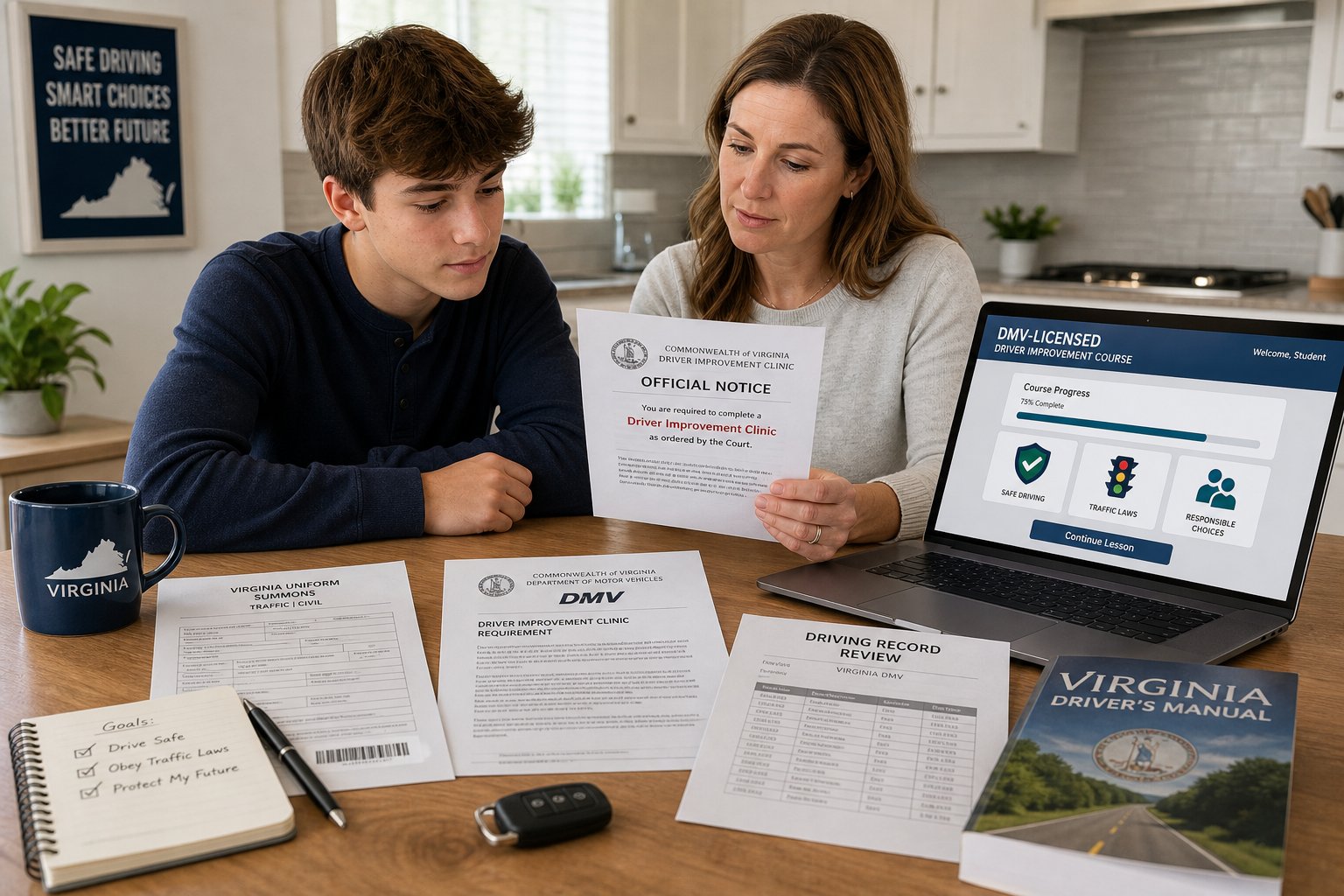
What A Virginia Driver Improvement Clinic Is And When A Teen May Need One
A Virginia Driver Improvement Clinic is the state’s official driver improvement course. The Virginia Department of Motor Vehicles says it is an 8-hour program that teaches crash-avoidance and safer driving habits.
A teen may need one for more than one reason. The most common are a court order, a DMV notice, or a voluntary choice to try to earn safe driving points if the driver is eligible. Still, you should not guess which rule applies. The exact answer depends on the notice, the court, the judge, the ticket, the teen’s driver record, and the teen’s license status.
If your teen got a letter from the Virginia DMV, read every line. If your teen has a court date, read the citation and any court papers just as closely. Some families assume a clinic is optional when it is not. Others assume any clinic will count, which can also be wrong.
For online courses, Virginia requires a DMV-licensed online provider. The online provider handles the course and the final test under Virginia rules. That matters because a non-approved course may not meet the requirement in the notice or order.
Common Reasons Teens Are Assigned Or Choose A Clinic
Teens and young drivers usually take a clinic for one of these reasons:
- A court ordered it as part of a traffic case
- Virginia DMV required it based on a notice or record issue
- The driver chose it voluntarily for possible safe-driving point credit
- A parent wants record improvement education after a ticket or close call
The Virginia DMV clinic page and provider guidance both make clear that the reason for attendance matters. For example, court-ordered attendance may not work the same as voluntary attendance. And a course taken for insurance reasons may not work the same as a course taken for DMV credit.
That is why parents should match the course to the exact need before enrollment.
Court-Ordered, DMV-Required, And Voluntary Options Explained
These three paths are not the same. A teen can be court-ordered, DMV-required, or voluntary, and each path can lead to different rules about proof, deadlines, and credit.
With a court order, the court tells the driver to complete a clinic. In that case, the court may set the deadline and may decide what proof it wants. Virginia DMV notes that when attendance is court-ordered, the court decides whether safe-driving points are awarded, and court documentation must be shown to the clinic before DMV can award points. That detail comes from the Virginia DMV Driver Improvement Clinic information.
With a DMV-required clinic, the teen receives a DMV notice. That notice matters most. It should tell you what is required and when the completion deadline applies. Do not treat a DMV warning as general advice. It is a direct notice tied to that driver’s record.
A voluntary clinic is different again. Virginia providers commonly state that eligible drivers may earn 5 safe-driving points once every 24 months, but voluntary point credit is not the same as erasing a ticket, conviction, or prior demerit-point history. Those are separate issues. See the Virginia DMV safe driving points page for the state’s current points framework.
If the teen has both a court case and DMV mail, compare both documents. One may control court credit, while the other controls DMV compliance.
How The 8-Hour Online Clinic Works For Busy Teen Drivers
The online version is built for flexibility, but it is still the full 8-hour Driver Improvement Clinic. Virginia says online students must use a DMV-licensed online provider, and the final test is part of the online process.
That means your teen can often work from home and use a phone, tablet, or computer, but the course still has state rules. It is not a quick video or a short quiz. The provider must deliver the full program required by Virginia.
Most approved providers present the course in short lessons. That makes it easier for busy students, athletes, and working teens to fit the class into their week. Some providers also allow self-paced progress, which helps if your teen cannot sit for eight hours at once.
Driving Logic and virginia driver improvement clinic teenager focus on online access and flexible scheduling, which can help families who need a legal course format without the travel time of a classroom. But convenience should come after the first check: make sure the provider is approved for the exact type of credit your teen needs.
Before you sign up, confirm these points:
- The provider is DMV-licensed for Virginia online clinics
- The course is the Virginia Driver Improvement Clinic
- The teen can meet any court or DMV deadline
- The provider issues the required DMV-standardized certificate of completion
If a notice or order is involved, keep a copy nearby while your teen enrolls.
Final Exam, Completion Requirements, And What To Expect
Your teen must complete the full course to get credit. In Virginia, the online clinic includes the final exam as part of the required 8 hours, and a certificate is issued only after the provider’s completion rules are met.
That usually means your teen will move through all lessons, answer any required quiz items, and then take the final test through the online system. Some approved providers mention lesson quizzes during the course. Others focus on the final exam at the end. The exact format can vary by provider, but the core rule stays the same: the student must complete the approved clinic in full.
Parents often ask if the exam is separate from the course clock. For online Virginia clinics, provider guidance says the final test is part of the required course time, not an extra class added after the eight hours. Even so, your teen should allow enough time before any completion deadline.
A few practical tips help:
- Use the teen’s correct legal name and driver information
- Save emails and login details
- Finish early enough to avoid last-minute problems
- Keep the certificate and any court filing proof together
If the clinic is tied to a court matter, check whether the court wants the teen to file proof, bring proof to court, or both. Do not assume the provider sends everything everywhere automatically.
Will The Court Or Virginia DMV Accept The Course?
The course is more likely to be accepted if it is the right course from the right provider, but acceptance still depends on who required it. For Virginia DMV purposes, the accepted proof for an online clinic is the DMV-standardized certificate of completion, according to DMV and provider materials.
That does not mean every court will accept every online course in every case without question. If the clinic is court-required, the safest step is to confirm that the court allows online completion and that the course meets the judge’s or clerk’s instructions. Some providers say this directly because court rules can vary by case and locality.
This is where families get tripped up. They hear “DMV-approved” and assume that ends the question. But a court order may have its own terms. A juvenile or young-driver case may also come with facts that change what proof the court wants.
You should verify:
- Who required the course: court or Virginia DMV
- Whether the court allows an online clinic
- What proof must be filed or shown
- The exact completion deadline
- Whether the teen seeks court credit, DMV credit, or voluntary points
If your teen needs an online Virginia course from a state-approved provider, you can review the option to take the Virginia Driver Improvement Course online at Driving Logic.
How To Choose The Right Virginia Teen Driver Improvement Course
Choose the course based on the notice, not on the ad. The right class for your teen is the one that matches the court order, DMV notice, or voluntary goal and comes from a DMV-approved provider.
Start with approval status. The Virginia DMV keeps information about Driver Improvement Clinics and online provider rules. If the teen needs online completion, make sure the provider is licensed for that format.
Next, match the course to the reason for attendance:
- Court-ordered: verify the court accepts online completion
- DMV-required: follow the DMV notice exactly
- Voluntary: confirm the course can qualify for safe-driving point credit if the teen is eligible
Then look at practical details. Busy families often want mobile access, easy logins, and a fast certificate process. Those points matter, but only after state approval and case fit are clear.
Driving Logic and virginia driver improvement clinic teenager are built for drivers who need flexible online access on almost any device. That can make the process easier for students with school, sports, and work. Still, the smart move is to compare the provider’s features with the exact legal or DMV need first.
Before enrollment, read the teen’s paperwork one more time. A small detail in the notice can change the right next step.
Related Articles
- Court-Ordered Driver Improvement Clinic in Virginia: What to Do
- DMV-Ordered Driver Improvement Clinic in Virginia: Points, Notices, and Deadlines
- Virginia Driver Improvement Program: Points, Orders, and Clinics Explained
- How to Submit Your Virginia Driver Improvement Certificate to the Court or DMV
Sources
- Virginia DMV — Driver Improvement Clinics
- Virginia DMV — Demerit Points and Safe Driving Points
- Virginia Judicial System
- Code of Virginia — Motor Vehicles
Billy Forte is the owner of Driving Logic, a state-approved online driver education provider serving Virginia and other U.S. states. Driving Logic offers DMV-approved online driver improvement courses for drivers handling court orders, DMV notices, demerit points, and voluntary safe-driving point credit.
This article is general information, not legal advice. Virginia DMV rules, court orders, deadlines, insurance decisions, and case facts can differ. Use official Virginia DMV and court sources for current requirements, and consult a qualified Virginia attorney for legal guidance specific to your situation.