
Updated June 2026 · Reviewed by Billy Forte
If a Virginia court ordered you to take a Driver Improvement Clinic, you need to complete a Virginia DMV-approved 8-hour course, follow the exact completion deadline in your court order or DMV notice, and make sure proof of completion gets to the right place. In Virginia, court-ordered clinic rules can depend on the court order, ticket, judge, locality, driver record, license status, and case facts, so the course alone does not change your case unless the court says it does. DMV-approved clinics report completion to the Virginia DMV for Virginia license holders, but many courts still require you to file or bring your completion certificate by the date listed in the order.
This article covers Virginia requirements only.
Key Facts
- Court order controls: Follow the exact deadline and proof instructions in your court paperwork.
- Course length: Virginia Driver Improvement Clinics are 8-hour DMV-approved courses.
- Online option: Online completion may be allowed if the court or DMV notice accepts it.
- Proof: DMV reporting and court certificate submission are not always the same step.
- No erasure: The clinic does not erase tickets, convictions, or demerit-point history.
What Court-Ordered Driver Improvement Means in Virginia
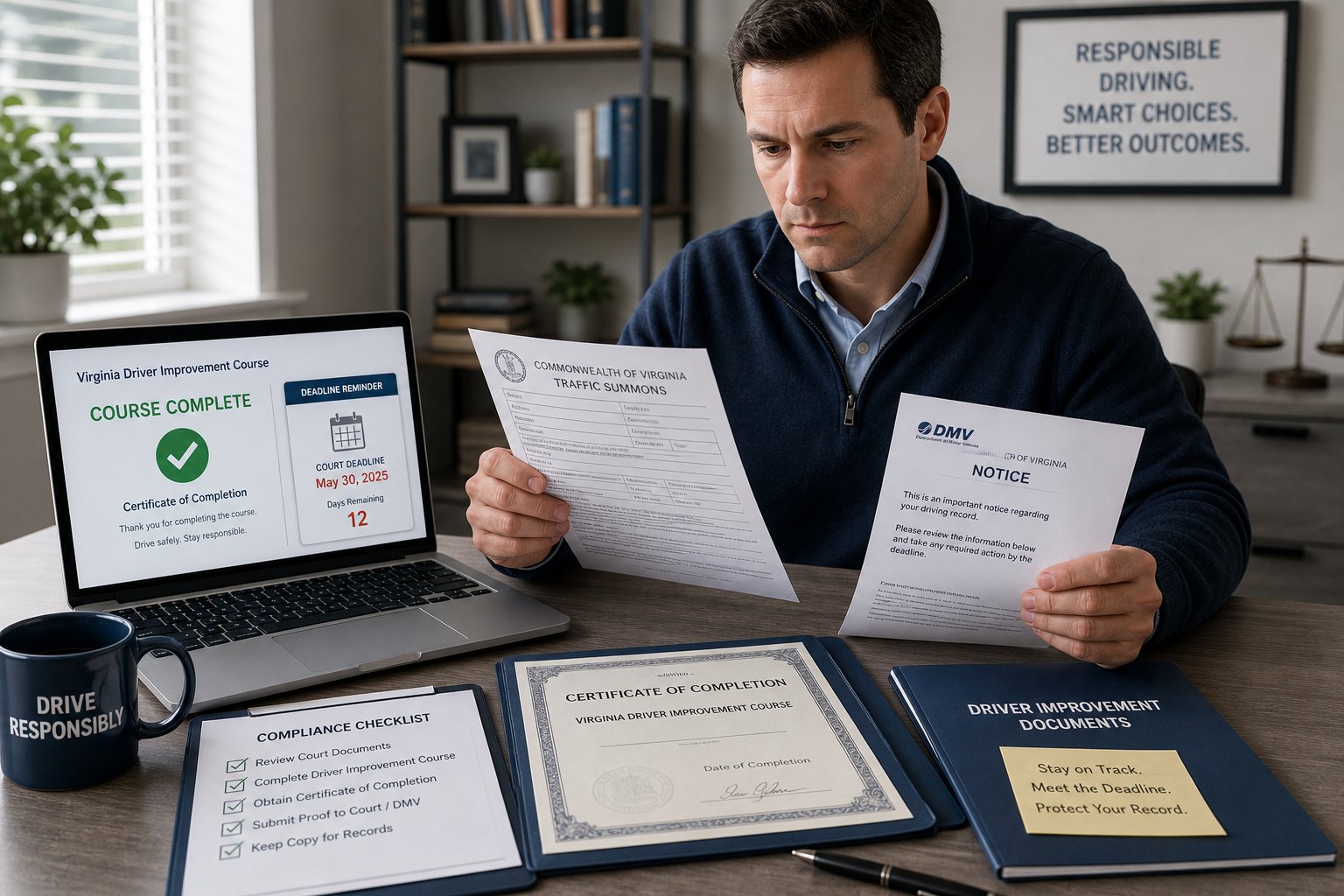
A court order to complete driver improvement in Virginia means a judge has made the course part of your case. It is not just a suggestion. You must finish the required clinic by the deadline in your paperwork and follow any extra court steps, such as returning to court or submitting proof.
In Virginia, the official course is the DMV-approved Driver Improvement Clinic (DIC). When this requirement applies, it is usually the standard 8-hour course unless your paperwork says something more specific. Some drivers see this after a moving violation. Others get the requirement because of their record, a license issue, or a case where the judge wants proof of driver education before closing the matter.
Your next step is to read every page of the court order, citation, and any DMV notice. Look for these details:
- The exact completion deadline
- Whether the court allows online completion
- Whether you must use a specific type of clinic
- Whether you must send the certificate to the court, DMV, or both
- Whether you must appear in court again after finishing
Do not assume all Virginia courts handle this the same way. The Virginia Department of Motor Vehicles approves clinics, but the court controls its own order. That is why one of the most important parts of a court ordered driver improvement Virginia case is matching the course to the order.
If you miss the deadline, the court can treat that as failure to comply. Depending on the case, that can affect fines, license status, probation terms, or other court conditions. The safest move is to confirm the requirement early and keep records of everything you submit.
For the official clinic framework, review the Virginia DMV information on driver improvement clinics.
Who Usually Has To Take a Virginia Driver Improvement Course
Most people who take a virginia driver improvement program because of a court order are dealing with a traffic case, a record problem, or a DMV action. The reason matters because it can affect what kind of course you need and where your completion proof must go.
A judge may order the clinic after:
- Speeding or another moving violation
- A more serious driving charge
- A case where the court wants education before sentencing or final disposition
- A repeat-pattern record that raised concern
Virginia DMV may also require action when a driver builds up too many demerit points or triggers entry into the Driver Improvement Program. That is separate from a judge’s order, but sometimes both happen around the same time. If that is your situation, do not treat one notice as covering the other. Read both.
Some drivers need a different format. For example, commercial drivers may need a clinic built for CDL holders. Drivers in reckless or aggressive driving matters may be told to complete a broader program tied to those facts, not just the standard clinic.
The key point is simple: your requirement depends on your own paperwork. Your friend’s case, a lawyer forum, or a provider FAQ may sound similar, but your court order and DMV notice control your next step. If anything is unclear, contact the court clerk or DMV before you enroll so you do not waste time on the wrong course.
How To Make Sure Your Online Course Is court-accepted when your court allows that provider and format
The course must be from a DMV-approved provider. That is the first rule. But for a court order, that alone may not be enough, because the court decides whether it will accept online completion for your case.
Before you sign up, verify two things:
- The provider is licensed by the Virginia DMV for driver improvement.
- Your specific court will accept that provider’s online clinic for your order.
This step matters more than people expect. Some courts accept online clinics in many cases. Some may limit them. Some may require you to bring proof in a certain form or by a certain date. And some orders include extra language that changes what you need.
A fast check can save a big mess later. Ask the court:
- Is an online Driver Improvement Clinic allowed for my case?
- Is this provider accepted?
- Do I need to file the certificate before court?
- Do I still have to appear on my return date?
Driving Logic offers a Virginia online driver improvement course built for flexible scheduling on your phone, tablet, or computer. But even with a DMV-approved provider, you should still confirm court acceptance first when your course is court ordered.
You can also verify provider status through the Virginia DMV and review Virginia court information through the Virginia Judicial System. Keep a screenshot, email, or note of who told you the course was acceptable if your court gives confirmation.
What To Expect From the 8-Hour Course and Final Exam
Virginia’s Driver Improvement Clinic is an 8-hour course. That is the standard length set for the approved program. If you take it online, you complete the material through the provider’s system and then take the required final exam there.
The course usually covers:
- Virginia traffic laws
- Defensive driving habits
- Common crash causes
- Risky choices behind the wheel
- Driving attitude and judgment
Online courses are made for self-paced use, but they still must meet state rules. That means you cannot skip the required material. You work through each section, answer checkpoints, and finish the final test as the provider instructs.
Many drivers worry most about the exam. In most cases, the better question is whether you chose the right provider and started early enough. The exam is part of the approved course flow. It is not a separate paper test you schedule somewhere else.
Plan for the full time. Do not wait until the last night before your completion deadline if the court date is close. Tech issues, identity checks, or provider processing can eat up the time you thought you had. Starting earlier gives you room to finish, get your certificate, and send proof where it needs to go.
If you need a flexible option, you can court ordered driver improvement virginia.
How Completion, Certificates, and DMV Reporting Work
After you finish and pass, you should receive a completion record from the provider. For online Virginia driver improvement, that is commonly the DIC 552B certificate of completion or the approved equivalent used by the clinic.
For Virginia license holders, DMV-approved clinics generally report completion electronically to the Virginia DMV. Many providers state that reporting is usually done within about 24 business hours, but you should still confirm timing with the provider if your deadline is close.
Here is the part that causes confusion: DMV reporting does not always replace your court duty. A court may still require you to:
- Upload or mail the certificate
- Bring the certificate to court
- Return on a set hearing date
- Show proof by a deadline before sentencing or review
So do not assume “the provider sent it to DMV” means the judge has what the judge needs. The court and DMV are related, but they are not the same office.
Keep copies of:
- Your court order
- Your registration receipt
- Your completion certificate
- Any email showing the course was reported or submitted
If the deadline is very close, ask the court what form of proof it wants and when it must arrive. Then follow that direction exactly. Clear records can help if there is any question about whether you complied on time.
What Court-Ordered Driver Improvement Can And Cannot Do for Points, Fines, and Insurance
A court-ordered clinic can satisfy a requirement in your case. But it does not automatically erase a ticket, remove a conviction, cut your fine, or fix insurance rates.
That distinction matters.
In Virginia, completing a driver improvement clinic may lead to safe driving points in some situations. But when the course is court ordered, the court decides whether those points apply. You should not assume you will receive them unless the court process and provider documentation support it.
Also, safe driving points are not the same as removing demerit points already assessed. A clinic does not, by itself, wipe a conviction from your history. If a charge is dismissed or amended, that happens because of the court’s action, not because the course magically changed your record.
The same caution applies to money and insurance:
- A judge may or may not reduce a fine
- A judge may or may not change the case result
- A course taken for a court order does not guarantee an insurance discount
Virginia DMV explains point systems and driver improvement rules on its official driver improvement page. If you want to know what your course can do, use the exact words in your order and ask the court or provider how completion is handled in that setting.
Special Situations for Commercial Drivers, Probation, and Control Period Cases
Some Virginia driver improvement cases have extra rules. The biggest examples are commercial drivers, DMV probation, and the control period used in the Driver Improvement Program.
If you hold a CDL or were cited in a commercial motor vehicle, you may need a clinic made for commercial drivers. A standard course may not fit the order. Check the wording on your paperwork before you register.
If Virginia DMV has placed you on probation or in a control period, new traffic convictions can lead to more trouble fast. DMV says probation is commonly 6 months, with an 18-month control period where your record is watched. During probation, a new conviction can trigger a suspension based on the point value of the violation:
- 3-point violation: 45-day suspension
- 4-point violation: 60-day suspension
- 6-point violation: 90-day suspension
Some drivers may ask for restricted driving privileges after a probation violation, but those privileges are limited and do not allow operation of a commercial motor vehicle. The court may require documents to support work, school, medical, religious, child visitation, court, or program travel.
Because these cases can turn on your exact record, license class, and order language, use your own documents as the final guide. If you need a flexible way to complete an approved course, review the Virginia options at court ordered driver improvement virginia.
This article is for general information only and is not legal advice.
Related Articles
- DMV-Ordered Driver Improvement Clinic in Virginia: Points, Notices, and Deadlines
- Virginia Driver Improvement Program: Points, Orders, and Clinics Explained
- How to Submit Your Virginia Driver Improvement Certificate to the Court or DMV
- Can I Take the Virginia Driver Improvement Course Online If It’s Court-Ordered?
Sources
- Virginia DMV — Driver Improvement Clinics
- Virginia DMV — Demerit Points and Safe Driving Points
- Virginia Judicial System
- Code of Virginia — Motor Vehicles
Billy Forte is the owner of Driving Logic, a state-approved online driver education provider serving Virginia and other U.S. states. Driving Logic offers DMV-approved online driver improvement courses for drivers handling court orders, DMV notices, demerit points, and voluntary safe-driving point credit.
This article is general information, not legal advice. Virginia DMV rules, court orders, deadlines, insurance decisions, and case facts can differ. Use official Virginia DMV and court sources for current requirements, and consult a qualified Virginia attorney for legal guidance specific to your situation.