
Updated June 2026 · Reviewed by Billy Forte
To dispute an error on your Virginia driving record, compare your DMV record to court documents and ask the correct agency to fix the wrong item. This article is for Virginia drivers who need a clear answer before checking a record, taking a course, or responding to a DMV or court notice. You will learn what the rule means, how a Driver Improvement Clinic may fit, and what to verify before your next step.
This article covers Virginia requirements only.
Key Facts
- Official record: Virginia DMV records are the source for your point balance and license status.
- Record details: A record may show convictions, points, suspensions, and status history.
- Court vs DMV: Court records and DMV records may update on different timelines.
- Course role: Driver Improvement Clinic completion may appear separately from the violation.
- Verify first: Use official DMV or court records before taking action.
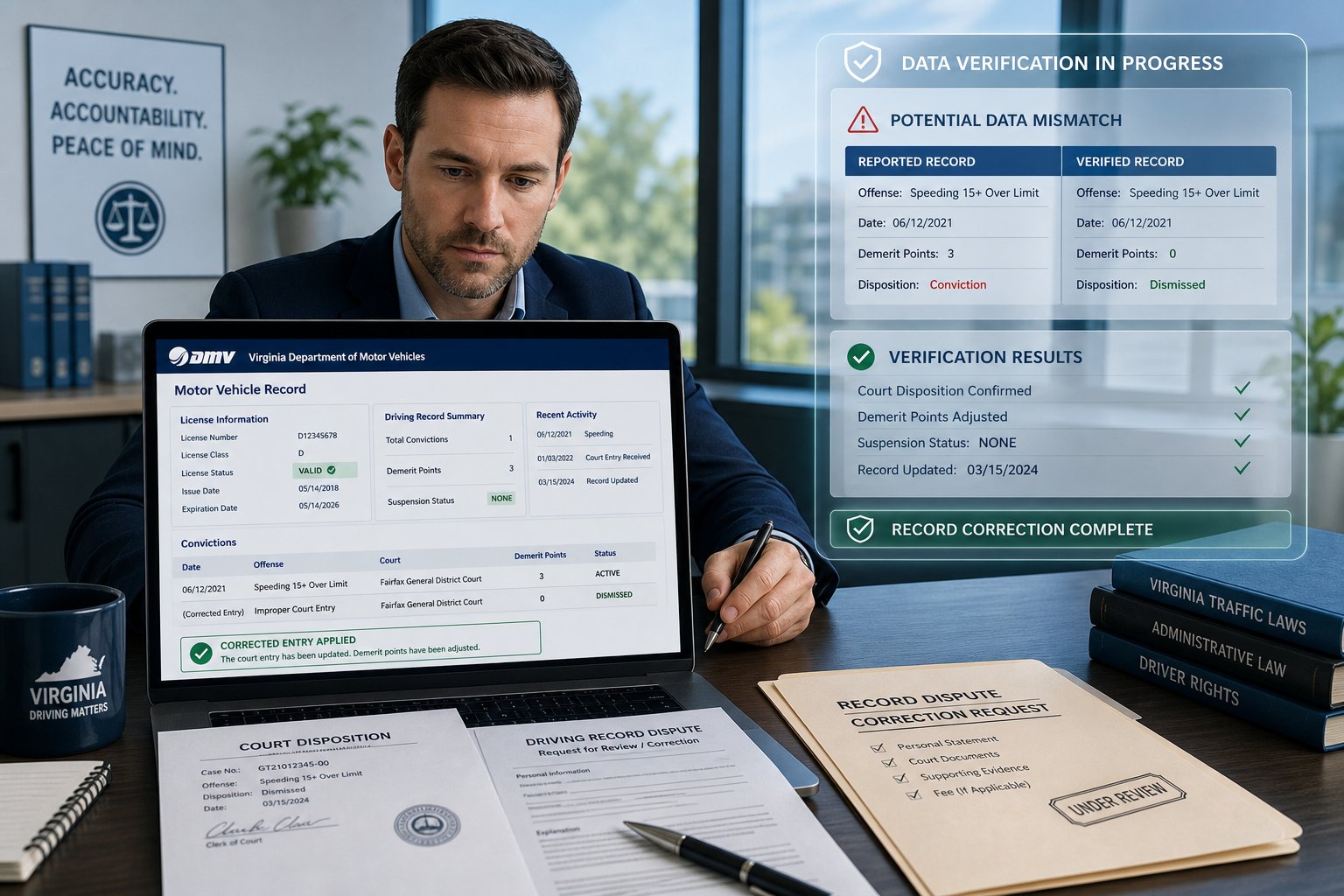
What A Virginia Driving Record Shows And Why Disputes Happen
Your Virginia driving record is more than a list of tickets. It can show your license status, traffic convictions, crashes reported to DMV, demerit points, suspensions, revocations, and DMV orders. In some cases, it also shows serious offenses such as DUI or reckless driving.
If you need an approved online option, review the Virginia Driver Improvement Course and compare it with your Virginia DMV notice, court order, or driver record goal.
That matters because many people use this record to judge your driving history. Employers may check it. Insurance companies often review it when they set rates. Courts and the Virginia Department of Motor Vehicles may use it when they decide if you must complete a program or face a license suspension.
Disputes happen when the record is wrong, incomplete, or matched to the wrong person. Sometimes the court record is the source of the problem. Other times, the court data was right, but the item was posted wrong at DMV.
Common reasons a Virginia driving record dispute starts include:
- A charge was reduced in court, but the old charge still shows
- The conviction date is wrong
- The wrong court or locality appears
- Demerit points were added in the wrong amount
- A suspension still shows after you met the terms to clear it
- Another person’s ticket or case was posted to your file
Virginia uses demerit points and safe driving points in different ways. So a point problem can be more than a small typo. It can affect your point balance, your notice from DMV, and even whether you must attend a Driver Improvement Clinic, which in Virginia is the DMV-approved 8-hour course.
Common Problems To Dispute, From Wrong Violations To Point And Suspension Errors
The most common issue is a wrong violation. For example, you may have gone to court and received a lower charge, but your driving record still shows the higher one. If that happens, your record may carry the wrong impact for insurance, job screening, or future court review.
Another common issue is the wrong conviction date. Dates matter because Virginia tracks how long violations remain on the record and how demerit points apply from the offense date. A bad date can make your record look worse than it should.
You may also need to correct error Virginia driving record entries tied to points. Virginia traffic convictions can carry 3, 4, or 6 demerit points. If DMV posts the wrong point value, your point balance can drop too far and trigger more trouble.
Suspension errors are also serious. Your record may still show a suspension or revocation even after you finished the listed steps. In some cases, DMV may need proof that you paid a fee, filed a form, completed a court requirement, or met another condition.
Watch for these problems:
- Wrong offense listed after a court reduction
- Wrong point count or point level
- Old suspension still active on the record
- Identity mix-up with another driver
- Missing update after court action or DMV compliance
If the problem came from the court result, the court clerk usually needs to fix and re-report it. If DMV posted accurate court data in the wrong way, DMV may correct it after review.
How Virginia Demerit Points, Record Length, And Insurance Issues Affect You
Virginia demerit points can affect your license fast. Most traffic convictions carry 3, 4, or 6 demerit points, and those points stay on your record for 2 years from the offense date. The full conviction may stay visible much longer.
That difference matters. A ticket can stop counting as active demerit points after two years, but the conviction may still appear on your transcript for several years. Serious matters can stay much longer, including some offenses tied to alcohol, reckless driving, or license action.
Virginia DMV may take action if you build up too many points. According to Virginia DMV, 18 points in 12 months or 24 points in 24 months can lead to a suspension and a driver improvement requirement. That is one reason record accuracy matters so much.
Insurance is another concern. Insurers often use your motor vehicle record when they set premiums. A wrong conviction or wrong point entry may make you look like a higher-risk driver.
A bad record can also affect:
- Employment, especially jobs that involve driving
- Court proceedings, where prior history may matter
- License status, including suspension risk
- DMV notices, including improvement or compliance orders
And if you see a DMV order for a Driver Improvement Clinic, remember that Virginia’s official course is a DMV-approved 8-hour Driver Improvement Clinic. That course may help in some cases, but it does not erase every problem on a record.
How To Request Your Virginia Driving Record Before You File A Dispute
Before you challenge anything, get a fresh copy of your official DMV record. In Virginia, this is often called a Driver Transcript. You can request it through your myDMV account or through other DMV options listed by the Virginia Department of Motor Vehicles.
You may also want a Compliance Summary. That report can show what you still need to do to keep or restore your license. If a suspension is part of your dispute, this can be very useful.
When you review your record, compare each item to your own papers. Do not rely on memory alone. Match the violation, date, court, case result, point effect, and license status line by line.
Helpful documents include:
- Court order or final disposition
- Ticket or citation copy
- Payment receipt
- Notice from Virginia DMV
- Completion proof for a Driver Improvement Clinic
- Any reinstatement or compliance papers
If you find a problem, mark the exact line that is wrong. Then note whether the mistake seems to come from the court or from DMV posting. That can save time when you ask for a fix.
If your record shows a course requirement, suspension warning, or deadline, do not ignore it while you investigate. Pull your record first, gather your papers, and confirm the source of the error.
Steps To Dispute A Virginia Driving Record Error With The DMV Or Court
The right path depends on where the error started. If the court disposition is wrong, contact the clerk for the court where the case was heard. If the court record is right but DMV posted it wrong, contact Virginia DMV with proof.
Start with these steps:
- Get your current driver transcript and review the exact error.
- Collect proof such as court orders, receipts, notices, and completion records.
- Contact the court clerk if the charge, date, or case result is wrong.
- Ask the court to correct and re-report the record to DMV if needed.
- Contact Virginia DMV if the court data was correct but DMV mis-posted it.
For DMV issues, use the contact methods listed on the official Virginia DMV contact page. Keep copies of everything you send.
How long does it take? There is no single timeline for every case. A simple posting fix may move faster than a court correction. Delays can happen if DMV must wait for the court, if documents are missing, or if the issue involves identity, medical review, or a suspension status.
During a dispute, points and insurance may still be affected until the record is updated. That means your insurer may still see the item, and DMV may still act on the current record. If a notice, court date, or payment deadline applies, follow it unless the proper agency tells you in writing that it changed.
For medical-related license issues, DMV may offer an administrative hearing process through Medical Review Services, with possible court appeal after that depending on the matter.
When A Driving Course Can Help Reduce The Impact Of A Violation
A driving course does not fix a wrong record entry by itself. But it can help in some situations after a ticket or DMV notice. In Virginia, the official course is a DMV-approved Driver Improvement Clinic, and it is an 8-hour course.
A Driver Improvement Clinic may matter if:
- DMV orders you to complete one
- A court orders you to complete one
- You want to earn up to 5 safe driving points if you are eligible
- You want to show effort after a violation
Safe driving points and demerit points are not the same thing. Safe driving points can help your overall point balance, but they do not mean a conviction disappears from your history. Also, whether a course helps can depend on the DMV notice, court order, ticket, driver record, license status, judge, locality, and case facts.
If you need an approved online option, Driving Logic offers the Virginia Driver Improvement Course for busy drivers who want a flexible format on any device. You can review the course and enrollment details at Driving Logic’s Virginia Driver Improvement page.
If you were ordered to take a course, check that the provider and course type match the Virginia requirement before you enroll.
When To Get Extra Help For Serious Issues Like DUI, Reckless Driving, Or License Restoration
Some record errors are too serious to handle as a simple paperwork fix. If your case involves DUI, reckless driving, license suspension, revocation, identity problems, or license restoration, get extra help fast. These issues can affect your record for years and may involve criminal court, DMV action, or both.
A lawyer may be helpful when:
- The court record does not match the case outcome
- You face a license suspension or possible jail time
- DMV says you failed to meet restoration rules
- Another person’s case appears on your record
- A medical or administrative review affects your privilege to drive
You can also review official public information from the Virginia DMV and the Virginia Judicial System to confirm forms, contacts, and court locations.
For license restoration or a serious point problem, act on the exact notice you received. The steps may depend on the DMV notice, court order, citation, court, locality, and your record history. If a Driver Improvement Clinic is required, make sure it is the right Virginia-approved 8-hour course and keep your proof of completion.
This information is general and not legal advice.
FAQ
Can a Virginia Driver Improvement Clinic remove a ticket from my record?
No. A Virginia Driver Improvement Clinic does not erase a ticket or conviction from your driving record. When eligible, it may add safe driving points that help your overall point balance.
How many safe driving points can I earn from a Virginia clinic?
Eligible drivers may receive 5 safe driving points after completing an approved clinic. Voluntary clinic credit is generally limited to once every 24 months.
Should I follow the DMV notice or the court order?
Follow the document that applies to your situation. A DMV notice, court order, citation, or insurance request may have different instructions and deadlines.
Where should I check my Virginia point balance?
Use your official Virginia DMV driving record. Do not rely only on memory, insurance paperwork, or an old copy of your record.
Conclusion
How to Dispute an Error on Your Virginia Driving Record depends on your official Virginia DMV record, the specific violation, and any court or DMV notice you received. A Driver Improvement Clinic may help with safe driving points when eligible, but it does not erase the underlying ticket or conviction. Check the official record and deadline before you act.
Take the Virginia Driver Improvement Course online when you are ready to begin.
Related Articles
- Virginia DMV Points System Explained
- What Is a Safe Driving Points Balance in Virginia?
- How to Earn Safe Driving Points in Virginia (And Why the DIC Gives You 5)
- How Many Points Is a Speeding Ticket in Virginia?
Sources
- Virginia DMV — Driver Improvement
- Virginia DMV — Points System
- Virginia DMV — Moving Violations and Points
- Virginia Code § 46.2-494 — Safe Driving Points
- Virginia DMV — Driver Improvement Clinics
Billy Forte is the owner of Driving Logic, a state-approved driver improvement course provider serving Virginia and other U.S. states. Driving Logic offers online driver improvement and driver safety courses for drivers handling DMV notices, court orders, point concerns, and state requirements.
This article is general information, not legal advice. Virginia DMV rules, court orders, deadlines, insurance decisions, CDL rules, and case facts can differ. Use official Virginia DMV and court sources for current requirements, and consult a qualified Virginia attorney for legal guidance specific to your situation.