
Updated June 2026 · Reviewed by Billy Forte
Virginia DMV points track both demerit points from convictions and safe driving points from good driving or an approved clinic. This article is for Virginia drivers who need a clear answer before checking a record, taking a course, or responding to a DMV or court notice. You will learn what the rule means, how a Driver Improvement Clinic may fit, and what to verify before your next step.
This article covers Virginia requirements only.
Key Facts
- Point types: Virginia uses demerit points for convictions and safe driving points for good driving or eligible clinic completion.
- Balance matters: Your DMV point balance can affect warnings, control periods, and suspension risk.
- Course role: A DMV-approved clinic may add 5 safe driving points when eligible.
- No erasure: The course does not erase convictions or old demerit-point history.
- Verify first: Use your official DMV record before relying on assumptions.
How Virginia’s DMV Point System Works
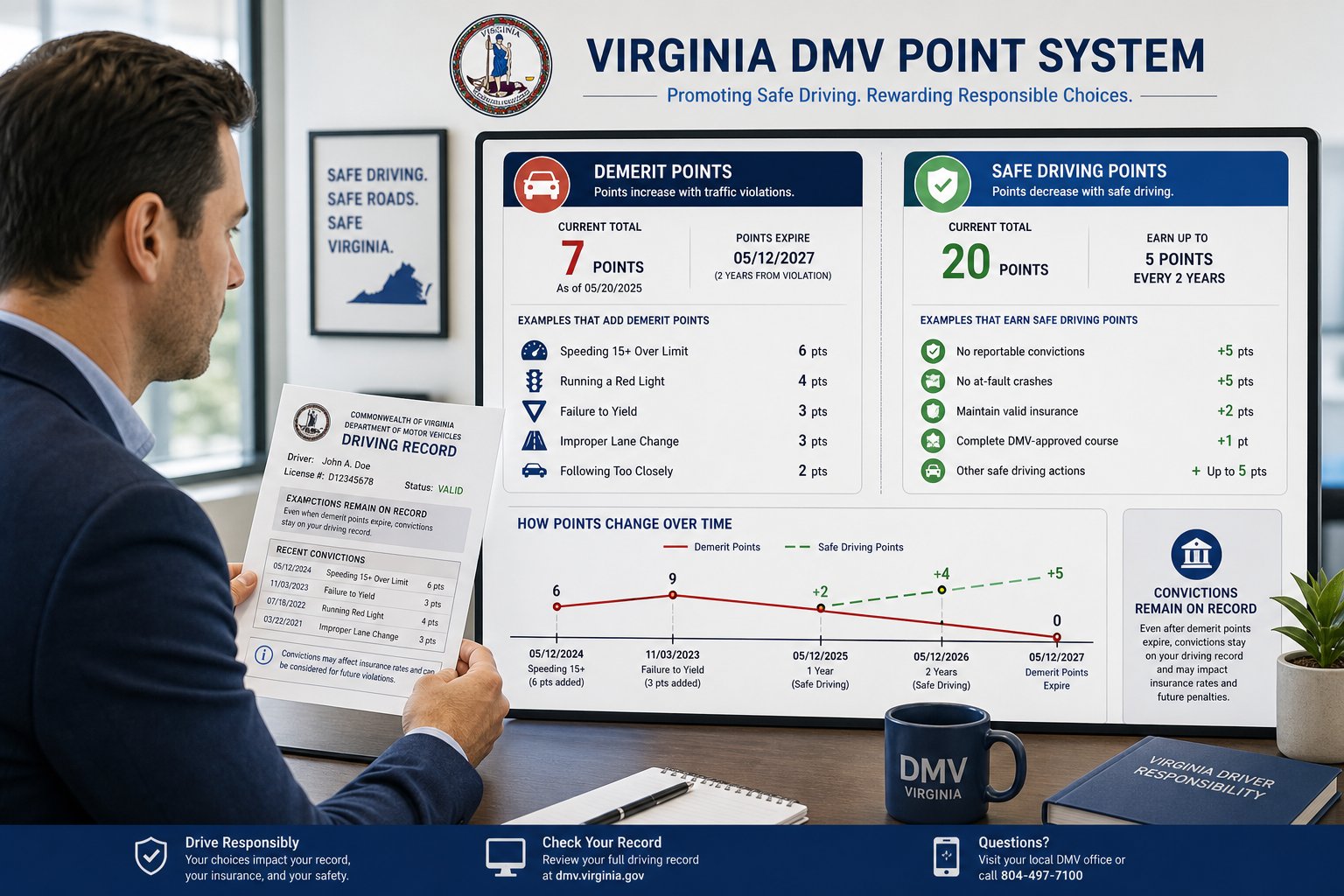
Virginia uses two kinds of points on your driving record: demerit points for traffic convictions and safe driving points for clean driving. The Virginia Department of Motor Vehicles tracks both, and your point balance can go up or down over time.
If you need an approved online option, review the Virginia Driver Improvement Course and compare it with your Virginia DMV notice, court order, or driver record goal.
A conviction for a traffic offense adds 3, 4, or 6 demerit points in most cases. The more serious the offense, the higher the points. These points are tied to the conviction, not just the ticket.
The DMV also rewards safe driving. If you complete a full calendar year with no violations and no license suspension, you can earn 1 safe driving point. You can build up to 5 safe driving points total. You may also earn 5 safe driving points for taking a DMV-approved Driver Improvement Clinic, but only once every 24 months if you are eligible.
Your record can hence show both a conviction history and a current point balance. That is why people get confused. A violation may stay on the record for years, even after the demerit points tied to it expire.
Demerit Points Vs. Safe Driving Points
Demerit points are penalties. They come from traffic convictions and count against you for DMV action. Safe driving points are credits. They can help your point balance, but they do not erase a ticket, a conviction, or the record of that event.
For example, you might have a reckless driving conviction on your driving record and still later earn safe driving points. Both things can be true at once. That is why you should read any DMV notice closely and check your official record through the Virginia DMV.
How Many Points It Takes To Suspend A License In VA
The short answer is clear: 18 demerit points in 12 months or 24 demerit points in 24 months can lead to a 90-day license suspension in Virginia. That is the main answer to how many points to suspend license in va.
But suspension usually does not come out of nowhere. Virginia DMV uses lower point levels first.
- 8 points in 12 months or 12 points in 24 months: advisory letter
- 12 points in 12 months or 18 points in 24 months: mandatory Driver Improvement Clinic
- 18 points in 12 months or 24 points in 24 months: possible 90-day suspension
The official course is the DMV-approved Driver Improvement Clinic (DIC). It is an 8-hour course. If the DMV requires it, you need to follow the notice terms and deadline.
Your result can also depend on the exact DMV notice, your driver record, your license status, and the facts in your case. In some cases, a court order or citation may add separate duties. The court, judge, and locality can matter too.
If you were told to complete a course, use the notice and your record to confirm what the Virginia DMV requires.
Common 3-, 4-, And 6-Point Violations In Virginia
Virginia traffic convictions usually fall into 3-point, 4-point, or 6-point groups. The exact offense matters because the points affect your driving record and your risk of DMV action.
Common 3-point violations often include less serious moving violations. These can include things like improper driving in some cases or other lower-level traffic offenses, depending on the conviction entered.
Common 4-point violations often include speeding and other moving violations that are more serious than a basic 3-point offense. The exact point value depends on the charge and conviction.
Common 6-point violations are the most serious in the DMV point system. These often include:
- Reckless driving
- Driving while your license is suspended or revoked
- Leaving the scene of a crash
- Other major moving violations listed by the DMV
One 6-point conviction can put you much closer to a clinic requirement or suspension threshold. Two or three serious convictions in a short time can create a real problem fast.
Because point values follow the conviction, not your guess about the ticket, it is smart to verify the final outcome through the Virginia Courts system and your DMV record. That helps you see what was actually reported.
How Long Points Stay On Your Record And What Else Can Happen
In Virginia, demerit points usually stay active for 2 years from the offense date. But the violation itself can stay on your driving record much longer. That difference matters.
For example, many routine traffic convictions carry demerit points for two years. Yet some serious offenses remain visible on your record for a longer period. Reckless driving can stay on a Virginia driving record for 11 years. Other offenses may have their own record periods under DMV rules or the Code of Virginia.
So there are really two timelines:
- Demerit point period: often 2 years
- Driving record history: can be much longer
Other things can happen besides a suspension. The DMV may send an advisory letter. It may require the 8-hour Driver Improvement Clinic. A court may also order a course in some cases. And a conviction can affect insurance pricing, though your insurer sets its own rules.
This is also where people mix up point credit and record cleanup. A clinic may add safe driving points if you qualify, but that does not mean the conviction vanishes from your record. Keep that distinction in mind when you read DMV material from the Virginia Department of Motor Vehicles.
How To Reduce Points And Protect Your License
You cannot simply wipe away Virginia demerit points on demand, but you can take steps that may improve your point balance and help protect your license. The best step is to avoid new convictions.
First, keep a clean record long enough to earn 1 safe driving point per full year, up to 5 points total. Second, if you are eligible, you may take a DMV-approved Driver Improvement Clinic once every 24 months for up to 5 safe driving points.
The official Virginia course is an 8-hour Driver Improvement Clinic. Some drivers take it because the DMV requires it. Others take it voluntarily when eligible. Requirements can depend on your DMV notice, ticket, court order, driver record, license status, and case facts.
If you need a Virginia course and want a flexible online option, you can review the Virginia Driver Improvement Course at Driving Logic. For busy drivers, online access can make it easier to fit a state-required course into a full schedule.
Also, do not miss deadlines on any DMV notice, payment notice, suspension warning, citation, or required court date. Missing one problem can turn into two.
Special Rules For Teen Drivers, Serious Offenses, And Out-Of-State Tickets
Virginia has extra rules for younger drivers and for more serious cases. So the normal point chart is not always the whole story.
Drivers who are 18 or 19 and get convicted of a demerit-point violation must complete a Driver Improvement Clinic under DMV rules. Drivers under 18 can face stricter penalties. Those can include DMV actions tied to the conviction, age, and license stage.
Serious offenses also bring added risk beyond normal point totals. A charge like reckless driving may carry 6 demerit points, stay on the record for years, and lead to court-ordered penalties. In these cases, the court outcome matters as much as the DMV points.
Out-of-state tickets are less simple. Virginia sources do not always say the same thing in plain language. Some guidance suggests Virginia does not assign its normal demerit points the same way for other jurisdictions, while other sources say out-of-state convictions can still affect your Virginia record. The safest move is to check your official Virginia driving record after the case is reported.
If you received a DMV notice or court order, follow that notice exactly and confirm what applies to your case through the DMV or court record.
Not legal advice. Rules and results can depend on the Virginia DMV notice, court order, ticket or citation, driver record, license status, court, judge, locality, and case facts.
FAQ
Can a Virginia Driver Improvement Clinic remove a ticket from my record?
No. A Virginia Driver Improvement Clinic does not erase a ticket or conviction from your driving record. When eligible, it may add safe driving points that help your overall point balance.
How many safe driving points can I earn from a Virginia clinic?
Eligible drivers may receive 5 safe driving points after completing an approved clinic. Voluntary clinic credit is generally limited to once every 24 months.
Should I follow the DMV notice or the court order?
Follow the document that applies to your situation. A DMV notice, court order, citation, or insurance request may have different instructions and deadlines.
Where should I check my Virginia point balance?
Use your official Virginia DMV driving record. Do not rely only on memory, insurance paperwork, or an old copy of your record.
Conclusion
Virginia DMV Points System Explained is easier to understand when you separate demerit points, safe driving points, convictions, and course completion. A Virginia Driver Improvement Clinic may help eligible drivers add safe driving points, but it does not erase tickets or old convictions. Always check your official DMV record and any court or DMV notice before choosing your next step.
Driving Logic offers an online Virginia Driver Improvement Course for drivers who need a flexible DMV-approved option. Review your DMV notice, court order, or voluntary point goal before enrolling.
Take the Virginia Driver Improvement Course online when you are ready to begin.
Related Articles
- What Is a Safe Driving Points Balance in Virginia?
- How to Earn Safe Driving Points in Virginia (And Why the DIC Gives You 5)
- How Many Points Is a Speeding Ticket in Virginia?
- How to Check Your Points on a Virginia Driver’s License
Sources
- Virginia DMV — Driver Improvement
- Virginia DMV — Points System
- Virginia DMV — Moving Violations and Points
- Virginia Code § 46.2-494 — Safe Driving Points
- Virginia DMV — Driver Improvement Clinics
Billy Forte is the owner of Driving Logic, a state-approved driver improvement course provider serving Virginia and other U.S. states. Driving Logic offers online driver improvement and driver safety courses for drivers handling DMV notices, court orders, point concerns, and state requirements.
This article is general information, not legal advice. Virginia DMV rules, court orders, deadlines, insurance decisions, CDL rules, and case facts can differ. Use official Virginia DMV and court sources for current requirements, and consult a qualified Virginia attorney for legal guidance specific to your situation.