
Updated June 2026 · Reviewed by Billy Forte
A Virginia DMV control period is a warning period after certain driver record problems, and another conviction during that period can trigger stronger DMV action. This article is for Virginia drivers who need a clear answer before checking a record, taking a course, or responding to a DMV or court notice. You will learn what the rule means, how a Driver Improvement Clinic may fit, and what to verify before your next step.
This article covers Virginia requirements only.
Key Facts
- DMV action: Virginia DMV may act when points or repeat convictions reach certain thresholds.
- Notices matter: A DMV letter, court order, or suspension notice controls your next step.
- Course role: A Driver Improvement Clinic may be required or may help with safe driving points.
- No erasure: A clinic does not remove the underlying conviction.
- Act early: Check deadlines before the notice or suspension date.
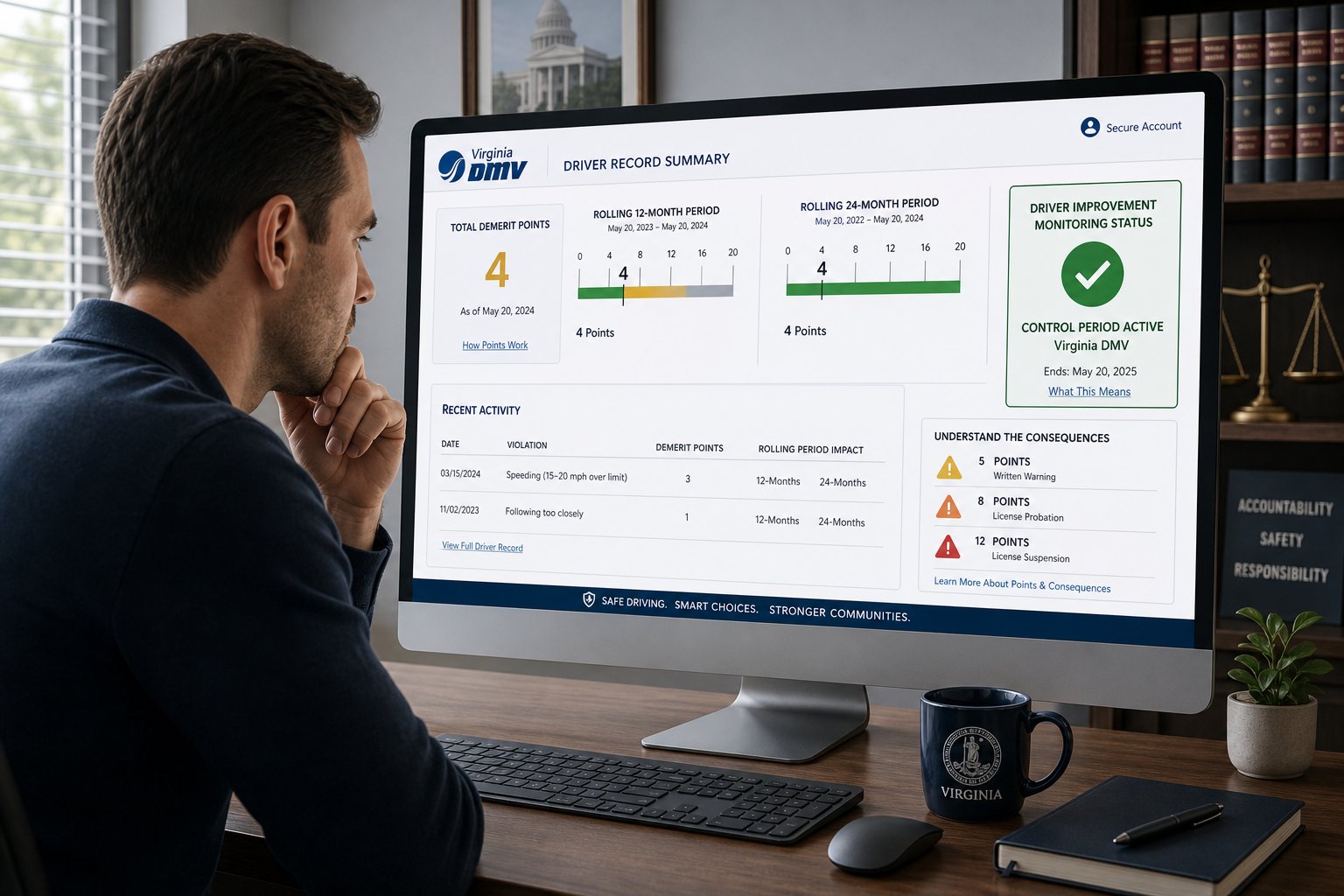
What The Virginia DMV Control Period Actually Means
The Virginia DMV control period is a monitoring period tied to your recent driving record. It is not just a warning. It means the Virginia DMV is watching for new demerit-point offenses because you built up too many points in a short time.
If you need an approved online option, review the Virginia Driver Improvement Course and compare it with your Virginia DMV notice, court order, or driver record goal.
Virginia looks at your record through rolling time windows. That means the DMV does not wait for a calendar year to end. Instead, it checks the last 12 months and the last 24 months from any given point in time.
Here is the basic idea:
- Demerit points are added after certain traffic convictions
- Those points usually stay active for 2 years from the offense date
- The conviction itself can stay on your driving record longer, depending on the offense
- Too many points too fast can trigger DMV action
A control period matters because later tickets can carry more weight than they would on a clean record. If you get another demerit-point offense during that period, the DMV can move your case forward to probation. If violations continue after that, license suspension can follow.
So when people ask what a Virginia driver license control period means, the short answer is this: it is a DMV watch period created by point buildup, and it puts your license at greater risk if you keep getting convictions.
For the official framework, see the Virginia DMV’s information on demerit points and point balance and the related rules in the Code of Virginia.
How Driver Control Periods, Probation, And Point Systems Work Together
Virginia’s system works in steps. First, the DMV counts your demerit points in the rolling 12-month and 24-month periods. Then it decides what level of action applies.
For drivers 18 and older, the point levels listed by the Virginia DMV are:
- 8 points in 12 months or 12 points in 24 months: advisory letter
- 12 points in 12 months or 18 points in 24 months: required Driver Improvement Clinic
- 18 points in 12 months or 24 points in 24 months: 90-day suspension
These levels matter because each step can lead to the next if your record gets worse.
A required clinic is not just a class. In Virginia, the official course is a DMV-approved Driver Improvement Clinic (DIC), and it is an 8-hour course. After a required clinic, Virginia law says the Commissioner must place you on 6 months of probation. That means the DMV is still watching closely after the class is done.
Probation and control periods overlap in a practical way. If you get a new demerit-point offense during a driver control period, that can also trigger probation. And if you get more violations while on probation, the DMV can suspend your license.
This is why your point balance matters so much. The points do not just sit on your record. They drive a chain of DMV responses that can grow more serious, fast.
When You Can Be Placed In A Control Period
You can be placed in a control period when your recent convictions show a pattern the Virginia DMV considers risky. The trigger is not one fixed event in every case. It depends on how many demerit points you collect and how quickly you collect them.
The most common path starts with point accumulation in the DMV’s rolling review periods. If you hit the lower action levels, you may first get an advisory letter. If you reach the next level, the DMV can order you to complete the 8-hour Driver Improvement Clinic. If the pattern continues, the DMV can move to suspension.
A control period becomes especially important after the DMV has already acted on your record. According to Virginia’s rules, if you commit another demerit-point offense during a driver control period, the Commissioner can place you on probation. That means a later ticket may bring more than just a fine or court cost. It can affect your license status.
A few things can shape what happens next:
- The exact DMV notice you received
- Whether there is also a court order
- The charge on the ticket or citation
- Your prior driving record and current license status
- The court, judge, locality, and case facts
Because of that, read each Virginia DMV notice carefully and follow all deadlines. Missing a required step can make the problem worse.
What Happens If You Get New Violations During The Control Period
A new violation during the control period can push your case into a more serious DMV stage. In simple terms, the Virginia DMV may treat that new offense as proof that the earlier warning or required class did not fix the problem.
One major risk is probation. Virginia law says a driver can be placed on probation if a demerit-point offense happens during a driver control period. Once you are on probation, the margin for error gets very small.
If you then get more violations while on probation, license suspension can follow. That is the part many drivers miss. They focus only on the new ticket, but the DMV may be looking at the full point history and your current status.
This can create a chain like this:
- Too many demerit points
- DMV control period or required clinic
- New violation during the control period
- Probation
- Another violation during probation
- Suspension
The exact result depends on the Virginia DMV notice, the court outcome, and your record. Some cases also involve payment deadlines, court dates, or separate suspension warnings. Do not ignore any notice from the DMV, a Virginia court, or the Virginia Judicial System. If the DMV orders a clinic or sets a deadline, complete the requirement on time and keep proof of completion if needed.
How Excessive Points, Suspensions, And Rapid Point Violator Rules Can Affect You
Excessive points can change your license status even if each ticket seems minor by itself. Virginia does not only look at one offense. It also looks at how fast the points stack up in the 12-month and 24-month windows.
That is why a driver can move from a warning letter to a required clinic and then to suspension in a fairly short time. For adults, the DMV says 18 points in 12 months or 24 points in 24 months can bring a 90-day suspension.
This kind of rapid buildup is often what people mean when they talk about a “rapid point violator” problem. The issue is not a special nickname. The issue is the speed and volume of demerit-point convictions on your record.
A suspension can create other problems too:
- You may lose legal driving privileges for the suspension period
- You may need to meet extra DMV requirements before driving again
- New violations during a bad record period can make future action more likely
Also, do not confuse safe driving points with demerit-point expiration. Safe driving points can improve your point balance within DMV rules. They do not erase convictions from your driver history. And they do not automatically cancel every DMV action already in place.
The official details can change based on the notice, court result, and your record, so always compare your situation to current Virginia DMV rules.
How To Check Your Record And Reduce The Risk Of More DMV Action
The best way to know where you stand is to check your Virginia driving record. The Virginia Department of Motor Vehicles allows drivers to purchase a copy of their driver record online, which can help you confirm convictions, point balance, and license status.
That matters because many drivers guess wrong. They may know about one ticket but forget an older conviction that still counts inside the rolling 24-month window.
When you review your record, look for:
- Recent convictions with demerit points
- Your current point balance
- Any note about probation, suspension, or required action
- Dates that show whether points are still active
You can reduce risk by driving carefully, responding to DMV notices fast, and finishing any required clinic by the deadline. A voluntary clinic may also help some drivers by adding 5 safe driving points, but only once every 2 years, and your positive-point total cannot go above +5.
You can order your record through the Virginia DMV driver transcript and record request tools. If your notice or ticket also involves a court, check the Virginia Judicial System for court information tied to your case.
When A Driver Improvement Course Can Help
A Driver Improvement Clinic can help in two main ways. First, it can be required by the Virginia DMV when your demerit points reach the mandatory clinic level. Second, in some cases, a voluntary DMV-approved clinic can add 5 safe driving points to your record, subject to the DMV limits.
In Virginia, this course is the official DMV-approved Driver Improvement Clinic (DIC), and it is an 8-hour course. If the DMV orders you to complete it, follow the exact notice. Requirements can depend on the notice, court order, citation, driver record, license status, court, judge, locality, and case facts.
A course can be useful when you need a state-approved option that fits a busy schedule. Driving Logic offers a Virginia driver improvement course online through MyDrivingLogic.com, which is built for drivers who need flexible access on a phone, tablet, or computer.
Still, keep your expectations accurate:
- A course may help your point balance within DMV rules
- A required course may be necessary to satisfy a DMV order
- A course does not mean a conviction disappears from your history
- A course does not promise court results or reinstatement
If you need to complete the Virginia course, review the terms in your notice and choose a DMV-approved provider. You can also confirm current rules on the Virginia DMV driver improvement page.
This information is general education only and is not legal advice.
FAQ
Can a Virginia Driver Improvement Clinic remove a ticket from my record?
No. A Virginia Driver Improvement Clinic does not erase a ticket or conviction from your driving record. When eligible, it may add safe driving points that help your overall point balance.
How many safe driving points can I earn from a Virginia clinic?
Eligible drivers may receive 5 safe driving points after completing an approved clinic. Voluntary clinic credit is generally limited to once every 24 months.
Should I follow the DMV notice or the court order?
Follow the document that applies to your situation. A DMV notice, court order, citation, or insurance request may have different instructions and deadlines.
Where should I check my Virginia point balance?
Use your official Virginia DMV driving record. Do not rely only on memory, insurance paperwork, or an old copy of your record.
Conclusion
What Is the Virginia DMV Control Period and How Does It Work? depends on your official Virginia DMV record, the specific violation, and any court or DMV notice you received. A Driver Improvement Clinic may help with safe driving points when eligible, but it does not erase the underlying ticket or conviction. Check the official record and deadline before you act.
Take the Virginia Driver Improvement Course online when you are ready to begin.
Related Articles
- Virginia DMV Points System Explained
- What Is a Safe Driving Points Balance in Virginia?
- How to Earn Safe Driving Points in Virginia (And Why the DIC Gives You 5)
- How Many Points Is a Speeding Ticket in Virginia?
Sources
- Virginia DMV — Driver Improvement
- Virginia DMV — Points System
- Virginia DMV — Moving Violations and Points
- Virginia Code § 46.2-494 — Safe Driving Points
- Virginia DMV — Driver Improvement Clinics
Billy Forte is the owner of Driving Logic, a state-approved driver improvement course provider serving Virginia and other U.S. states. Driving Logic offers online driver improvement and driver safety courses for drivers handling DMV notices, court orders, point concerns, and state requirements.
This article is general information, not legal advice. Virginia DMV rules, court orders, deadlines, insurance decisions, CDL rules, and case facts can differ. Use official Virginia DMV and court sources for current requirements, and consult a qualified Virginia attorney for legal guidance specific to your situation.