
Updated June 2026 · Reviewed by Billy Forte
A Virginia safe driving points balance shows whether your record has positive safe points, demerit points, or a net total that may affect DMV action. This article is for Virginia drivers who need a clear answer before checking a record, taking a course, or responding to a DMV or court notice. You will learn what the rule means, how a Driver Improvement Clinic may fit, and what to verify before your next step.
This article covers Virginia requirements only.
Key Facts
- Safe points: Virginia safe driving points can offset demerit points in your DMV balance.
- Clinic credit: Eligible drivers may receive 5 safe driving points after a DMV-approved clinic.
- Timing rule: Voluntary clinic credit is generally limited to once every 24 months.
- No deletion: A clinic does not remove the underlying ticket or conviction.
- Check notices: Court and DMV instructions control required course deadlines.
What A Safe Driving Points Balance Means In Virginia
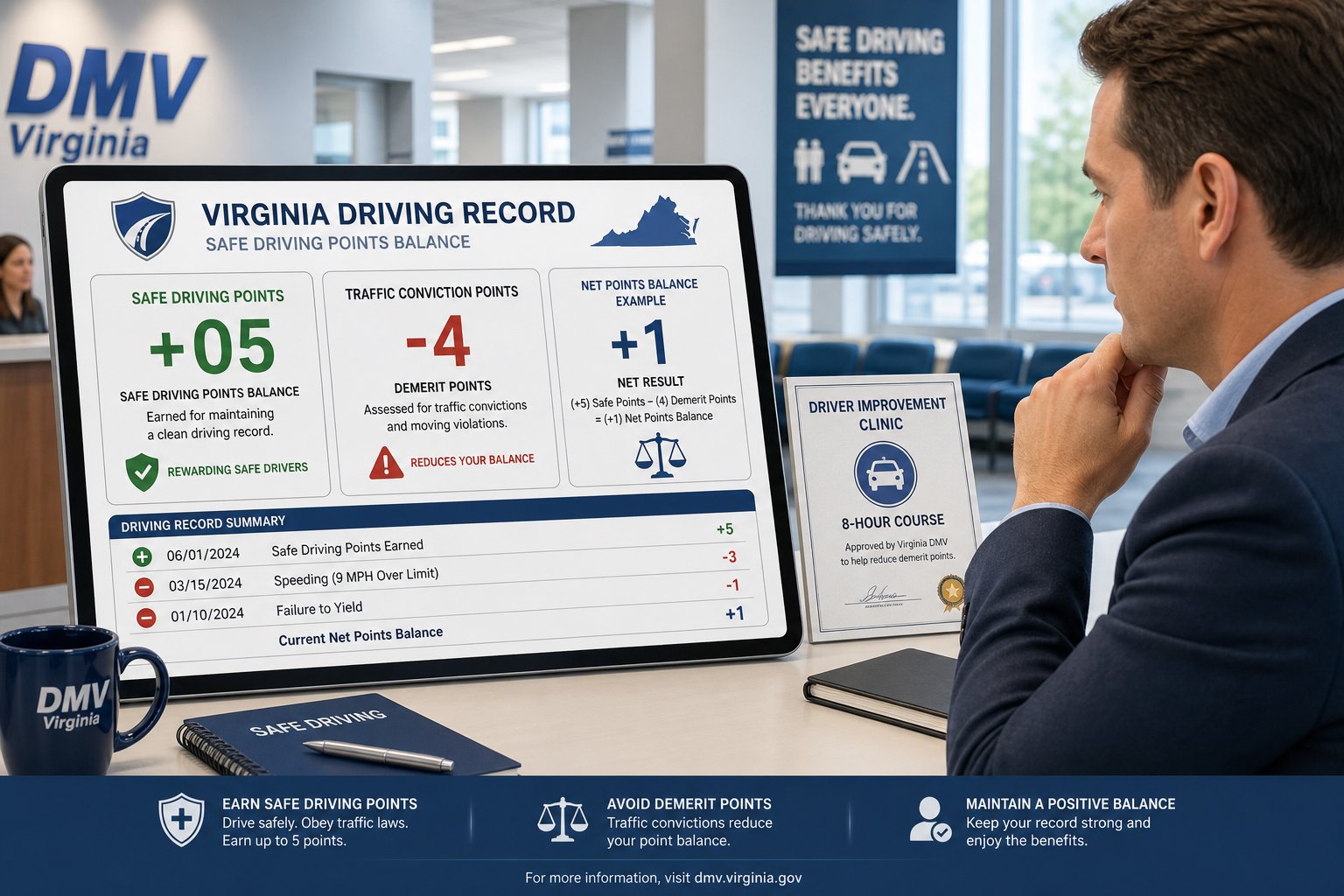
Your safe driving points balance is a running score on your Virginia driving record. It tells you where you stand between positive safe driving points and negative demerit points. In simple terms, the number shows whether your recent record gives you a buffer or puts you at more risk.
If you need an approved online option, review the Virginia Driver Improvement Course and compare it with your Virginia DMV notice, court order, or driver record goal.
In Virginia, drivers start at 0. Then the Virginia DMV may add +1 safe driving point for each full calendar year with no violations or suspensions, up to +5. That is why a balance of +5 is the best normal balance. It means you have built the highest safe driving cushion the system allows.
If your record shows +05, read that as plus five. The zero is just part of the way the number may appear on a Virginia driving record. It does not mean something different from +5.
A positive balance is good. It means demerit points have not used up all of your safe driving points. A negative balance means the opposite. It means traffic convictions have pushed your point balance below zero.
The key point is this: the balance is not the same as your list of tickets. It is a score based on them.
Demerit Points Vs. Safe Driving Points
These two point types do different jobs.
- Safe driving points are positive
- Demerit points are negative
- Safe driving points can help offset demerit points
- Demerit points come from traffic convictions
- Safe driving points do not erase a conviction
For example, if you have +5 and then get a 4-point violation, your balance may drop to +1. The conviction still stays on your driving record for its own period. The safe driving point balance just shows the net result at that time.
Virginia also uses a DMV-approved Driver Improvement Clinic, often called a DIC, in this system. The official course is an 8-hour course. If you take the clinic voluntarily and qualify, it can add 5 safe driving points to your balance. That can help, but it does not automatically remove convictions from your record.
How Virginia Demerit Points Work For 3-, 4-, And 6-Point Violations
Virginia DMV assigns demerit points after certain traffic convictions. These are usually 3-point, 4-point, or 6-point violations. The more serious the violation, the more demerit points it carries.
Here is the basic idea:
- 3-point violations are lower-level moving violations
- 4-point violations are more serious than 3-point violations
- 6-point violations are the most serious common demerit category
Speeding is a common example. In Virginia, a conviction for 1 to 9 mph over the limit is generally a 3-point violation. A conviction for 10 to 19 mph over the limit is generally a 4-point violation. More serious offenses, including some reckless driving cases, can bring 6 demerit points. The Virginia DMV and the Code of Virginia control the official treatment of each offense.
Each conviction subtracts that number from your current point balance. If your balance is +3 and you get a 6-point violation, your balance can drop to -3. That negative number matters because Virginia DMV looks at demerit point totals when it decides whether to send warnings, require a clinic, place you on probation, or suspend your license.
This is also why drivers get confused. They may think a ticket gives them a balance of 3 or 4. But the safe driving points balance is the result after those demerit points are applied to whatever positive points you already had.
If a notice, ticket, or court paper is involved, read it closely. Requirements can depend on the Virginia DMV notice, court order, citation, driver record, license status, court, judge, locality, and case facts.
How Long Points Stay On Your Record And Why Your Balance Changes
Your point balance changes over time because demerit points expire on one schedule and safe driving points build on another. That is why the number on your Virginia driving record may move up or down even if you have not checked it in a while.
In general, demerit points stay on your DMV record for 2 years from the offense date. That means the negative point effect does not last forever. When that 2-year period ends, those demerit points no longer count in the same way toward your point balance.
Safe driving points work differently. Virginia DMV may add +1 safe driving point each full calendar year with no violations or suspensions, up to +5. DMV has also stated that annual safe driving points are added in early April for the prior year.
So your balance can change for a few main reasons:
- You are convicted of a new traffic offense
- Older demerit points age off after 2 years
- You earn annual safe driving points
- You complete a qualifying voluntary Driver Improvement Clinic
This is why a balance is a snapshot, not a permanent label. A negative balance can improve if time passes without new violations. And a good balance can drop fast after one or two convictions.
Your full driving record also may show more than the current point balance. A conviction can remain visible on the record longer than the demerit points affect your balance. Those are different issues, and they should not be mixed together.
When Point Totals Trigger Warnings, Clinics, Probation, Or Suspension
Virginia DMV uses demerit point totals to decide when to act. A low or negative balance is not just a bad look. In some cases, it is tied to formal DMV action.
For adult drivers, Virginia DMV may send a warning or require action at these levels:
- 12 demerit points in 12 months
- 18 demerit points in 24 months
At those levels, DMV may issue a warning and may require a Driver Improvement Clinic under its driver improvement rules. The official course is a DMV-approved 8-hour Driver Improvement Clinic.
More serious totals can lead to suspension:
- 18 demerit points in 12 months
- 24 demerit points in 24 months
Those totals are widely cited as triggers for a 90-day suspension, a mandatory clinic, and then a 6-month probation period after reinstatement. The Virginia Department of Motor Vehicles explains these programs on its driver improvement page.
Do not ignore a Virginia DMV notice, court order, citation, payment deadline, suspension warning, or required court date. The exact requirement can depend on the notice itself and the facts of the case. It may also depend on your prior record and license status.
If you are ordered to complete a clinic, make sure the provider is Virginia approved. And if you are trying to understand whether your point balance puts you near DMV action, check your current driving record instead of guessing.
How To Check Your Virginia DMV Safe Driving Points Balance
The main way to check your safe driving points balance is to get your Virginia driving record from the Virginia DMV. That record shows your current point balance and other record details.
The best place to start is the official Virginia DMV online services. You may need to sign in or create an account, depending on the service you use. DMV records are the source that matters here because your court papers or traffic school paperwork may not show your current net balance.
A few important facts:
- Your driving record is the key document
- The record may show the balance in a format like +05
- Schools and courts do not usually tell you your current DMV point balance
- The balance can change as points age off or new points are added
When you read the record, look for the current point total, then compare it with any recent convictions or clinic completions you know about. If you took a voluntary clinic recently, remember that safe driving point credit depends on whether you qualified under DMV rules.
If you need the most accurate answer, use the official DMV record instead of relying on memory. That is especially important if you got a notice from DMV or if a court or judge has entered an order affecting your license.
How To Earn Safe Driving Points And Reduce The Damage From Tickets
You can build or rebuild your point balance in two main ways in Virginia. First, you can go full calendar years with no violations or suspensions. Second, you may be able to take a qualifying voluntary Driver Improvement Clinic.
Here is how safe driving points are earned:
- +1 point for each full calendar year with no violations or suspensions
- Up to a normal maximum of +5 safe driving points
- +5 safe driving points for a qualifying voluntary DMV-approved Driver Improvement Clinic
That clinic is the official Virginia Driver Improvement Clinic (DIC), and it is an 8-hour course. Not every clinic situation gives safe driving point credit. A clinic taken under a court order or DMV order may serve a different purpose. Whether points are awarded can depend on the exact requirement and DMV rules.
Safe driving points can reduce the damage from later tickets by giving you a cushion. But they do not promise any court outcome, and they do not erase convictions from your history. They help your point balance. That is the real benefit.
If you want a flexible online option, you can review the Virginia course from Driving Logic. It is built for busy drivers who want to complete a state-approved course on their own schedule from almost any device.
Not legal advice. Rules and outcomes can depend on your Virginia DMV notice, court order, citation, driver record, license status, court, judge, locality, and case facts. Check official Virginia DMV and Virginia Courts sources for the most current information.
FAQ
Can a Virginia Driver Improvement Clinic remove a ticket from my record?
No. A Virginia Driver Improvement Clinic does not erase a ticket or conviction from your driving record. When eligible, it may add safe driving points that help your overall point balance.
How many safe driving points can I earn from a Virginia clinic?
Eligible drivers may receive 5 safe driving points after completing an approved clinic. Voluntary clinic credit is generally limited to once every 24 months.
Should I follow the DMV notice or the court order?
Follow the document that applies to your situation. A DMV notice, court order, citation, or insurance request may have different instructions and deadlines.
Where should I check my Virginia point balance?
Use your official Virginia DMV driving record. Do not rely only on memory, insurance paperwork, or an old copy of your record.
Conclusion
What Is a Safe Driving Points Balance in Virginia? depends on your official Virginia DMV record, the specific violation, and any court or DMV notice you received. A Driver Improvement Clinic may help with safe driving points when eligible, but it does not erase the underlying ticket or conviction. Check the official record and deadline before you act.
Take the Virginia Driver Improvement Course online when you are ready to begin.
Related Articles
- Virginia DMV Points System Explained
- How to Earn Safe Driving Points in Virginia (And Why the DIC Gives You 5)
- How Many Points Is a Speeding Ticket in Virginia?
- How to Check Your Points on a Virginia Driver’s License
Sources
- Virginia DMV — Driver Improvement
- Virginia DMV — Points System
- Virginia DMV — Moving Violations and Points
- Virginia Code § 46.2-494 — Safe Driving Points
- Virginia DMV — Driver Improvement Clinics
Billy Forte is the owner of Driving Logic, a state-approved driver improvement course provider serving Virginia and other U.S. states. Driving Logic offers online driver improvement and driver safety courses for drivers handling DMV notices, court orders, point concerns, and state requirements.
This article is general information, not legal advice. Virginia DMV rules, court orders, deadlines, insurance decisions, CDL rules, and case facts can differ. Use official Virginia DMV and court sources for current requirements, and consult a qualified Virginia attorney for legal guidance specific to your situation.