
Updated June 2026 · Reviewed by Billy Forte
Virginia school zone and work zone speeding tickets can cost more than ordinary speeding tickets when enhanced penalties apply. This article is for drivers who received a ticket in a marked school or work zone and need to understand fines, points, and court risk. You will learn what can make the penalty higher and how driver improvement may fit after the ticket.
This article covers Virginia requirements only.
Key Facts
- Enhanced areas: School and work zones can carry higher fines when the rules apply.
- Points: DMV points usually follow the underlying speed and violation type.
- Signs matter: Posted signs and active-zone conditions can affect the case.
- Reckless risk: High speeds can still create reckless-driving exposure.
- DIC role: Driver improvement may help with safe points after eligible moving violations.
If your court, DMV notice, or personal record goal allows a course option, review the Virginia driver improvement course before your deadline.
How Virginia Defines A Work Zone Speeding Violation
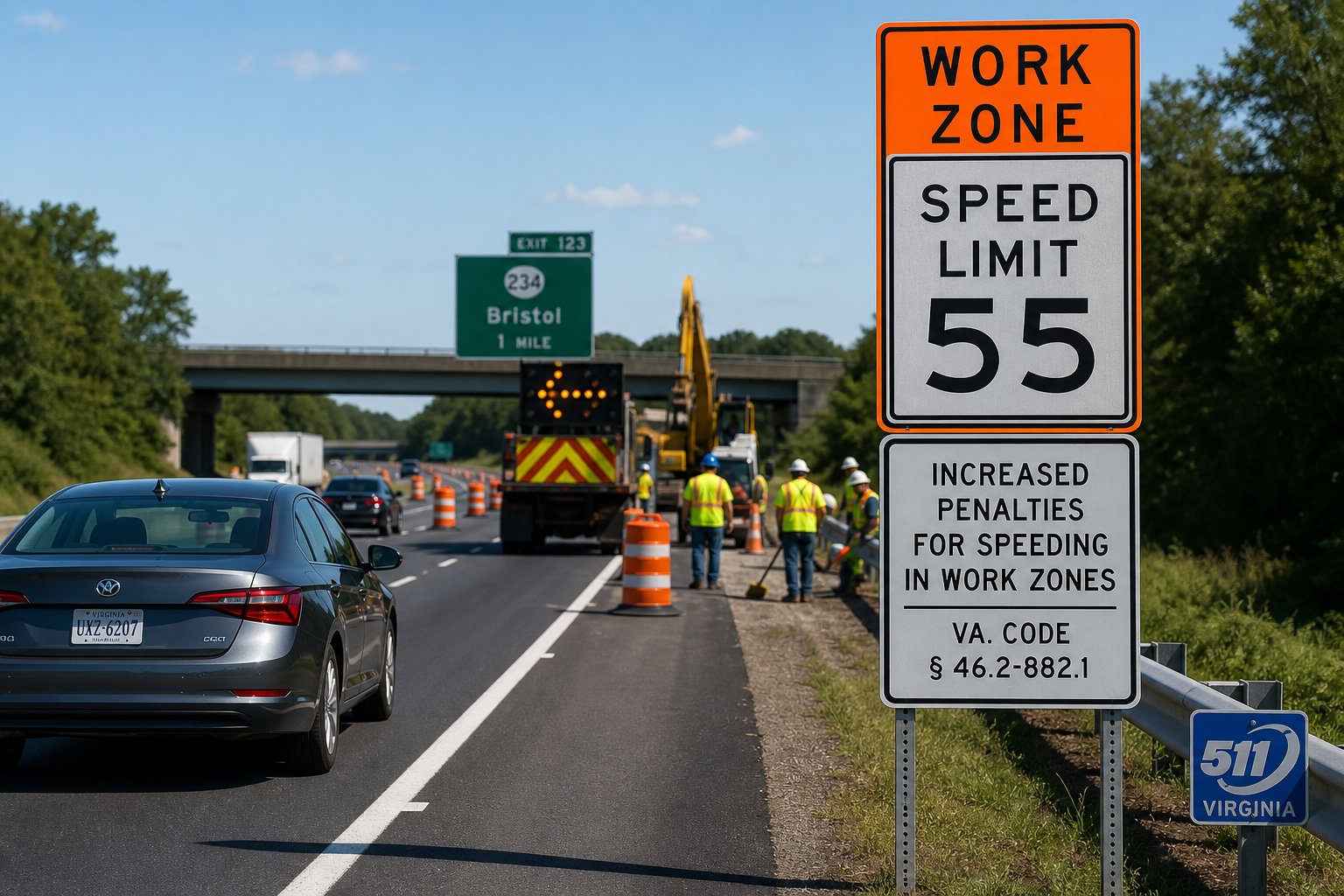
Virginia treats a work zone speeding ticket as more than ordinary speeding when the zone is active and properly marked. The key rule is in Code of Virginia § 46.2-878.1. It says you cannot drive over a special work-zone speed limit when workers are present and the area has appropriately placed signs that show both the maximum speed and the penalty.
That part matters. A lot of drivers assume any cones or barrels make it a work zone for fine purposes. In Virginia, the enhanced penalty depends on more than seeing construction equipment. The law ties the violation to a posted work-zone speed limit, proper signs, and worker presence.
In plain terms, an active work zone usually needs these features:
- Workers present in the zone
- Posted signs with the speed limit
- Posted signs warning of the added penalty
- A roadway area under construction, repair, or maintenance
If those elements are there, the charge can be written under the work-zone statute instead of, or along with, ordinary speeding rules. Virginia also has a broader work-zone moving violation law, § 46.2-808.3, which applies to certain moving violations in highway work zones when workers are present.
That is different from a school zone speeding ticket Virginia drivers may get. School zone enhanced penalties turn on posted school hours and signs, not road construction. The idea is similar, though: the zone must be active for the higher penalty to apply.
So, if you are asking how much more a Virginia speeding ticket costs in a work zone or school zone, the short answer is this: work zones can add up to $500 in fines when the legal conditions are met, while school zone enforcement also depends on active times, signage, and the exact charge written on your citation.
When A Work Zone Speeding Ticket Can Become Reckless Driving
A work zone speeding case can become much more serious if your speed crosses Virginia’s reckless driving line. Under § 46.2-862, driving 20 mph or more over the speed limit or over 85 mph can be charged as reckless driving by speed.
That rule applies in a work zone too. So a work zone speeding ticket Virginia drivers think is “just speeding” can quickly turn into a misdemeanor charge.
Virginia also has § 46.2-864, which covers reckless driving on roads under construction or repair if the driving endangers life, limb, or property. That means even if your speed is not 20 over, the facts of the case can still matter.
Why does this matter so much? Because reckless driving in Virginia is not a simple traffic infraction. It is a Class 1 misdemeanor. According to the Virginia Judicial System, penalties can include:
- Up to 12 months in jail
- Up to $2,500 in fines
- Up to 6 months of license suspension
- 6 DMV demerit points
And in a work zone, there may be an added enhancement tied to the zone itself. That means the total financial hit can be much higher than drivers expect.
If your summons lists reckless driving, pay close attention to your court date in General District Court. Do not assume prepaying is an option. Many reckless driving charges require a court appearance, and local practice can depend on the court, judge, your record, and the exact facts in the ticket.
Fines, Court Costs, And Other Penalties You Could Face
The fine on a Virginia work zone speeding case depends on the code section and the facts. For a violation under § 46.2-878.1, the law allows a fine of up to $500.
That does not mean every ticket will cost exactly $500. Your total can vary based on the charge, your speed, the court, and added court costs. Virginia Courts publish case information and payment details, but exact totals often depend on how the case is handled in court. You can review court information through the Virginia Courts system.
There is also the broader work-zone moving violation law, § 46.2-808.3, which can carry these minimum fines:
- $300 minimum for a first offense
- $500 minimum for a later offense
- $750 minimum for another work-zone moving violation within 12 months
If the charge is reckless driving, the stakes rise fast. A reckless driving fine can be as high as $2,500, and work-zone enhancement rules may add up to $500 more in some cases. That can push the exposure to roughly $3,000, before you even think about court costs or insurance effects.
For school zones, enhanced fines also depend on an active zone and proper signs. But the DMV points do not double just because the ticket happened in a work zone or school zone. The fine may increase, while the underlying speeding offense still falls into the same Virginia demerit points system.
That distinction matters. More money is one problem. Points on your record can affect insurance, driving status, and future penalties.
Do Workers Need To Be Present For The Higher Penalty To Apply?
Yes, for Virginia’s main work-zone enhancement laws, workers need to be present for the higher penalty to apply. This is one of the most important facts in these cases.
Under § 46.2-878.1 and § 46.2-808.3, the law ties enhanced work-zone penalties to zones where workers are present and the area is properly signed. If no workers were present, the state may still pursue an ordinary speeding charge, but the special work-zone penalty may not fit the statute.
This is why the details matter so much:
- Were workers actually visible or present?
- Were signs posted in the right place?
- Did the sign list the speed and penalty?
- Was the special speed limit clear?
A driver may see cones and assume the zone is active. But legally, the question is narrower. Virginia law looks at worker presence and proper signage, not just whether road work exists somewhere nearby.
The same general logic applies to school zones. A school zone speeding ticket Virginia courts treat as enhanced usually depends on the zone being active during posted hours and marked by signs. If school-zone times are not active, the higher penalty may not apply even though the sign remains in place.
That is also why your summons matters. The exact code section, the officer’s notes, and the facts at the scene can affect whether the higher penalty stands.
If you are contesting the enhanced part of the charge, write down what you remember while it is fresh. Note worker presence, sign placement, traffic flow, and the time shown on the citation.
What To Do After Getting A Work Zone Speeding Ticket In Virginia
Start with the ticket itself. The first thing to check is the exact code section listed on the summons. That tells you whether you are facing ordinary speeding, a work-zone infraction, a broader work-zone moving violation, or reckless driving.
Look for codes such as:
- § 46.2-878.1 for work-zone speed limit violations
- § 46.2-808.3 for work-zone moving violations
- § 46.2-862 for reckless driving by speed
- § 46.2-864 for reckless driving in a construction area
Next, confirm the facts while you still remember them. Note whether workers were present. Note where the signs were placed. If you have dashcam footage, save it. If your speed is close to a threshold, your own records may matter later.
Then check your Virginia DMV driving record. Your prior record can affect how the court views the case. You can find official information through the Virginia Department of Motor Vehicles.
If the charge is reckless driving, or if the speed is high, many drivers choose to speak with a Virginia traffic lawyer. That is especially common when a court appearance in General District Court is required.
You should also pay close attention to any DMV notice, court date, payment notice, or order. Requirements can depend on the Virginia DMV notice, court order, citation, driver record, license status, court, judge, locality, and case facts.
In some cases, a judge or court may consider a Virginia DMV-approved Driver Improvement Clinic (DIC). Virginia’s official DIC is an 8-hour course. If you need a flexible online option, Driving Logic offers a Virginia Driver Improvement Course that is built for busy drivers on any device.
Common Defense And Mitigation Strategies In Court
The best defense depends on the charge and the facts. Still, a few issues come up often in Virginia work-zone cases.
One common issue is worker presence. If the law requires workers to be present, that fact can matter a lot. Another issue is signage. If signs were missing, blocked, unclear, or not properly placed, the enhanced penalty may be harder to support.
Drivers and lawyers also look at how speed was measured. That may include:
- Radar or LIDAR calibration records
- The officer’s training and observation
- Any issues with traffic conditions or line of sight
- A speedometer calibration for your vehicle
Mitigation is different from a full defense. It does not always argue that the ticket is wrong. Instead, it gives the judge reasons to reduce the charge or penalty if the facts allow it.
Common mitigation points may include:
- A clean driving record
- Completion of a driver improvement course
- Proof of cooperation and court readiness
- In some cases, community service
If the court allows or orders a course, remember that Virginia uses the DMV-approved Driver Improvement Clinic, often called a DIC. It is an 8-hour course. The course does not erase the ticket from your history, but it may help in some court or DMV situations depending on the case.
And keep expectations realistic. Outcomes vary by court, judge, locality, charge, and record. No one should promise a dismissal or a reduction.
How A Conviction Can Affect Your Driving Record, Insurance, And Course Options
A conviction for speeding in a work zone can affect more than the fine. It can hit your driving record, your insurance, and sometimes your future options with the court or DMV.
For DMV points, the work zone does not create a brand-new point scale. The same demerit point tiers apply based on the underlying speeding offense. A more serious conviction, like reckless driving, brings 6 DMV points. The Virginia DMV explains how demerit and safe-driving points work.
That means a work zone or school zone may raise the fine, but it does not automatically increase the DMV point level beyond the underlying offense. This is a point many drivers miss.
Insurance is different. Insurers may treat any speeding conviction as a risk signal, and a reckless driving conviction can have a much bigger effect. Exact rate changes vary by insurer and policy.
Now to the course question. A Driver Improvement Clinic can sometimes help offset the same demerit points earned from a work-zone or school-zone speeding conviction by adding safe-driving points, if you are eligible under DMV rules. That is not the same as removing the conviction or deleting demerit points from history. Those are different things.
Virginia’s official course is the DMV-approved DIC, and it runs 8 hours. Some drivers take it because the DMV allows it. Others take it because a court orders it. If you received a notice or order, follow it closely.
If you need an online option that fits a busy schedule, you can review the Virginia Driver Improvement Course from Driving Logic. It is designed for people who need a flexible way to complete a state-approved requirement.
This information is general education only and is not legal advice.
Where A Virginia Driver Improvement Course May Fit
A Virginia driver improvement course can matter after a speeding ticket, but it has a limited role. Virginia DMV-approved clinics are 8-hour courses. When you complete a clinic voluntarily and meet DMV rules, you may receive 5 safe driving points once every 24 months.
That does not erase the ticket. It does not remove the conviction from your driving record. It also does not guarantee a court result, an insurance discount, or a change in how a judge handles your case.
The course is most useful when your goal is to improve your DMV point balance, satisfy a DMV requirement, or comply with a court order that specifically allows or requires driver improvement. If you are using the course for a court case, follow the court’s instructions first. If you are using it for DMV safe points, confirm that the provider is approved and that your timing fits DMV rules.
You can review the Virginia driver improvement course if your ticket, court order, DMV notice, or personal record goal makes a course appropriate.
FAQ
Can a Virginia driver improvement course help after a speeding ticket?
It may help with DMV safe driving points when eligible, or satisfy a court or DMV requirement. It does not erase the ticket or guarantee a court result.
Should I check my court paperwork first?
Yes. Your citation, court notice, DMV notice, and deadline control what you need to do next.
Does the course remove a conviction?
No. A Virginia driver improvement clinic does not remove a conviction from your DMV record.
Related Articles
- Virginia Speeding Ticket: Costs, Points, and What Happens Next
- Virginia Speeding Ticket Fines: What Affects the Cost?
- 20 MPH Over the Speed Limit in Virginia: Fines, Points, and Reckless Driving Risk
- When Does a Speeding Ticket Become Reckless Driving in Virginia?
Sources
- Virginia DMV — Driver Improvement Clinics
- Virginia DMV — Demerit Points
- Virginia Courts — Pay Traffic Tickets and Other Offenses
- Code of Virginia § 46.2-878.1 — Work Zone Speeding
- Code of Virginia § 46.2-873 — School Zone Speed Limits
Billy Forte is the owner of Driving Logic, a state-approved driver improvement course provider serving Virginia and other U.S. states. Driving Logic offers DMV-approved online driver improvement courses for drivers handling DMV notices, court orders, and state requirements.
This article is general information, not legal advice. Virginia DMV rules, court orders, deadlines, insurance decisions, CDL rules, and case facts can differ. Use official Virginia DMV and court sources for current requirements, and consult a qualified Virginia attorney for legal guidance specific to your situation.