
Updated June 2026 · Reviewed by Billy Forte
Virginia speeding ticket fines depend on the speed, location, court costs, and whether the charge stays a traffic infraction or becomes reckless driving. This article is for Virginia drivers trying to estimate the real cost before paying or going to court. You will learn what affects the fine, how points fit in, and why the final amount can vary by case.
This article covers Virginia requirements only.
Key Facts
- Cost varies: Final cost can include a fine, court costs, and possible insurance impact.
- Speed tiers: Higher speed can mean more demerit points and higher risk.
- Reckless risk: 20 mph or more over the limit can change the case type.
- Court costs: Local court costs can change the total amount owed.
- DIC role: Driver improvement may help with safe points, not erase the ticket.
If your court, DMV notice, or personal record goal allows a course option, review the Virginia driver improvement course before your deadline.
How Virginia Speeding Ticket Fines Are Calculated
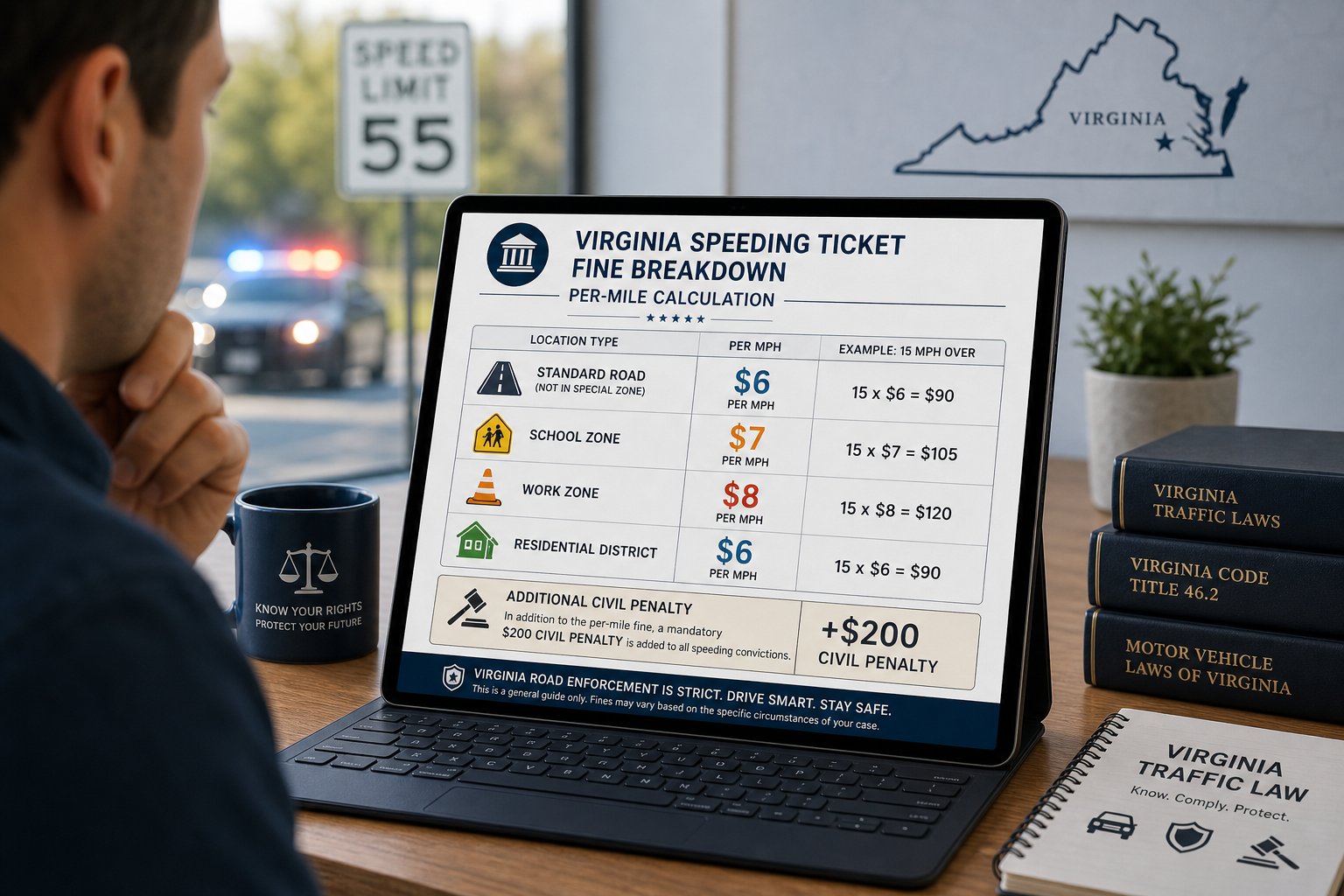
Virginia calculates many prepayable speeding fines by a per-mile formula, not by one flat statewide ticket price. That is why the answer to how much is a 10 over speeding ticket in Virginia depends first on where the stop happened.
On a standard road, the usual schedule is $6 for each mph over the limit under Va. Code § 46.2-878.3. In a school zone or highway work zone, the prepayable fine is commonly $7 per mph over. In certain designated residential districts, it can be $8 per mph over plus a $200 civil penalty.
Here is the simple version for standard roads before court costs:
- 1–9 mph over: base fine usually follows the $6 per mph schedule: 3 DMV points
- 10–14 mph over: base fine usually follows the same schedule: 4 DMV points
- 15–19 mph over: base fine usually follows the same schedule: 4 DMV points
- 20+ mph over: possible reckless driving risk
So, if you were 10 mph over on a standard road, the base fine is often calculated from that $6-per-mph schedule. But that is not the full amount you will pay. The final total often includes court costs and fees, and those can vary by locality and case type.
Virginia also has one more rule drivers miss. If you drive over 80 but under 86 mph on a 65-mph highway, an extra $100 can apply under the state schedule. For the most current payment rules, check the Virginia Judicial System’s online case information and payment tools.
When A Speeding Ticket Costs More In Work Zones, School Zones, And Residential Areas
A Virginia speeding ticket costs more when the road is in a work zone, school zone, or some residential areas with special speed penalties. The same number of miles over the limit can lead to a much higher bill.
In school zones and work zones, the common prepayable rate is $7 per mph over instead of $6. That means a ticket for the same speed can cost more simply because of the location. Courts may also view these cases more strictly because the state treats these areas as higher risk.
In some designated residential districts, the cost can rise even more. Virginia law allows $8 per mph over plus a $200 civil penalty in certain areas. That extra civil penalty changes the math fast.
A quick example shows why location matters:
- 10 mph over on a standard road: base fine often follows $6 per mph
- 10 mph over in a school or work zone: base fine often follows $7 per mph
- 10 mph over in a covered residential area: base fine may follow $8 per mph, then add $200
This is why two drivers going the same speed can owe very different amounts.
You should read the ticket closely. Look for the charge code, road type, and any note about a zone or district. You can also confirm the charge with the Virginia Courts traffic case resources or the court named on your citation.
Court Costs, Extra Fees, And The Total Price Beyond The Fine
The fine is only part of what you may pay. In many Virginia traffic cases, the bigger surprise is the added court costs and processing charges.
For many simple speeding cases, reported court costs often fall around $66 to $86, with many summaries putting the average near $75. That means a small base fine can still turn into a noticeably larger total. This is one reason people ask about Virginia speeding ticket fines and get confused by different numbers online.
A rough example helps:
- Base fine for speed over the limit
- Court costs set by the court system
- Extra zone-based penalties, if any
- Extra statutory amounts in special speed situations
That is why a standard speeding ticket may end up in the range of roughly $120 to $200 total in some common cases. But you should not treat that as a guaranteed amount. The real total can change based on:
- Your exact speed
- The road type or zone
- The court and locality
- Whether the charge is prepayable
- Whether the charge is amended or reduced
If you prepay, you usually accept the charge as a conviction. If you go to General District Court, the final amount may depend on what happens there. For current case details, use the Virginia Judicial System and follow the instructions on your citation and notices.
When Speeding Becomes Reckless Driving In Virginia
In Virginia, speeding can stop being a traffic infraction and become reckless driving by speed. That line matters a lot because reckless driving is a criminal charge, not a normal speeding ticket.
Under the Code of Virginia § 46.2-862, you face reckless driving by speed if you are:
- 20 mph or more over the posted speed limit, or
- Driving over 85 mph anywhere in Virginia
So, if you were going 75 in a 55, the case may be charged as reckless driving. If you were going 86, even on a higher-speed road, the reckless driving threshold can apply.
The possible penalties are much more severe than regular fines. Reckless driving in Virginia is a Class 1 misdemeanor. Penalties can include:
- Up to 12 months in jail
- Up to $2,500 in fines
- License suspension
- A criminal record
- 6 DMV demerit points
This also affects how long the case stays on your Virginia record. A simple speeding conviction may stay for 5 years, while reckless driving can stay for 11 years.
If your ticket shows a speed that hits this threshold, do not miss the required court date. Check the charge and court information right away through the Virginia Courts system.
DMV Points, Insurance Increases, And How Long A Ticket Stays On Your Record
The ticket price is only the first cost. A speeding conviction can also add DMV points, raise your insurance, and stay on your record for years.
For many Virginia speeding offenses, the point impact works like this:
- 1–9 mph over: 3 demerit points
- 10–14 mph over: 4 demerit points
- 15–19 mph over: 4 demerit points
- Reckless driving: 6 demerit points
According to the Virginia Department of Motor Vehicles, demerit points usually remain active for 2 years from the offense date. But the conviction itself can stay on your driving record longer. A normal speeding conviction often stays for 5 years. Reckless driving can stay for 11 years.
Insurance is separate from DMV points. Many drivers see premium increases after a ticket, and some reports place that bump around 20% to 30% for about three years, though the real amount depends on your insurer, record, and rating factors.
Point totals can also trigger more action from the state. Virginia notes that 12 demerit points in 12 months can lead to a required driver improvement step, and 18 points in 12 months can bring a 90-day suspension in some cases. Your notice, driver record, and license status all matter.
Your Options After Getting A Virginia Speeding Ticket
After a Virginia speeding ticket, your main options are usually to prepay if the charge is eligible or to go to court. The best path depends on the charge, your speed, and what is listed on the citation.
If you prepay, you usually enter a guilty plea and accept the conviction. That means you also accept the related fines, court costs, DMV points, and possible insurance impact. Many drivers choose this for lower-level, prepayable charges because it is faster.
If you appear in General District Court, you can contest the charge. In some cases, a driver may seek a lower speed finding, a reduced charge, or another outcome allowed by the court. What happens depends on the facts, your record, the judge, the locality, and the specific charge.
Common options may include:
- Prepaying an eligible ticket
- Pleading not guilty and contesting the charge
- Requesting a reduction if the facts support it
- Completing a course if the court orders or allows it
Always follow the deadline and court instructions on the ticket, payment notice, or court paper. Do not assume your case is optional if a court appearance is required. If you want to review your record before court, you can check official information through the Virginia DMV.
When A Driver Improvement Course May Help
A Driver Improvement Clinic may help in some Virginia speeding cases, but the effect depends on who requires it and why. Virginia’s official course is the DMV-approved Driver Improvement Clinic (DIC), and it is an 8-hour course.
A judge may order or allow a course as part of a court outcome. In some cases, completing a clinic may help reduce the impact of a speeding case, but that depends on the court order, judge, locality, case facts, your driver record, and the exact charge. You should follow the instructions on any DMV notice, citation, or court order.
Virginia DMV also allows many drivers to take a clinic voluntarily once every 24 months to earn up to 5 safe driving points. Those safe driving points are not the same thing as erasing a ticket, removing a conviction, or deleting demerit points from history. They may, but, help offset demerit points on your record in the way DMV allows.
If you need a state-approved online option, Driving Logic’s Virginia Driver Improvement Course is built for busy drivers who want flexible scheduling on any device and fast certificate delivery when completion is required. Before you enroll, confirm the requirement on your Virginia DMV notice, court order, ticket, license status, and court paperwork.
This article is for general information only and is not legal advice.
Where A Virginia Driver Improvement Course May Fit
A Virginia driver improvement course can matter after a speeding ticket, but it has a limited role. Virginia DMV-approved clinics are 8-hour courses. When you complete a clinic voluntarily and meet DMV rules, you may receive 5 safe driving points once every 24 months.
That does not erase the ticket. It does not remove the conviction from your driving record. It also does not guarantee a court result, an insurance discount, or a change in how a judge handles your case.
The course is most useful when your goal is to improve your DMV point balance, satisfy a DMV requirement, or comply with a court order that specifically allows or requires driver improvement. If you are using the course for a court case, follow the court’s instructions first. If you are using it for DMV safe points, confirm that the provider is approved and that your timing fits DMV rules.
You can review the Virginia driver improvement course if your ticket, court order, DMV notice, or personal record goal makes a course appropriate.
FAQ
Can a Virginia driver improvement course help after a speeding ticket?
It may help with DMV safe driving points when eligible, or satisfy a court or DMV requirement. It does not erase the ticket or guarantee a court result.
Should I check my court paperwork first?
Yes. Your citation, court notice, DMV notice, and deadline control what you need to do next.
Does the course remove a conviction?
No. A Virginia driver improvement clinic does not remove a conviction from your DMV record.
Related Articles
- Virginia Speeding Ticket: Costs, Points, and What Happens Next
- 20 MPH Over the Speed Limit in Virginia: Fines, Points, and Reckless Driving Risk
- When Does a Speeding Ticket Become Reckless Driving in Virginia?
- Virginia Work Zone and School Zone Speeding Tickets: Higher Fines
Sources
- Virginia DMV — Driver Improvement Clinics
- Virginia DMV — Demerit Points
- Virginia Courts — Pay Traffic Tickets and Other Offenses
Billy Forte is the owner of Driving Logic, a state-approved driver improvement course provider serving Virginia and other U.S. states. Driving Logic offers DMV-approved online driver improvement courses for drivers handling DMV notices, court orders, and state requirements.
This article is general information, not legal advice. Virginia DMV rules, court orders, deadlines, insurance decisions, CDL rules, and case facts can differ. Use official Virginia DMV and court sources for current requirements, and consult a qualified Virginia attorney for legal guidance specific to your situation.