
Updated June 2026 · Reviewed by Billy Forte
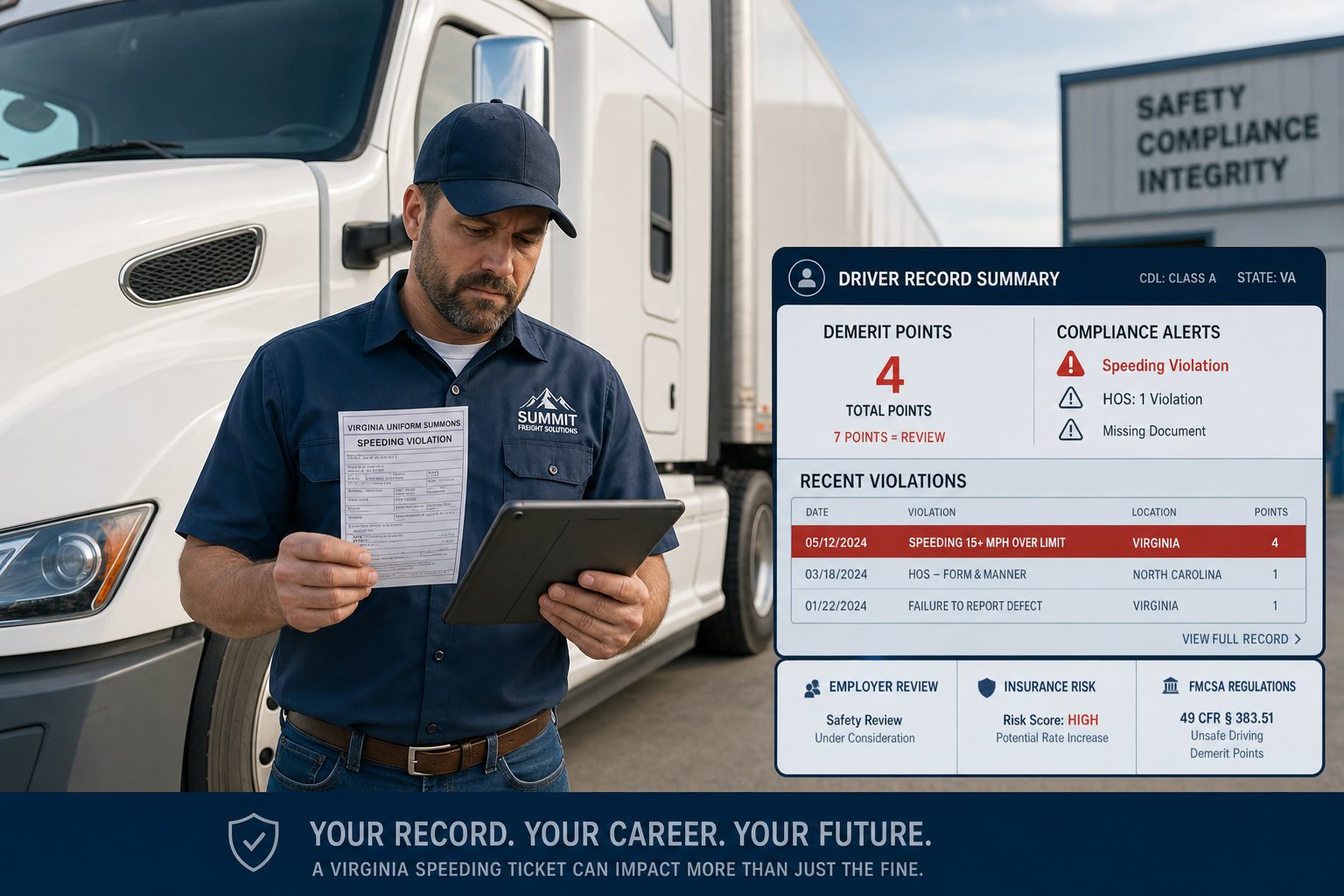
A Virginia speeding ticket can create higher risks for CDL holders because federal commercial-driver rules may apply on top of Virginia law. This article is for CDL drivers who received a Virginia ticket in a personal or commercial vehicle. You will learn why speed, record history, and serious-traffic-violation rules matter before you act.
This article covers Virginia requirements only.
Key Facts
- Higher stakes: CDL holders can face federal rules in addition to Virginia penalties.
- Serious violation: 15 mph or more over can be a serious traffic violation under federal rules.
- Multiple violations: Repeat serious violations can create CDL disqualification risk.
- Vehicle type matters: Personal and commercial vehicle cases may be treated differently.
- DIC caution: A clinic does not erase a CDL violation or federal reporting issue.
If your court, DMV notice, or personal record goal allows a course option, review the Virginia driver improvement course before your deadline.
Why A Virginia Speeding Ticket Matters More With A CDL
A speeding ticket carries more weight when you hold a CDL. You do not just face a fine and court costs. You also face job risk, employer review, insurance issues, and federal CDL rules layered on top of Virginia law.
That is the key point. A commercial driver speeding ticket in Virginia can matter even if it happened off duty in your own car. For many CDL holders, one conviction is not just a bad day. It can become part of a larger record that affects future work.
Virginia uses demerit points for traffic convictions. The Virginia Department of Motor Vehicles tracks those points on your driving record. A speeding conviction may add points depending on the charge. If the charge rises to reckless driving, the stakes jump fast because reckless driving in Virginia is a criminal offense, not just a routine infraction.
CDL holders also answer to federal safety standards. The Federal Motor Carrier Safety Administration treats certain offenses as serious traffic violations. Those rules can trigger CDL disqualification even when a driver did not expect the ticket to become a career issue.
And there is a practical point many drivers miss: employers often review motor vehicle records closely. A single Virginia speeding ticket may affect hiring, retention, route assignments, or internal discipline. So before you treat a ticket like a small expense, look at the full picture.
When Speeding Becomes A Serious Violation Or Reckless Driving Charge
Not every speeding ticket is the same. For CDL holders, the line that matters most is often 15 mph over the limit. Under federal CDL rules, that level of speed can count as a serious traffic violation.
Virginia law can make things even harder. In some cases, high-speed driving can be charged as reckless driving under the Code of Virginia. Virginia is well known for treating certain speeding conduct more harshly than many other states.
Here is why that matters:
- 15+ mph over the limit can trigger serious violation issues for CDL purposes
- Reckless driving can bring criminal penalties in Virginia
- A reckless driving conviction can carry 6 DMV points in Virginia
- The case may require you to appear in General District Court
If the ticket is written as reckless driving, you are no longer dealing with a simple prepaid traffic matter. Virginia Courts may require a court appearance, and the charge can carry much bigger consequences than a standard speeding infraction.
That is also why details matter. Your speed, the posted limit, the type of vehicle, the road, and the wording on the citation all shape the risk. On roads with changing speed limits, including major freight routes like I-81 or I-95, a quick mistake can become a very serious case.
How Virginia CDL Disqualification Rules Can Apply In Commercial And Personal Vehicles
A lot of drivers assume CDL penalties only apply when they are in a truck. That is not always true. Federal rules can apply to serious traffic violations in both commercial vehicles and personal vehicles.
For CDL holders, that is a major issue. Under 49 CFR § 383.51, two serious traffic violations within three years can lead to a 60-day CDL disqualification. Three or more within three years can lead to a 120-day disqualification.
Common examples of serious traffic violations include:
- Speeding 15 mph or more above the limit
- Reckless driving
- Improper or erratic lane changes
- Following too closely
Virginia DMV applies its own licensing rules, but CDL holders also sit under this federal system. That means a conviction in your own car may still count toward CDL consequences, depending on the offense and record.
This is where many drivers get trapped. They think, “I was not working.” But the CDL is tied to your driving history, not only your shift. So if you get a Virginia speeding ticket in a personal vehicle, do not assume the matter stays separate from your commercial license.
The safest approach is to read the citation carefully, check any DMV notice, and look at how the charge fits under both Virginia law and FMCSA rules.
What Happens If You Pay The Ticket Instead Of Fighting It
In Virginia, prepaying a ticket usually means you accept guilt. For a CDL holder, that can be a costly move.
Once you pay, the case is generally treated as a conviction. That may add demerit points, place the offense on your record, and count toward a serious traffic violation if the speed qualifies. It may also affect your employer review and insurance.
This is the part many busy drivers miss. Prepayment is convenient, but convenience can come with long-term damage. If the citation involves high speed, possible reckless driving, or any fact that could trigger federal CDL rules, a quick payment may close off better options.
You should also watch the wording on the ticket. Requirements can depend on:
- The Virginia DMV notice
- The exact citation or charge
- A court order
- Your driver record and license status
- The court, judge, locality, and case facts
Some cases must go through General District Court rather than simple prepayment. If you hold a CDL, it often makes sense to consult a Virginia traffic attorney before paying any moving violation. That is not because every case can be fixed. It is because paying first may create a result that is much harder to undo later.
What To Do Immediately After Getting A Virginia CDL Speeding Ticket
Start with the basics. Stay calm, stay polite, and do not argue on the roadside. Small choices in the first hour can matter later.
Then review the citation closely. Check the listed speed, the posted limit, the court date, and whether the charge is simple speeding or reckless driving. If anything looks wrong, make a note right away.
Helpful next steps include:
- Save the ticket and take a clear photo of it
- Write down road, weather, traffic, and work-zone conditions
- Note signs, lane closures, or sudden speed-limit changes
- Check whether your employer requires prompt notice
- Watch all deadlines on the ticket or court notice
Do not ignore mail from the Virginia Department of Motor Vehicles or the court. If the ticket requires a court appearance, missing it can create new problems.
If the charge could be a serious violation, talk with a lawyer who handles Virginia traffic or CDL cases before you prepay. You may also want to review your motor vehicle record so you know whether another prior offense could combine with this one.
A fast response does not guarantee any result. But it can help you avoid preventable mistakes while the case is still open.
Can Traffic School Help A CDL Driver In Virginia?
Sometimes, but only in a limited way. A driver improvement course does not automatically erase a CDL problem.
Virginia’s official course is the DMV-approved Driver Improvement Clinic (DIC). It is an 8-hour course approved by the Virginia DMV. In some situations, a court, judge, or DMV notice may allow or require it.
The course may help in a few ways:
- It can satisfy a court order or DMV requirement when assigned
- It may help some drivers earn safe driving point credit under DMV rules
- It can refresh safe-driving habits and lower future risk
But there are limits. A course does not mean a conviction disappears from your record. And it does not stop a qualifying conviction from counting under federal CDL rules just because you took class later.
That is why you should check the exact notice, order, or citation terms. Requirements can depend on your record, license status, locality, and the facts of the case.
If you need a Virginia Driver Improvement Clinic and want a flexible online option, you can take the Virginia Driver Improvement Course online at Driving Logic. It works well for busy drivers who need to complete an approved course on their own schedule.
How To Reduce The Risk Of Future CDL Speeding Violations In Virginia
The best defense is fewer tickets. That sounds obvious, but for CDL holders the payoff is bigger because one more serious violation can trigger a disqualification clock.
Start by treating speed control as a route-planning issue, not just a driving habit. Virginia roads often change speed limits quickly, especially near towns, work zones, mountain grades, and freight corridors.
Focus on practical steps:
- Use truck-safe GPS tools with speed alerts
- Slow early when entering work zones
- Watch for posted changes on I-81, I-95, Route 58, and US-460
- Leave more time in your schedule so speed pressure drops
- Check your record when a notice from DMV arrives
- Take extra care in personal vehicles too
Also, do not assume your off-duty driving is separate from your CDL life. For many drivers, personal vehicle tickets are the surprise source of CDL trouble.
If a court or DMV notice requires training, finish it by the deadline. And if you want a simple online option for the Virginia DMV-approved 8-hour clinic, review the course at Virginia driver improvement course.
This information is for general education only and is not legal advice.
Where A Virginia Driver Improvement Course May Fit
A Virginia driver improvement course can matter after a speeding ticket, but it has a limited role. Virginia DMV-approved clinics are 8-hour courses. When you complete a clinic voluntarily and meet DMV rules, you may receive 5 safe driving points once every 24 months.
That does not erase the ticket. It does not remove the conviction from your driving record. It also does not guarantee a court result, an insurance discount, or a change in how a judge handles your case.
The course is most useful when your goal is to improve your DMV point balance, satisfy a DMV requirement, or comply with a court order that specifically allows or requires driver improvement. If you are using the course for a court case, follow the court’s instructions first. If you are using it for DMV safe points, confirm that the provider is approved and that your timing fits DMV rules.
You can review the Virginia driver improvement course if your ticket, court order, DMV notice, or personal record goal makes a course appropriate.
FAQ
Can a Virginia driver improvement course help after a speeding ticket?
It may help with DMV safe driving points when eligible, or satisfy a court or DMV requirement. It does not erase the ticket or guarantee a court result.
Should I check my court paperwork first?
Yes. Your citation, court notice, DMV notice, and deadline control what you need to do next.
Does the course remove a conviction?
No. A Virginia driver improvement clinic does not remove a conviction from your DMV record.
Related Articles
- Virginia Speeding Ticket: Costs, Points, and What Happens Next
- Is a Virginia Speeding Ticket a Misdemeanor or Just a Traffic Infraction?
- Virginia Speeding Ticket from Out of State: What Happens to Your License
- Virginia Speeding Ticket: What to Know Before You Pay or Go to Court
Sources
- Virginia DMV — Driver Improvement Clinics
- Virginia DMV — Demerit Points
- Virginia Courts — Pay Traffic Tickets and Other Offenses
- FMCSA — Serious Traffic Violations
Billy Forte is the owner of Driving Logic, a state-approved driver improvement course provider serving Virginia and other U.S. states. Driving Logic offers DMV-approved online driver improvement courses for drivers handling DMV notices, court orders, and state requirements.
This article is general information, not legal advice. Virginia DMV rules, court orders, deadlines, insurance decisions, CDL rules, and case facts can differ. Use official Virginia DMV and court sources for current requirements, and consult a qualified Virginia attorney for legal guidance specific to your situation.