
Updated June 2026 · Reviewed by Billy Forte
A standard Virginia speeding ticket is usually a traffic infraction, not a misdemeanor, unless it is charged as reckless driving or another criminal offense. This article is for drivers trying to understand whether their ticket can affect a criminal record. You will learn the difference between an infraction and reckless driving, including points and court risks.
This article covers Virginia requirements only.
Key Facts
- Infraction: Standard speeding is usually a traffic infraction.
- Misdemeanor: Reckless driving is a Class 1 misdemeanor.
- Threshold: 20 mph or more over or over 85 mph can trigger reckless driving.
- Record risk: Criminal and DMV consequences are different.
- DIC role: Driver improvement can help with safe points, not remove a criminal charge.
If your court, DMV notice, or personal record goal allows a course option, review the Virginia driver improvement course before your deadline.
The Short Answer: Most Virginia Speeding Tickets Are Traffic Infractions, Not Misdemeanors
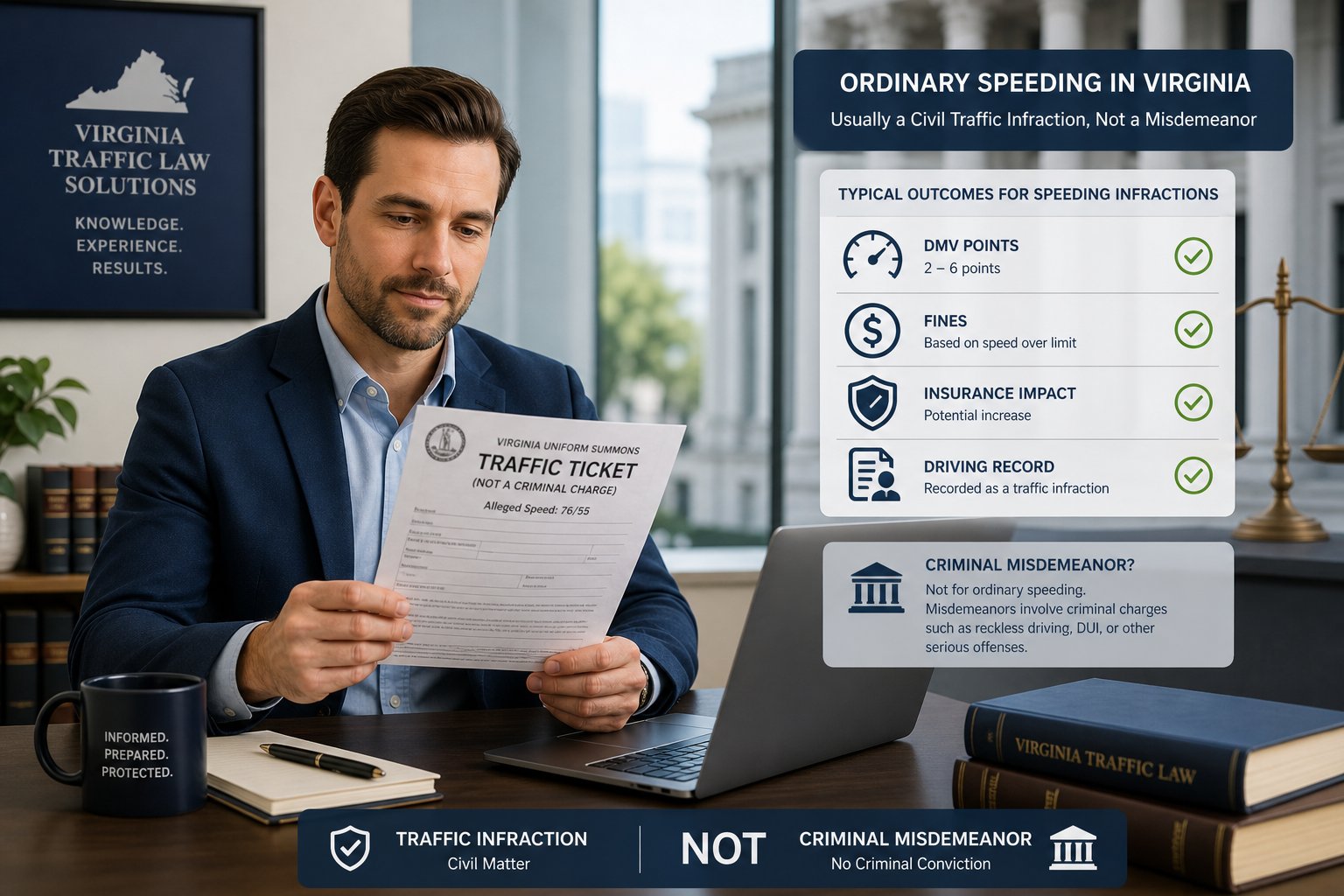
Most Virginia speeding tickets are civil traffic infractions. That means they are not criminal misdemeanors and do not create a criminal record by themselves.
This is the key answer to the question is a speeding ticket a misdemeanor in virginia: usually no. If the ticket is for ordinary speeding under the regular speeding laws, it is handled as a traffic infraction. You can still face a fine, court costs, and DMV points, but it is not the same as being charged with a crime.
That said, a traffic infraction is still serious. Virginia drivers can get:
- Demerit points on their driving record
- A fine and added court costs
- A possible insurance increase
- A record with the Virginia Department of Motor Vehicles
The distinction matters because employers and insurers often treat criminal and non-criminal cases very differently. A standard speeding ticket may show up on your driving history, but it is not the same as a misdemeanor conviction in the Virginia Courts system.
If you are looking at a ticket and wondering whether it will follow you like a criminal case, the first thing to know is simple: ordinary speeding is usually not criminal in Virginia. The bigger risk comes when the charge crosses into reckless driving.
When Speeding Becomes Reckless Driving In Virginia
Speeding becomes much more serious in Virginia when it meets the state’s reckless driving threshold. Under Va. Code § 46.2-862, you can be charged with reckless driving by speed if you were:
- 20 mph or more above the posted speed limit, or
- Driving over 85 mph no matter what the speed limit was
Once that happens, the case is no longer just a basic traffic infraction. It becomes a Class 1 misdemeanor. That is a criminal charge.
This is where many drivers get caught off guard. They think they only got a fast speeding ticket, but the charge on the summons is actually reckless driving. In Virginia, that can happen even if there was no crash, no racing, and no bad weather. Speed alone can trigger the misdemeanor.
A Class 1 misdemeanor is one of the most serious misdemeanor levels in Virginia. According to the Code of Virginia, possible penalties can include up to 12 months in jail and up to a $2,500 fine, depending on the facts and the court. Judges may also have power to suspend your license in some cases.
So the line is clear: standard speeding is usually an infraction, but 20+ over or 85+ can mean criminal reckless driving.
How To Tell Whether You Were Charged With Speeding Or A Misdemeanor Offense
The fastest way to tell is to read your Virginia Uniform Summons closely. The wording on the ticket often tells you whether you have a traffic infraction or a misdemeanor charge.
Look first at the charge or offense line. If it says:
- Speeding
- A general speed violation
it is usually a traffic infraction.
If it says:
- Reckless Driving
- Reckless Driving by Speed
- R/D Speed
it is usually a misdemeanor charge.
Next, check the code section listed on the summons. A citation under § 46.2-862 points to reckless driving by speed. Standard speeding infractions are often listed under other speed statutes in the 46.2-87x range.
You should also look for whether the ticket is prepayable. In many standard speeding cases, you can prepay the ticket instead of going to court. But prepaying usually counts as admitting guilt, so the conviction and points still apply. Reckless driving charges are generally not prepayable because they require a court appearance in General District Court.
The court date section matters too. If the summons says you must appear, do not ignore that notice. Court requirements can depend on the ticket, court, judge, locality, license status, driver record, and case facts.
If the wording is unclear, use the exact charge and code section on the summons when you review your options.
Penalties And Consequences For Speeding Vs. Reckless Driving
The penalties are very different because the charges are different. A standard speeding ticket is a traffic infraction. Reckless driving is a criminal misdemeanor.
For a normal Virginia speeding ticket, the usual consequences may include:
- A monetary fine
- Court costs
- 3 to 6 DMV points, depending on the speed
- A mark on your driving record
Virginia courts often calculate speeding fines by the number of miles per hour over the limit, though the final amount can vary with costs and local processing. You can review court information through the Virginia Judicial System.
For reckless driving, the stakes are much higher. A Class 1 misdemeanor can bring:
- Up to 12 months in jail
- Up to a $2,500 fine
- Possible license suspension
- 6 DMV demerit points in many cases
- A criminal record
That criminal record issue is a major reason drivers ask whether a speeding ticket is a misdemeanor in Virginia. For ordinary speeding, the answer is usually no. For reckless driving, the answer is yes.
And that difference can matter outside court. A misdemeanor may affect job applications, professional licensing, housing checks, military matters, or security clearance reviews. Insurance companies may also react more strongly to reckless driving than to a simple speeding infraction.
DMV Points, Insurance Increases, And Other Long-Term Effects
Even when your ticket is not criminal, it can still cost you for years. A standard speeding conviction in Virginia can add demerit points to your DMV record and may raise your insurance rate.
The Virginia Department of Motor Vehicles explains that traffic convictions can carry demerit points. For speeding, the number often falls in the 3 to 6 point range, depending on the offense. Those points are different from the length of time the conviction stays on your driving history.
That distinction matters. Demerit points expire on one schedule, while the conviction record may remain for longer. Drivers often mix those up.
Insurance is another issue. Many insurers treat speeding as a risk signal, especially if:
- You were far over the limit
- You already have prior tickets
- You are a younger driver
- The charge was reckless driving
A virginia speeding ticket criminal record concern usually applies to reckless driving, not ordinary speeding. That is important for background checks. A normal speeding infraction may appear on a driving record, but it is not the same as a criminal misdemeanor conviction.
Reckless driving can have longer and broader effects. It may affect insurance pricing more sharply and can create problems in employment screens because it is a criminal offense, not just a traffic matter.
What To Do After A Virginia Speeding Ticket
Start by reading the ticket carefully. You need to know the exact charge, code section, court date, and whether the case is prepayable.
If the summons is for ordinary speeding, some drivers choose to prepay the ticket. But prepaying is usually an admission of guilt. That means the conviction goes through, along with any fine, court costs, and DMV points that apply.
If the charge is reckless driving, treat it differently. Because it is a misdemeanor, you usually must appear in General District Court. Do not assume it is just a routine ticket.
Useful first steps include:
- Check whether the ticket says speeding or reckless driving
- Review the listed Virginia code section
- Note all deadlines and hearing dates
- Look at your recent driver record
- Consider whether your license type or job makes the case more serious
Requirements can depend on the Virginia DMV notice, court order, citation, driver record, license status, court, judge, locality, and case facts. So one driver’s result may not match another’s.
If a court or notice requires action, respond on time. If you may need a driver course for DMV, court, or personal reasons, gather that information early so you can choose a state-approved option that fits your schedule.
When A Traffic School Or Driver Improvement Course May Help
A traffic school can help in some Virginia cases, but it does not turn a misdemeanor into an infraction by itself and does not erase a conviction unless an official action says so. In Virginia, the official course is the DMV-approved Driver Improvement Clinic (DIC), which is an 8-hour course.
A judge may order a course. In other cases, a driver may take one voluntarily if it fits the case and the court or DMV will recognize it. This can matter when you want to show responsibility or qualify for safe driving point credit under Virginia DMV rules. You should confirm what applies to your own case.
A course may be useful when:
- A court orders it
- A DMV notice requires it
- You want to show mitigation in court
- You want to earn any DMV safe-driving point credit for which you qualify
If you need a flexible online option, Driving Logic offers a Virginia driver improvement course built for busy drivers on phones, tablets, and computers. You can review the course at Driving Logic’s Virginia Driver Improvement page.
Always make sure the course matches your actual requirement. Court acceptance and DMV impact can depend on the notice, judge, locality, record, and case facts.
This information is general only and is not legal advice.
Where A Virginia Driver Improvement Course May Fit
A Virginia driver improvement course can matter after a speeding ticket, but it has a limited role. Virginia DMV-approved clinics are 8-hour courses. When you complete a clinic voluntarily and meet DMV rules, you may receive 5 safe driving points once every 24 months.
That does not erase the ticket. It does not remove the conviction from your driving record. It also does not guarantee a court result, an insurance discount, or a change in how a judge handles your case.
The course is most useful when your goal is to improve your DMV point balance, satisfy a DMV requirement, or comply with a court order that specifically allows or requires driver improvement. If you are using the course for a court case, follow the court’s instructions first. If you are using it for DMV safe points, confirm that the provider is approved and that your timing fits DMV rules.
You can review the Virginia driver improvement course if your ticket, court order, DMV notice, or personal record goal makes a course appropriate.
FAQ
Can a Virginia driver improvement course help after a speeding ticket?
It may help with DMV safe driving points when eligible, or satisfy a court or DMV requirement. It does not erase the ticket or guarantee a court result.
Should I check my court paperwork first?
Yes. Your citation, court notice, DMV notice, and deadline control what you need to do next.
Does the course remove a conviction?
No. A Virginia driver improvement clinic does not remove a conviction from your DMV record.
Related Articles
- Virginia Speeding Ticket: Costs, Points, and What Happens Next
- When Does a Speeding Ticket Become Reckless Driving in Virginia?
- 20 MPH Over the Speed Limit in Virginia: Fines, Points, and Reckless Driving Risk
- Virginia Speeding Ticket for CDL Holders: Higher Stakes and Federal Rules
Sources
- Virginia DMV — Driver Improvement Clinics
- Virginia DMV — Demerit Points
- Virginia Courts — Pay Traffic Tickets and Other Offenses
- Code of Virginia § 46.2-862 — Reckless Driving by Speed
Billy Forte is the owner of Driving Logic, a state-approved driver improvement course provider serving Virginia and other U.S. states. Driving Logic offers DMV-approved online driver improvement courses for drivers handling DMV notices, court orders, and state requirements.
This article is general information, not legal advice. Virginia DMV rules, court orders, deadlines, insurance decisions, CDL rules, and case facts can differ. Use official Virginia DMV and court sources for current requirements, and consult a qualified Virginia attorney for legal guidance specific to your situation.