
Updated June 2026 · Reviewed by Billy Forte
In Virginia, speeding can become reckless driving at 20 mph or more over the posted limit or at more than 85 mph. This article is for drivers who are close to that line or who received a ticket that may involve reckless-driving language. You will learn the difference between ordinary speeding and reckless driving, including points, court risk, and next steps.
This article covers Virginia requirements only.
Key Facts
- 15 over: 15 mph over is usually not the statutory reckless-driving speed threshold by itself.
- 20 over: 20 mph or more over the limit can be reckless driving under Virginia law.
- 85 mph: Driving over 85 mph can be reckless driving regardless of the posted limit.
- Charge type: Reckless driving is a misdemeanor, not just a traffic infraction.
- DIC role: A clinic may help with safe points but does not dismiss a reckless-driving charge.
If your court, DMV notice, or personal record goal allows a course option, review the Virginia driver improvement course before your deadline.
When 15 Over The Limit Becomes Reckless Driving In Virginia
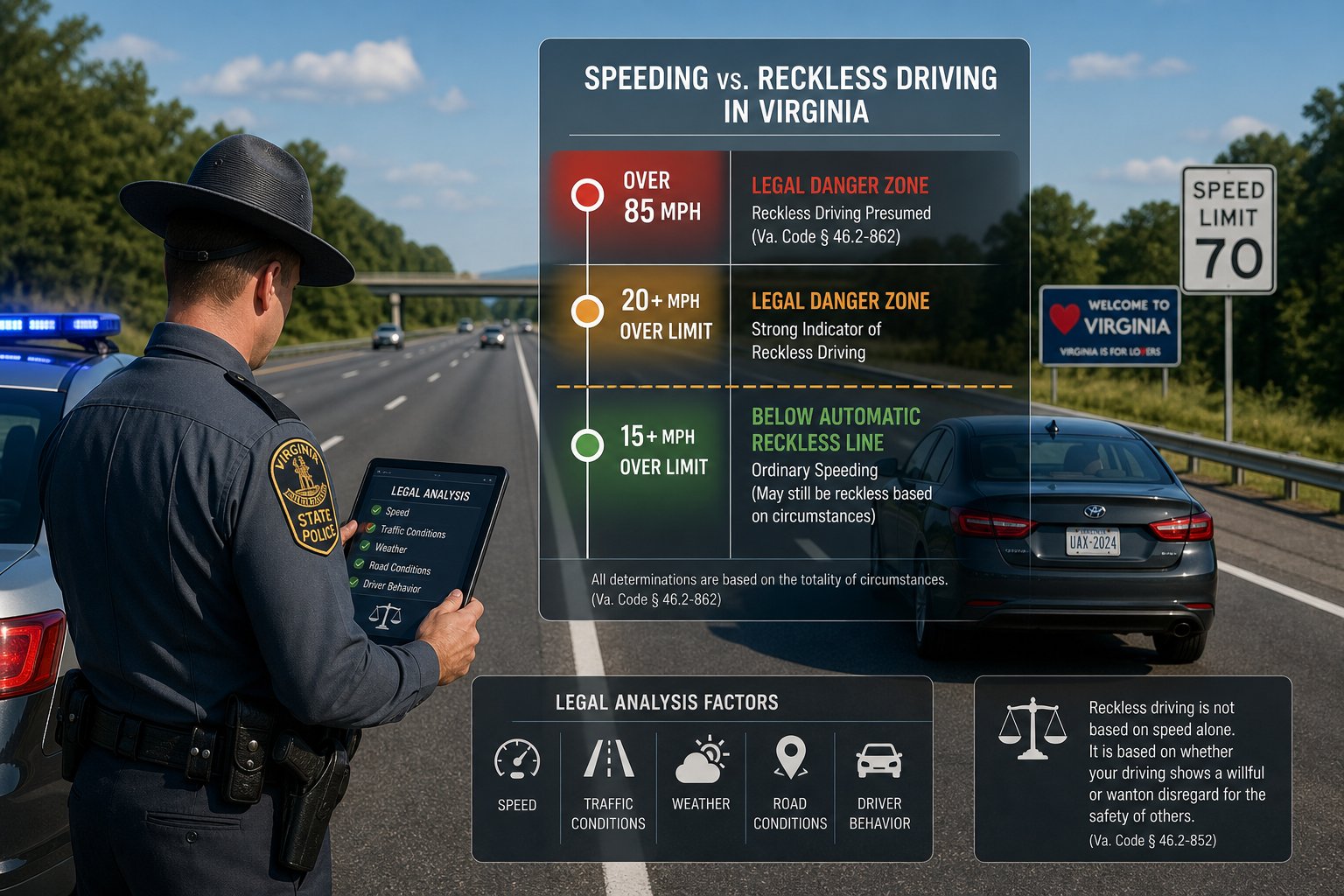
15 over is not reckless driving by speed in Virginia by itself. That is the short answer to the question, is 15 over reckless driving in va. If you were going 15 mph above the posted limit, you are below the automatic reckless driving threshold in § 46.2-862.
But that does not mean 15 over is always treated like an ordinary speeding ticket. Virginia also has a general reckless driving law. Under § 46.2-852, a driver can face a reckless driving charge if the speed or manner of driving endangered life, limb, or property.
That means facts matter. A driver going 15 over on a dry, open road is different from a driver going 15 over in heavy rain, in traffic, or while weaving between cars. The number alone may not trigger reckless driving, but the full situation still can.
For most drivers, the key point is simple:
- 15 over is not automatic reckless driving by speed
- 20 or more over is automatic reckless driving by speed
- Over 85 mph is automatic reckless driving by speed
A standard Virginia speeding ticket is generally a traffic infraction. That is serious enough. Still, reckless driving is a misdemeanor charge, and the stakes are much higher.
The Two Speed Rules That Matter Most
Virginia uses two main speed rules for reckless driving by speed under § 46.2-862:
- 20 mph or more over the speed limit
- Over 85 mph, no matter what the posted limit is
So if the speed limit is 55 and you are going 70, that is 15 over and not automatic reckless driving by speed. If you are going 75 in a 55, that is 20 over and crosses the reckless driving threshold.
The same rule applies on faster roads. If the speed limit is 70 and you are going 86, you can still face reckless driving because Virginia uses the over 85 mph rule even when you are not 20 over the limit.
What Virginia Law Says About Reckless Driving By Speed And Other Offenses
Virginia law separates normal speeding from reckless driving. That difference matters because many drivers ask, is a speeding ticket a misdemeanor in virginia. In most cases, the answer is no. A normal speeding ticket is usually a traffic infraction. Reckless driving is different.
Under Va. Code § 46.2-862, reckless driving by speed happens when you:
- Drive 20 mph or more above the speed limit, or
- Drive over 85 mph
Under Va. Code § 46.2-852, reckless driving can also be charged when a person drives at a speed or in a manner that endangers life, limb, or property. So even if you are not at the automatic speed level, your driving conduct can still lead to a reckless driving charge.
Virginia has several other reckless driving statutes too. The Code of Virginia includes offenses tied to bad brakes, passing a stopped school bus, passing on a curve, racing, and failing to control a vehicle on a grade.
The practical point is this: speed is not the only path to reckless driving in Virginia. If your citation says reckless driving, do not treat it like a routine speeding ticket.
And because reckless driving is a Class 1 misdemeanor, your case usually goes to the General District Court and may require your appearance, depending on the charge, court, locality, and case facts.
Penalties You Could Face For A Reckless Driving Conviction
A reckless driving conviction carries much heavier penalties than a standard speeding ticket. In Virginia, reckless driving is generally a Class 1 misdemeanor. That is the same class used for many criminal offenses.
According to the Virginia Judicial System and the Code of Virginia, a Class 1 misdemeanor can bring:
- Up to 12 months in jail
- Up to $2,500 in fines
- Possible court costs
- Possible license suspension for up to 6 months
The DMV side is serious too. A reckless driving conviction usually adds 6 demerit points to your Virginia driving record. By contrast, a normal speeding conviction often carries fewer points, such as 4 demerit points in many common speeding situations. That gap matters.
The record impact is different as well. Reckless driving can remain on your Virginia DMV record for 11 years. A plain speeding ticket does not carry the same criminal label, and it is generally less damaging.
Some drivers also ask whether a course helps. In Virginia, the official course is the DMV-approved Driver Improvement Clinic (DIC), which is an 8-hour course. A court may order it, or the Virginia DMV may require it based on a notice, your driver record, your license status, or other facts. If that applies to you, follow the exact terms on the notice or court order.
When A Virginia Reckless Driving Charge Can Become More Serious
Some reckless driving charges can become much more serious than a misdemeanor. That usually happens when the driving causes severe harm or death, or when other major facts are involved.
For example, Virginia law includes felony-level offenses tied to deaths caused by certain reckless driving conduct. Racing cases can also become far more serious. And if a person drives while suspended or revoked, the legal risk can rise fast.
That does not mean every reckless driving case leads to jail or a felony. Many do not. But it does mean you should not assume the charge is minor just because it started with speed.
A few facts can change the whole case:
- A crash with injuries
- A death
- Street racing or speed competition
- A suspended or revoked license
- Prior driving or criminal history
Also, local practice matters. Outcomes can depend on the court, judge, locality, citation, driver record, and case facts. A charge in one Virginia court may not be handled the same way in another.
That is why drivers should pay close attention to every paper they receive from the court or the Virginia Department of Motor Vehicles. Deadlines, required appearances, and license warnings are not things to brush off.
What To Do If You Are Charged With Reckless Driving In Virginia
Treat a reckless driving charge as a court case, not as a simple ticket. That is the safest starting point. Because it is usually a misdemeanor, the process is different from paying a normal speeding fine.
First, read the citation carefully. Check the court date, the exact code section, and whether you must appear in General District Court. Do not ignore any court notice, DMV notice, payment warning, or license-suspension notice.
Next, gather basic records that may matter:
- Your citation or summons
- Your driving record
- Any photos or dashcam video
- Notes about weather, traffic, and road conditions
- Repair records or speedometer calibration records, if relevant
Many drivers also speak with a Virginia traffic lawyer, especially when the charge is under § 46.2-862 or § 46.2-852. Some cases may involve discussion of a lesser charge, such as improper driving under § 46.2-869, depending on the facts.
If the court or DMV requires a course, Virginia uses the DMV-approved Driver Improvement Clinic, an 8-hour program. Requirements can depend on the DMV notice, court order, citation, license status, and your record.
If you need a Virginia driver improvement course online, you can review the options at Virginia driver improvement course. Make sure the course matches what your court or DMV notice requires.
How A Reckless Driving Charge Can Affect Your License, Record, And Insurance
A reckless driving charge can affect far more than one court date. It can hit your license, your DMV record, and often your insurance costs.
In Virginia, a reckless driving conviction generally adds 6 DMV demerit points. Those points are higher than many ordinary speeding convictions. The conviction can also stay on your record for 11 years, which is a long time for one traffic case to follow you.
Your license may also be at risk. Courts can suspend driving privileges in some reckless driving cases. Whether that happens can depend on the speed, the court, the judge, your record, and other facts.
Insurance is another major issue. Insurers often view reckless driving as much more serious than a basic speeding ticket. A misdemeanor traffic conviction can lead to higher premiums, though exact rate changes vary by company and policy.
If you receive a Virginia DMV notice or court order that requires education, use a DMV-approved Driver Improvement Clinic, not a random course. Driving Logic offers a Virginia option online through Virginia driver improvement course, which can help busy drivers complete the required 8-hour Driver Improvement Clinic on their schedule.
** Requirements and outcomes depend on your DMV notice, court order, ticket, driver record, license status, court, judge, locality, and case facts.
Where A Virginia Driver Improvement Course May Fit
A Virginia driver improvement course can matter after a speeding ticket, but it has a limited role. Virginia DMV-approved clinics are 8-hour courses. When you complete a clinic voluntarily and meet DMV rules, you may receive 5 safe driving points once every 24 months.
That does not erase the ticket. It does not remove the conviction from your driving record. It also does not guarantee a court result, an insurance discount, or a change in how a judge handles your case.
The course is most useful when your goal is to improve your DMV point balance, satisfy a DMV requirement, or comply with a court order that specifically allows or requires driver improvement. If you are using the course for a court case, follow the court’s instructions first. If you are using it for DMV safe points, confirm that the provider is approved and that your timing fits DMV rules.
You can review the Virginia driver improvement course if your ticket, court order, DMV notice, or personal record goal makes a course appropriate.
FAQ
Can a Virginia driver improvement course help after a speeding ticket?
It may help with DMV safe driving points when eligible, or satisfy a court or DMV requirement. It does not erase the ticket or guarantee a court result.
Should I check my court paperwork first?
Yes. Your citation, court notice, DMV notice, and deadline control what you need to do next.
Does the course remove a conviction?
No. A Virginia driver improvement clinic does not remove a conviction from your DMV record.
Related Articles
- Virginia Speeding Ticket: Costs, Points, and What Happens Next
- 20 MPH Over the Speed Limit in Virginia: Fines, Points, and Reckless Driving Risk
- Is a Virginia Speeding Ticket a Misdemeanor or Just a Traffic Infraction?
- Virginia Speeding Ticket: What to Know Before You Pay or Go to Court
Sources
- Virginia DMV — Driver Improvement Clinics
- Virginia DMV — Demerit Points
- Virginia Courts — Pay Traffic Tickets and Other Offenses
- Code of Virginia § 46.2-862 — Reckless Driving by Speed
Billy Forte is the owner of Driving Logic, a state-approved driver improvement course provider serving Virginia and other U.S. states. Driving Logic offers DMV-approved online driver improvement courses for drivers handling DMV notices, court orders, and state requirements.
This article is general information, not legal advice. Virginia DMV rules, court orders, deadlines, insurance decisions, CDL rules, and case facts can differ. Use official Virginia DMV and court sources for current requirements, and consult a qualified Virginia attorney for legal guidance specific to your situation.