
Updated June 2026 · Reviewed by Billy Forte
A Virginia traffic violation points chart shows how many demerit points the DMV assigns to different moving violations. This article is for Virginia drivers who need a clear answer before checking a record, taking a course, or responding to a DMV or court notice. You will learn what the rule means, how a Driver Improvement Clinic may fit, and what to verify before your next step.
This article covers Virginia requirements only.
Key Facts
- Violation points: Virginia assigns demerit points based on the type and seriousness of the conviction.
- Speeding points: Speeding can carry different point levels depending on the offense.
- Record impact: Demerit points and convictions are related but not identical.
- Course role: A clinic may add safe driving points when eligible, not erase the violation.
- Verify first: Check your official DMV record for the current point entry.
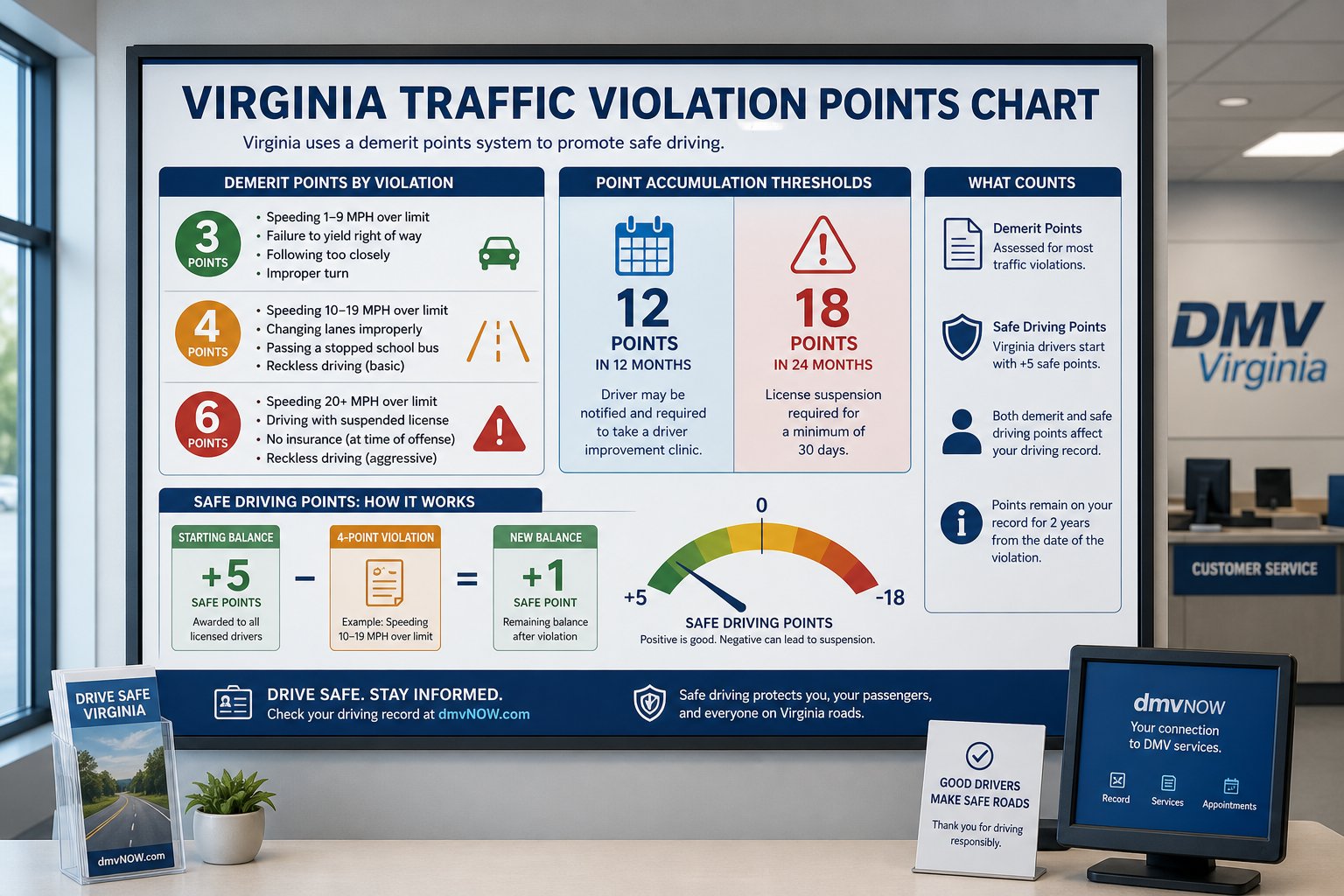
How The Virginia Demerit Point System Works
Virginia uses a point-based system through the Virginia Department of Motor Vehicles. When you are convicted of a traffic offense, the Virginia DMV adds demerit points to your driving record.
If you need an approved online option, review the Virginia Driver Improvement Course and compare it with your Virginia DMV notice, court order, or driver record goal.
Those points are tied to the offense date. For DMV action, they stay active for 2 years. But the conviction itself can stay on your record much longer, depending on the charge. Some routine convictions stay for a few years. Serious offenses, like reckless driving, can remain for 11 years.
The basic structure is simple:
- 3 points for lower-level moving violations
- 4 points for mid-level violations
- 6 points for serious violations
The more points you collect in a short time, the more likely the DMV is to act. Virginia DMV may order a Driver Improvement Clinic, place you on a control period, or suspend your license if your total reaches the state’s action limits.
The main thresholds many drivers watch are:
- 12 demerit points in 12 months
- 18 demerit points in 24 months
If you get a Virginia DMV notice, court order, or citation with a deadline, do not ignore it. What happens next can depend on the notice, your driver record, your license status, the court, the judge, the locality, and the facts of your case.
Demerit Points Vs. Safe Driving Points
Virginia also gives safe driving points. These are not the same as demerit points.
You can earn +1 safe driving point for each full calendar year with no violations or suspensions, up to +5 points. That means a careful driver may build a positive point balance over time.
Then, if you later get a ticket, the demerit points reduce that balance. For example:
- You have +5 safe points
- You are convicted of a 4-point offense
- Your net point balance becomes +1
That does not mean the conviction disappears. It means your point balance is better than it would be without those safe driving points. This is a key part of how the Virginia demerit point chart works.
Virginia Traffic Violation Points Chart: 3-, 4-, And 6-Point Offenses
Here is the short answer to the question most drivers ask: Virginia assigns 3, 4, or 6 demerit points per conviction.
Below is a practical Virginia traffic violation points chart for common offenses.
3-point offenses often include:
- Speeding 1 to 9 mph over the limit
- Improper lane change
- Failure to signal or improper signal
- No license plate
- Some equipment violations
- Improper passing on the right
4-point offenses often include:
- Speeding 10 to 19 mph over the limit
- Running a red light
- Failure to stop at a stop sign
- Failure to yield
- Following too closely
- Improper passing
- Improper turning
6-point offenses include more serious violations, such as:
- Speeding 20+ mph over the limit
- Driving over 80 mph in cases that qualify under Virginia rules
- Reckless driving
- DUI
- Driving on a suspended or revoked license
- Hit and run
- Manslaughter
- Certain serious CDL offenses
A few details matter here. First, the exact code section and conviction control the points, not just the officer’s wording on the ticket. Second, some speeding cases can cross into reckless driving, which is much more serious than a standard speeding ticket. You can review offense details through the Virginia Courts and the Code of Virginia.
So if you are comparing tickets, the key question is not only “Was I speeding?” but also how much, and whether the court treated it as reckless driving.
How Long Points Stay On Your Record And When The DMV Takes Action
In Virginia, demerit points stay active for 2 years from the offense date for DMV action purposes. That is the rule many drivers care about most when they are trying to judge license risk.
But the full conviction stays on your driving record longer. The time depends on the offense. A routine ticket may stay for several years. A reckless driving conviction can stay for 11 years.
This difference causes confusion. Think of it this way:
- Demerit points affect DMV action for 2 years
- The conviction history may stay much longer
Virginia DMV can take action if you collect too many points within set time periods. Common action levels include:
- 12 points in 12 months
- 18 points in 24 months
If that happens, the DMV may require a driver improvement program, place you on probation or a control period, or suspend your license. The exact outcome can depend on your age, prior record, and the notice the DMV sends.
This is why timing matters. Two 6-point convictions close together can create much more trouble than one old 3-point ticket. And if you already have a weak point balance, even a 4-point red-light or following-too-closely conviction can push you near action levels.
You can confirm point rules and record options with the Virginia DMV driver improvement information.
Special Rules For Speeding, Reckless Driving, Teen Drivers, And CDL Holders
Some drivers face stricter rules than others. In Virginia, speeding, reckless driving, teen driving, and commercial driving each have added risks.
For speeding, the point tiers are usually:
- 1 to 9 mph over = 3 points
- 10 to 19 mph over = 4 points
- 20+ mph over = 6 points
In some cases, speeding over a certain level can also become reckless driving. That matters because reckless driving is a 6-point offense and can stay on your record for 11 years.
For drivers under 18, the rules are tougher. According to Virginia DMV, a first demerit-point conviction can trigger a mandatory driver improvement course. A second can lead to a 90-day suspension. A third can lead to revocation until age 18 and later reapplication.
For CDL holders, the risk is also higher. Some commercial violations carry 6 points, and some offenses can trigger CDL disqualification under state and federal rules. Even if the ticket happened in a personal vehicle, it may still affect your commercial driving record depending on the offense.
If you hold a CDL or if your ticket mentions reckless driving, read every court notice and DMV notice closely. Those cases often have bigger consequences than a basic moving violation.
How A Driver Improvement Course Can Help Your Point Total
A DMV-approved Driver Improvement Clinic (DIC) can help your Virginia point balance in some cases. In Virginia, the official course is an 8-hour driver improvement clinic.
If you take it voluntarily and you are eligible, you may receive up to +5 safe driving points. Virginia allows that credit once every 24 months. That can help offset demerit points on your record.
Still, the course does not erase a conviction from your driving history. It also does not mean a court will dismiss a charge. Safe-driving point credit and demerit-point expiration are different things.
A course may come up in several ways:
- You choose it voluntarily for safe driving points
- The Virginia DMV requires it after point problems
- A court order requires it in your case
- A judge or locality makes course completion part of the outcome
Requirements can depend on the DMV notice, your ticket, your driving record, your license status, the court, the judge, the locality, and the facts of the case.
If you need a state-approved online option, Driving Logic’s Virginia Driver Improvement Course is built for busy drivers who want flexible scheduling on almost any device.
How To Check Your Virginia Driving Record And Decide Your Next Step
The best next step is often simple: check your Virginia driving record. Your record can show convictions, your point balance, and other details that affect what you should do next.
You can get your record through the Virginia DMV. Review it for:
- Your current safe driving point balance
- Recent convictions and offense dates
- Whether you are close to 12 points in 12 months or 18 in 24 months
- Any signs of suspension, probation, or control action
Then look at your situation in context. If you have a minor 3-point ticket and a strong safe-point balance, your risk may be lower. If you have a 6-point charge, a weak point balance, or a prior history, the risk is much higher.
You should also factor in special status:
- Teen driver
- CDL holder
- Prior suspension or revoked license issues
- Court-ordered appearance or DMV notice
Based on that, your next step may include paying close attention to deadlines, taking a Driver Improvement Clinic, or getting legal help for a serious charge. If you are ready to complete a Virginia course online, you can start with Driving Logic.
This information is for general education only and is not legal advice.
FAQ
Can a Virginia Driver Improvement Clinic remove a ticket from my record?
No. A Virginia Driver Improvement Clinic does not erase a ticket or conviction from your driving record. When eligible, it may add safe driving points that help your overall point balance.
How many safe driving points can I earn from a Virginia clinic?
Eligible drivers may receive 5 safe driving points after completing an approved clinic. Voluntary clinic credit is generally limited to once every 24 months.
Should I follow the DMV notice or the court order?
Follow the document that applies to your situation. A DMV notice, court order, citation, or insurance request may have different instructions and deadlines.
Where should I check my Virginia point balance?
Use your official Virginia DMV driving record. Do not rely only on memory, insurance paperwork, or an old copy of your record.
Conclusion
Virginia Traffic Violation Points Chart: How Many Points for Each Offense depends on your official Virginia DMV record, the specific violation, and any court or DMV notice you received. A Driver Improvement Clinic may help with safe driving points when eligible, but it does not erase the underlying ticket or conviction. Check the official record and deadline before you act.
Take the Virginia Driver Improvement Course online when you are ready to begin.
Related Articles
- Virginia DMV Points System Explained
- What Is a Safe Driving Points Balance in Virginia?
- How to Earn Safe Driving Points in Virginia (And Why the DIC Gives You 5)
- How Many Points Is a Speeding Ticket in Virginia?
Sources
- Virginia DMV — Driver Improvement
- Virginia DMV — Points System
- Virginia DMV — Moving Violations and Points
- Virginia Code § 46.2-494 — Safe Driving Points
- Virginia DMV — Driver Improvement Clinics
Billy Forte is the owner of Driving Logic, a state-approved driver improvement course provider serving Virginia and other U.S. states. Driving Logic offers online driver improvement and driver safety courses for drivers handling DMV notices, court orders, point concerns, and state requirements.
This article is general information, not legal advice. Virginia DMV rules, court orders, deadlines, insurance decisions, CDL rules, and case facts can differ. Use official Virginia DMV and court sources for current requirements, and consult a qualified Virginia attorney for legal guidance specific to your situation.