
Updated June 2026 · Reviewed by Billy Forte
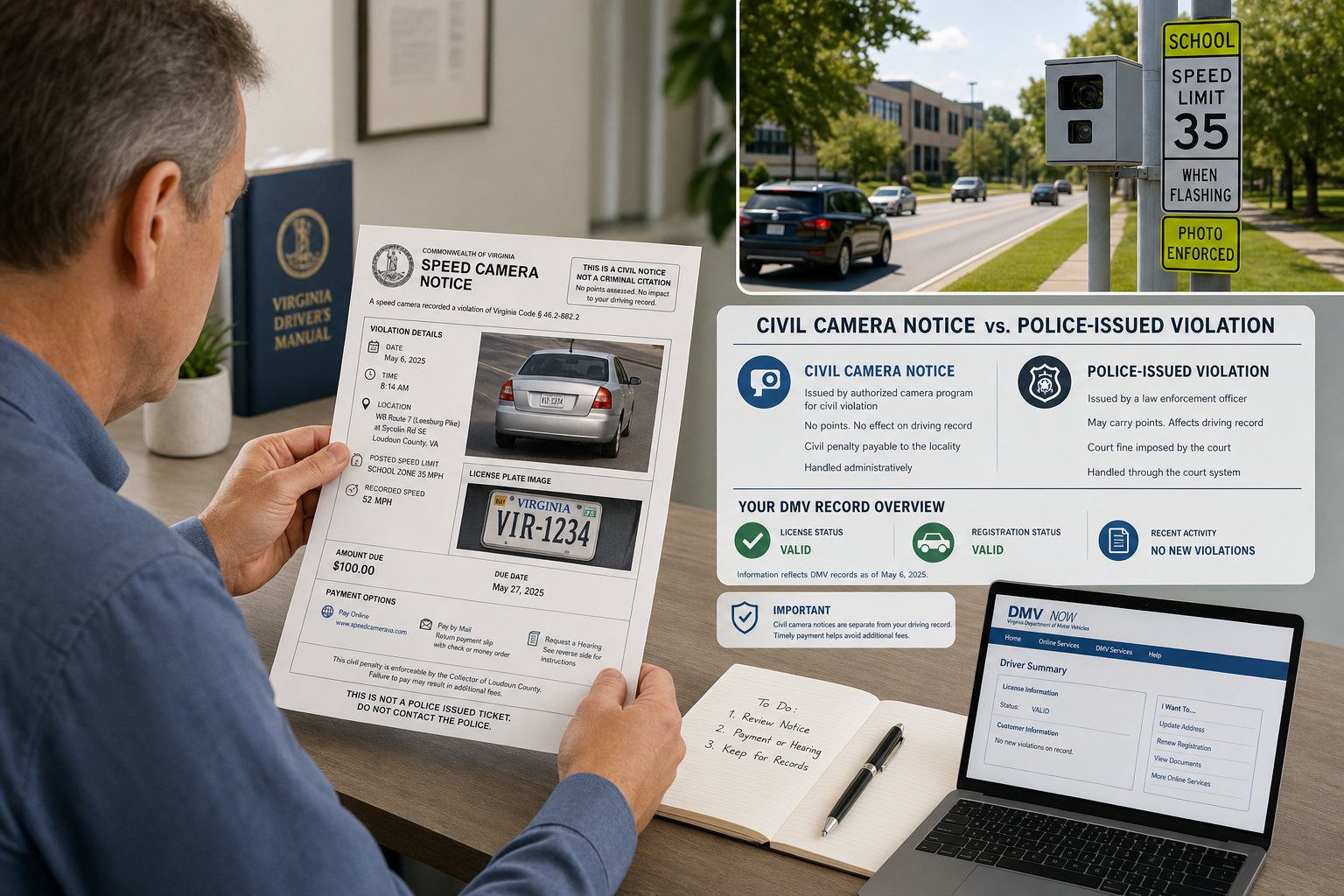
Most Virginia speed camera tickets are civil penalties and do not work like officer-issued moving violations. This article is for drivers who received an automated ticket and want to know whether it affects their DMV record or points. You will learn how camera tickets differ from regular speeding tickets and what to verify on your notice.
This article covers Virginia requirements only.
Key Facts
- Civil penalty: Many automated speed tickets are civil penalties.
- Record impact: They usually do not add DMV demerit points like officer-issued tickets.
- Ticket type: Read the notice to confirm whether it is automated or officer-issued.
- Insurance: Civil camera penalties are different from moving-violation convictions.
- DIC role: Driver improvement usually fits moving violations, not every camera notice.
If your court, DMV notice, or personal record goal allows a course option, review the Virginia driver improvement course before your deadline.
What A Virginia Camera Speeding Ticket Actually Is
A Virginia speed camera ticket is usually not the same as a regular traffic ticket from a police officer. It is usually a civil penalty sent after a photo speed monitoring device records a vehicle going fast in a place where cameras are allowed.
Under Virginia law, these systems are used in limited settings. The camera records the vehicle, plate, speed, date, time, and place. Then the notice is mailed to the owner, lessee, or renter of the vehicle.
That point matters. A camera ticket is based on the vehicle tied to the plate, not on an officer stopping you and identifying you as the driver. So the legal result is different from a standard moving violation.
In many Virginia camera programs, the trigger is 10 mph or more over the posted speed limit in an authorized zone. The notice usually includes:
- The alleged speed
- The posted speed limit
- Photos or video details
- The amount due
- A deadline to pay or contest
This is why the answer to does camera speeding ticket go on your record in Virginia is usually no. A civil camera notice is not treated like a conviction for a normal Virginia speeding ticket.
Still, verify the ticket type on the notice. If a police officer issued the citation, that is a different matter and may lead to DMV points, fines, court costs, or even reckless driving issues depending on the speed and facts. Official information is available from the Code of Virginia and the Virginia Judicial System.
Does A Camera Speeding Ticket Go On Your Driving Record In Virginia?
No, most Virginia automated speed camera violations do not go on your driving record. They also do not add demerit points to your Virginia DMV record.
That is the key rule most drivers want to know. For a civil camera penalty, the law says it should not be made part of the operating record and should not be used for insurance purposes. In plain terms, it is not treated as a moving violation conviction.
That makes a big difference from an officer-issued speeding ticket. If an officer writes you a Virginia speeding ticket and you are convicted, the case can go on your driving record. It may also bring DMV demerit points, court costs, and possible insurance effects.
A camera ticket usually does one main thing: it creates a civil fine. That is why many drivers will not need a court-ordered class from a camera ticket alone.
But there are limits to that general rule. You should confirm:
- Whether your notice is truly a civil camera penalty
- Whether a court appearance is listed
- Whether the paper came from a camera program or an officer
- Whether your case involves another charge
If you later get a court order or DMV notice in a separate case, follow it. In Virginia, a DMV-approved Driver Improvement Clinic (DIC) is the official course when one is required. It is an 8-hour course. If you need that option, you can review the Virginia Driver Improvement Course online from Driving Logic for a state-approved format that works on your schedule.
When Camera Tickets Are Used In Virginia
Virginia does not allow speed cameras everywhere. Their use is limited to places named by law and local programs.
That matters because a valid virginia speed camera ticket usually comes from a specific type of zone, not from random road enforcement. Local governments must follow state rules on where devices may be placed and how drivers are warned.
Common authorized settings include:
- School crossing zones
- Certain high-risk roadway segments or intersections
- Some work zone or related local safety programs where allowed
These programs usually require visible signs. The signs warn drivers that photo speed monitoring is in use. The camera system is meant to improve safety in places where people face greater risk.
A camera notice also depends on the speed threshold set by law or program rules. In many Virginia programs, the recorded speed must be at least 10 mph over the posted limit before a notice is issued.
That does not mean every fast-driving case will be handled by camera. In many places, regular police enforcement still applies. And if an officer stops you, the case is no longer just a civil camera matter.
So if your notice came by mail after a recorded event in a marked zone, it is likely the civil type. If you were pulled over and handed a citation, treat it as a standard traffic case and review your court date, possible fines, and DMV point risk.
School Zones, Work Zones, And High-Risk Areas
School zones are the best-known example. Cameras are often tied to times when the zone is active, and signs should tell you when photo enforcement applies.
Work zones and high-risk areas also come up in Virginia. These are places where safety concerns are stronger, such as road work or roadway segments with serious crash history.
In each setting, details can vary by locality and by the exact program. So read the notice for the location, time, and basis for the penalty.
How Much A Virginia Camera Ticket Costs And Who Is Responsible
The civil penalty is capped by Virginia law at $100 per offense. That cap is one reason camera cases are different from officer-issued speeding charges, which can involve a fine, court costs, and bigger consequences depending on the speed.
Some local programs use tiered amounts based on how far over the limit the vehicle was traveling. For example, a locality may set lower penalties for smaller speed ranges and the full $100 for higher ones. But the state cap still controls the maximum civil penalty.
Responsibility usually starts with the registered owner, or in some cases the lessee or renter. The notice goes to the person or entity tied to the vehicle record.
That does not always mean that person was driving. Virginia camera systems use owner-based liability, so the law may let the owner respond if someone else had the vehicle. The exact method can depend on the notice and local process.
You may see options such as:
- Paying the civil penalty
- Requesting a hearing in General District Court if the notice allows it
- Filing an affidavit or other response if you were not the driver
Do not assume all tickets work the same way. Requirements can depend on the DMV notice, court order, ticket, driver record, license status, court, judge, locality, and case facts.
And remember the contrast: a normal Virginia speeding ticket can lead to demerit points and, at higher speeds, possible reckless driving issues. A civil camera ticket usually does not.
What To Do If You Receive A Camera Speeding Ticket In Virginia
First, read the notice all the way through. The paper should tell you the alleged speed, location, date, response deadline, and how to pay or contest the ticket.
Next, review the proof listed in the notice. Many programs provide photos or video details. Check the plate number, vehicle, place, and speed reading.
Then decide how you will respond before the deadline. Common options include:
- Pay the civil penalty
- Request a hearing if the notice gives that option
- Submit the required form if you were not the driver and the program allows that response
Do not ignore the notice. Even though it usually does not place points on your Virginia DMV record, unpaid civil penalties can still lead to added trouble, such as late fees, collection action, or other registration-related issues depending on the program.
If your paperwork is not a camera notice and instead is a standard citation, treat it differently. An officer-issued case can affect your record and may lead to court costs or DMV points if you are convicted.
If a court or the Virginia Department of Motor Vehicles later requires education, the official course is the 8-hour DMV-approved Driver Improvement Clinic. For a flexible online option, you can use Driving Logic at MyDrivingLogic.com, which offers state-approved courses for busy drivers on most devices.
For public records and court details, use the Virginia Courts case information system and the Virginia DMV.
Special Cases For Commercial Drivers, Company Cars, And Other Drivers
These tickets can raise extra questions when the vehicle owner and driver are not the same person. That often happens with commercial drivers, fleet vehicles, rentals, and family cars.
For commercial drivers, the main point is still the same: a civil camera penalty is generally not a moving violation conviction on the DMV record. So it usually does not work like an officer-issued ticket for CDL point concerns.
Still, a CDL holder may have other issues outside the DMV record itself. An employer may track safety events under company policy. A fleet manager may also require you to report any camera notice involving a work vehicle.
For company cars, the business often receives the notice as the registered owner. The company may then decide whether to pay it, contest it, or seek repayment from the employee driver under its own rules.
For rental cars or leased cars, the notice may go first to the rental company or leasing company. That company may then transfer responsibility under its process or agreement.
For shared family vehicles, the owner should not guess. Read the notice and follow the listed steps if another person was driving.
A few final points help keep this straight:
- A camera ticket is usually civil
- An officer-issued Virginia speeding ticket is different
- Only the second type usually risks a conviction record and DMV points
- Local procedures can vary, so confirm the exact ticket type
This page is for general information only and is not legal advice.
Where A Virginia Driver Improvement Course May Fit
A Virginia driver improvement course can matter after a speeding ticket, but it has a limited role. Virginia DMV-approved clinics are 8-hour courses. When you complete a clinic voluntarily and meet DMV rules, you may receive 5 safe driving points once every 24 months.
That does not erase the ticket. It does not remove the conviction from your driving record. It also does not guarantee a court result, an insurance discount, or a change in how a judge handles your case.
The course is most useful when your goal is to improve your DMV point balance, satisfy a DMV requirement, or comply with a court order that specifically allows or requires driver improvement. If you are using the course for a court case, follow the court’s instructions first. If you are using it for DMV safe points, confirm that the provider is approved and that your timing fits DMV rules.
You can review the Virginia driver improvement course if your ticket, court order, DMV notice, or personal record goal makes a course appropriate.
FAQ
Can a Virginia driver improvement course help after a speeding ticket?
It may help with DMV safe driving points when eligible, or satisfy a court or DMV requirement. It does not erase the ticket or guarantee a court result.
Should I check my court paperwork first?
Yes. Your citation, court notice, DMV notice, and deadline control what you need to do next.
Does the course remove a conviction?
No. A Virginia driver improvement clinic does not remove a conviction from your DMV record.
Related Articles
- Virginia Speeding Ticket: Costs, Points, and What Happens Next
- How Long Does a Speeding Ticket Stay on Your Record in Virginia?
- Virginia Speeding Ticket Fines: What Affects the Cost?
- Is a Virginia Speeding Ticket a Misdemeanor or Just a Traffic Infraction?
Sources
- Virginia DMV — Driver Improvement Clinics
- Virginia DMV — Demerit Points
- Virginia Courts — Pay Traffic Tickets and Other Offenses
- Code of Virginia § 46.2-882.1 — Photo Speed Monitoring Devices
Billy Forte is the owner of Driving Logic, a state-approved driver improvement course provider serving Virginia and other U.S. states. Driving Logic offers DMV-approved online driver improvement courses for drivers handling DMV notices, court orders, and state requirements.
This article is general information, not legal advice. Virginia DMV rules, court orders, deadlines, insurance decisions, CDL rules, and case facts can differ. Use official Virginia DMV and court sources for current requirements, and consult a qualified Virginia attorney for legal guidance specific to your situation.