
Updated June 2026 · Reviewed by Billy Forte
A Virginia speeding ticket can stay on your DMV driving record for years, and the record period depends on the violation. This article is for drivers who want to know how long points and convictions may affect them. You will learn how record timing works, how safe driving points can help, and what to verify with Virginia DMV.
This article covers Virginia requirements only.
Key Facts
- Record time: Virginia speeding convictions can remain on DMV records for several years.
- Points: Demerit points have their own timing and severity rules.
- Insurance: Insurers may review motor vehicle records for recent violations.
- Safe points: A voluntary clinic may add 5 safe driving points once every 24 months.
- No erasure: Driver improvement does not remove the conviction.
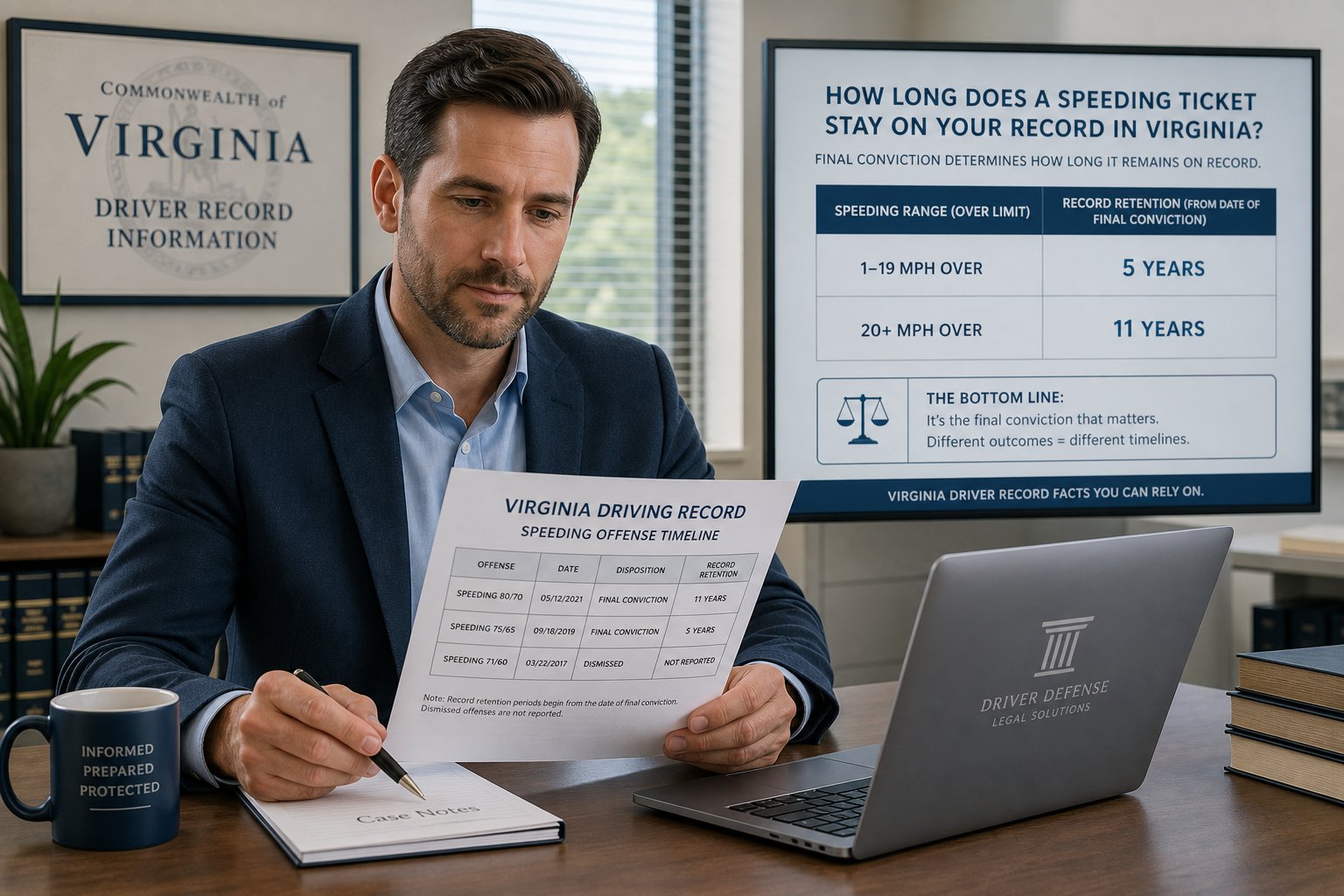
If your court, DMV notice, or personal record goal allows a course option, review the Virginia driver improvement course before your deadline.
How Long A Virginia Speeding Ticket Stays On Your DMV Record
The short answer is most Virginia speeding convictions stay on your DMV driving record for 5 years. That covers many standard speeding tickets, including lower-range speeding convictions.
But not every ticket follows the same clock. In Virginia, the time depends on how fast you were driving and what charge appears on the final court record.
Here is the general rule based on Virginia DMV offense tables:
- 1 to 9 mph over the limit: 5 years
- 10 to 19 mph over the limit: 5 years
- 20 mph or more over the limit: 11 years
- More serious speed-based offenses, including some reckless driving cases: often 11 years or longer
That means the answer to how long does speeding ticket stay on record in Virginia is not always the same. A basic ticket may stay 5 years. A more serious conviction can stay much longer.
Virginia DMV also keeps an internal history for longer than the public-facing counting period. So even when a violation stops counting the same way for point purposes, the record itself may still exist in DMV files. That matters because courts, insurers, and the Virginia Department of Motor Vehicles may look at different parts of your Virginia speeding ticket record depending on the issue.
What matters most is the final conviction, not just the original citation. If a judge reduces your charge, the record period may change. If you prepay the ticket and accept the charge as written, the original offense usually goes onto your record as a conviction. For the most current offense codes, Virginia DMV publishes driver improvement and point information through the Virginia Department of Motor Vehicles.
How Virginia’s Demerit Point System Works For Speeding Tickets
A speeding ticket can affect you in two different ways in Virginia: the conviction stays on your driving record, and demerit points can hit your point balance.
These are not the same thing. The conviction may stay for 5 or 11 years, while the demerit points usually stay for 2 years from the offense date.
Virginia uses this general point structure for speeding:
- 1 to 9 mph over: 3 demerit points
- 10 to 19 mph over: 4 demerit points
- 20 mph or more over: 6 demerit points
That split is important. You might stop losing points after 2 years, but the conviction can still remain visible on your driving record much longer.
Virginia DMV also uses your total point balance to decide when more action is needed. If you build up too many demerit points in a short time, you may face extra steps such as a warning letter, a required hearing, or even license suspension. Virginia DMV states that high point totals, such as 18 points in 12 months or 24 points in 24 months, can trigger serious consequences.
How the point balance can improve
Virginia also gives safe driving points. You can earn:
- 1 safe driving point for each year you drive without a violation or suspension
- Up to a maximum of 5 safe driving points on your record
You may also take a DMV-approved Driver Improvement Clinic. In Virginia, that is the official course name, and it is generally an 8-hour course. If you take it voluntarily and you are eligible, the course can add up to 5 safe driving points once every 2 years. That can help offset demerit points during the period when the ticket still affects your record. More details appear on the Virginia DMV driver improvement page.
When A Speeding Ticket Affects Insurance Rates And How Long That Impact Can Last
A speeding conviction can affect your insurance even after DMV demerit points expire. That is where many drivers get surprised.
Virginia DMV rules control your driving record and point balance. Your insurance company uses its own rating rules, within state law, to decide how long a conviction affects your premium. In practice, that means a ticket may stay on your DMV record for 5 years, but the insurance impact can last a different amount of time.
In general:
- A standard speeding conviction often leads to a rate increase
- Higher speeds usually bring larger increases
- Reckless driving or very high-speed cases often hurt more and last longer
Insurers often look at the seriousness of the offense, your full driving history, your age, and whether you had prior claims or tickets. So two drivers can get the same ticket and still see different insurance results.
This is why the exact answer to how long does speeding ticket stay on record in Virginia does not fully answer the money question. Your DMV record period and your insurance rating period may not match.
If you contest the ticket and the court reduces it to a lesser offense, that can matter a lot. A lower-level conviction may carry fewer demerit points and may look less severe to an insurer. But nothing is automatic. Each company has its own underwriting rules.
If you want to confirm what appears on your official history, you can order a transcript from the Virginia Department of Motor Vehicles.
When Speeding Becomes Reckless Driving In Virginia
In Virginia, speeding can turn into reckless driving, and that changes everything. Reckless driving is not just a traffic infraction. It is generally a criminal charge.
Under Virginia law, you can face reckless driving by speed if you drive:
- 20 mph or more over the posted speed limit, or
- Over 85 mph
That means a high-speed ticket may not be treated like a normal speeding case at all. The charge can carry 6 demerit points and often stays on your DMV record for 11 years. Some reckless driving entries may also have longer-term effects beyond the basic DMV counting period.
This is one reason the facts matter so much. The ticket or citation, the exact speed alleged, your driver record, and what happens in court can all change the outcome. The court, judge, locality, and case facts also matter.
For example, if the charge is reduced from reckless driving to a lower speeding offense, the record impact may become shorter. If the reckless charge stays in place, the effect is usually much more serious for your record, your point balance, and your insurance.
Virginia drivers should not assume that a “speeding ticket” is always minor. If your paperwork shows reckless driving, read the notice closely and follow any court date or order. The Code of Virginia reckless driving statute explains the speed-based rule.
What Happens If You Prepay, Contest, Or Ignore The Ticket
Your choice after a ticket can affect how long the violation stays on your record. The key issue is whether you end up with a conviction, and if so, for what offense.
If you prepay
In Virginia, prepaying a ticket usually counts as a guilty plea. That means the offense is treated as a conviction and goes on your driving record based on the charge listed. If it is a standard speeding ticket, it may stay 5 years. If it is a higher-speed offense, it may stay 11 years.
If you contest the ticket
If you go to court, the judge may:
- dismiss the ticket,
- find you guilty as charged, or
- reduce or amend the charge.
A reduction can matter a lot. A lower speed range may mean fewer demerit points and a shorter DMV record period.
If you ignore the ticket
Ignoring a Virginia citation is risky. It can lead to:
- a default judgment,
- extra penalties,
- license suspension issues, or
- other problems tied to your court or DMV status.
Requirements can depend on the Virginia DMV notice, court order, citation, license status, driver record, court, judge, locality, and the facts of the case. So read every notice carefully and respond by the stated deadline. You can review court process information through the Virginia Judicial System.
Can You Reduce The Impact Of A Virginia Speeding Ticket?
Yes, in some cases you can reduce the impact, even if you cannot erase the event from history. The best option depends on the charge and your record.
A few common ways drivers may reduce harm include:
- Contesting the ticket in court
- Seeking a reduction to a lower speed or lesser offense
- Showing a clean driving record
- Avoiding new violations while points age off
- Adding safe driving points through an approved course when eligible
What helps one driver may not help another. A first ticket with a clean record may be viewed differently than a repeat offense. And a serious speed allegation, such as 20+ mph over the limit, can limit your options.
It also helps to separate three ideas:
- The conviction on your record
- The demerit points tied to that conviction
- The insurance effect
These move on different timelines. A course may help your point balance. Safe driving over time may improve your record. But neither one automatically removes a conviction from your DMV history.
If your notice or court order requires a course, make sure you follow the exact terms. If you are taking a course on your own, confirm that the provider is approved and that you are eligible for point credit.
Traffic School, Safe Driving, And Other Ways To Protect Your Record
Virginia’s official course is the DMV-approved Driver Improvement Clinic, often called a DIC. It is generally an 8-hour course. If you qualify and take it voluntarily, it can add up to 5 safe driving points once every 2 years.
That point credit can help offset demerit points from a speeding ticket. But it does not erase the conviction itself from your Virginia speeding ticket record. That is a big difference, and many drivers miss it.
Safe driving points can also build over time. If you go a full year without a violation or suspension, Virginia DMV may add 1 safe driving point, up to 5 total.
A DIC may help in a few ways:
- It can improve your point balance if you are eligible
- It may satisfy a court order or DMV requirement when one applies
- It may show the court that you took a corrective step, depending on the case facts
Court acceptance and outcome can depend on the judge, locality, ticket details, and your driving record. So do not assume a course guarantees dismissal, reduction, or insurance savings.
If you need a Virginia course that fits a busy schedule, Driving Logic offers an online option through Virginia driver improvement course. You can also review Virginia-approved course rules through the Virginia DMV.
This information is general education only and is not legal advice.
Where A Virginia Driver Improvement Course May Fit
A Virginia driver improvement course can matter after a speeding ticket, but it has a limited role. Virginia DMV-approved clinics are 8-hour courses. When you complete a clinic voluntarily and meet DMV rules, you may receive 5 safe driving points once every 24 months.
That does not erase the ticket. It does not remove the conviction from your driving record. It also does not guarantee a court result, an insurance discount, or a change in how a judge handles your case.
The course is most useful when your goal is to improve your DMV point balance, satisfy a DMV requirement, or comply with a court order that specifically allows or requires driver improvement. If you are using the course for a court case, follow the court’s instructions first. If you are using it for DMV safe points, confirm that the provider is approved and that your timing fits DMV rules.
You can review the Virginia driver improvement course if your ticket, court order, DMV notice, or personal record goal makes a course appropriate.
FAQ
Can a Virginia driver improvement course help after a speeding ticket?
It may help with DMV safe driving points when eligible, or satisfy a court or DMV requirement. It does not erase the ticket or guarantee a court result.
Should I check my court paperwork first?
Yes. Your citation, court notice, DMV notice, and deadline control what you need to do next.
Does the course remove a conviction?
No. A Virginia driver improvement clinic does not remove a conviction from your DMV record.
Related Articles
- Virginia Speeding Ticket: Costs, Points, and What Happens Next
- Virginia Speeding Ticket Fines: What Affects the Cost?
- How Does a Virginia Speeding Ticket Affect Your Car Insurance?
- Virginia Speed Camera Tickets: Do They Go on Your Driving Record?
Sources
- Virginia DMV — Driver Improvement Clinics
- Virginia DMV — Demerit Points
- Virginia Courts — Pay Traffic Tickets and Other Offenses
Billy Forte is the owner of Driving Logic, a state-approved driver improvement course provider serving Virginia and other U.S. states. Driving Logic offers DMV-approved online driver improvement courses for drivers handling DMV notices, court orders, and state requirements.
This article is general information, not legal advice. Virginia DMV rules, court orders, deadlines, insurance decisions, CDL rules, and case facts can differ. Use official Virginia DMV and court sources for current requirements, and consult a qualified Virginia attorney for legal guidance specific to your situation.