
Updated June 2026 · Reviewed by Billy Forte
A speeding ticket in Tennessee is usually a traffic violation, but reckless driving is a Class B misdemeanor criminal charge that can leave you with a criminal record. A standard Tennessee speeding ticket usually brings fines, court costs, and 1 to 8 demerit points, while reckless driving under Tennessee Code Annotated § 55-10-205 carries 6 demerit points and possible jail time. That difference matters because 12 points in 12 months can lead the Tennessee Department of Safety and Homeland Security (TDOSHS) to suspend your license, and a reckless driving charge can move you much closer to that line fast.
This article covers Tennessee requirements only.
Key Facts
- Reckless-driving standard: Tennessee law focuses on willful or wanton disregard for safety.
- No fixed mph rule: A high speed can matter, but the statute does not set one automatic threshold.
- Criminal risk: Reckless driving can be treated differently from a standard speeding ticket.
- Course role: A driver education course may help only if the court accepts or orders it.
- No guarantee: The course does not erase charges, convictions, points, or court requirements.
#
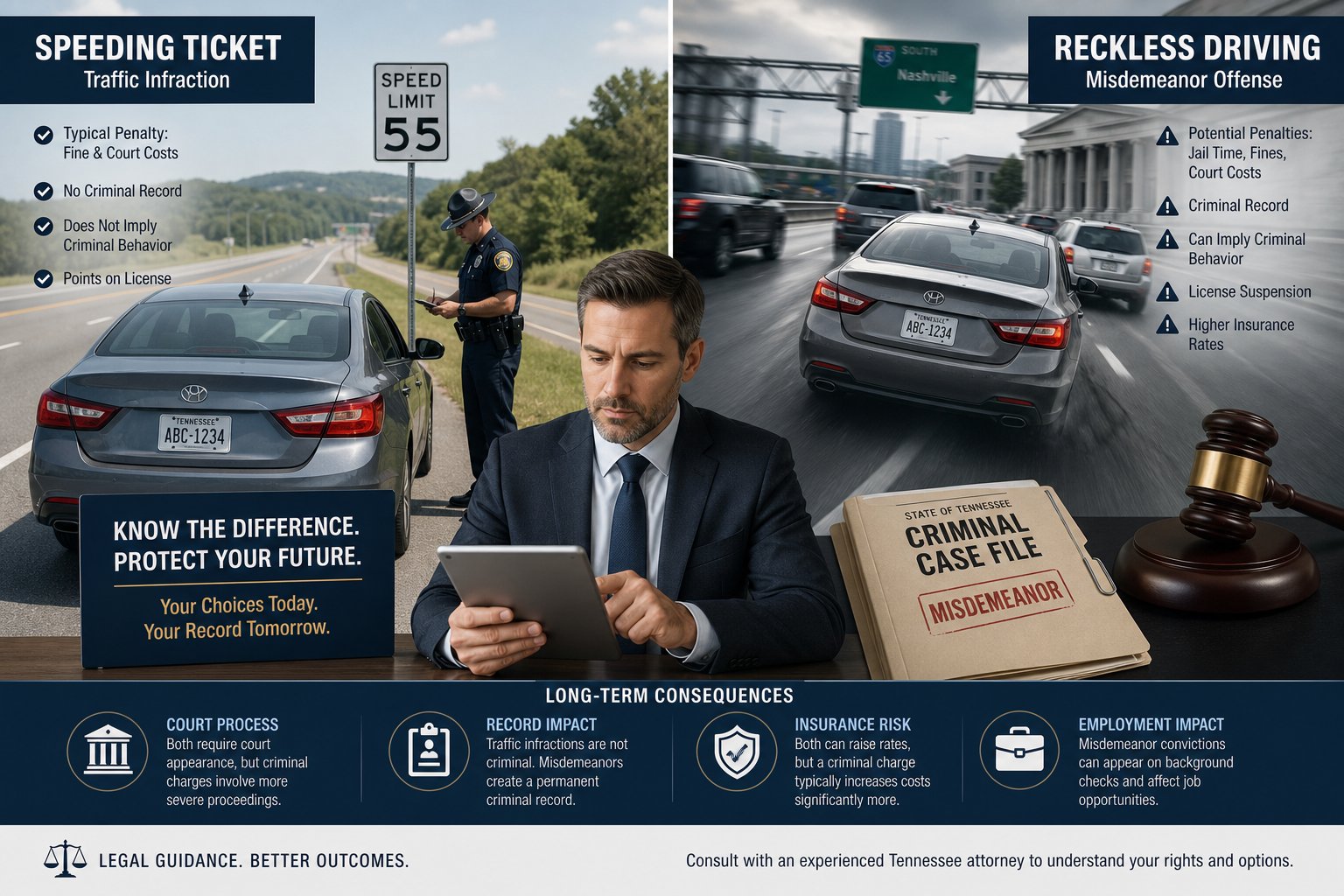
In Tennessee, the gap between reckless driving vs speeding ticket Tennessee cases is bigger than many drivers think.
A normal Tennessee traffic ticket for speeding is usually handled as a traffic offense tied to how fast you were going over the posted limit, or whether you drove too fast for road conditions. In most cases, it does not create a criminal record. It still matters, though, because it can add demerit points to your driving record and lead to fines and court costs.
Reckless driving is different in both label and consequence. Tennessee law describes it as driving with willful or wanton disregard for the safety of persons or property. That wording comes from TCA § 55-10-205. Tennessee treats that conduct as a Class B misdemeanor, not just a simple moving violation.
That single change, from traffic infraction to criminal charge, can affect:
- your employment background checks
- your insurance risk profile
- your court process
- your long-term record
A speeding citation usually stays in the lane of traffic enforcement. A reckless charge can move into criminal court concerns. That means the clerk, the judge, and any future employer may view it very differently.
So if you are asking what is considered reckless driving in Tennessee, the short answer is this: it is not just driving fast. It is driving in a way the state sees as clearly dangerous to people or property.
#
A speeding stop can turn into a reckless driving charge when the facts suggest more than ordinary speeding.
In Tennessee practice, very high speed can be enough by itself to raise that risk. A common rule of thumb is that driving about 25 mph or more over the limit may be treated as strong evidence of reckless driving, especially when the speed creates clear danger. That does not mean every such case becomes reckless driving, but it does mean the charge can change fast.
Other facts can also push a simple speeding ticket into something more serious:
- weaving through traffic
- tailgating at high speed
- speeding in a school or construction zone
- losing control of the car
- driving dangerously in rain, fog, or heavy traffic
- putting other drivers, walkers, or property at obvious risk
This is where the answer to what is considered reckless driving in Tennessee becomes practical. The state looks at both speed and behavior. Going 10 mph over on an open road is not the same as blasting through dense traffic while changing lanes hard.
Officers often use the full scene, not just the number on the radar. And if you are cited for reckless driving, the court will look at the total facts, not only the posted speed limit. If your charge involves reckless driving, it may be wise to speak with a traffic attorney rather than treating it like a routine ticket.
#
The penalties for speeding and reckless driving in Tennessee are not in the same class.
For a speeding ticket, the usual result is a fine, court costs, and demerit points on your driving record. The exact point total depends on how far over the limit you were. In Tennessee, speeding can add 1 to 8 points. That range matters because a lower-level speeding ticket may hurt, but it often does less damage than a reckless charge.
For reckless driving, the penalties are much sharper. Because it is a Class B misdemeanor, the court can impose:
- up to 6 months in jail
- up to $500 in fines
- court costs
- 6 demerit points
- possible license suspension at the judge’s discretion
The biggest hidden penalty is often the criminal record. A speeding ticket normally does not create one. A reckless driving conviction can.
That difference can affect far more than the ticket itself. A routine speeding case is often about money, points, and traffic court. A reckless driving case can become a criminal matter with wider effects.
You can review Tennessee law and court information through the Tennessee court system and the Tennessee Code Annotated resources.
#
A speeding ticket and a reckless driving conviction can both hurt your driving record, but they do not hit the same way.
In Tennessee, demerit points stay on your record for 2 years. If you reach 12 points in 12 months, the TDOSHS may suspend your license. That is one reason reckless driving stands out. It adds 6 points at once, which is half the suspension threshold in a single case.
A standard speeding ticket may add fewer points, depending on speed. So while repeated speeding tickets can still put your license at risk, one reckless driving conviction can move you much closer, much faster.
The record issue is also different:
- Speeding ticket: usually affects your driving record
- Reckless driving: affects your driving record and may appear on criminal background checks
That can matter for jobs that involve driving, delivery work, commercial roles, government hiring, or any employer that runs a background screen.
Insurance can change too. Many insurers treat reckless driving as a much higher-risk event than ordinary speeding. Rate increases vary by company and driver history, but reckless driving is often one of the most expensive marks on a policy and can affect rates for several years.
If you already have points, check your status with the Tennessee Department of Safety and Homeland Security so you understand where your license stands.
#
After a Tennessee traffic ticket, the first step is simple: read the citation and follow the court instructions.
Do not miss a court date. Do not ignore deadlines. And do not assume a reckless driving charge will be handled like a basic speeding ticket. The charge on the paper controls what you are dealing with.
If the case is for speeding, you may have options depending on the court, your record, and the facts. Some drivers choose to pay the ticket. Others contest it. In some cases, the court may allow a class or another form of resolution. But that depends on the specific Tennessee court and case.
If the charge is reckless driving, be careful. Because it is a criminal offense, it is smart to consider speaking with a traffic attorney. A lawyer can explain the charge, court process, and possible outcomes without guessing.
You may also want to gather basic records, such as:
- the citation itself
- notes about weather, traffic, and road conditions
- photos, if they are relevant and safe to obtain
- any witness information
##
Sometimes, yes, but not always.
In Tennessee, a defensive driving course may help in some courts, especially for ticket diversion or near-suspension situations. The course often comes in two common formats:
- 4-hour course: typically used when a court orders a class for a ticket matter
- 8-hour course: often used when a TDOSHS-approved class is needed in a near-suspension setting
Still, you should never assume a class will dismiss a ticket or reduce points. That depends entirely on the court and your case. Also, whether a court accepts online completion varies, so confirm with your specific court before you enroll.
If you need a fast online option, you can review the Tennessee defensive driving course at Driving Logic.
#
The best way to avoid a future charge is to make small driving changes before a stop happens.
Start with speed. Give yourself more time, leave earlier, and use cruise control when it is safe. Many speeding tickets happen because drivers drift above the limit without noticing.
Then look at conditions. Tennessee law does not only care about the posted number. It also cares about whether your speed was safe for rain, traffic, curves, work zones, and visibility. In other words, even legal speed can become unsafe speed.
To lower your risk:
- keep more space between your car and the one ahead
- avoid quick lane changes
- slow down in school and construction zones
- adjust for wet roads and low light
- do not weave through traffic to save a minute
- check your point total if you have recent tickets
A driving course can also help you reset habits. For busy drivers, an online class may be easier to fit into a full week. Driving Logic offers mobile-friendly Tennessee courses built for flexible scheduling, but you should still confirm court acceptance first if your case involves a court order.
And if your citation is already pending, use official sources for your next step, such as the Tennessee court system and TDOSHS.
*This page is for general information only and is
FAQ
Can a Tennessee driver education course dismiss my ticket?
Only if your court allows that result. Tennessee courts and local instructions control whether a course affects a ticket, points, or court requirement.
Can I take the course online?
Maybe. Some Tennessee courts accept online courses, while others may require a specific format, so confirm with the court before enrolling.
Does the course remove points from my record?
Do not assume it removes points automatically. Any point or ticket benefit depends on the court, TDOSHS rules, and the facts of your case.
What should I check before enrolling?
Check your ticket, court notice, clerk instructions, deadline, and whether online completion is accepted. Then choose a course that matches those requirements.
Conclusion
A Tennessee speeding ticket and a reckless driving charge are very different: speeding is a points-based traffic violation, while reckless driving under TCA § 55-10-205 is a criminal misdemeanor. Check which one your citation actually alleges before deciding how to respond. If it is reckless driving, treat it as the criminal matter it is and consider legal advice.
Take the Tennessee driver education course online with Driving Logic when you are ready to begin.
Related Articles
- Tennessee Speeding Ticket: Costs, Points, and What to Know
- Tennessee Speeding Ticket Fines: What Affects the Cost?
- Tennessee First-Time Speeding Ticket: What to Expect
- Tennessee Traffic Ticket Options: Pay, Contest, or Ask About Driving School
Sources
- Tennessee Department of Safety and Homeland Security — Defensive Driving Schools
- Tennessee Department of Safety and Homeland Security — Driver Improvement / Traffic School
- Tennessee Code Annotated — Reckless Driving, TCA § 55-10-205
- Tennessee Department of Safety and Homeland Security
Billy Forte is the owner of Driving Logic, a state-approved driver improvement course provider serving Tennessee and other U.S. states. Driving Logic offers online driver education, defensive driving, and traffic school courses for drivers handling court, ticket, insurance, and state requirements.
This article is general information, not legal advice. Tennessee court rules, TDOSHS requirements, deadlines, insurance decisions, and case facts can differ. Use official Tennessee court and state sources for current requirements, and consult a qualified Tennessee attorney for legal guidance specific to your situation.