
Updated June 2026 · Reviewed by Billy Forte
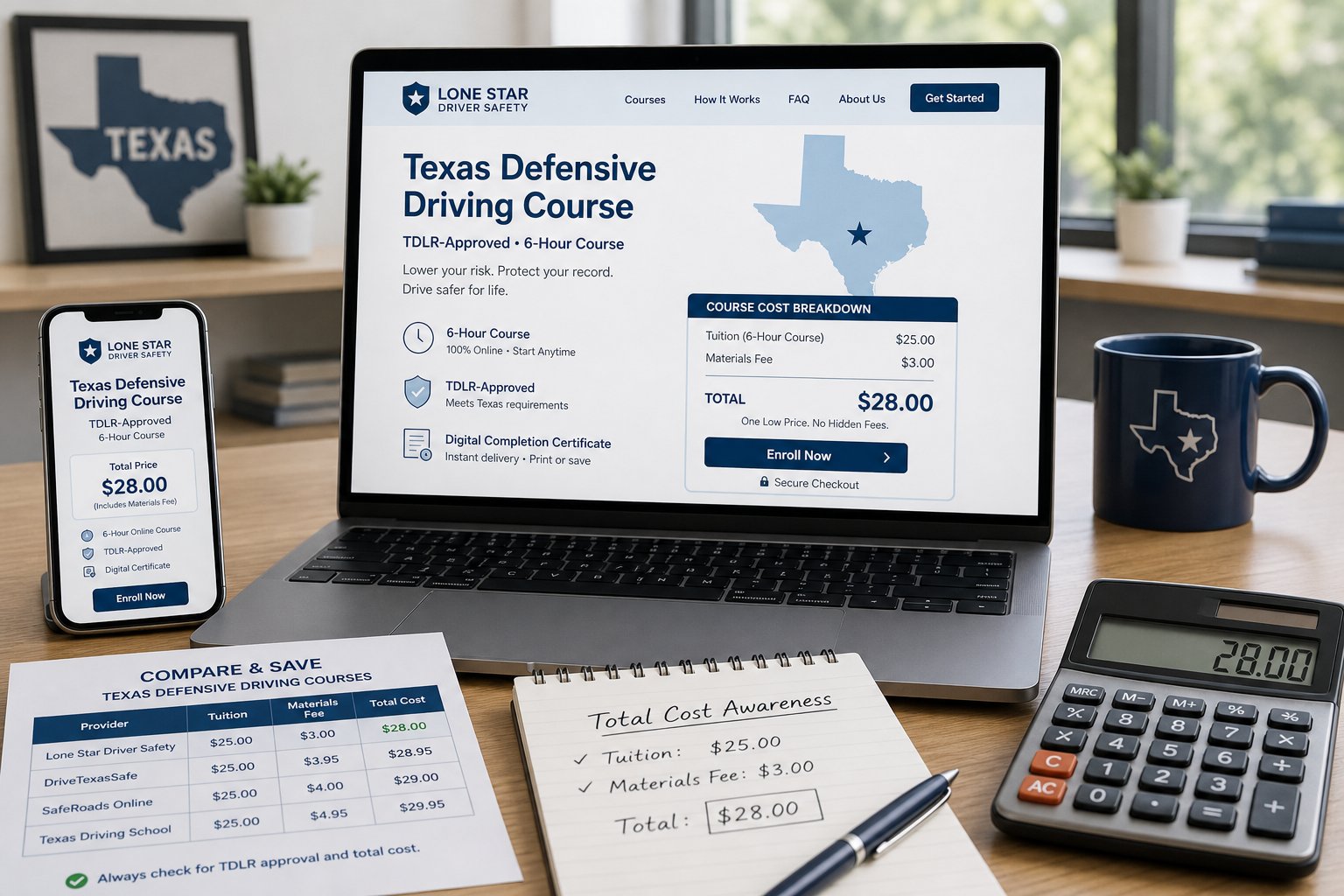
A Texas Driver Safety Course costs a state-set minimum of $25 plus a $3 materials fee under Education Code § 1001.352, though providers may charge more for added features. Budget separately for court costs and any administrative fee the court charges to allow dismissal, and for a Type 3A driving record most courts require — the course fee does not cover those. The course can reduce what a conviction would cost you over time, but it does not erase court costs, and dismissal only happens when the court approves it for your citation.
Applies to Texas. Court rules and deadlines vary by county.
Key Facts
- $25 + $3 minimum: Education Code § 1001.352 sets the floor; a provider charging far less may not be legitimate.
- Court costs are separate: The court charges its own administrative fee to allow a DSC, billed apart from the course.
- Type 3A record has its own fee: Most courts require a TxDPS three-year record, which you pay for separately.
- You may still owe part of the citation: Whether any base amount is due depends on the court’s order — read it closely.
- Insurance savings are separate: A voluntary course may earn an insurer discount, but that is independent of the dismissal cost.
What Defensive Driving Usually Costs In Texas
The short answer to how much is defensive driving in Texas is this: the lowest legal price is $28 total for the course itself. That comes from $25 tuition plus a $3 materials fee under Texas Education Code § 1001.352. Some schools charge that exact amount, while others charge more.
In Texas, the course may be called a Driver Safety Course (DSC) or a defensive driving course. For most drivers, those names mean the same TDLR-approved 6-hour program. The approving agency is the Texas Department of Licensing and Regulation (TDLR), not Texas DPS or TxDMV. You can confirm approved schools through TDLR.
What your base course fee usually covers depends on the provider, but it often includes:
- Access to the 6-hour online course
- The required state curriculum
- Chapter quizzes or progress checks
- Your completion certificate
Some providers also include instant certificate processing or email delivery. Others may charge extra for faster shipping or optional add-ons. That is why one site may advertise the legal minimum, while another ends up closer to $35 to $50.
If you are only taking the course for an insurance discount, the course fee may be your main cost. If you are taking it for ticket dismissal, the course price is only one part of the total. Court costs and your driving record often matter just as much.
What Can Change The Total Price You Pay
The biggest factor is simple: not every provider charges the same amount. Texas sets the minimum course fee, but it does not force every school to stay at that minimum. So if you are comparing options, look at the final checkout price, not just the headline rate.
A few things can raise the total:
- A provider charges above the $25 + $3 minimum
- Extra processing or certificate delivery fees
- A required Type 3A driving record from Texas DPS
- A court administrative fee if you want dismissal
The Type 3A driving record is a separate cost. It is not included with your course. Many Texas courts require it when you use a Driver Safety Course for dismissal because it shows your recent driving history. You order that record through Texas DPS, and the fee is separate from both the course and the court.
Court fees also vary a lot. One court may charge far less than another. The county, city, and violation type can all affect what you pay.
And then there is convenience. Some schools offer mobile access, quick certificate delivery, and easy login on any device. That may be worth a few extra dollars if your schedule is tight. If you want a simple online option, you can take the Texas DSC at Driving Logic and compare the total cost before you enroll.
Court Fees, Ticket Costs, And Whether You Still Pay The Fine
If you use defensive driving for a ticket, you should expect to pay more than just the course fee. In many Texas courts, dismissal through a Driver Safety Course still comes with a court administrative fee or similar court cost. That fee is separate from what you pay the school.
This point trips people up. They hear that the ticket may be dismissed and assume they will pay nothing else. Usually, that is not how it works. Courts may treat the amount as a court cost, administrative fee, or special expense rather than the original fine, but you should still expect some payment to the court.
The total can depend on:
- The court listed on your citation
- The county or city rules
- The violation type
- Whether the court requires payment up front
Some courts may ask for the full fine amount first and later adjust the case. Others may charge a reduced amount or a set administrative fee. Policies differ, so always check with the court on your ticket.
Also, do not assume the course erases every cost tied to the citation. Even when dismissal is allowed under Texas Code of Criminal Procedure Art. 45.0511, the process often still includes court-related charges. That is why the real answer to how much is defensive driving course in Texas often depends on whether you are paying for the course alone or for a full ticket dismissal process.
Who Qualifies For Defensive Driving In Texas
Not every driver or ticket qualifies. In Texas, you usually must meet a set of court and state rules before you can use a Driver Safety Course for dismissal.
Common requirements include:
- You have a valid Texas driver license or learner permit
- You ask the court for the course before the appearance date on the citation
- You have not used a DSC for ticket dismissal in the past 12 months
- The ticket is for an offense the court allows
Speeding cases often have limits. A common rule is that the speed cannot be more than 25 mph over the posted limit. Some courts also restrict use in work zones or for more serious violations.
In general, courts may deny dismissal by course for offenses such as:
- Passing a stopped school bus
- Certain high-risk driving violations
- Other citations excluded by law or court policy
The safest step is to contact the court and ask if you are eligible. Do that before your response deadline. In Texas, timing matters. You must request permission before the appearance date listed on your ticket, not after.
Also remember that a defensive driving course and a Driver Safety Course are the same thing here when people mean the standard TDLR-approved 6-hour course. That one detail can help avoid confusion when you speak with the court or compare course providers.
How To Request Defensive Driving And Get A Ticket Dismissed
The first step is to contact the court listed on your citation before your appearance date. Tell the court you want to request a Driver Safety Course for dismissal and ask if you qualify. Do not miss that deadline, because the option may be denied if you wait too long.
Once the court approves the request, the process often looks like this:
- Plead guilty or no contest, if required by the court
- Pay the court administrative fee or other required amount
- Enroll in a TDLR-approved 6-hour course
- Order your Type 3A driving record from Texas DPS, if the court requires it
- Finish the course by the deadline
- Submit your completion certificate and driving record to the court
Many courts give about 90 days from your plea to finish everything, but the exact deadline can vary. Read the court instructions closely.
Make sure the course is approved by TDLR. Texas DPS handles driver licenses and records, but it does not approve Driver Safety Course providers. That distinction matters.
If you want a simple online option built for busy schedules, you can start a Texas Driver Safety Course at Driving Logic. Just make sure you get court approval first and follow the filing steps the court gives you.
How Long The Course Takes And How Often You Can Use It
Texas requires the standard Driver Safety Course to last 6 hours. That is the statewide rule for the TDLR-approved course, whether you take it online or in a classroom. Many providers break that into about 5 hours of instruction plus 1 hour of breaks.
For online students, the main benefit is flexibility. You can often complete the course:
- In one sitting
- Over several short sessions
- On a phone, tablet, or computer
That helps if you are fitting the class around work, school, or family time. Your progress is usually saved, so you can stop and come back later.
How often can you use it? For ticket dismissal, Texas generally allows the course once every 12 months. If you already used a Driver Safety Course to dismiss a ticket within the last year, the court may deny another request.
That rule is different from taking the course for another reason, like an insurance discount or personal review. But if your goal is dismissal, the once-per-year limit is the one to remember.
Before you enroll, check your court deadline and make sure you have enough time to complete the course and submit the certificate. Finishing the class is only part of the process. The court must receive the required documents on time.
Can Defensive Driving Lower Insurance Rates In Texas
Yes, it can. In Texas, many insurers offer a discount when you complete an approved defensive driving course. The amount varies by company, but many discounts fall in about the 1% to 10% range.
The same TDLR-approved 6-hour course may work for both purposes:
- Ticket dismissal, if the court approves it
- Insurance savings, if your insurer accepts it
That can make the course a better value. Even so, savings are not automatic. Each insurer has its own rules, and not every policy gives the same discount. Some insurers may ask for a copy of your completion certificate before they apply any change.
The discount, when offered, often lasts for up to three years. After that, your insurer may require a new course to renew the savings.
So, is defensive driving worth the cost? For many drivers, yes. The legal minimum course price is low, and the course may help with a ticket or reduce insurance costs. But the full price depends on your court, your provider, and whether you need a driving record.
FAQ
What is the cheapest a Texas Driver Safety Course can legally cost?
$25 plus a $3 materials fee, the minimum set by Education Code § 1001.352. Be cautious of providers advertising below that floor.
Do I still pay the court if I take the course?
Usually yes — courts charge their own administrative fee to allow the DSC, and that is separate from the course price. Your court’s order lists what you owe.
Why do prices vary between providers?
Above the state minimum, providers compete on features like mobile design, fast certificate delivery, and support. The legal floor is the same; the extras differ.
Does the course cost include my driving record?
No. Most courts require a Type 3A driving record from TxDPS, which carries its own fee and is ordered separately.
Conclusion
The headline price of a Texas DSC is small, but the real budget includes court costs and a Type 3A record on top of the $25-plus course fee. Knowing those pieces up front keeps the “cheap course” from turning into a surprise. Compare providers above the state minimum on convenience and certificate speed, not on a price that dips below what the law allows.
You can see exactly what is included and complete a TDLR-approved Texas defensive driving course online, with court costs and your driving record handled separately through the court and TxDPS.
Related Articles
- Texas Driver Safety Course (DSC): The Complete Guide
- Texas Driver Safety Course Certificate: What It Is and How to Submit It
- How to Choose a Texas Driver Safety Course Online
- Texas Defensive Driving for Ticket Dismissal: The Complete Guide
Sources
Billy Forte is the owner of Driving Logic, a state-approved driver safety and defensive driving course provider serving Texas and other U.S. states. Driving Logic offers online driver safety, defensive driving, and traffic-ticket courses for drivers handling court, license, and insurance-related requirements.
This article is general information, not legal advice. Texas court rules, TDLR requirements, deadlines, eligibility, and case facts can differ by county and court. Use official Texas court and state sources for current requirements, and consult a qualified Texas attorney for legal guidance specific to your situation.