
Updated June 2026 · Reviewed by Billy Forte
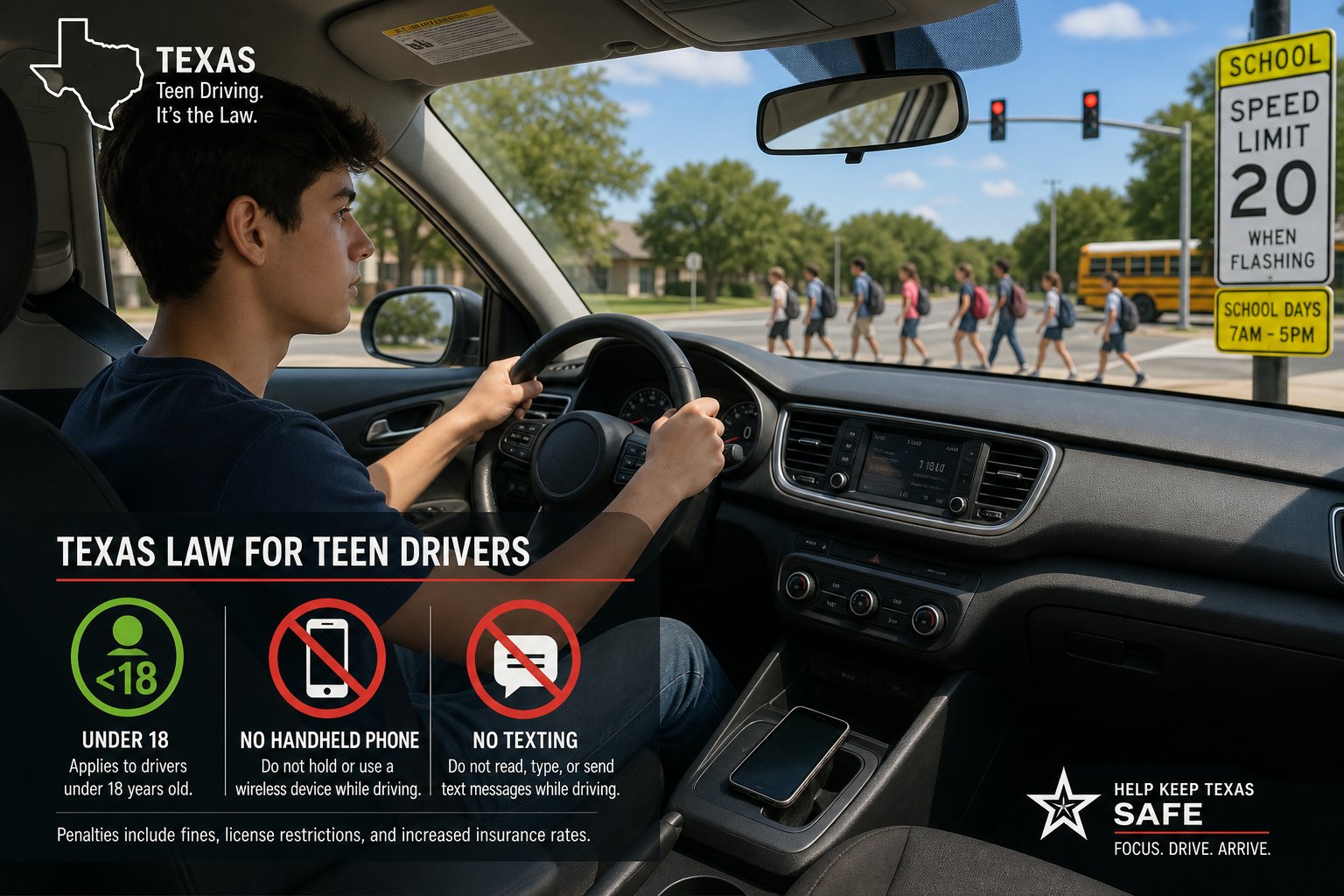
Texas law prohibits drivers with a provisional license, and drivers under 18, from using handheld wireless devices while driving, and it bans handheld use for all drivers in active school zones. The rule covers texting, calling, and similar handheld use, with narrow exceptions such as emergencies. Because distracted driving is a leading crash factor for teens, this restriction is one of the core provisional rules and applies until the driver turns 18.
Applies to Texas teen driver education and licensing (ages 14–17). Requirements are set by TDLR (driver education) and the Texas DPS (licensing) and can change.
Key Facts
- Teen handheld ban: Provisional and under-18 drivers may not use handheld wireless devices while driving.
- School zones: Handheld use is prohibited for all drivers in active school zones.
- What it covers: Texting, calling, and similar handheld interaction while driving.
- Narrow exceptions: Limited exceptions such as genuine emergencies.
- Applies until 18: Part of the provisional restrictions that end at 18.
What Texas Law Says About Teens And Cell Phones Behind The Wheel
The texas teen driving cell phone law is stricter for young drivers than for adults. In simple terms, Texas does not let teens use a handheld mobile communication device while driving if they are under 18. That matters for teens with a learner license and for teens with a provisional license under the Texas graduated driver license (GDL) system.
Texas also has a statewide texting ban. That means drivers cannot read, write, or send electronic messages while driving. So even when a teen is not holding the phone for a call, texting behind the wheel is still illegal.
For families, it helps to think of the rules in layers:
- Under 18: no handheld phone use while driving
- All drivers: no texting or electronic messaging while driving
- Permit holders in the first 6 months: no cellphone use
- All drivers in active school zones: no handheld device use
These rules work with other teen driving restrictions. A teen with a provisional license also faces limits on midnight driving and passengers. In most cases, a provisional license holder cannot drive between midnight and 5 a.m. unless an exception applies, and cannot drive with more than one passenger under 21 who is not family.
Those limits come from Texas GDL rules meant to cut risk during the most dangerous early driving months. Phone use is part of that same safety picture.
Who The Rules Apply To: Drivers Under 18 And New License Holders
The rules apply to more than one group. First, they apply to drivers under 18. If you are under 18, handheld phone use while driving is off-limits.
Second, they apply to learner license holders. During the first six months of driving, cellphone use is not allowed. That is true even if the driver is older than 18 and driving on a permit.
Third, they matter to teens moving through driver education. For teens under 18, PTDE and TDE are teen programs approved by the Texas Department of Licensing and Regulation (TDLR). ADE is separate and is only for adults 18 and older. And ITTD, or Impact Texas Teen Drivers, is a free 2-hour course from TxDPS. It is not the same thing as PTDE or TDE.
A teen in Parent Taught Drivers Ed may first get a DE-964E for the permit stage, then later a DE-964 for the provisional license. The license itself comes from Texas DPS (TxDPS), not TDLR.
What Counts As Illegal Phone Use In Texas
A lot of teens ask the same thing: what exactly counts as illegal phone use? The short answer is any handheld use if you are under 18 and driving.
That can include:
- Holding a phone to make or answer a call
- Looking at social media on the screen
- Typing or reading texts
- Using apps by holding the phone
- Scrolling music or playlists by hand
- Recording video while driving
If the phone is in your hand, that is the big problem for teen drivers. This is the core texas teen driver cell phone restriction parents need to understand.
The line between handheld and hands-free matters. In general, hands-free use is treated differently. If a device is mounted and used without holding it, that is usually not the same as handheld use. But texting while driving is still banned, and local rules can be stricter.
Also, being stopped in traffic is not the same as being parked. If you are at a red light or stuck in traffic, you are still driving for purposes of these rules. If you want to lawfully use the phone, the safer choice is to pull over and legally park first.
Parents should also remind teens that “I only touched it for a second” is not a real defense in practice. A quick glance at a screen can be enough to miss a brake light, drift from a lane, or roll into a crosswalk.
Special Rules In School Zones And Around School Buses
Texas adds another layer of phone limits in places where children are present. In an active school zone, drivers cannot use a handheld device. This applies to adults too, not just teens.
That means a teen who already cannot use a handheld phone while driving is under an even clearer ban near schools. And an adult who might otherwise be allowed to use a phone hands-free still cannot pick up and use a handheld device in that zone.
School zones matter because traffic is tighter and less predictable. You have:
- Children crossing the street
- Crossing guards and buses stopping often
- Parents pulling in and out
- Lower speed limits
Phone use in that setting can turn a small mistake into a serious crash.
Texas also places strict limits around school buses. Drivers of school buses carrying children cannot use cellphones while driving. That rule is broader because of the duty to protect student passengers.
For teen drivers, the practical rule is simple: when you are anywhere near a school, keep the phone put away. Do not hold it at a stop sign. Do not check a message in the pickup line. Do not unlock it just to change music.
If you want the current state rules straight from the source, check Texas DPS. For driver education program approval, use the Texas Department of Licensing and Regulation website. Those are the right agencies, not a “Texas DMV,” which is not the correct agency name.
Exceptions Teens Should Know Before Using A Phone In The Car
There are a few exceptions, but they are narrow. Teens should not treat them like loopholes.
The biggest exception is an emergency. Texas allows phone use to:
- Call 911
- Report a crime
- Report a crash
- Report a medical emergency
- Report a serious road hazard
Another key point is that using a phone while legally parked is different from using it while driving. Parked means the vehicle is safely stopped in a lawful parking spot. It does not mean waiting at a light, sitting in a drive-through, or inching through traffic.
Hands-free tools may also be treated differently than handheld use. For example, a mounted phone running GPS is not the same as holding a phone in your hand. But teens still need to be careful. If you touch the screen again and again, or start reading messages, you can still create a dangerous distraction.
A smart setup is simple:
- Enter the route before moving
- Start music before driving
- Put the phone on Do Not Disturb
- Keep the phone mounted or out of reach
Parents in PTDE often ask when to teach phone habits. The best time is early, before solo driving starts. If your teen is in Parent Taught Drivers Ed, remember the program guide packet is issued by TDLR. As of January 2026, the PTDE Program Guide costs $20 and is sent by email only, not by mail.
And one more common mix-up: ITTD is a free, 2-hour course at Impact Texas Teen Drivers. It is separate from PTDE or classroom TDE.
Penalties, Fines, And What A Violation Can Mean For A Teen Driver
A phone ticket can cost more than most teens expect. Texas fines for texting while driving can run about $25 to $99 for a first offense and $100 to $200 for later offenses. Court costs can add more.
For teens, the damage may go beyond the fine. A violation can affect the path through the GDL system. It may lead to delays, trouble with licensing steps, or other consequences depending on the case.
A ticket can also trigger problems at home and with insurance. Parents may see:
- Higher insurance costs
- Less trust in solo driving
- Delays in moving forward with driving privileges
- A worse driving record
If phone use is tied to a crash, the stakes get much higher. Serious injury crashes can bring major legal consequences. In extreme cases, criminal charges may be possible.
That is why teens should not think of this as “just a phone rule.” Texas treats distracted driving as a real safety issue.
If your teen is still working through driver education, keep the paperwork straight. For permit stage completion, students may receive DE-964E, which shows partial completion of the teen course. For the provisional license, they need the full DE-964 after completing the required parts of the program. TxDPS issues the license, while TDLR oversees course approval.
If you need a state-approved teen course, Driving Logic offers online options built for busy families who want flexible scheduling on any device.
How Distracted Driving Can Affect Fault, Safety, And Driving Records
Phone use does not just risk a ticket. It can shape who is blamed after a crash. If a teen was texting, holding a phone, or looking at an app right before impact, that can be used as evidence of negligence.
In plain words, it can help show the driver failed to use reasonable care. That can matter in insurance claims and in court.
The safety risk is not small. Texas crash data has long shown that distracted driving is a major problem, with roughly 1 in 5 crashes involving distraction. For teen drivers, the risk is even worse because they have less experience spotting danger early.
A phone distraction often stacks with other teen risks:
- Night driving after midnight
- Extra teen passengers
- Speeding to keep up with traffic
- Missing signs or brake lights
And records matter. Tickets and crashes can stay on a teen’s driving history and may affect insurance costs for years. A single bad choice with a phone can keep costing money long after the fine is paid.
The best habit is boring but effective: put the phone away before the car moves. Set the map. Start the playlist. Then leave it alone.
If your family still needs to finish teen driver education, Driving Logic offers a simple path for PTDE/TDE students. You can review the course options at Driving Logic, then confirm licensing steps and records with TxDPS. That helps you stay focused on the rules that matter most, including phone limits, passenger limits, and midnight driving rules for provisional license holders.
FAQ
What does Texas law say about teens and cell phones?
Drivers with a provisional license and drivers under 18 may not use handheld wireless devices while driving. Handheld use is also banned for all drivers in active school zones.
What counts as illegal phone use?
Handheld interaction such as texting and calling while driving. The teen rule restricts handheld device use broadly for provisional and under-18 drivers.
Are there exceptions?
There are narrow exceptions, such as genuine emergencies. The general rule is no handheld device use while driving for teens.
How long does the restriction last?
Until the driver turns 18, alongside the other provisional restrictions. Distracted driving remains dangerous at any age.
Conclusion
The cell phone rule targets the single biggest distraction for new drivers, and Texas applies it strictly to teens and in school zones. The safe habit it encourages — phone down while driving — is one worth keeping long after the provisional period ends at 18. For teens, treating it as a firm rule avoids both crashes and citations.
Safe-driving habits start in driver education — your teen can complete the TDLR-approved Texas parent-taught driver education course online.
Related Articles
- How to Get a Texas Driver’s License at 16: The Complete Teen Guide
- Texas Provisional License Restrictions: Complete Rules for 16-Year-Old Drivers
- Texas Teen Driving Passenger Restrictions: How Many Passengers Can a Teen Have?
- Texas Teen Midnight Driving Rule: What It Is and the Exceptions
Sources
Billy Forte is the owner of Driving Logic, a TDLR-approved Texas driver education provider. Driving Logic offers the online Texas parent-taught and teen driver education course that helps Texas teens complete the 32-hour classroom requirement and work toward a learner’s permit and provisional license.
This article is general information about Texas teen driver education and licensing, not legal advice. Requirements, fees, and procedures are set by TDLR and the Texas DPS and can change, so confirm current details with official Texas sources before you enroll or visit a DPS office.