
Updated June 2026 · Reviewed by Billy Forte
Under Texas teen driving rules, a provisional license holder may not drive between midnight and 5 a.m., with exceptions for employment, school-related activities, and medical emergencies. This nighttime restriction is one of the core provisional limits and applies until the driver turns 18, because late-night driving carries a higher crash risk for new drivers. Knowing exactly when the exceptions apply helps families plan around work shifts and school events without breaking the rule.
Applies to Texas teen driver education and licensing (ages 14–17). Requirements are set by TDLR (driver education) and the Texas DPS (licensing) and can change.
Key Facts
- The rule: No driving between midnight and 5 a.m. on a provisional license.
- Exceptions: Driving for work, a school-related activity, or a medical emergency.
- Why it exists: Late-night driving is higher-risk for new drivers.
- Applies until 18: The curfew is part of the provisional restrictions that end at 18.
- Plan ahead: Keep records (like work schedules) in case the exception needs to be shown.
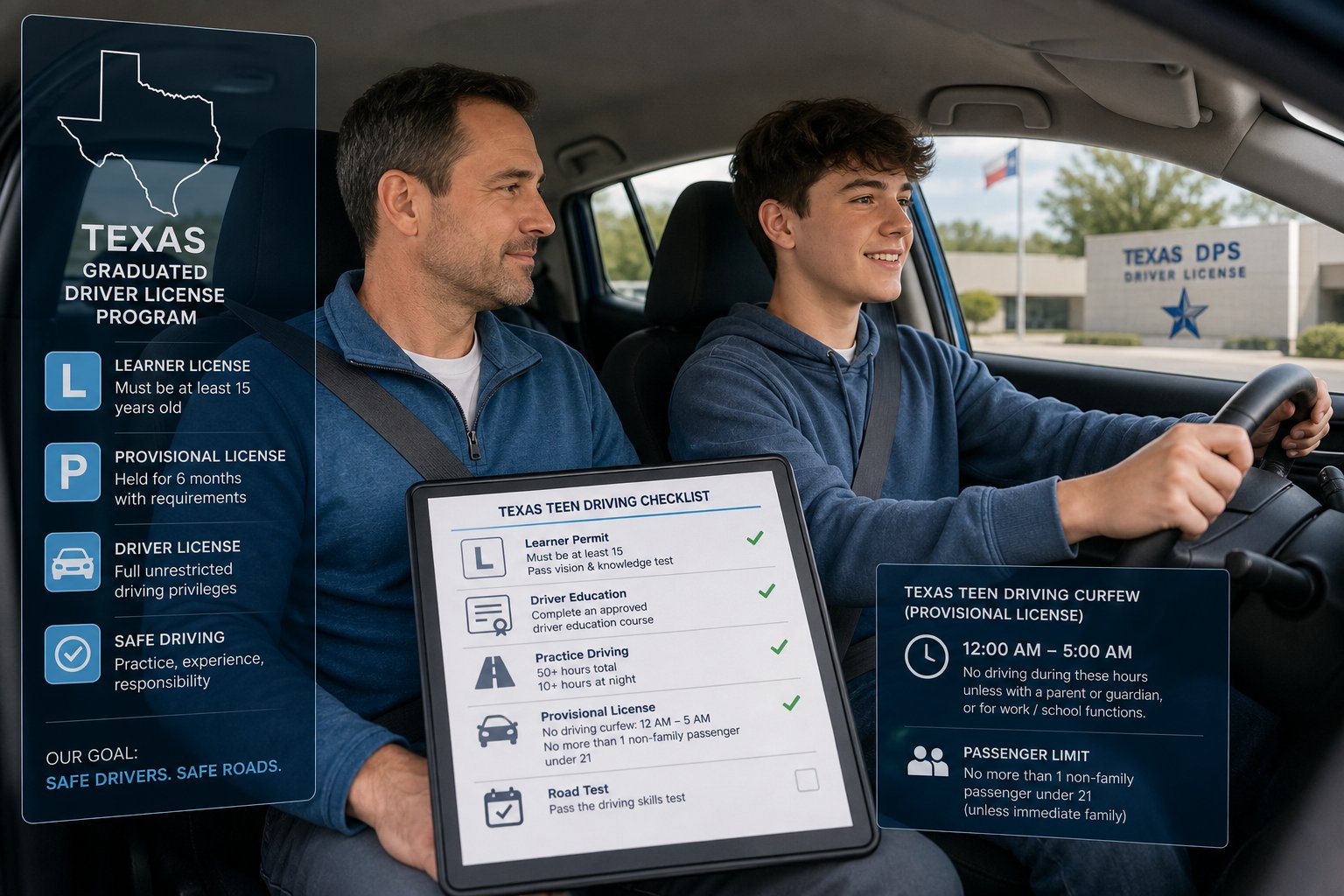
How Texas Teen Licensing Works Under the Graduated Driver License Program
Texas uses a Graduated Driver License, or GDL, system for drivers under 18. It is meant to give teens more practice before they get full driving rights. The system has two main stages before an unrestricted adult license.
The first stage is the learner license. In most cases, a teen can get it at age 15. To reach that point, the teen must start an approved driver education program. That can be PTDE (Parent Taught Drivers Ed) or another TDE course approved by the Texas Department of Licensing and Regulation.
A few details matter here:
- TDLR approves teen driver education courses
- TxDPS issues permits and licenses
- PTDE and TDE are for teens under 18
- ADE is for adults 18 and older, and it is a different course
If your family chooses PTDE, you first need the PTDE Program Guide from TDLR. That guide costs $20, and as of January 2026 it is sent by email only, not by mail. After Module 1, the teen gets the DE-964E partial completion certificate, which is used for the learner license step.
The second stage is the provisional license. A teen usually gets it at 16 or 17 after holding the learner license for at least 6 months, finishing the course, completing required practice, passing the road test, and taking ITTD. Impact Texas Teen Drivers is a free, 2-hour program from TxDPS, and it is separate from PTDE or TDE. When the teen finishes the full driver ed course, the school or provider issues the DE-964 certificate for the provisional license.
You can check official teen license rules with TxDPS and course information with TDLR.
When a Teen Can Drive Alone in Texas
A teen in Texas can drive alone only after getting a provisional license. That usually happens at age 16 or 17, after the teen has met the state’s education, practice, and testing rules. Before that, a learner license does not allow solo driving.
If your teen has a learner license, a licensed adult who is at least 21 years old must sit in the front seat. That is not optional. So even if your teen feels ready, Texas does not treat a learner license like a license to drive alone.
To move from a learner license to a provisional license, the teen must usually:
- Hold the permit for at least 6 months
- Complete the required driver education program
- Finish practice driving requirements
- Pass the driving test
- Complete ITTD before the road test window closes
That means the answer to “When can a teen drive alone in Texas?” is simple: only after the provisional license is issued. But even then, the teen does not have full driving freedom yet. The provisional stage comes with limits, including the Texas teen driving midnight rule, passenger limits, and phone rules.
This is where many families get confused. A teen may legally drive alone to school, work, or practice with a provisional license, but that same teen still may not drive during restricted overnight hours unless an exception applies. So “can drive alone” does not mean “can drive anytime.”
Before a late trip, it helps to ask two questions: Does my teen have a provisional license, and does this trip fall inside the restricted midnight-to-5 a.m. window?
Texas Teen Driving Curfew: The Midnight To 5 A.M. Rule
The core Texas teen driving curfew rule is this: if your teen has a provisional license, they may not drive between midnight and 5 a.m. unless a listed exception applies. This is the rule many people call the Texas teen driving midnight rule.
The three main exceptions are:
- Driving for employment purposes
- Driving to or from a school-related activity
- Driving for a medical emergency
Each exception should be read in a common-sense way. A late shift at a job can qualify. So can driving home after a school game, band event, or other school activity that ends late. A medical emergency can include an urgent need for treatment or help.
Still, the best approach is caution. Not every late-night trip fits an exception. A normal social trip, a fast-food run, or a ride to see friends would usually not qualify.
It is smart to keep proof with the teen when possible. For example:
- Some employers give a letter showing work hours
- A schedule, pay stub, or work app record may help
- A school email, event schedule, or team notice can support a school trip
- Medical records are not always possible in the moment, but details should be easy to explain later
You do not need to treat this like a courtroom file, but clear records can help if questions come up.
The restriction is not forever. It generally ends when the driver turns 18 or is no longer under the provisional license stage. Until then, the midnight-to-5 a.m. rule stays in place.
For current rules, use official state sources like TxDPS.
Passenger, Phone, And Distracted Driving Restrictions for Teen Drivers
The midnight rule is only one part of Texas teen limits. A teen with a provisional license also faces rules about passengers and phones. These rules matter because they target the biggest crash risks for young drivers: friends in the car and distractions.
First, the passenger rule. A teen with a provisional license may not drive with more than one passenger under 21 who is not a family member. That means siblings usually do not count the same way as teen friends do. But loading the car with classmates can break the rule fast.
Second, the phone rule. In Texas, drivers under 18 may not use a cell phone or wireless device, even hands-free, except in an emergency. And texting while driving is illegal for all drivers, not just teens.
These rules are stricter than many parents expect. A teen may think a quick voice reply or map check is harmless. It is still risky. Looking away for a few seconds at 45 mph covers a lot of road.
Here is the simple version:
- One non-family passenger under 21 max
- No phone or wireless device use under 18, except emergencies
- No texting while driving for anyone
Parents should make these rules even tighter if needed. For example, some families ban all teen passengers for the first few months. That is not a legal rule, but it can be a smart house rule.
If your teen is still taking courses, keep the terms straight: PTDE/TDE teach teen driver education, while ITTD is the separate free safety program from impacttexasdrivers.dps.texas.gov.
What Happens If a Teen Breaks Texas Driving Rules
If a teen breaks Texas driving rules, the result can be more than a warning. Penalties can include fines, delays in licensing, suspension, or other action by the state or the court. The exact outcome depends on the violation and the teen’s record.
For example, breaking a provisional license rule like the curfew, passenger limit, or phone restriction can create problems if the teen is stopped. It can also affect how parents, schools, insurers, and courts view the teen’s driving judgment.
One especially serious area is alcohol. Texas has a zero-tolerance rule for drivers under 21. That means any detectable alcohol can trigger penalties. Those may include:
- License suspension
- Fines
- Community service
- Alcohol awareness classes
This is one reason families should not treat the provisional stage as “close enough” to full driving rights. The law still puts limits on the teen because crash risk is still higher in those first years.
A rule violation can also create bigger trouble after a crash. If a teen was driving during restricted hours without a valid exception, or was using a phone, that fact may matter to police, insurers, or others reviewing the event.
You do not need to assume the worst from every ticket. But you should take any violation seriously and check the current official rules with TxDPS. Keeping records, showing up prepared, and fixing bad habits early can help prevent a small mistake from becoming a larger problem later.
Parent Responsibility, Liability, And Insurance Considerations
Parents have a big role in teen driving in Texas. In many cases, a parent or guardian signs the teen’s license application. That is not just paperwork. It reflects real responsibility for training, supervision, and safe habits.
If your teen drives the family car and causes a crash, your family may face financial fallout. That can include claims for:
- Vehicle damage
- Medical bills
- Lost income
- Other crash-related losses
Insurance is a major part of this. Even one crash or serious ticket can raise premiums. And if a teen breaks the Texas teen driving curfew or another provisional rule, an insurer may look closely at what happened.
Parents can lower risk by setting clear house rules that match or exceed state rules. Good examples include:
- No late-night driving unless truly needed
- No extra passengers for the first months
- No phone use at all in the car
- Check-in texts before leaving and after arrival
Yes, that last rule sounds funny because teens cannot text while driving. The point is to send messages only before the car moves and after it is parked.
Parents should also track paperwork. Keep copies of course records, permit dates, and completion documents like DE-964E and DE-964. Make sure your teen finishes ITTD through the official TxDPS ITTD site.
If you still need an approved course option, Driving Logic offers Texas teen education that fits busy schedules on almost any device. That can make it easier to stay on track without classroom hassles.
What To Do After a Crash Involving a Teen Driver in Texas
If your teen is in a crash, focus on safety first. Check for injuries, call 911 if needed, and move to a safe place if the vehicles can be moved. If there may be injuries, keep everyone as still and calm as possible until help arrives.
Next, call the police when the situation requires it and follow instructions at the scene. Then gather basic facts. A teen driver should try to exchange:
- Names and contact details
- Insurance information
- License plate numbers
- Vehicle details
Photos help a lot. Take pictures of damage, the road, traffic signs, weather, and anything else that shows what happened. If anyone saw the crash, ask for witness names and numbers.
After that, report the crash to your insurance company as soon as you can. Be accurate. Do not guess if you are not sure. If the teen was driving during restricted hours, say so honestly and explain whether an exception applied, such as work, a school event, or a medical emergency.
Because teens are held to the same fault standards as adults, a crash can lead to claims for property damage, injury costs, lost wages, and more. That is another reason to keep records when a teen drives late for a valid reason.
If your teen is still in training, make sure all state steps are complete. For teen education options that work around a busy schedule, you can look at Driving Logic for a Texas PTDE/TDE course. Also use official sources for forms and licensing details, including TDLR, TxDPS, and the Impact Texas Teen Drivers site.
FAQ
What is the Texas teen midnight driving rule?
Provisional license holders may not drive between midnight and 5 a.m., except for employment, a school-related activity, or a medical emergency.
What counts as an exception?
Driving to or from work, a school activity, or because of a medical emergency. Outside those reasons, driving in the midnight–5am window isn’t allowed on a provisional license.
How long does the curfew last?
Until the driver turns 18, when the provisional restrictions end and a full license is available.
Does the curfew apply to learner’s permit holders?
Permit holders can only drive supervised at any hour. The midnight–5am curfew specifically governs independent driving on a provisional license.
Conclusion
The midnight rule targets the riskiest hours for new drivers while leaving room for the realities of work and school. The exceptions are specific — employment, school activities, and medical emergencies — so it helps to know them and keep simple records. Like the other provisional limits, it lifts at 18.
Provisional driving comes after driver education — your teen can complete the TDLR-approved Texas parent-taught driver education course online.
Related Articles
- How to Get a Texas Driver’s License at 16: The Complete Teen Guide
- Texas Provisional License Restrictions: Complete Rules for 16-Year-Old Drivers
- Texas Teen Driving Passenger Restrictions: How Many Passengers Can a Teen Have?
- When Do Texas Teen Driving Restrictions End?
Sources
Billy Forte is the owner of Driving Logic, a TDLR-approved Texas driver education provider. Driving Logic offers the online Texas parent-taught and teen driver education course that helps Texas teens complete the 32-hour classroom requirement and work toward a learner’s permit and provisional license.
This article is general information about Texas teen driver education and licensing, not legal advice. Requirements, fees, and procedures are set by TDLR and the Texas DPS and can change, so confirm current details with official Texas sources before you enroll or visit a DPS office.