
Updated June 2026 · Reviewed by Billy Forte
Texas teen driving restrictions follow the graduated licensing timeline: the learner’s permit supervision rule ends when a teen earns a provisional license at 16, and the provisional restrictions — the midnight–5am curfew, the passenger limit, and the no-handheld-devices rule — generally end when the driver turns 18. At 18 the driver moves to a full, unrestricted license. Knowing when each rule lifts helps teens and parents track exactly where they are in the process.
Applies to Texas teen driver education and licensing (ages 14–17). Requirements are set by TDLR (driver education) and the Texas DPS (licensing) and can change.
Key Facts
- Permit supervision ends at the provisional stage: Independent driving begins with the provisional license at 16.
- Provisional restrictions end at 18: The curfew, passenger limit, and phone rule generally lift at 18.
- Full license at 18: The driver moves to an unrestricted Texas license.
- The restrictions in question: Midnight–5am curfew, one non-family passenger under 21, and no handheld devices.
- Exceptions exist along the way: For example, hardship cases can affect timing in special situations.
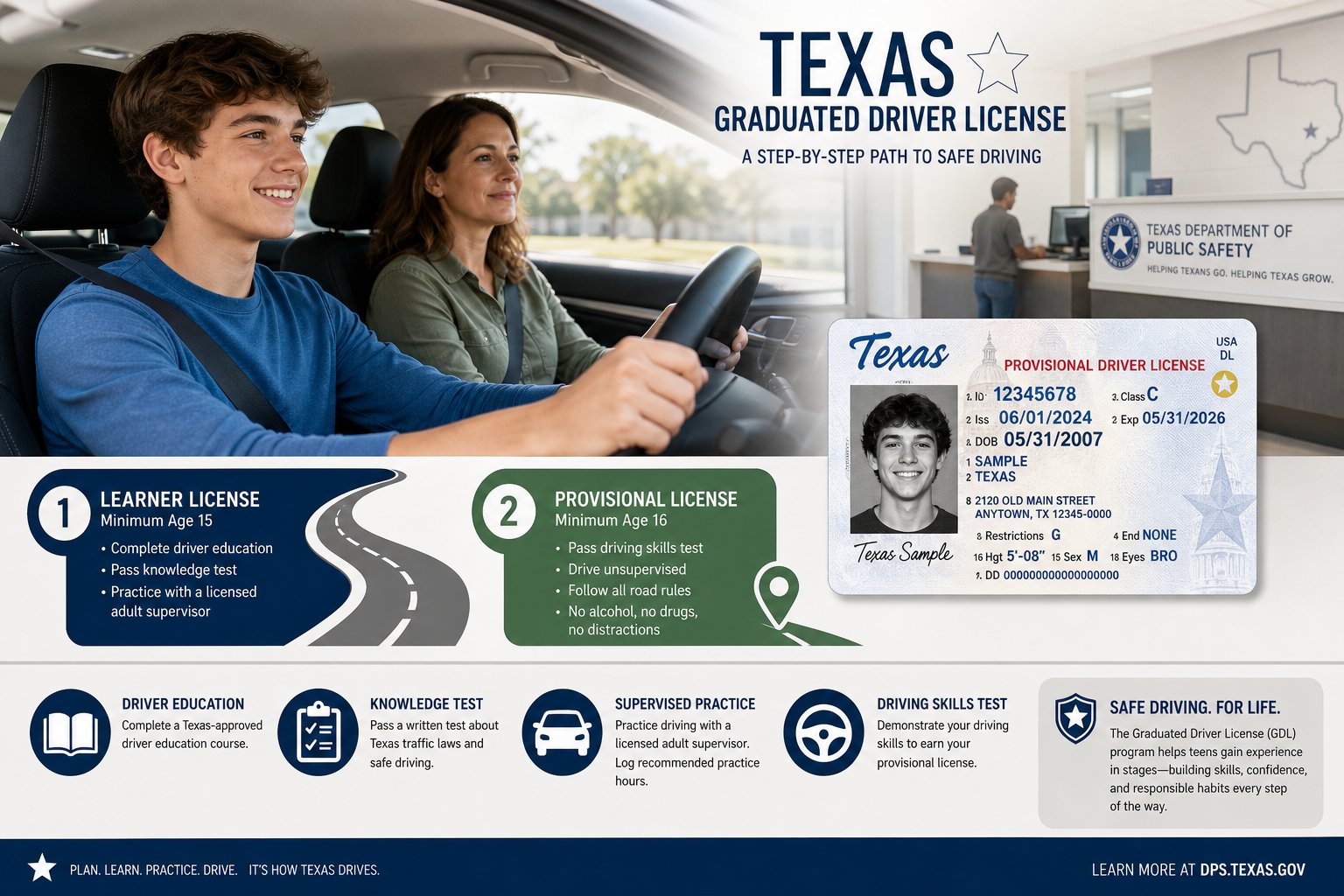
How Texas Teen Licensing Works Under The Graduated Driver License Program
Texas uses a Graduated Driver License (GDL) system for drivers under 18. It has two main stages. First comes the learner license. Then comes the provisional license.
The learner stage is for practice. A teen must drive with a licensed adult in the car. That adult must meet Texas rules for supervision. The goal is simple: build skill before solo driving starts.
The second stage is the provisional phase. This lets a teen drive alone, but only under extra limits. Those limits are the Texas teen driving restrictions most families ask about.
Texas agencies split the work. The Texas Department of Licensing and Regulation approves driver education providers and course rules. You can TDLR. Texas DPS, also called TxDPS, handles licenses, tests, and license status at TxDPS.
For teens under 18, driver education may be done through PTDE or another approved teen course. PTDE means Parent Taught Drivers Ed. It is not the same as ADE, which is for adults 18 and older.
A few key course terms matter:
- DE-964E: partial completion proof for the learner license
- DE-964: full completion proof for the provisional license
- ITTD: Impact Texas Teen Drivers, a separate free 2-hour course required by TxDPS
If you use PTDE, the PTDE Program Guide comes from TDLR. The guide packet costs $20 and, as of January 2026, is sent by email only. No paper packet is mailed.
That setup matters because your restrictions do not exist in a vacuum. They are tied to the GDL system, your age, your license type, and your driving record.
When Texas Learner License Rules End And Provisional Driving Begins
In Texas, a teen can usually get a learner license at age 15. But that does not mean solo driving starts right away. The learner license is a supervised stage.
To move forward, the teen must hold the learner license for at least six months, unless they turn 18 sooner. They also must complete the required parts of teen driver education and meet Texas DPS testing and document rules.
For many families, the path looks like this:
- Start approved teen driver education
- Get the DE-964E for permit eligibility
- Apply for the learner license through TxDPS
- Practice supervised driving
- Finish the rest of the course
- Complete ITTD before the road test
- Apply for the provisional license at 16 or later
A learner license generally expires on the teen’s 18th birthday. Before that, the teen cannot drive alone like a regular adult driver. They are still in the training stage.
The provisional phase usually begins at age 16. The teen must have held the learner license at least six months and met all other Texas requirements. Once approved, Texas DPS issues a provisional license.
That is the point where unsupervised driving begins. But it comes with limits. So if you are asking when learner rules end, the short answer is: they end when Texas DPS issues the provisional license, usually at 16 after six months of permitted driving and course completion.
When Texas Provisional License Restrictions End
If you are searching when do Texas teen driving restrictions end, the practical answer is at age 18 for most drivers in Texas. The provisional license is meant for ages 16 and 17. It expires on the driver’s 18th birthday.
That means the Texas provisional license restrictions age 18 rule is the main one to remember. Once you are 18, the teen-only GDL limits no longer apply the same way they did under the provisional license.
In many cases, the change is tied to age and license status, not to a brand-new training period. But Texas DPS may still require you to keep your license current and handle renewal steps when needed. Families should always check the current record and status with TxDPS, especially if there were tickets, suspensions, or missed requirements.
A common question is whether you need to rush to DPS the day you turn 18. Usually, drivers do not need a special visit just for the teen restrictions to stop applying. The provisional license expires at 18, and the driver can move into standard adult licensing rules. Still, you should verify what document you need to carry and whether renewal or replacement is due.
There is one big catch. Turning 18 does not wipe away penalties. If a teen broke the law, got suspended, or had another enforcement issue, those problems can still affect driving privileges after 18.
So the clean answer is this: Texas teen provisional restrictions usually end at 18, but unresolved violations can still keep full driving freedom from being simple or automatic.
The Midnight Curfew, Passenger Limit, And Phone Rules Teens Must Follow
Texas puts three big limits on drivers with a provisional license. These are the rules most people mean when they talk about teen driving restrictions.
First is the midnight driving rule. A teen with a provisional license may not drive between midnight and 5 a.m. There are exceptions for:
- Work
- School activities
- Medical emergencies
Second is the passenger limit. A teen may not drive with more than one passenger under 21 who is not a family member. This rule aims to reduce distractions and risky group driving.
Third is the phone rule. Teens with a provisional license may not use a wireless communication device, even hands-free, except in an emergency. That means no texting, no scrolling, and no quick call at a red light.
These rules matter because they apply even if the teen feels experienced. Texas law treats the provisional phase as a higher-risk period. Night driving, teen passengers, and phone use all raise crash risk.
Parents should also know that local police and state officers can enforce these rules like other traffic laws. A stop can lead to a ticket. And a pattern of violations can create bigger issues with Texas DPS.
The rules are simple on paper. Real life is where teens get tripped up. A late shift, a friend needing a ride, or a quick phone check can turn into a citation fast.
Exceptions To Texas Teen Driving Restrictions, Including Hardship Cases
Texas does allow some exceptions. The clearest ones are built into the curfew rule. A teen may drive during restricted hours for work, school, or an emergency.
Those exceptions are narrow. They are not a general pass for convenience. Driving home from a late school event is different from driving around with friends after midnight.
Texas also has a type of hardship license in limited cases. This can help a younger driver who has a real need to drive, such as a family hardship or another serious issue recognized by the state. These cases are not routine.
Even with hardship approval, a teen still has to meet state requirements. That may include education, documents, and testing through Texas DPS. A hardship path is not a shortcut around all training rules.
Parents should be careful here. It is easy to hear about hardship licenses online and assume they are broad. They are not. TxDPS reviews these cases closely.
If your family is using PTDE, make sure your paperwork is correct from the start. The course provider, the PTDE Program Guide from TDLR, and your completion forms all matter. For a teen permit, the key early document is the DE-964E. For the provisional license, it is the DE-964.
And remember one point that causes confusion: ITTD is separate. It is the free, 2-hour course at Impact Texas Teen Drivers. It does not replace PTDE or another teen driver education course.
What Happens If A Teen Breaks Texas Driving Laws Or Gets A Ticket
A ticket during the provisional period can cause more than a fine. Texas can also impose license suspension, added requirements, or delays in moving on cleanly from the teen stage.
That is why people often hear that violations can extend the provisional period. In plain terms, a bad driving record can keep a teen from enjoying full driving freedom, even if they are close to 18. The exact result depends on the offense and Texas DPS action.
Some examples are more serious than others:
- Breaking curfew or passenger rules
- Using a phone while driving
- Speeding or reckless driving
- Driving after drinking alcohol
- Failing to follow license restrictions
Texas has a zero tolerance approach to alcohol for minors. That can lead to suspension, fines, classes, and other penalties. These are not small issues.
A teen should also know that court orders matter. Missing a court date or ignoring a ticket can make the problem much worse. The best move is to deal with the citation fast and follow all court and DPS instructions.
For families trying to stay on track with education requirements, a state-approved provider helps. Driving Logic offers Texas teen course options that fit busy schedules and work on your device, which can make it easier to complete the right steps without classroom hassles. But a course does not erase a ticket or give legal advice.
The safe takeaway is simple: if you want restrictions to end smoothly at 18, protect your record before 18.
What Parents And Teens Should Know After A Crash
After a crash, teen drivers face the same basic fault and liability rules as adults. If your teen caused the wreck, there may be costs for vehicle damage, medical bills, and other losses.
Parents often have a financial stake too. If the teen was driving a parent-owned or insured vehicle, the family’s insurance and legal exposure may come into play. That is one reason parents should take provisional rules seriously.
Right after a crash, focus on the basics:
- Check for injuries
- Call 911 if needed
- Move to safety if possible
- Exchange information
- Follow police instructions
- Report the crash to your insurer
Do not guess about fault at the scene. Do not argue. And do not let a teen post about the crash online while facts are still unclear.
A crash can also affect licensing issues if there were citations, unsafe driving claims, or alcohol-related facts. Texas DPS may review parts of the driver’s record later.
Parents should keep copies of key documents, including the license, insurance card, and any crash report details. If your teen is still working through driver education, keep course records too.
If you still need to finish the teen education path, use an approved provider and keep your paperwork clean. Driving Logic offers a flexible Texas PTDE/TDE option for busy families at mydrivinglogic.com, which can help you complete required training on your schedule. That will not change a crash outcome, but it can keep the licensing side organized while you handle the rest.
FAQ
When do Texas teen driving restrictions end?
The provisional restrictions — nighttime curfew, passenger limit, and phone rule — generally end when the driver turns 18, when a full unrestricted license is available.
Do restrictions end after a set number of months?
The provisional restrictions are tied to age and generally last until 18. Confirm current specifics with DPS, since rules can change.
What changes at 18?
The provisional restrictions lift and the driver receives a full, unrestricted Texas license, ending the graduated licensing limits.
When does the supervised-driving rule end?
The learner’s permit supervision requirement ends once the teen earns a provisional license at 16 and can drive independently within the provisional restrictions.
Conclusion
The end point is simple to remember: most teen driving restrictions lift at 18, when a full license replaces the provisional one. Before then, the provisional limits are the rules in play, and the permit’s supervision rule ends earlier, at the provisional stage. Tracking those two transition points keeps families clear on what applies right now.
The path to a provisional license begins with driver education — your teen can complete the TDLR-approved Texas parent-taught driver education course online.
Related Articles
- How to Get a Texas Driver’s License at 16: The Complete Teen Guide
- Texas Graduated Driver License (GDL) System: The Three Stages Explained
- Texas Provisional License Restrictions: Complete Rules for 16-Year-Old Drivers
- Texas Car Insurance for Teen Drivers: What Parents Should Ask Insurers
Sources
Billy Forte is the owner of Driving Logic, a TDLR-approved Texas driver education provider. Driving Logic offers the online Texas parent-taught and teen driver education course that helps Texas teens complete the 32-hour classroom requirement and work toward a learner’s permit and provisional license.
This article is general information about Texas teen driver education and licensing, not legal advice. Requirements, fees, and procedures are set by TDLR and the Texas DPS and can change, so confirm current details with official Texas sources before you enroll or visit a DPS office.